




Abstract
The demands placed upon employees in their roles have long been thought to be important in predicting employee well-being and in reducing the risk of anxiety and depression, increasing cardiovascular functioning and reducing employee burnout. The present study sought to examine the job demands of rural, regional and remote educational leaders. Demand ratings were generally lower for regional areas than rural areas and lower for rural areas than remote areas. Higher qualifications and experience were associated with lower demand ratings. Participants in desired areas rated themselves under lower demand than participants in undesired areas and participants who were undecided about the desirability of their locations. These findings have important implications for the selection, preparation and support of leaders in non-metropolitan contexts.
Introduction
There is a growing body of evidence that school leadership plays an important role in a variety of school, teacher and student outcomes (Fuller, Young, & Baker, 2011; Hallinger & Heck, 1998; Heck & Hallinger, 1999; Leithwood & Jantzi, 2000; Mulford & Johns, 2004; Orr, 2011; Orr & Orphanos, 2011; Prestine & Nelson, 2005; Riehl, 2000; Roach, Smith, & Boutin, 2011; Waters, Marzano, & McNulty, 2003). In particular, links have been established between school leadership and progress toward substantial school improvement (Orr & Orphanos, 2011), as well as indirect links between principals’ preparation and student outcomes (Fuller et al., 2011).
If school leaders’ well-being and performance are to be improved, it is important to identify areas of school leadership that place demands (physical, emotional and psychological stressors; see de Jonge, Mulder, & Nijhuis, 1999) upon school principals. Qualitative studies have indicated that the demands placed upon school leaders are many, complex and contextually dependent (Clarke, Stevans, & Wildy, 2006; Wildy & Clarke, 2005). The 2008 Australian Council for Educational Research (ACER) OECD Report Improving School leadership Activity Australia: Country Background Report (Anderson et al., 2008) indicates that small schools, especially prevalent in rural areas, pose unique problems for leader preparation. In Queensland for example, few first-time teacher principals have any experience of the multi-age teaching typical of such settings, only 30% of them undergo formal induction to their roles, and turnover after one year in the role is high (Clarke et al., 2006). In Western Australia, commencing teaching principals in small rural schools, especially women, often reported that they were ill-prepared to deal with conservative values, intrusive pressures to integrate and general lack of community trust (Wildy & Clarke, 2005, p. 52). Despite qualitative descriptions of the high demands of school leadership in rural, regional and remote areas, little attempt has been made to construct a consistent scale of job demand that can quantify and compare the relative demands across educational contexts. Such is the primary purpose of this study.
The general effects of the demands placed upon people in various jobs have been extensively examined (e.g., Johnson & Hall, 1988; Karasek, Baker, Marxer, Ahlbom, & Theorell, 1981; Pelfrene et al., 2002; Sanne, Mykletun, Dahl, Moen, & Tell, 2005; van der Doef & Maes, 1999). A meta-analysis conducted by van der Doef and Maes (1999) indicates that amongst the most common findings, high levels of job demand are associated with lower ratings of employee well-being. Further, some research has indicated that high levels of job demand may be one risk factor for depression and anxiety (Sanne et al., 2005), and poorer physical health, particularly in the area of cardiovascular functioning (Johnson & Hall, 1988; Karasek et al., 1981).
Further to the important aspects of the mental and physical health outcomes of employees in demanding roles, it has been established that job performance is negatively related to the job demands placed on employees (Bakker & Demerouti, 2007; Bakker, Demerouti, & Verbeke, 2004; Demerouti, Bakker, Nachreiner, & Schaufeli, 2001). In addition to higher levels of job demand being associated with poorer job performance, higher levels of job burnout (being defined as a combination of exhaustion and disengagement from employee’s roles) are consistently observed in higher demand positions (Bakker & Demerouti, 2007; Bakker et al., 2004; Demerouti et al., 2001). Demerouti et al. (2001) indicate that exhaustion is due to job demands more generally, while job disengagement is primarily due to a lack of available job resources. The measures of job resources used by Demerouti et al. (2001) were limited and primarily related to employer feedback and employee autonomy however.
While job demand in the aforementioned studies has typically been measured as the combination of five psychological factors, research suggests that these items do not consider the full range of job demands that might occur in different professions (de Jonge et al., 1999). De Jonge et al. (1999) found little support for the traditional model of job-control and demand, but expanded considerably on the range of demands associated with the profession of health care. They suggested that the model of job demand used may not be suitable for the health care profession because there are more aspects to demand than mere psychological burden. These, they argue include the physical, psychological and emotional demands associated with the particular job of health care. Here we argue that such is also true of educational leadership roles, and attempt to capture the range of demands of this profession.
The present study sought to clarify and elaborate upon the demands of educational leadership. In particular, the present paper considers rural, regional and remote educational leadership, which due to its distance from metropolitan services may have demands quite specific to its location. Certainly, a variety of findings are indicative of difficulties specific to the rural environment (e.g., Ainley, 2010; Alston & Kent, 2003; Bell, 2010; Bradley, Noonan, Nugent, & Scales, 2008; Drummond, Halsey, & van Breda, 2011, 2012a, 2012b), although none of these have considered educational leadership demands specifically. Clarke (2006) indicates that rural school leadership tends to be more complicated than urban school leadership, and the OECD report (Anderson et al., 2008) discusses the difficulties associated with isolation, which are particularly common in remote areas (see also Clarke & Wildy, 2004). For this reason, we predicted that rural schools would be perceived as more demanding than regional schools, and that remote school contexts would be considered the most demanding.
School leadership is considered to be one of the most important factors for school survival and student outcomes (Alston, 2005; Anderson et al., 2010; Browne-Ferrigno & Allen, 2006). Certainly, rural, regional and remote school principals are in a unique position to contribute to community building and rural sustainability. Leithwood, Louis, Anderson, and Wahlstrom (2004, p. 1) concluded from their research on school leadership that “leadership not only matters: it is second only to teaching among school-related factors in its impact on student learning”. The researchers found that school leaders achieve this kind of impact by “setting directions … developing people and … making the organization work”. Further, Mulford (2003) in a major paper commissioned by the OECD to review and report on research of leader’s impact on teachers and onschool effectiveness and learning found that: “schools that are effective and have the capacity to improve are led by head teachers who make a significant and measurable contribution to the effectiveness of their staff” (p. 18).
Definitions of regional, rural and remote locations differ between countries, and even within countries. Due to the diversity of location definitions used by education authorities in Australia, for the purposes of this paper, brief qualitative definitions for the three locations have been adopted. Regional locations are non-metropolitan locations with a moderate to large population, sufficient to have a range of human services and commercial activities. Rural locations typically have a small community centre and district population and are located a considerable distance from a regional or metropolitan area. The main characteristics of remote locations are large distances from any small to moderate population centre and very thin population density.
Fundamentally, there are three reasons to consider the demands of rural, regional and remote school leaders in depth. First, as previously indicated, job demand is extensively linked to well-being (Sanne et al., 2005), and higher demands may be linked to anxiety and depression (van der Doef & Maes, 1999), poorer cardiovascular functioning and higher levels of burnout (Bakker & Demerouti, 2007; Bakker et al., 2004; Demerouti et al., 2001). For rural, regional and remote school leaders to positively influence their school environments, teachers and students, it stands to reason they must be emotionally, physically and psychologically healthy. Second, one approach to increasing rural school principals’ ability to improve their local schools would be to reduce the demands upon them to ensure they have adequate time and energy to appropriately lead their school. To do this, the demands placed on principals in such environments need to be adequately understood. Thirdly, it is important to consider the factors that may be associated with lower demand ratings in rural, regional and remote environments, to assess what factors may positively influence the demands placed on principals.
One factor that could influence the perceived demands of school leaders is the desire to be in the kind of location that they currently reside in. Leaders living in a location that is a good match for the kind of location they wish to live within may adjust their beliefs about the demands of their role downward, so that their beliefs more closely resemble their behaviour. On the other hand, leaders living in locations they consider undesirable may inflate their perceived demands in the current location so that their beliefs about the location are consistent with their attempting to leave that location as soon as possible. Both these kinds of perceptual biases are methods for reducing cognitive dissonance, an uncomfortable state in which one’s beliefs and behaviour are in conflict (Festinger, 1957).
A secondary consideration of the present study is to examine the current levels of preparation of rural, regional and remote school leaders and to consider what effect, if any, preparation might have upon demand ratings. It has been established that preparation of principals has a number of positive effects for the school environment (Fuller et al., 2011; Orr, 2011; Orr & Orphanos, 2011), and the present study seeks to explore the preparation of rural school leaders and to determine whether, in addition to the previously established effects of preparation, reductions in demand from higher levels of preparation are observed. Experience, which could be considered a form of on-the-job training, is also considered in the present study. Finally, several characteristics of principals and their schools were predicted to influence demand ratings. Specifically, it was predicted that:
Higher demand ratings would be observed in schools located further from metropolitan areas. Specifically, higher ratings of demand would be observed in remote schools than in rural schools and in rural schools than in regional schools. Demand ratings would be related to the participants’ desire to be in the location. Specifically, participants who resided in a location that matched their reported ideal residential location would display lower demand ratings than participants who lived in locations that did not match their ideal locations. Demand ratings would be related to formal leadership preparation and highest qualifications. Specifically, lower demand ratings would be observed for participants with higher qualification levels, and more formal preparation. Demand ratings would be negatively related to years of experience as an educational leader, and years of experience as an educational leader in rural Australia.
Methods
Participants
Participants were 683 school leaders (309 male, 362 Female, 12 non-responses) from rural, regional and remote areas of Australia. Their modal age was 51–55 years, with 32% of participants falling into this age category. Overwhelmingly, participants were school principals, with 573 participants indicating that they were principals (n = 532) or in the role of principal (n = 41) at the time of the survey. Remaining participants were in a variety of educational leadership roles, including deputy principals (n = 29), assistant principals (n = 22), directors (n = 12), assistant directors (n = 5) and a variety of specialist leadership positions (n = 19). Approximately 46% of participants indicated they had received no formal preparation for their roles, and a further 29% indicated that they had received only short courses prior to their appointment.
Questionnaire
The questionnaire was developed in collaboration with executive members of a large professional association of Principals and sought to quantify the demands placed on school principals in different contexts. Members gave feedback on what aspects of their work were demanding in terms of their leadership responsibilities, and this was used to develop the final 26-item demand scale. The final questionnaire assessed participant demographics, current location, desired location, years of experience, qualifications, formal preparation and ratings of the demand placed on them in 26 different areas. Participants were asked to rate how demanding each item was on a seven-point scale, one representing not demanding and seven representing very demanding. A “not applicable response” was coded as a zero. A seven-point scale was chosen because similar scales have been found to maximise sensitivity without sacrificing usability (Preston & Colman, 2000). A complete list of the demand items is included in the results section.
Results
Factor analysis
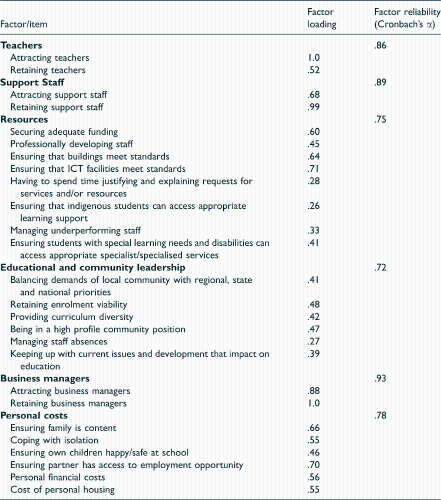
Five hundred and fifty six participants answered all 26 demand items. Therefore, the recommended minimum number of 300 participants for factor analysis with at least 3 participants per item (Tabachnick & Fidell, 2001; Tinsley & Tinsley, 1987) was met. The Kaiser-Meyer-Olkin measure of sampling adequacy was satisfactory for Exploratory Factor Analysis (KMO = .84) and Bartlett’s test of sphericity was significant (p < .001), demonstrating that the present matrix was not an identity matrix. As domain-specific demands were expected to correlate with one another, an Oblimin rotation with Kaiser normalisation was employed to maximise item loadings on each factor, while allowing the factors to remain correlated. An exploratory factor analysis using the maximum likelihood method and the Kaiser rule of keeping factors with eigenvalues greater than 1 (Tabachnick & Fidell, 2001) revealed a six-factor solution. The solution was shown to be reliable, and explained approximately 57% of sample variance, a solution favouring parsimony. Importantly, the six-factor solution made conceptual sense. The six factors have been labelled: Teachers, Support Staff, Resources, Personal Costs, Business Managers and Educational and Community Leadership (Table 1).
Items, factors loadings and factor reliabilities.
Influences on demand ratings
Following the factor analysis, we sought to investigate what factors influenced the demand ratings supplied by educational leaders. As a single-factor solution explained much of the variance, we conducted all comparative analyses using both a single-factor (total demand) and a six-factor model.
Demand by school location
To investigate the influence of the location of the school on participant’s ratings of job demand, one-way between subjects Analyses of Variance (ANOVA) were conducted. For this, and all subsequent analyses, an alpha level of .05 was used to determine statistical significance. Bonferroni post-hoc analyses were used to determine the exact nature of statistical effects.
Differences in demand of the job by school location.
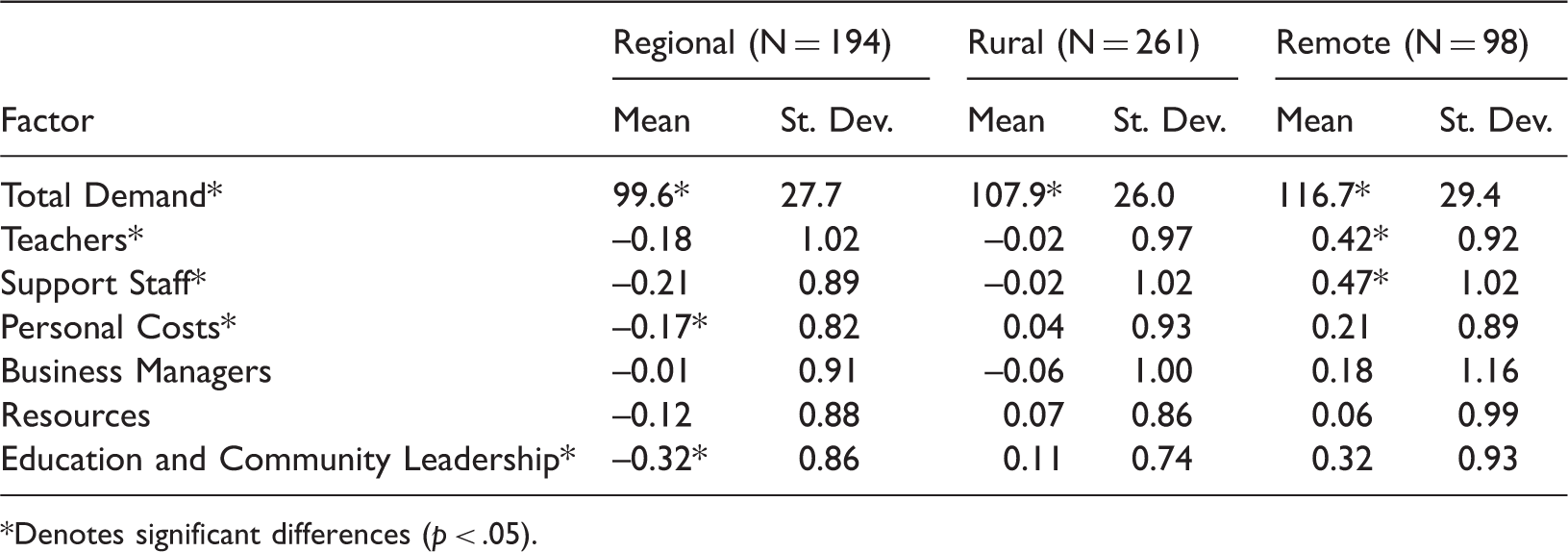
Denotes significant differences (p < .05).
Effect sizes (Cohen’s d) for post-hoc comparisons of significant main effects for school location.
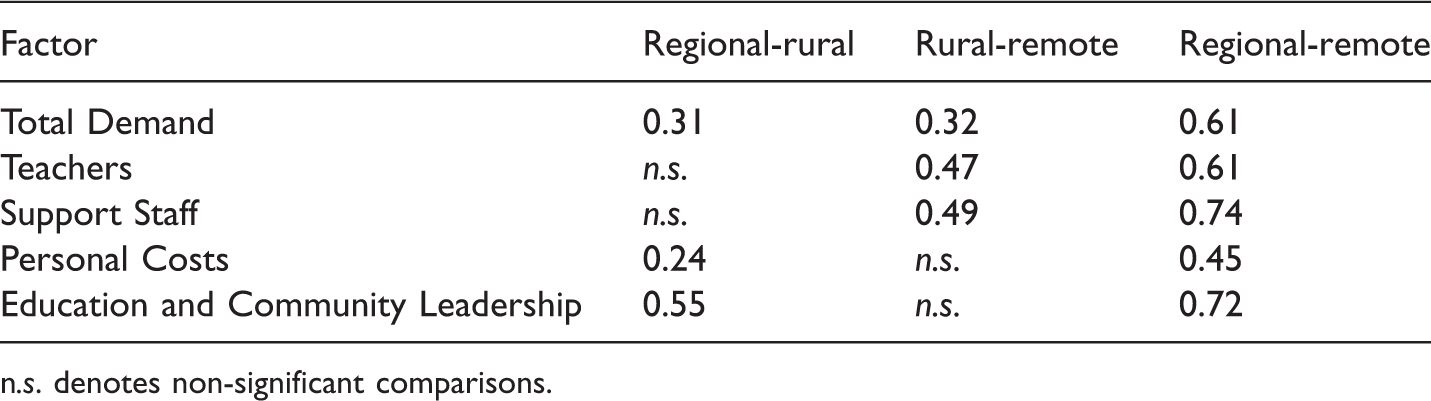
.s. denotes non-significant comparisons.
Effect of location match on demand
Differences in demand of the job by location match.
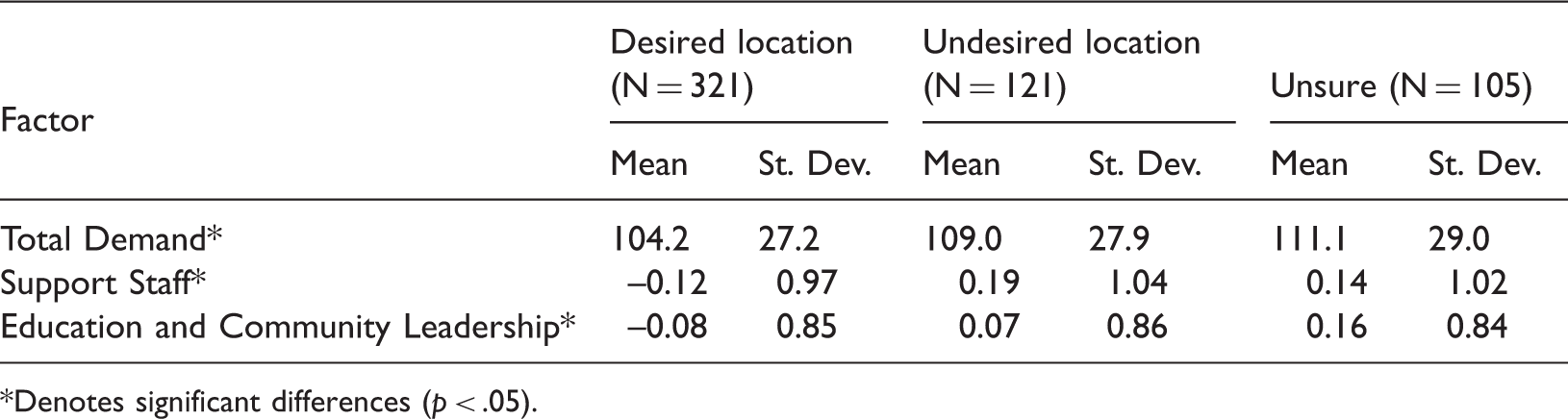
Denotes significant differences (p < .05).
Effect sizes (Cohen’s d) for post-hoc comparisons of significant main effects of location match.

.s. denotes non-significant comparisons.
Marginal trends toward differences in the demand ratings of desired, undesired and undecided locations were also observed in the teacher (p < .08) and personal costs factors (p < .06). As these were not statistically significant, no conclusions can be drawn, although the data were consistent with the general pattern of desired locations displaying lower demand scores than undesirable and/or undecided locations.
Demand by qualifications
Total demand of the job by highest qualification.
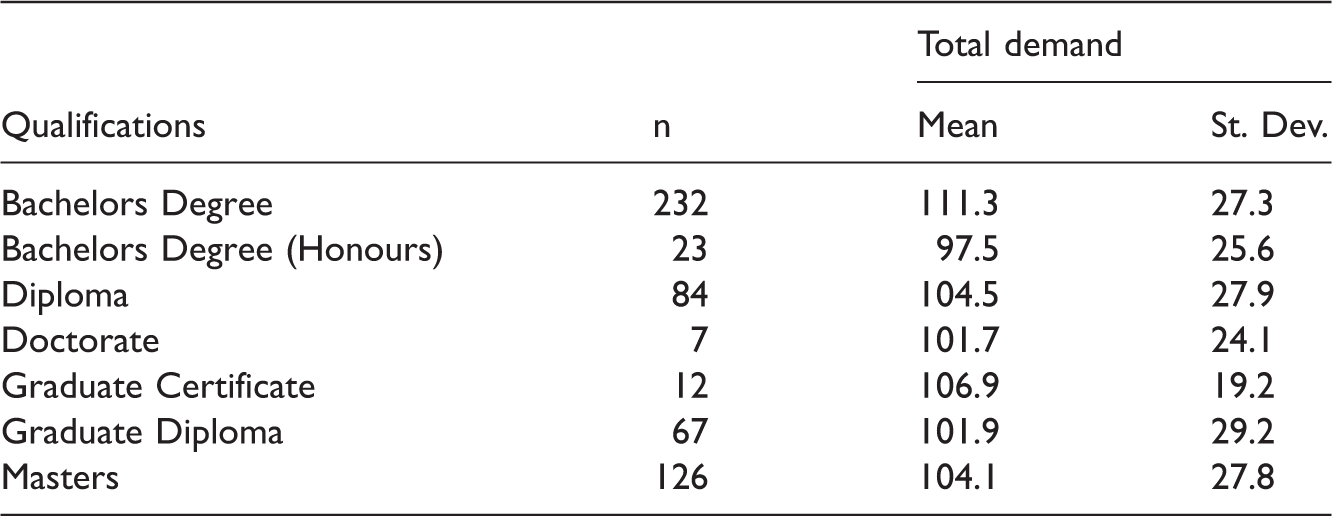
Table 6 clearly shows higher demand ratings for those with a Bachelor’s degree than other qualifications. To test this, we undertook t-test comparisons between this degree and all other degrees. For each of these comparisons, Levene’s test for equality of variances was significant (p < .05) indicating that the homogeneity of variance assumption had not been met. Correspondingly, we employed a Welch-Satterthwaite adjustment. Analyses revealed that an Honours degree resulted in lower demand ratings than a Bachelor degree, t(27.21) = 2.44, p < .05, d = 0.52, that a Diploma resulted in marginally lower demand ratings, t(144.30) = 1.91, p < .07, d = 0.25, and a Graduate Diploma resulted in lower ratings of demand than a Bachelors degree, t(101.64) = 2.34, p < .05, d = 0.19. Further, a Masters degree also resulted in lower demand ratings than a Bachelor’s degree alone, t(252.42) = 2.34, p < .05, d = 0.26. The numbers of respondents with doctoral qualifications (n = 7) graduate certificates (n = 12) were insufficient to warrant hypothesis testing. In general, it appears that qualifications above a Bachelors degree are associated with lower ratings of job demand.
Demand by experience
Years of experience and total demand ratings were not significantly correlated. A weak negative relationship was observed between total demand ratings and years of experience in rural areas, r = –.11, p < .05. However, scores on demand ratings on attracting and retaining support staff correlated significantly with years of experience, r = –.13, p < .01, and years of experience in rural areas, r = –.16, p < .01. Further, the demand of educational and community leadership was significantly related to both years of experience, r = –.14, p < .01, and years of experience in rural areas, r = –.16, p < .01. Attracting and retaining teachers was related to years of experience in rural areas, r = –.10, p < .05. No other significant correlations were observed.
Discussion
The present study investigated the demanding aspects of rural, regional and remote school leadership, as well as the factors that may reduce demand in such locations. In general, remote schools received the highest demand ratings, followed by rural locations and finally regional schools. This is consistent with previous research describing the difficulties of remote schooling (e.g., Anderson et al., 2008; Clarke, 2006). Certainly, the present sample demonstrates that, on average, the respondents found remote schools to be more demanding than regional and rural schools. Rural and remote schools were considered more demanding than regional schools in personal costs and educational and community leadership, while remote schools were considered more demanding than either regional or rural schools in the attraction and retention of teachers and support staff. There is a case to be made for a particular focus on reducing the demands associated with staff attraction and retention in remote schools. Similarly, preparing leaders for the demands of educational and community leadership, and compensating them for the personal costs associated with their locations, may help reduce the high levels of leadership demand in rural and remote locations.
How might we reduce the demands on school leaders in rural, regional and remote areas? Several factors in the present data were observed to be associated with a reduction in either total job demand or demand on one or more factors. In particular, it appears that the degree of match between a principal’s current and ideal location plays some part in the demands placed upon school principals. Generally, principals in desirable locations found demands to be lower than those in undesired/undecided locations. Further, those with higher formal qualifications and those with greater experience in a rural context found the demands of their role to be less than those with lower levels of formal education and rural experience.
The relationship between highest qualifications and total demand ratings did not arise from significant effects on any particular factor. This suggests that small, non-significant effects on most or all of the demand factors combined to yield a significant effect on total demand. The present data display a tendency for those with qualifications above the standard Bachelor’s degree required to report lower demand than participants who held a Bachelor’s degree as their highest qualification. While this may be due to the greater amount of knowledge available to them, it could also be that those with higher qualifications are generally appointed to leadership positions that are more in keeping with their aspirations. Further investigation into this phenomenon is required to determine whether demand is lower between samples matched on position desirability, something the present study did not measure.
There is a small but statistically significant correlation between demand rating and years of experience, with more experience associated with lower ratings of demand. In rural schools, the correlation between years of experience is slightly stronger, although still weak. The rated demand of educational and community leadership and years of experience as a rural/regional/remote educational leader displayed the strongest relationship, with greater experience in rural/regional/remote areas being linked with lower demand ratings of educational and community leadership. When considering the reduction on work demand for principals, and the role such a reduction may have on student outcomes and the health of leaders, we suggest that greater experience as a rural educational leader might play a small yet vital role in reducing work demand in rural, regional and remote contexts. Certainly, this is one factor that should be considered both in future research and in selection of appropriately qualified rural school leaders. Further, the fact that years of experience as an educational leader generally was less predictive of lowered demand ratings than years of experience as an educational leader in a rural, regional or remote context strengthens the suggestion that school leadership demands in a rural, regional and remote context are unique, and that experience in the rural context is important in preparing leaders for such a context.
Formal leadership preparation had no observed effect of demand ratings. However, previous research has linked leadership preparation programs to other important outcomes such as progress toward school improvement and a climate of school progress (Orr & Orphanos, 2011). The present sample of leaders indicated that overwhelmingly, few of the respondents had received more than short courses for their leadership preparation, with just over 75% of respondents receiving no training or only short courses prior to their undertaking a rural, regional or remote school leadership position. Given the apparent importance of formal preparation on the aforementioned outcomes, the lack of formal preparations for this cohort is a matter of concern. Because school leaders prepared at regional institutions tend to be less successful in raising teacher qualifications in their schools (Fuller et al., 2011), the finding that such a high number of rural, regional and remote schools have little or no formal leadership preparation raises strong concerns about their abilities to have a positive impact on their schools’ climate and performance.
These findings have important implications for the manner in which educational leaders are selected, prepared and supported in rural, regional and remote Australia. Given that experience, formal qualifications and location desirability play a role in determining how demanding a leader’s job is likely to be, it is vital to consider these aspects in selection criteria. Specifically, it appears that educational leaders’ experience in rural areas might help to mitigate some of the demanding aspects of the job. It may also be beneficial to assess the potential candidates’ desire to live in the community they will be moving to, since this may serve as a protective factor against job demands.
The formal preparation for leaders, being objectively low in the present sample, may be one method for mitigating some of the demands of the role. Perhaps a targeted campaign to increase the formal qualifications of rural, regional and remote school leaders may help mitigate some of the demands of these roles. One option is for financial support to be provided for successful rural school leaders to undertake a Masters’ degree in rural/regional/remote school leadership and management.
Finally, leadership in remote contexts may benefit from increased support from state and territory educational departments. Such support should include increasing the attractiveness of teaching and working in these contexts, as well as compensation for the personal costs of doing so.
The present study sought to investigate the aspects of rural, regional and remote school leadership that were considered demanding. Given that research on job demand more generally suggests that high demands, low support and low control are risk factors for physical, psychological and job outcomes (Bakker & Demerouti, 2007; Bakker et al., 2004; de Jonge et al., 1999; Demerouti et al., 2001; Johnson & Hall, 1988; Karasek et al., 1981; Pelfrene et al., 2002; Sanne et al., 2005; van der Doef & Maes, 1999) and that effective leadership is known to improve student outcomes (Fuller et al., 2011) the high ratings of demand, especially in remote areas, raise concerns. There could be benefits from future research that investigates the health of school leaders and student performance, examining the link between the demands detailed in the present paper and these important outcomes. The present study sought to examine the job demands on rural school leaders in a more fine-grained manner, and similar measures of job control and social support may be informative in terms of rural school leaders’ physical and mental health risk factors and, ultimately, their job performance.
Footnotes
Funding
This research received no specific grant from any funding agency in the public, commercial, or not-for-profit sectors.
Declaration of conflicting interests
None declared.