




Abstract
School choice in China is characterized by the payment of substantial amounts of additional (“choice”) fees by parents to the preferred school, and by the use of cultural, social and economic capital to obtain places in oversubscribed schools. This study examines the role of social capital in current parent-initiated school choice in China. It finds that it is common for parents to mobilize their social capital in the form of guanxi to acquire insider information, to facilitate or gain exceptional entry into the preferred school and to reduce or waive the choice fee. The paper also addresses the issue of educational inequality caused by such practice in the school choice process.
Keywords
Introduction
School choice in China is characterized by the payment of substantial amounts of “choice fees” (additional money, often substantial, that parents of choice students, who do not live in the catchment area, pay to their preferred school), as well as the use of cultural, social and economic capital before and during the school choice process in order to obtain a place in oversubscribed schools (Wu, 2008, 2011).
According to the Compulsory Education Law of the People’s Republic of China (National Peoples’ Congress, 1986), school placement in the compulsory education sector should be determined on the basis of proximity. Thus, the official policy on school choice is that there should be no school choice for compulsory education (i.e., primary schools and junior middle schools) and limited school choice for post-compulsory education (i.e., senior middle schools). But in reality, school choice takes place in both compulsory and pre- and post-compulsory education because choice fees benefit the schools, the local governments and those parents and their children who obtain a place in their preferred school (Wu, 2008).
The concept of social capital is seen in different ways by different scholars. Grounding it in the context of social reproduction, Bourdieu defined social capital as “the sum of resources, actual or virtual, that accrue to an individual or a group by virtue of possessing a durable network of more or less institutionalized relationships of mutual acquaintance and recognition” (Bourdieu & Wacquant, 1992, p. 19). Approaching social capital from a functional perspective, Coleman (1988) stated that “[s]ocial capital is defined by its function. It is not a single entity, but a variety of two elements in common: they all consist of some aspect of social structure, entities with and they facilitate certain actions of actors. within the structure” (p. S98). Since there is not a universally accepted concept of social capital, the term “social capital” used in this paper is defined operationally as the resources embedded in one’s social network that can be mobilized to facilitate individual action.
The notion of social capital is closely related to the Chinese term guanxi, a central concept in Chinese society. Literally meaning “connections” or “relationships,” the actual meaning of the term goes far beyond this, as relationships do not necessarily produce guanxi. Guanxi refers to “a dyadic, particular and sentimental tie that has the potential of facilitating favour exchanges between the parties connected by the tie” (Bian, 2006, p. 312). It is a form of social investment or social capital (Butterfield, 1983) and it creates a culture of connections and provides one with easy access to limited resources, increased access to controlled information, credit grants and protection from external competitors (Lee, Pae, & Wong, 2001). The important role of guanxi is highlighted in the Chinese expression, “one more connection offers one more road to take” and it is “the informal connections so essential to gaining approval for or access to just about everything in China” (Tsang, 1998, p. 64).
There are two types of guanxi, each established on a different base: blood bases, which include family members and distant relatives, and social bases, embracing those arising from social interactions at school, the workplace or the locality (Tsang, 1998). The term guanxi can refer to a person or to a relationship.
In this paper, guanxi is regarded as a form of social capital and includes the network of ties between people and access to the resources (social capital). The amount of social capital one possesses depends on the size of the person’s guanxi network as well as the amount of the social capital that each of the members has.
As one of sociology’s most popular theoretical exports, the concept of social capital has been increasingly used in educational research. In relation to school choice, Vryonides (2007) examines the way social capital and cultural capital affect choice making for post-secondary school destinations in Cyprus, revealing that social capital extended the horizons for choice making. The findings of some studies (Schneider, Teske, & Marschall, 2000; Schneider, Teske, Marschall, Mintrom, & Roch, 1997) suggest that school choice and parent involvement help to build social capital, and that charter schools are comprised of parents with higher levels of social capital than traditional public schools. Social capital will be fostered by choice programs because “[t]he act of choosing seems to make parents feel more responsible and become more involved” (Ravitch, 1994, p. 9). But some scholars are skeptical that choice-related policies can increase social capital, as choice programs cannot force parents to become actively engaged in school activities (Handler, 1996; Henig, 1994).
There has been some recent research concerning social capital in the educational context in China. For example, Ross and Lin (2006) investigated how communities in China used schools to create and reproduce the values, knowledge and social expectations that engender social capital. Their findings indicated that “even struggling schools can act as sites for the production and extension of social capital that reaches those most in need” (p. 64). Examining the family social capital for ethnic Uyghur students in Chinese boarding schools, Chen’s (2010) study revealed that despite the fact that family structure became deficient for Uyghur students away from home, their boarding school life could still be facilitated through parental educational expectations, the influence of relatives, problem-solving advice and institutional assistance, which in turn ensured the ongoing functioning of certain types of family social capital. Chen and Postiglione (2009) also found that Uyghur students have developed a bonding form of social capital as a response to the school goal of ethnic integration in the dislocated inland boarding school.
The existing literature, however, tends to focus on how social capital can be created or accumulated in the school context or through school choice, but very little attention has been paid to the use of social capital to achieve parental choice of school for one’s children. Therefore, this paper attempts to bridge this gap by reporting findings from a study focusing on the use of social capital to gain positional advantage by the middle class families in the competition for oversubscribed school places.
The research questions for this study are: How is social capital mobilized to facilitate the successful entry of children into an oversubscribed school? What educational inequalities and social injustices result from the involvement of social capital in the school choice process?
Methodology
This study arises out of a larger project investigating the use of cultural, social and economic capital in the school choice process. This paper is concerned only with the mobilization of social capital to obtain a place in oversubscribed schools. It involves an extensive case study of three schools in China.
Research setting
The provincial city of Nanning was selected as the research site for the following reasons. First, school choice is actively taking place in big and medium-sized cities where growth is common and competition is keen. Nanning is such a city. Second, as a capital city, the population of Nanning is socio-economically diverse. Third, since the researcher had worked in one of the local middle schools for nearly ten years, he had some guanxis in the local schools, which facilitated access to the sample schools.
In the examination-driven educational system in China, the transition rate to the next level of schooling, especially to the best schools, is the most important criterion by which schools are classified as “above-average,” “average” or “below-average.” “Above-average” schools are usually subdivided into “top schools” (commonly known as “key schools”) and “second-level” schools. In order to understand the school choice situation in different types of schools, three differently-categorized schools (in terms of comparative transition rates and reputations) were selected for this study: a “top school,” a “second-level school” and a “below-average school.” To protect their anonymity, the three schools are referred to as “School A,” “School B” and “School C,” respectively, in this study.
Data collection
The present study uses three different data collection techniques (documentation, questionnaire and interview) in order to gain as holistic a picture as possible within the confines of a limited research undertaking.
The questionnaire forms were printed in Chinese, which is the native language of the respondents. Technical terms were avoided wherever possible. A pilot study was conducted, and this led to the modification of many items. The use of social capital in the school choice process is a sensitive issue to the schools, and the questionnaire focuses on the respondents’ occupation, income, educational level etc. to provide indications of the availability of social capital for use in the school choice process. Interviews with parents provided direct information concerning the ways in which social capital was used.
In October 2008, 450 copies of questionnaire forms were distributed to randomly sampled students of the three schools (150 copies for each) by their teachers to take home to their parents. The completed forms were returned to the schools and collected by the teacher, and then returned to the researcher anonymously. With response rates of 84% and 85%, School A and School B had 126 copies and 128 copies returned, respectively. At School C, 107 copies were returned, a response rate of 71%.
Thirty interviewees from the three schools (ten from each) were selected from those respondents who agreed to be interviewed. An effort was made to select interviewees from a diverse range of employments and backgrounds. As a result, the ten interviewees from School A include teachers, doctors, lawyers and public servants. All have Bachelors degrees or above. Seven of the ten interviewees of School C are migrant workers with a Diploma of Secondary Education. The rest are workers in the factories near the school, with similar levels of education. The employments of interviewees from School B are more diverse than the other two schools; three are university teachers with a Masters degree, two are public servants (Bachelors degree), two company clerks, two saleswomen and one migrant worker. The last three have only a middle school diploma.
The Head Teacher of School A, the Director of the Teaching Affairs office of School B and an Administrative Office director from School C were also interviewed by the researcher in order to triangulate the data obtained from the questionnaires and documents and therefore to increase the credibility and validity of the results.
The key interview questions are:
What do you think of the role of guanxi in the school choice process? Have you ever used guanxi to help your child to enter a preferred school? What benefits could guanxi bring you as far as school choice is concerned?
Data analysis
After collection, the survey data and the interview data were coded and analyzed, based on aspects of the conceptual frameworks identified during the literature review. Content analysis was employed to analyze the data from the interview, in which content categories were identified and the data systematically coded. The survey data were analyzed statistically in order to document respondents’ demographic characteristics and differences in social strata that might affect parents’ capacity for involvement in the school choice process. More explicit interpretation of the data was sought when some patterns and themes were identified. The research questions were reviewed continually, referring them to the data.
Findings and discussion
According to Lu’s (2002) classification, Chinese society can be divided into ten separate strata based on the availability of their organizational, economic and cultural resources. Organizational resources refer to the power given to the governmental and communist party organizations to dispose of social resources. Economic resources mean the right to own and/or use the production materials. Cultural resources are the socially acknowledged knowledge and professional skills (in the form of certificates or qualifications). The ten social strata are administrators (officials) of the state and social organization (e.g., trade union and women’s federation), corporate managers, owners of private enterprises, professionals, clerical workers, self-employed businessmen, service workers, blue collar workers, farm workers and unemployed (Lu, 2002). Those ranking at the top of the social strata classification have the most resources to manipulate whereas those at the bottom have the least. The first five social strata are regarded as the middle class in China, which accounts for about 15% of all the work forces (Li, 2005). This paper uses the term “middle class” to refer to people of the first five social strata and “working class” to people of the last five strata.
In addition to cultural capital and commonly understood economic capital, the market for school choice can be influenced by the acquisition and use of social capital. Guanxi is perceived as a major determinant for successful obtainment of a place in the preferred school. Having the right guanxi becomes crucial in many cases in the successful acquisition of such a school place.
Keeping well-informed about preferred schools
Coleman (1990, p. 238) pointed out that when an individual is faced with important decisions, “a rational actor will engage in a search for information before deciding.” Selecting the most appropriate school for one’s child is a case in point as it is crucial for the future educational attainment and career opportunities for the child. Goldring and Phillips (2008) state that in the school choice process, parents often rely on two types of networks to make an informed choice of school for their children. One is “interpersonal networks” and the other is “formal networks.” The former refers to information gathered from people they know such as friends, colleagues and relatives while the latter refers to publicly available information such as brochures and pamphlets, published results of school test scores and so on. Previous research indicates that interpersonal networks are efficient means of gathering information (Schneider et al., 1997).
Before a parent can make judgments about suitable schools, a necessary step is to obtain relevant information about them. Except for available statistical data (transition rate in particular), details about the learning environment, such as the school management, teaching quality, school admission processes and the required choice fees in each school, are generally not available to outsiders. Without such information, it is impossible for parents to make fully-informed decisions about the most suitable schools for their child. In the interview, five parents of School A and three parents of School B admitted that they had mobilized their social capital to obtain inside information about the preferred schools before they made the decision.
Four parents of School A emphasized the importance of getting information about the learning environment and how responsible the teachers are in their teaching and coaching. In their view, these two factors determine whether or not their children can develop good learning habits, reach their full learning potential and make rapid progress in their studies.
Another parent of School A was interested in getting information about the source of students, saying that “one who stays near vermilion gets stained red, and one who stays near ink gets stained black” (a Chinese idiom suggesting that one’s behaviour is influenced by the company one keeps). “My son is more likely to benefit from the positive effects of his peers if he is in a top school than if he is in a regular school.” The logic behind this assumption is that most of the students who can enter a top school should be good students in terms of their academic performance, learning methods and attitudes towards study. Learning in the company of those good fellow students is seen as likely to result in greater success in studies.
In contrast to the parents of School A and B mentioned above, most of the interviewees of School C lacked the guanxis to obtain the information about the target schools. Often they did not begin to collect information about admission requirements and procedures until just a few months or even a few weeks before their children were due to enter junior middle school. The majority (84%) of the parents of School C students did not receive schooling beyond middle school. Their low educational level and subsequent life experience did not equip them to anticipate the importance of getting early involvement in their children’s education and the credential inflation in the job market (Wu, 2012). As well, they lacked the appropriate guanxis to obtain the information they need even if they had been aware of it.
Paving the way to enter a preferred school
Guanxi can aid in achieving a distinctive strategic positioning in the fierce competition for oversubscribed school places in the Chinese context and can become an important ingredient in the school choice strategy. It has become the common wisdom among parents of “choice” students that economic capital cannot be applied to its greatest effect without guanxi providing the appropriate contact or avenue. The guanxi ties can heavily influence screening and recruiting decisions by providing another basis for distinguishing among applicants. Nine parents of School A and B mentioned that they had asked a favour of either their relatives or friends, who themselves or whose friends have guanxi connections with the preferred school or the local education bureau, in order to get their child into the preferred school. For example a parent of a School A student said, “Money is not everything. You have to find the right person in order to have your choice fee accepted by the preferred school. In fact, we had to ask several people, including friends and relatives, to help our child enter this school.”
Quite a few parents shared the same view. In terms of academic achievement, their children were only average or just above average, and they knew that there were many students at this level. Therefore, having guanxi was perceived to influence the outcome of the school choice process.
In some cases, the use of influential guanxi is a must in order to guarantee a school place. According to the headteacher of a key middle school in Maoming, a city in Guangdong Province, the competition for the limited school places is so fierce that, of the over one thousand applicants, a student cannot possibly enter the school without a “leader’s memo.” The school plan to enroll 250 choice students had to be expanded to 280 due to powerful guanxi influences (Lin et al., 2007).
There are some cases of unqualified applicants successfully entering their preferred school through the use of influential guanxi. A parent of a School B student mentioned that he had managed to send his child (who did not meet the admission requirements) to an oversubscribed school with the help of a friend, who was a former college classmate and close friend of the Head Teacher. Cases like this usually require powerful guanxis.
Converting social capital into economic capital
Bourdieu (1986) pointed out that one form of capital can be converted into other form. Social capital in this case can be converted into economic capital through reduction and even waiving of choice fees if the guanxi is sufficiently powerful. Therefore, in addition to gaining the admittance of one’s child into a preferred school, another important use of guanxi is to acquire economic capital. The extent to which the choice fee can be reduced depends on the influence of guanxi networks. In this study, one parent’s guanxi connections knew the middle manager and had the choice fee reduced by one-third, while another parent’s guanxi had direct contact with the Head Teacher and reduced it by half. Several parents of School A and B students admitted that their guanxi helped them to pay less significantly smaller fees, saving themselves up to ¥10,000. In return, schools are believed to exploit the social capital of parents in powerful or influential positions to obtain more economic and non-economic gains for the school.
Using guanxi to reduce the amount of choice fee is a common practice. As early as 2003, it was reported in the local newspaper that a parent successfully reduced the choice fee from ¥18,000 (about 1800 pound or 2844 US dollar) to ¥12,000 with the help of his guanxi who knew the headteacher of the preferred school. If one happened to know the teacher or middle manager of that school, the choice fee would be reduced to ¥16,000 and ¥14,000, respectively, and those who had highly influential guanxi paid only ¥6000 (Reporters of Nanguo Morning Post, 2003).
Just as cultural capital can be converted to economic capital (e.g. by providing evidence of prior high achievement to reduce or waive the choice fee; see Wu, 2012), social capital can also be effectively converted into economic capital, as exemplified here. The extent of choice fee reduction by targeted preferred schools through the use of guanxi has become an important factor to be taken into account when parents decide to which school they will send their child. Several School A and B parents admitted that they had successfully reduced the amount of choice fee through the help of guanxi when their children attended kindergarten, their primary school and now their present school.
Making early investment in developing guanxi networks
The use of guanxi to gain long-term advantages can occur long before the junior middle school admission process, per se. For example, it is common practice in primary schools for certain teachers to identify exceptional, well-rounded students with the accolade of “san hao xue sheng” (Triple-A Outstanding Student), i.e., a student who excels in the three important facets of life: academics, health and morals. This designation has become a coveted title (a form of institutional cultural capital) that is a value-added qualification for a student seeking admission to junior middle school. Helping to gain this title for their child often means that parents work to establish and maintain good relations with the “ban zhu ren” teacher or “parentis teacher,” who is charged with overall responsibility for the life of the student, including study, discipline and social development, and who plays a key role in determining which child is identified as a triple-A outstanding student.
One parent of a School B student mentioned the frequent contact they had with the child’s parentis teacher in primary school, inviting her to dinner and giving her gifts in the hope that she might help her child to distinguish himself in the class and obtain the coveted title of a triple-A outstanding student. In this case, her child eventually did receive this valued bit of cultural capital, in part through judicious development and use of social capital.
Early investment in developing guanxi networks for use in future school choice situations was a wise strategic move among some parents in this study. One parent described how she established a connection with someone working in the local education department through one of her friends many years ago and maintained and developed closer relations with the new guanxi by sending him gifts and inviting him out for dinner on important holidays or festivals. She had not asked a favour from the guanxi connection yet because her other guanxi had taken care of everything in the school choice process so far. However, if some difficulty were to appear in the future, this guanxi who was being held in reserve would be one of her last resorts. “After all, having one more guanxi means having one more option of getting things done. No harm done,” the parent said.
Continual maintenance and gift giving is one of the effective ways of maintaining the proper functioning of the guanxi networks. Five parents of School A students and six parents of School B students admitted they had given gifts to their children’s teachers, parentis teachers in particular, during different periods of their children’s schooling. “There are so many students in the class, if the teacher could give my son more attention, he could have more opportunities to practice what he has learnt and naturally perform better in his study” said one of the parents. Other parents express explicitly or implicitly their hope that this gift-giving behaviour could put their children in a more favourable position in matters like the selection of triple-A outstanding students or class leaders, each of which could lead to a competitive advantage in the school admission process at the next level of schooling.
Zhou and Lu’s (2009) study showed that parents with more schooling, more income and more political capital are more likely to pay visits to teachers during Spring Festival and Chinese New Year. This practice improves their chance of successfully selecting schools for their children, since these teachers usually have connections in the schools at the next higher level.
Implications and conclusion
While the use of social capital for personal gain may exist in other countries, it is more salient in the Chinese context. Guanxi is one of the dynamics in Chinese society and is widely used by many people in their social interactions and business dealings to help get things done, especially obtaining scarce resources. The findings of this study demonstrate that guanxi has played an important role in the school choice process. However, the use of social capital to obtain school places has caused public concern over the issue of fairness as it creates unequal opportunity for school choice.
To begin with, working class and middle class parents are not competing equally in terms of the mobilization of social capital for the oversubscribed school places. Bourdieu (1986) pointed out that “[t]he volume of the social capital possessed by a given agent … depends on the size of the network of connections he can effectively mobilize and on the volume of the capital (economic, cultural or symbolic) possessed in his own right by each of those to whom he is connected” (p. 249). Schneider et al.’s (1997) study revealed that parents’ income and education almost always lead to stratification in social networks, “higher status individuals are embedded in better networks that can act as more efficient sources for information about schools” (pp. 1219–1220). These effective networks can provide valuable shortcuts to the information necessary to make an informed choice.
Major demographic information.
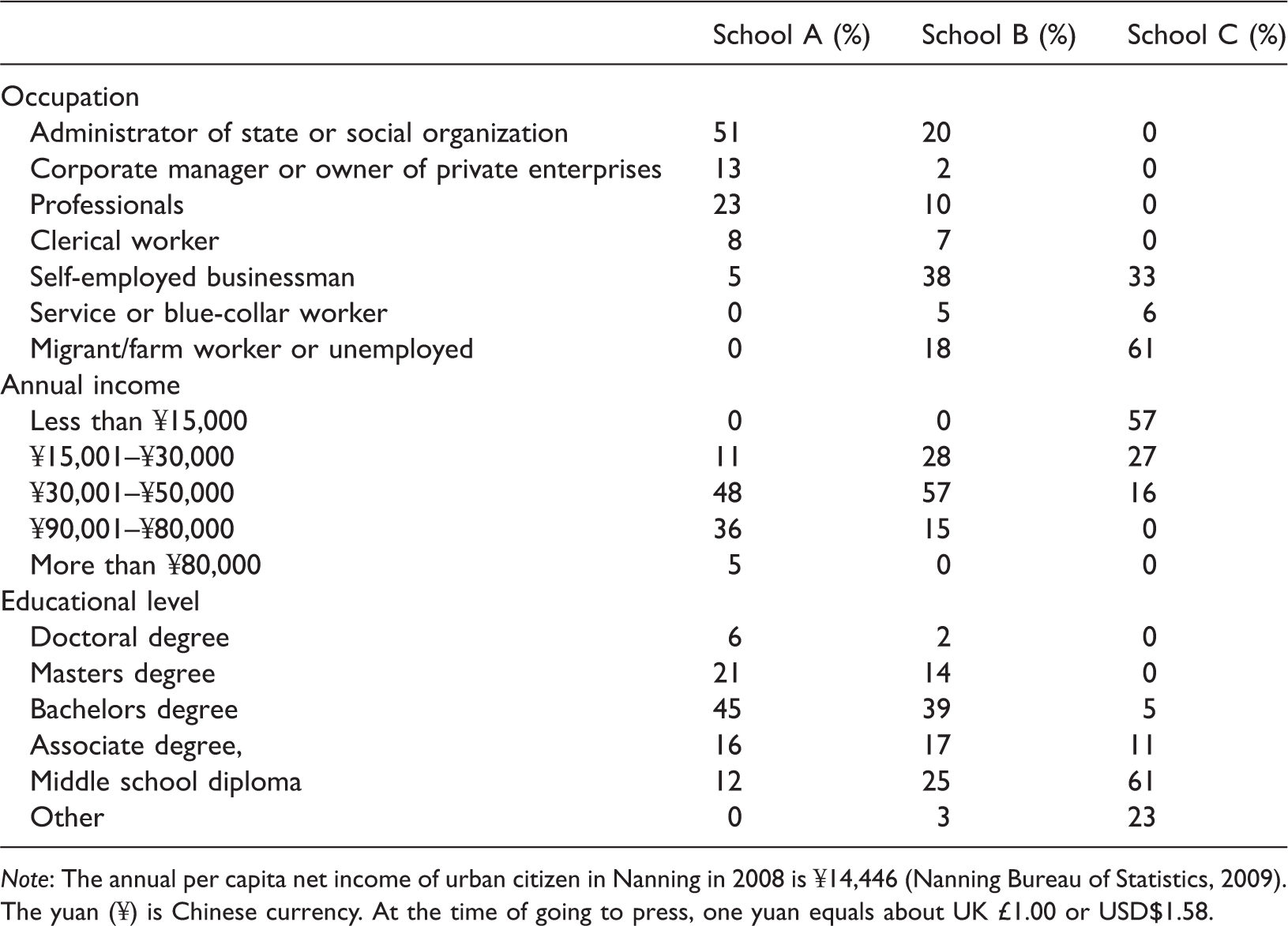
Note: The annual per capita net income of urban citizen in Nanning in 2008 is ¥14,446 (Nanning Bureau of Statistics, 2009). The yuan (¥) is Chinese currency. At the time of going to press, one yuan equals about UK £1.00 or USD$1.58.
Many parents of middle class families are in powerful or influential positions. They can convert their political capital into economic capital (e.g., reducing or waiving choice fee) by writing a request “memo” to the education authority or directly to the preferred school, or by asking the head of the education authority to do it for them. If parents are not in such position, then they need to use their social capital to find relevant guanxi. The Head Teacher of School A admitted that every year during the enrollment period he would receive many more guanxi requests for school places than the number of places available. Therefore, only those who are in powerful positions, who have close relationship with him or other school leaders, or who have the ability to influence matters affecting the school can secure a place for their child in School A. Obviously, the middle class has more such capacity to do this.
Working class families are much less likely to have friends or acquaintances in powerful or influential positions since “parental networks tend to be homogeneous with respect to class. … Working class and poor networks do not encompass middle-class parents” (Horvat, Weininger, & Lareau, 2006, p. 465). Working class parents, whose networks are unlikely to provide access to useful information about the target schools, are limited in their capacity to make informed choices. Three parents of students of School C mentioned that even if they wanted to select a better school for their children, they did not know who could help them to acquire information about target schools and facilitate entry into their preferred schools. Their social circle is restricted mostly to people of the same class who are equally unable to obtain inside information and influence recruiting decisions. One parent of School B complained about the present school admission practice and claimed that admission without an entrance exam presents a greater challenge to the parents because it “examines” the parents’ volume of economic capital, social capital and cultural capital rather than student’s academic achievement. The logic of “parentocracy” prevails over the traditional “meritocracy” (Brown, 1990) in the school admission process. The entrance examination for junior middle schools was abolished in the 1990s because the law required that school places be allocated on the basis of proximity. The current situation is not the outcome that would have been anticipated at the time.
The findings of this study indicate that the influence and importance of guanxi networks increase with the desirability of school places and the intensity of competition for those places. Top schools like School A are targets for the mobilization of social capital for their school places. Often, powerful and influential guanxis are needed to make it happen. The data show that there is a positive relationship between school choice and parent’s educational level, income and guanxi networks. The proportion of parents selecting schools for their children increases with their educational level, income and/or the availability of their guanxi networks.
This study reinforces the claim that choice is powerfully related to social-class differences. It is a major factor in maintaining and reinforcing social-class divisions and inequalities (Ball, Bowe, & Gewitz, 1996; Gewirtz, Ball, & Bowe, 1995). The high proportions of middle class families in Schools A and B and the interview findings illustrate the power of middle class families to use different kinds of capital (including social capital) to secure a place in a top school for their children. The continuation of this trend seems certain to constrain social mobility to an extent that would not have been anticipated. The likely outcome is social reproduction through school choice.
Footnotes
Funding
This research received no specific grant from any funding agency in the public, commercial, or not-for-profit sectors.
Declaration of conflicting interests
None declared.
Acknowledgements
The author is grateful to Professor Hugh Lauder and Dr Manuel Souto-Otero of the University of Bath, UK, and Dr. Alan Sparkes, Associate Professor of Sociology of Nipissing University, Canada, for their insightful comments and constructive suggestions on early drafts of this paper.