




Abstract
The aim of this viewpoint paper is to consider different psychological transdiagnostic processes that can inform the development of effective early intervention approaches in youth mental health before threshold diagnosis is attained. A transdiagnostic process is defined as a mechanism which is present across different disorders and is either a risk or a maintaining factor for the disorder. We consulted the literature with respect to processes across depression, anxiety and eating disorders. We suggest 38 unique transdiagnostic psychological processes. Each were defined to make them suitable for stakeholder consultation (e.g. people with lived experience) in developing transdiagnostic processes (targets) for youth early interventions. We recommend that the definitions of these processes are further developed in consultation with stakeholders, and that systematic reviews are conducted to further identify psychological processes that can inform essential ingredients of interventions that can then be tested for clinical impact in early intervention with youth.
Keywords
Introduction
It has been documented across numerous reviews that the mental health of youth (adolescents and emerging adult up to 25 years) has been declining over the last two decades. The Lancet Psychiatry Commission on youth mental health (McGorry et al., 2024) suggests a variety of influences could be responsible for this trend, including the rise of neoliberalism, the smartphone and unregulated social media, and greater pressure to achieve academically. A major surge in this trend was driven by the COVID-19 pandemic. For example, in Israel, significant increases in mental health diagnoses between 2017 and 2021 were documented in adolescents (Bilu et al., 2023). This increase was highest in eating disorders (50%), followed by depression (36%) and anxiety (31%), while psychiatric drug dispensation increased significantly by 28% for antipsychotics and 25% for antidepressants. These increases were most prominent among youth who were female, without a prior psychiatric history, of medium-high socioeconomic status and aged 14 to 15 (Bilu et al., 2023). In Australia, nearly 40% of youth aged 16–24 experience a mental health disorder, with more than one in four females engaging in self-harm in their lifetime (Australian Bureau of Statistics, 2023).
It is predicted that sustained effects of the pandemic will continue to be experienced by youth (Ipsos, 2024) due to persisting scars, including higher cost of living, heightened perceived vulnerability from the risk of another pandemic, erosion of social relationships, interrupted developmental milestones and impaired prospects related to interrupted academic progress (Ipsos, 2024; McGorry et al., 2024). The impact of climate change and regional conflicts adds to the perception that the future is bleak. In this context, the Australian Psychological Society (2024) has called for urgent investment in early intervention in youth mental health.
Applying a transdiagnostic approach to early intervention
In our work, we are developing brief digital interventions for youth before a diagnosable disorder emerges. An international panel (Scott et al., 2024) has defined six stages in a transdiagnostic staging framework, three of which occur before a full-threshold disorder emerges. This includes no current symptoms but increased risk of a disorder (Stage 0), mild or non-specific symptoms (Stage 1a) and moderate but sub-threshold symptoms (Stage 1b). Given the high level of comorbidity across depression, anxiety disorders and eating disorders (Udo and Grilo, 2019), our intent is to build interventions that are limited, in the first instance, to target the broad symptomatology that may develop into one or more of these three disorders.
To achieve this aim, we have adopted a transdiagnostic approach that removes the distinctions between proposed psychiatric taxa at the level of classification and suggests alternative conceptualisations relating to processes implicated in mental health (Dalgleish et al., 2020). A process is a mechanism that is present across different disorders and is either a risk or a maintaining factor for the disorder, which will result in a symptom. The National Institute of Mental Health Research Domain Criteria (RDoC; Cuthbert, 2015) is one such example, limiting processes to dysfunctions in neural circuitry with a view to developing an alternative system of mental illness classification (Lilienfeld and Treadway, 2016). This transdiagnostic approach enables novel ways of thinking about onset, maintenance, clinical treatment and recovery from experiences of disabling mental distress. In the case of our research, we wish to link identified processes to elements or ingredients (defined as the essential conceptually well-defined aspects of an intervention that drive clinical impact; Sebastian et al., 2021; Wolpert et al., 2021), to examine the impact on a broad range of symptomatology. Understanding these elements allows researchers to move beyond knowing that a particular approach works to being able to identify its effective components to further refine and improve the treatment. An example can be found in the work of van den Heuvel et al. (2023) examining the most effective components of cognitive behaviour therapy (CBT) for depression in adolescents.
As indicated above and shown in Figure 1, we suggest that the development of effective transdiagnostic early intervention approaches before a full-threshold disorder emerges requires consideration of three components to increase leverage for personalisation of interventions, regardless of the specific disorder that may eventually develop (Nye et al., 2023). These components include processes or mechanisms, elements or ingredients and symptoms. Sauer-Zavala et al. (2017) describe the way in which these three components interact. In a shared mechanisms treatment, resultant intervention components (elements) explicitly target common underlying mechanisms or processes that are relevant across a class of disorders where effectiveness is shown by a decrease in symptoms. Thus, the strategies included in a shared mechanisms approach are informed by theoretical models of psychopathology and are explicitly designed to target core features that occur across disorders. In their meta-analytic examination of interventions to prevent the onset of major depression, Buntrock et al. (2024) emphasise the importance of tailoring content to individuals’ specific challenges and experiences (i.e. processes) to further improve the effectiveness of preventive psychological interventions for subthreshold depressive symptoms. Our intent in this Viewpoint article is to elaborate further on the transdiagnostic processes relevant across depression, anxiety and eating disorders to better inform the development of effective transdiagnostic early intervention (Dalgleish et al., 2020; Skivington et al., 2021).
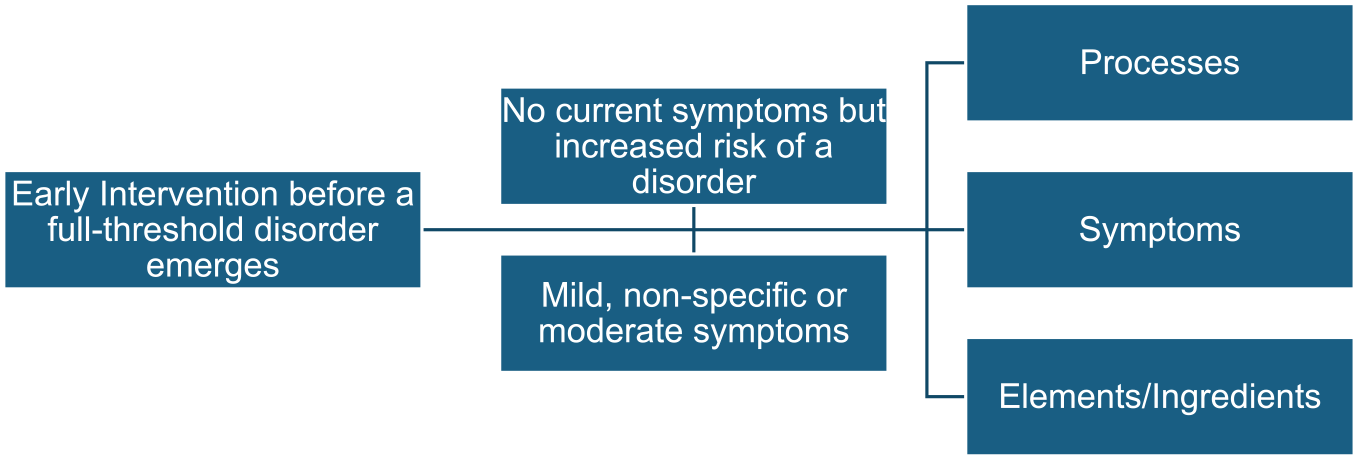
Components of early intervention.
While transdiagnostic interventions have not to date produced more effective interventions than diagnostic specific interventions (Fusar-Poli et al., 2019), there is an ‘overwhelming weight of evidence from decades of such data-driven efforts . . . that mental health problems are best conceptualized along a series of continua rather than as discrete categories’ (Dalgleish et al., 2020: 182). For example, hierarchical dimensions predict significantly greater variance in eating disorder behaviours and future impairment than diagnosis (Forbush et al., 2024).
Aims of this Viewpoint article
It has been suggested that a focus on transdiagnostic processes that are relevant to the development and maintenance of a range of diagnoses will lead to more robust treatment approaches that efficiently address symptoms of multiple disorders (Mansell et al., 2008; Sauer-Zavala et al., 2017). Despite this ambitious aim, researchers have struggled to leave disorder-specific confines when considering development of transdiagnostic approaches. For example, it is not unusual for transdiagnostic approaches to be applied explicitly only to anxiety and depression (Craske, 2012; Sebastian et al., 2021). In addition, the transdiagnostic CBT-enhanced model (CBT-E; Fairburn et al., 2003) was created to address only the full range of eating disorder diagnoses. In pursuit of developing brief digital interventions for youth before a diagnosable disorder emerges, we propose to take one step forward and identify psychological transdiagnostic processes across depression, anxiety disorders and eating disorders, to develop intervention elements that can impact a range of symptoms. It is also our aim to describe these processes in a way that can be understood by lay audiences in order to facilitate future co-design (involvement of relevant stakeholders), which is considered essential for the development of effective interventions (Skivington et al., 2021), consistent with the statement on consumer and community involvement in health and medical research co-authored by the National Health and Medical Research Council and the Consumers Health Forum of Australia. 1
Identifying psychological transdiagnostic processes
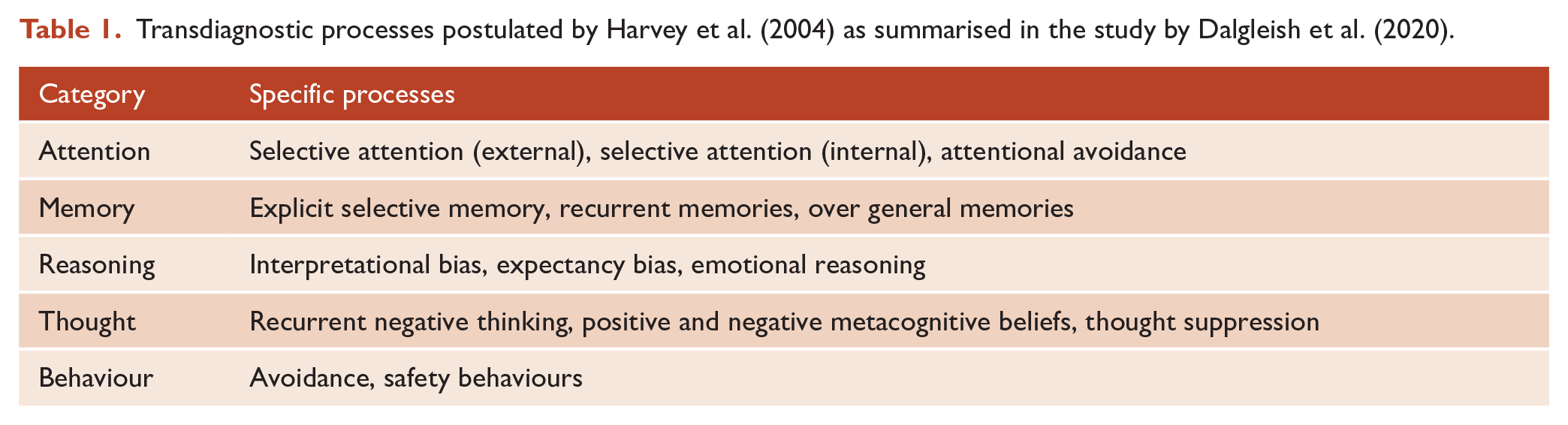
Early pioneering work (Harvey et al., 2004; Mansell et al., 2008) examined 14 psychological transdiagnostic processes, grouped in five categories, summarised in Table 1. A later review identified 16 transdiagnostic processes (Morris and Mansell, 2018), with new entries featuring perfectionism and intolerance of uncertainty.
Transdiagnostic processes postulated by Harvey et al. (2004) as summarised in the study by Dalgleish et al. (2020).
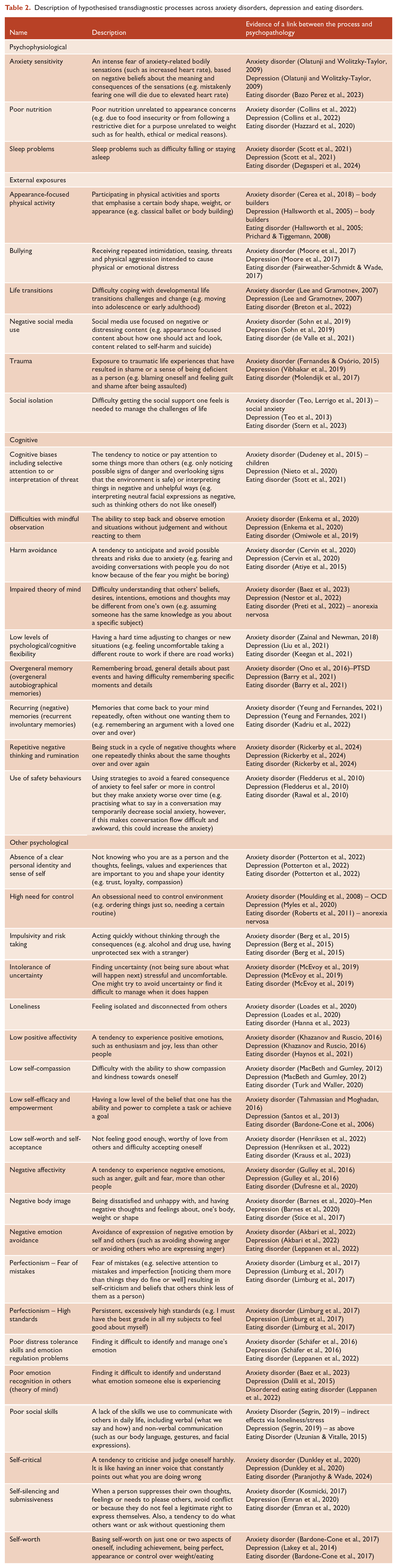
After consideration of the extant reviews in this area, our recent review and meta-analysis of augmentations to eating disorder treatment (Pennesi et al., 2024), as well as a meta-analysis of transdiagnostic early interventions in youth (Radunz et al., manuscript submitted for publication), we adopted a quasi-quantitative approach to suggest 38 potential transdiagnostic processes described in Table 2 in such a way that makes them suitable for initial stakeholder consultation. Each is supported by some degree of evidence (see Supplementary Material) relating to status as a risk or maintenance factor of relevance across at least three different indicators of mental distress (i.e. anxiety, depression, eating disorders). Not included in the table are eight processes that were identified for only two of our three areas of symptomatology; difficulties with problem solving, explicit selective memory and thought suppression (evidence lacking for eating disorders) and heightened interoceptive awareness, low central coherence, low optimism, poor interoceptive awareness and unhelpful thinking habits (evidence lacking for anxiety disorders).
Description of hypothesised transdiagnostic processes across anxiety disorders, depression and eating disorders.
Future directions
While this work represents one step forward in the identification of psychological transdiagnostic processes across depression, anxiety disorders and eating disorders, there is much further work required to see these translated to effective early intervention. First, we have submitted the list of transdiagnostic processes for consultation to stakeholders (i.e. people with lived experience, carers and significant others, clinicians and researchers) to further refine the descriptions, indicate omissions and identify consensus about the transdiagnostic processes that are most important to tackle in youth early intervention. Second, to further refine this list of transdiagnostic processes – either removing or adding processes or collapsing some processes – we have initiated a systematic review process. We will search for meta-analyses or systematic reviews related to mechanisms across the different psychopathologies. These two complementary processes can then inform development of elements to target in early interventions that can be tested in randomised controlled trials. To date, it is clear, that the evidence provided to support status as a transdiagnostic process is uneven and indicates gaps that need to be addressed in future research.
Supplemental Material
sj-docx-1-anp-10.1177_00048674241312803 – Supplemental material for Identifying transdiagnostic psychological processes that can improve early intervention in youth mental health
Supplemental material, sj-docx-1-anp-10.1177_00048674241312803 for Identifying transdiagnostic psychological processes that can improve early intervention in youth mental health by Tracey D Wade, Jamie-Lee Pennesi and Mia Pellizzer in Australian & New Zealand Journal of Psychiatry
Footnotes
Declaration of Conflicting Interests
The author(s) declared no potential conflicts of interest with respect to the research, authorship, and/or publication of this article.
Ethical Considerations
Ethical approval was not required.
Funding
The author(s) disclosed receipt of the following financial support for the research, authorship, and/or publication of this article: Tracey Wade is the recipient of a NHMRC Investigator Grant (2024–2028) 2025665.

Data Availability
Data sharing not applicable to this article as no datasets were generated or analysed during the current study.
Supplemental Material
Supplemental material for this article is available online.
Notes
References
Supplementary Material
Please find the following supplemental material available below.
For Open Access articles published under a Creative Commons License, all supplemental material carries the same license as the article it is associated with.
For non-Open Access articles published, all supplemental material carries a non-exclusive license, and permission requests for re-use of supplemental material or any part of supplemental material shall be sent directly to the copyright owner as specified in the copyright notice associated with the article.
