



Abstract

Background
There have been concerns for the last two decades that clinician-researchers are in decline (Silberman et al., 2012). This is apparent for the specialty of psychiatry, with previous authors reporting on the need to foster the next generation of academic-psychiatrists (Kisely, 2015; Suetani et al., 2022). According to the Royal Australia New Zealand College of Psychiatrists (RANZCP), Early Career Psychiatrists (ECPs) are defined as psychiatrists who obtained Fellowship within the first 5 years. They potentially represent the incoming generation of academic-psychiatrists, but little is known about their research participation or the factors that influence this. Zhang (2014) explored factors that motivated academic researchers at Chinese universities. These factors could be broadly grouped as either ‘internal’, such as personal desire for achievement, curiosity and autonomy, or ‘external’, such as pay, promotion opportunities and recognition. The aims of this study were to quantify research participation by ECPs and explore factors for research participation.
Methodology
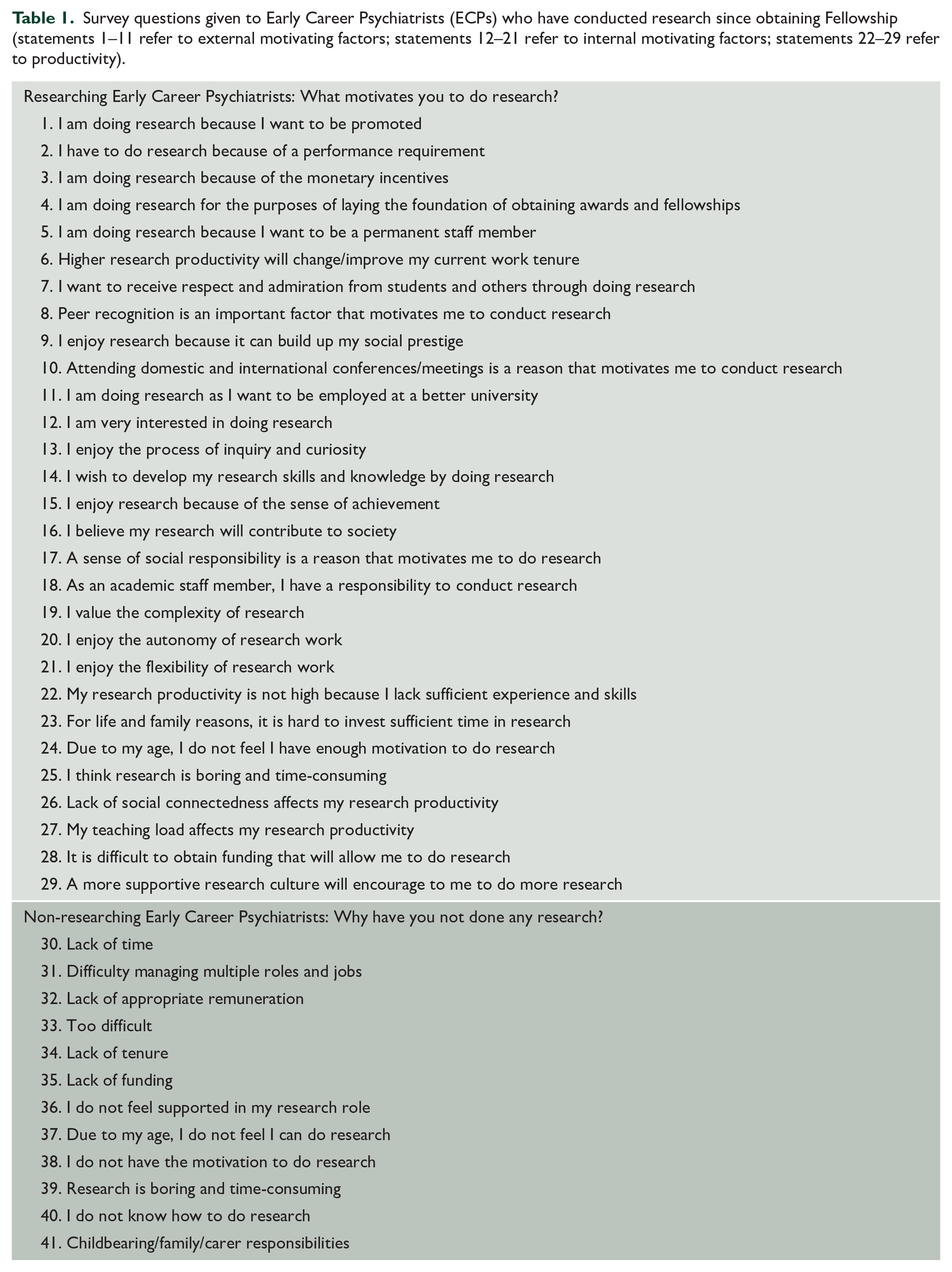
We adapted a survey originally developed by Zhang (2014) and asked ECPs about their research involvement since obtaining Fellowship. This was classified as (1) Academic-Psychiatrist, (2) Researcher or (3) Clinician who ‘dabbles’ in research. This latter option referred to ECPs who did research without specifically allocated time or funding. If an ECP had been involved in research, they were asked to respond to statements about factors that influenced their involvement on a 5-point Likert-type scale ranging from ‘strongly disagree’ to ‘strongly agree’. External factors included promotion, tenure and gaining respect and admiration, whereas internal factors included a sense of achievement, flexibility and autonomy. If a participant had not been involved in research, they were prompted to respond ‘Yes’ or ‘No’ to 13 statements regarding possible reasons for this (Table 1).
Survey questions given to Early Career Psychiatrists (ECPs) who have conducted research since obtaining Fellowship (statements 1–11 refer to external motivating factors; statements 12–21 refer to internal motivating factors; statements 22–29 refer to productivity).
The survey was conducted online via REDCap hosted at the Royal Melbourne Hospital. An invitation to complete the survey was distributed via email by the RANZCP to all 1039 members of its Section of ECPs on 4 May 2020. A reminder email was sent on 21 May 2020. Participation in the survey was voluntary and responses were de-identified. Chi-square analyses were used to compare groups. Minitab (v19.2020.1.0) was used for statistical analyses. Ethics approval was provided (MH-QA2019173).
Results
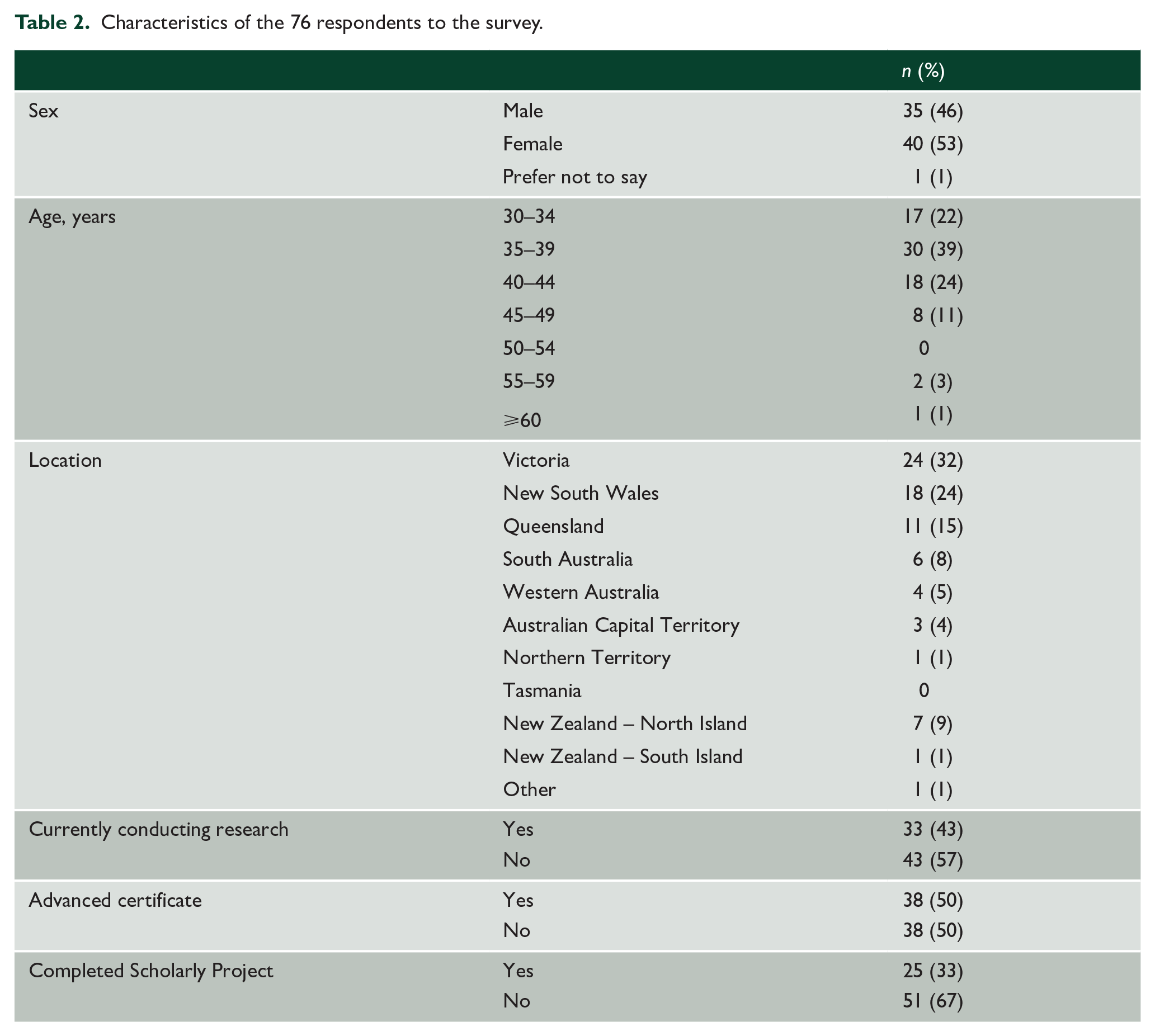
Of the survey recipients, 76 valid responses were received (7.3% response rate). Forty (53%) were female. The median age was 35–39 years old. The majority (n = 67/76, 88%) practised in Australia, mostly in Victoria and New South Wales. Half the respondents had completed an Advanced Certificate. Thirty-five respondents (46%) endorsed previous research experience prior to commencing psychiatry training. One-third of respondents (n = 25/76, 33%) had completed the RANZCP Scholarly Project as part of their training (Table 2).
Characteristics of the 76 respondents to the survey.
Thirty-three had participated in research since gaining Fellowship (43%). Of these, 18 respondents were more likely to identify as clinicians who ‘dabble’ in research (54%) compared to academic-psychiatrists (n = 9/33, 27%). Fewer female ECPs (n = 14/33, 35%) participated in research compared to males (n = 19/33, 54%), but this was not significant (χ(1) = 3.12, p = 0.093).
Of the 33 ECPs who had conducted research, 29 completed responses to statements regarding factors that motivated their research participation. Respondents identified with internal motivators such as a supportive research culture (‘strongly agree’ n = 17 [59%], ‘agree’ n = 10 [34%]), sense of achievement (‘strongly agree’ n = 12 [41%], ‘agree’ n = 14 [48%]) and developing skills and knowledge (‘strongly agree’ n = 14 [48%), ‘agree’ n = 11 [38%]). Productivity was affected by lack of financial remuneration (‘strongly agree’ n = 8 [28%], ‘agree’ n = 10 [34.5%]) and difficulty managing multiple roles/life and family (‘strongly agree’ n = 14 [48%], ‘agree’ n = 10 [35%]), which were seen as barriers. Nearly half (14/29, 48%) had already discontinued or had seriously considered stopping their involvement in research. ‘Lack of time’ (n = 10, 13%), ‘difficulty managing multiple jobs and roles’ and ‘lack of remuneration’ (n = 8, 10% each) were frequent reasons for ceasing.
For the 43 ECPs who had not conducted research since obtaining Fellowship, the three most common reasons were ‘lack of time’ (n = 29/43, 67%), ‘difficulty managing multiple roles and jobs’ (n = 28/43, 65%) and ‘lack of remuneration’ (n = 17/43, 40%). There were trends towards more males citing ‘lack of remuneration’ more than females (9/16, 56% and 7/26, 27%, respectively; p = 0.057) and ‘I do not feel supported in doing research’ (9/16, 56% and 7/26, 27%, respectively; p = 0.057). There were no sex differences in ‘childbearing, family or carer responsibilities’ as a disincentivising factor (males 4/16, 25%; females 8/26, 31% [p = 0.688]).
Discussion
To the authors’ knowledge, this is the first study to investigate contemporary research participation among RANZCP ECPs. A research participation rate of 43% suggests RANZCP ECPs engage with research. However this may be limited, with no time fraction or specific funding. Similar to Zhang’s (2014) study, internal factors such as curiosity, a sense of achievement, interest and autonomy were important motivating reasons to conduct research, but these may be outweighed by barriers which include lack of experience and training, lack of support and financial disincentives (Favilla and Bloch, 2004). Our data suggest research discontinuation. Having dedicated research discussions might encourage future research participation (Suetani et al., 2021); however, lack of time, balancing family life and difficulty managing multiple roles are challenges for ECPs (Looi et al., 2021).
We identified a trend towards lower rates of research participation by females compared to males. This finding is consistent with international studies reporting that academic career advancement of females lags behind that of males (Jagsi et al., 2011). An Australian study investigating factors affecting research participation by female psychiatrists reported that having a supportive institution and availability of a positive mentor were important motivators contributing to ongoing research involvement (Favilla and Bloch, 2004).
Major limitations of our study included the low response rate and small sample size. We were unable to use more sophisticated statistics to more definitively compare responses between sexes and also barriers reported by ECPs who had conducted research and those who did not. Those who have a greater interest in research may have been more likely to respond to the survey. In addition, the factors that govern human behaviour are not easily quantitatively measured. A qualitative study may allow further insight into factors that positively and negatively influence research participation among ECPs.
Despite the limitations, we suggest several recommendations. The Scholarly Project could be important in providing an opportunity for research experience in trainees (Kisely, 2015). Only a small proportion of our respondents had completed a Scholarly Project, so we were unable to make any useful interpretations. ECPs cited motivation for research to be internally derived, so ensuring a positive research experience during the Scholarly Project, such as allocated time, and fostering curiosity and sense of achievement might provide motivation for further research involvement after Fellowship. Grants and funding opportunities, such as those made available by the RANZCP Foundation, may offset the financial barriers to research for ECPs. Systems that provide good access to high-quality supervision and mentorship may also help (Favilla and Bloch, 2004). Overall, a positive encouraging research culture which embeds clinical work with research (Rego et al., 2020) is recommended.
Suetani et al. (2022) stated that there is a need to quantify and characterise academic-psychiatrists and the enablers and barriers. Our findings provide the first step in investigating interventions that support and foster the ongoing development of academic-psychiatrists in Australia and New Zealand.
Footnotes
Declaration of Conflicting Interests
The author(s) declared no potential conflicts of interest with respect to the research, authorship and/or publication of this article.
Funding
The author(s) received no financial support for the research, authorship and/or publication of this article.
