




Abstract

In the context of the drive for clinicians and academics to publish or present papers, as well as the advent of Open Access, we note the rise of shark-like predatory journals and conferences in psychiatry, neurology and neuroscience (Manca et al., 2017). Such journals and conferences aggressively solicit submissions across excessively broad academic domains (Mercier et al., 2018). Australian authors represented 2.1% of those publishing on Kscien’s list of predatory journals, an updated version of the seminal Beall’s list of predatory journals (Omer et al., 2019). We discuss how predatory journals/conferences seek to exploitatively profit from publishing or hosting research, charging authors excessive fees for substandard products. We describe tips to identify predatory journals/conferences, and how authors/presenters are protected by copyright in Australia.
Predatory journals may involve fake information, fake peer review and unethical practices such as extortionate behaviour and fees (Mercier et al., 2018). Wary experienced academics are often assailed by invitations from predatory journals. However, early career clinicians and researchers are likely less aware of such journals and are often targeted (Mercier et al., 2018).
Predatory conferences also appear to arise from the same motivation as predatory publishing, i.e. they appear to be (Cress, 2017), ‘… conferences that appear to be scholarly but are strictly exploitive money-making schemes that cost authors and funding sources time and money’. Predatory conferences aggressively solicit conference abstract submissions (Cobey et al., 2017) and cover a broad range of disparate topics (Cress, 2017). Predatory conferences may range from substandard to entirely sham events charging excessive fees.
Tips to avoid being devoured by the sharks
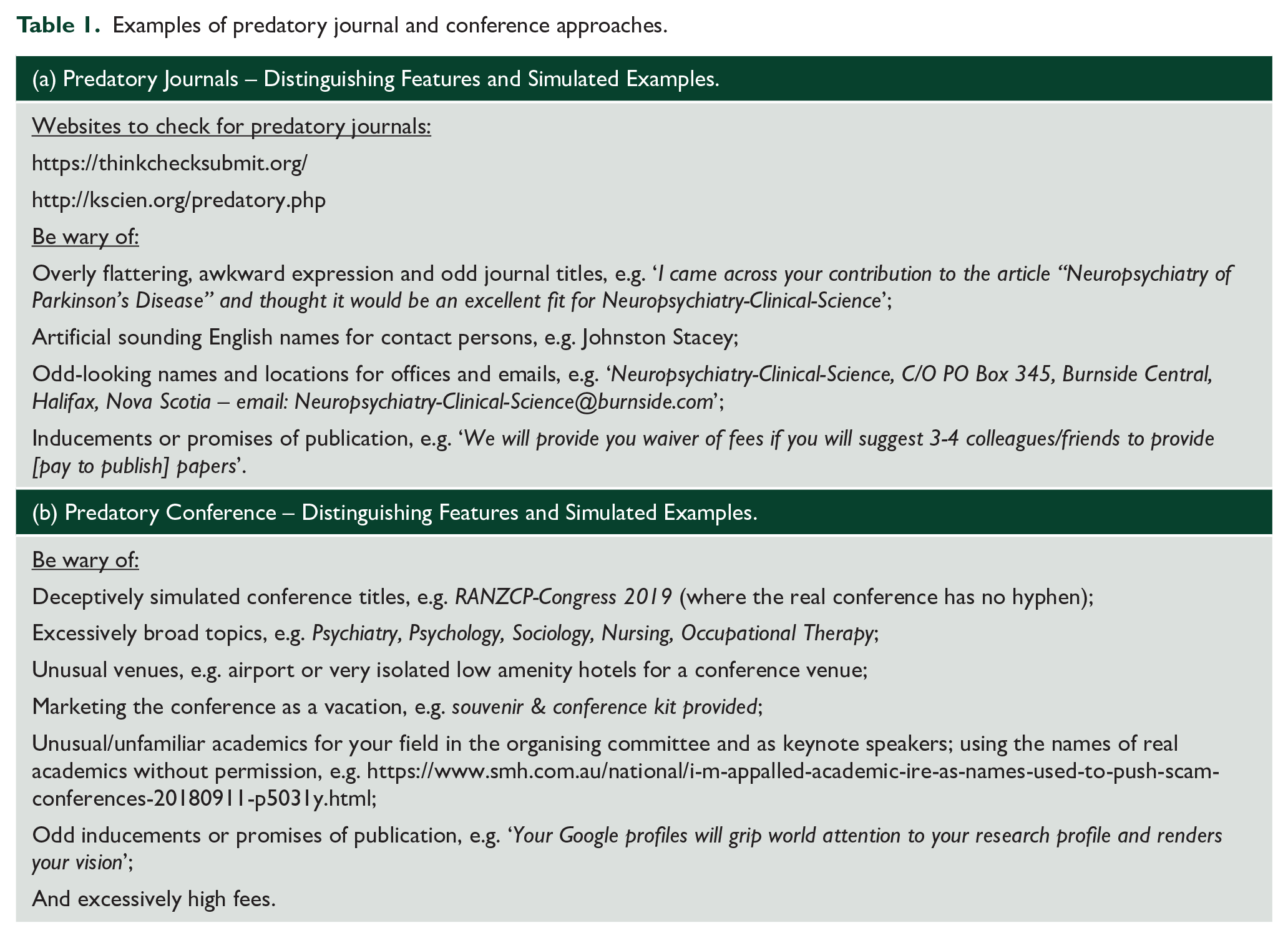
When it looks too good to be true, authors/presenters should be wary of possible predatory journals or conferences. We have summarised some characteristics of predatory journals and conferences in Table 1. We recommend Cress (2017), which provides more detailed advice on recognising such predatory journals and conferences. We also recommend asking experienced academic colleagues for advice as to whether a journal or conference is predatory (Mercier et al., 2018).
Examples of predatory journal and conference approaches.
Authors/presenters automatically acquire copyright to their work under Australian law, i.e Commonwealth Copyright Act, 1968, when the material is created, except for instances when they are expressly employed to produce the work, when they are commissioned to do the work or if the work is directed/controlled by state, territory or federal government. Accordingly, authors can explicitly assign or licence their rights to their work to a publisher/conference. The Australian Copyright Council advises it is good business practice to document such assignment in writing. Authors/presenters should ascertain whether a publisher or conference is not predatory before signing any agreements to publish or present, and payment of fees. Genuine journals/conferences will only ask for assignment of copyright after peer review and acceptance, as well as indicating before submission any publication fees for open access.
Conclusion
Early-career clinicians and academics should beware of shark-like predatory journals and publishers. They should carefully evaluate invitations to publish and present and seek advice from experienced academic colleagues before accepting involvement. Failure to avoid predatory journals and conferences may also negatively impact clinicians/academics through association with these disreputable organisations. Early-career clinicians/academics should especially avoid paying extortionate fees for predatory journals or conferences that may lead to a fate similar to Ian Fleming’s shark victim Felix Leiter (Live and Let Die): ‘He disagreed with something that ate him’.
Footnotes
Declaration of Conflicting Interests
The author(s) declared no potential conflicts of interest with respect to the research, authorship, and/or publication of this article.
Funding
The author(s) received no financial support for the research, authorship, and/or publication of this article.
