




Abstract

The suggestion that early traumatic memories are deterministic in later anxious/depressive ruminations is a powerful metaphor, but remains poorly understood in terms of underlying mechanisms. While infants clearly demonstrate discomfort and/or distress by tears and loud demands for attention, it is unclear when and whether this behaviour is deterministic for later reactions. The significance of the absence of early childhood memory for stressful experiences has remained controversial, since the psychoanalytic controversy between Freud and Ferenczi, who argued over the validity of early traumatic memory vs fantasy (Coates, 2016). Coates asserted that ‘how that traumatization resolves itself, or fails to, can be decisively affected by the functioning of the attachment system’.
French psychoanalysts have used the term ‘L’après-coup’ or ‘afterwardsness’ as a mode of retroactive attribution of sexual or traumatic meaning to earlier events, while Freud himself had described ‘Nachträglichkeit’ as a mode of belated understanding, or retroactive attribution of sexual or traumatic meaning to earlier events, with deferred action, or pathogenic effect of a traumatic event occurring in childhood.
Solms and Pansksepp (2012) elaborated a ‘detailed neuropsychoanalytic and primal consciousness perspective on the interface between affective and cognitive neuroscience’ in which ‘the id knows more than the ego admits’. It was claimed that ‘all consciousness ultimately derives from upper brain stem sources … all the cortical varieties depend upon the integrity of these subcortical structures’. The authors grant that the role of the prefrontal cortex has secondary verbal re-representation activity (p. 167), but they envisage the self of everyday cognition as an ‘abstraction’. A missing consideration in this reverse consciousness theory is the development of language and cerebral dominance at 2–4 years in typically developing children, which may have implications for the processes involved in the capacity for early memory.
A key developmental issue relates to the establishment of a number of connected circuits that may be essential for self-awareness and memory of salient events. The ‘apres coup’ concept suggests the idea that the developing brain is too immature to form a memory of a trauma at that time, and this potential only emerges later when neural networks are developed. In this regard, connections of deep brain areas such as the amygdala and insula may be important. Both of these structures contain numerous cigar-shaped nerves known as von Economo neurones (VENs) which are thought to play a role in the formation of social relationships, reading social cues and other functions unique to both humans and other primates.
According to Uddin et al. (2017), the anterior cingulate cortex (ACC) can be divided anatomically, based on cognitive (dorsal) and emotional (ventral) components. The dorsal part of the ACC is connected with the prefrontal cortex and parietal cortex, as well as the motor system, making it a central station for assigning appropriate executive controls to other areas in the brain. The ventral part of the ACC is connected with the amygdala, nucleus accumbens, hypothalamus, hippocampus and anterior insula (AI), and is involved in assessing the salience of emotion and motivational information. The insula has been described as having a role in language, with left insula functions related to both language production, and a critical role in switching between large-scale networks.
Daniels et al. (2010) have noted that many of the same regions such as ACC and posterior cingulate cortex (PCC) involved in the default mode network (DMN) are also believed to be involved in theory of mind, prospection and autobiographical memory. They point out that ‘the emergence of episodic memory for specific events in time and place is found to occur at around 4 years of age’. This is also a time of rapid synaptogenesis and beginning myelinisation, and children starting to become aware of causal relationships in others.
It is thus likely that brain mapping techniques have demonstrated developmental structures that could support the ‘apres coup’ concept, but this assumes that early experiences, be these positive or negative, are sufficiently retained to inform later developing structures. While ‘attachment deficits’ have been assumed since the 1960s to provide the basis of early memory, it is unclear whether genetic/temperamental/developmental factors in the child are also influential in the ‘direction of effects’ on attachment behaviour. As currently understood, the concept of attachment deficits would appear to be a broad description that does not sufficiently take individual differences into account, for example, in conditions such as attention-deficit hyperactivity disorder (ADHD), autism, and callous unemotional traits that might influence or interact with parental capacity. Thus, a complete analysis of ‘attachment’ should pay attention to developmental factors including language and related developmental factors.
The work of Castellanos and Proal (2012) drew attention to the ‘anti-correlation’ of executive vs default networks for ADHD, but mechanisms that control the rapid and transient switches from executive to default mode are debated. The authors described two critical networks whose activation and deactivation is observed during cognitive tasks: the central executive network and the default network. The executive network was thought to include the dorsolateral prefrontal cortex and posterior parietal cortex, while the DMN included the ventromedial prefrontal cortex (VMPFC) and PCC. While the central executive was important for the active maintenance and manipulation of working memory during goal-directed behaviour, the default network including medial temporal lobe and angular gyrus, in addition to PCC and VMPFC, was active during tasks that involved autobiographical memory and self-reference.
Daniels et al. (2010) investigated switching between executive and DMNs in post-traumatic stress disorder (PTSD). They studied the relation between task-negative and task-positive networks involved in switching to working memory updating and suggested two differentiated networks, an executive dorsolateral/frontal-parietal network and a dorsal anterior cingulate–orbitofrontal salience network. The authors found that the salience network, which encompassed the fronto-insular circuit and anterior cingulate, was uniquely positioned to activate the executive network (see Figure 1).
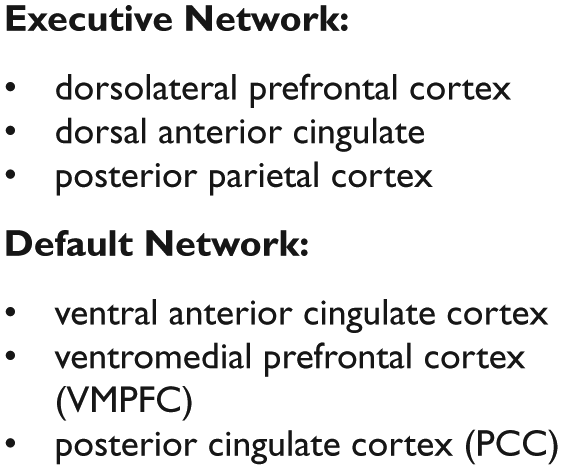
Network glossary.
Conclusion
The issue of whether early traumatic memories are deterministic in later anxious/depressive ruminations or, alternately, these concerns represent deficits in developmental processes that control switching mechanisms between default and executive circuits remains unresolved. While ‘attachment deficits’ have been the principal focus since 1969, there may be a need for further elaboration and/or inclusion of cognitive developmental factors. Maturational effects on the functional connectivity of default, executive and language-related circuits may help explain the age-related onsets of conditions such as autism and ADHD. But the presence and significance of early childhood traumatic memory with suggested later effects on behaviour remains an enigma, raising questions about the role of language in allowing ‘analogue to digital’ transformation of salient experience and memory, via default network connections. While the ‘après-coup’ idea is interesting, it is not established.
Footnotes
Declaration of Conflicting Interests
The author(s) declared no potential conflicts of interest with respect to the research, authorship and/or publication of this article.
Funding
The author(s) received no financial support for the research, authorship and/or publication of this article.