




Abstract

To the Editor
Brownstein et al. (2018) in their recent meta-analysis of randomized controlled trials (RCTs) concluded that those receiving angiotensin I converting enzyme inhibitor (ACEI) and angiotensin II type 1 receptor blocker (ARB) medications scored significantly better in domains of positive well-being, mental health and anxiety on quality of life measures.
Of the 11 studies included in the meta-analysis, 7 used enalapril as a comparator. Some studies had more than two comparators and only two trials included placebo arms. Enalapril is a hydrophilic drug, which does not readily cross the blood–brain barrier (BBB; Gohlke et al., 1989) and thereby does not have a rationale for psychotropic properties. In contrast, there have been reports of mood improvement or elevation after treatment with the more lipophilic ACEI, captopril. As enalapril was over-represented in this meta-analysis, some scepticism of the authors’ conclusions may be warranted.
The authors reported that the standard mean difference (SMD) ‘was calculated as the standardized difference in means between both arms in the follow up’. However, in Figure 2, Forest plot for random effects meta-analysis, by Brownstein et al. (2018), the data are incorrect. In the study by Omvik et al. (1993), there was no significant difference in the change to anxiety scores between the amlodipine and enalapril arms (mean difference in anxiety score = –0.05, 95% confidence interval [CI] = [–0.69, 0.58]). Figure 1, Forest plot using original data from the study by Omvik et al. (1993), displays the SMD calculated for anxiety, depression, well-being and total scores from the Psychological Well-Being Index. The SMD for the anxiety scores from our analysis of original data was not significant (SMD = –0.016, 95% CI = [–0.211, 0.180], p = 0.875), despite assertions to the contrary by Brownstein et al., 2018 (SMD = 0.20, p = 0.00).
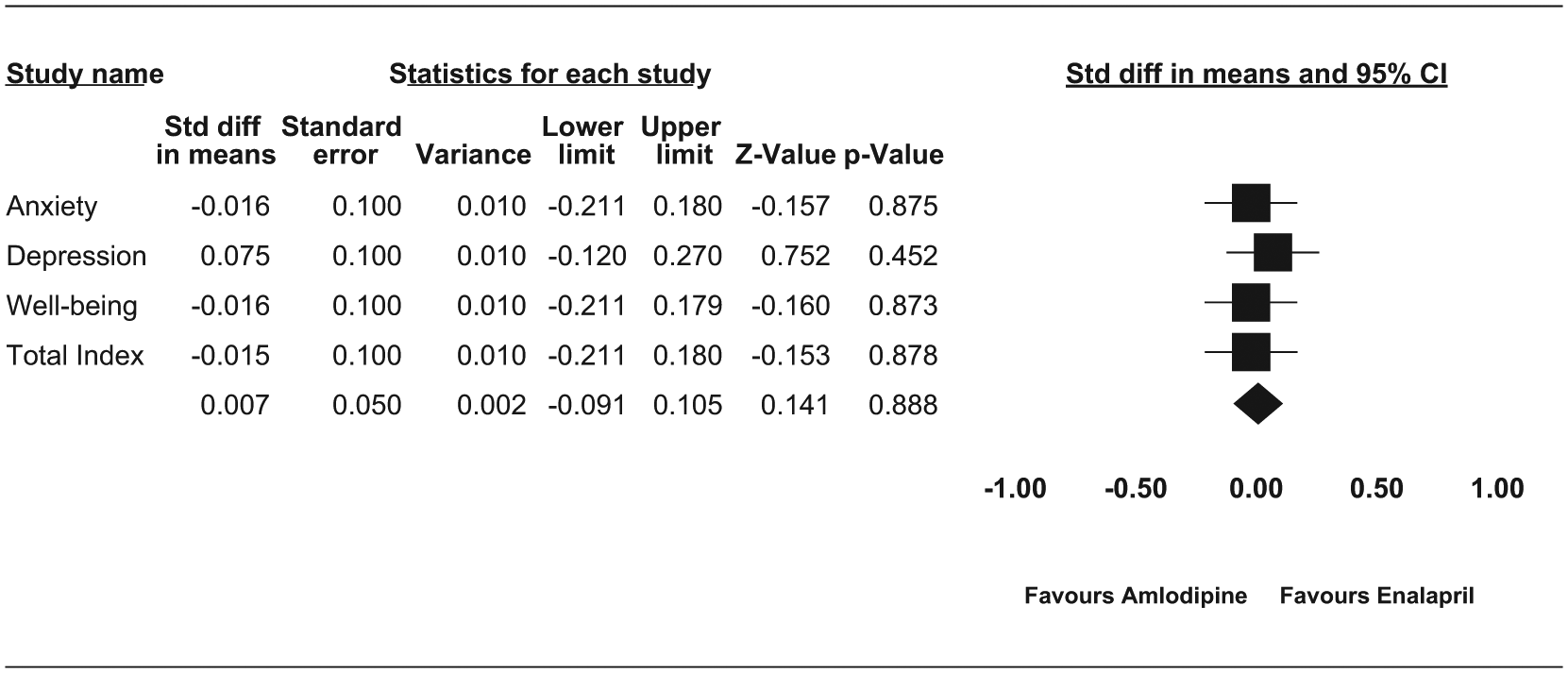
Forest plot using original data from the study by Omvik et al. (1993).
Similarly, the SMD for well-being scores (SMD = –0.016, 95% CI = [–0.211, 0.179], p = 0.873) and total scores (SMD = –0.015, 95% CI = [−0.211, 0.180], p = 0.878) from our analysis of the original data were not significantly different, in contrast to the claims by Brownstein et al. (2018).
The hypothesis that ACEI and ARB medications may have psychotropic properties is worthy of further consideration; however, the ability to cross the BBB is a relevant factor and a review of the psychotropic qualities of lipophilic ACEI may be more compelling. Meta-analyses of RCT with active comparators must surely prove that the treatment in question statistically outperforms the comparators. This study does not provide that certainty.
Footnotes
Declaration of Conflicting Interests
The author(s) declared no potential conflicts of interest with respect to the research, authorship and/or publication of this article.
Funding
The author(s) received no financial support for the research, authorship and/or publication of this article.