




Abstract
The increased availability of treatment has not reduced the prevalence of mental disorders, suggesting a need for a greater emphasis on prevention. With chronic physical diseases, successful prevention efforts have focused on reducing the big risk factors. If this approach is applied to mental disorders, the big risk factors are adverse childhood experiences, which have major effects on most classes of mental disorder across the lifespan. While the evidence base is limited, there is support for a number of interventions to reduce adverse childhood experiences, including an important role for mental health professionals. Taking action on adverse childhood experiences may be our best chance of emulating the success of public health action to prevent chronic physical diseases and thereby reduce the large global burden of mental disorders.
Community surveys across the world have found that many people who meet diagnostic criteria for a mental disorder do not receive treatment. Closing this ‘treatment gap’ has been promoted as a way to improve mental health globally (Saraceno, 2002). However, despite substantial increases in treatment uptake in recent decades in a number of high-income countries, including Australia and New Zealand, there has been no measurable reduction in the prevalence of common mental disorders (Jorm, 2014; Jorm et al., 2017; Mulder et al., 2017). A number of reasons have been advanced to account for the failure of reducing the treatment gap to improve population mental health, including limitations in the quality and targeting of treatment (Jorm et al., 2017). Another possibility is that we have focussed too heavily on treatment services as the solution to mental health problems in the community and have ignored prevention and the social determinants of mental health (Jorm, 2014; Mulder et al., 2017). In this Viewpoint, we expand on what needs to be done to redress the balance towards prevention and social determinants.
Current approaches to prevention
Prevention of mental disorders remains largely neglected and stands in stark contrast to the situation with major physical diseases where prevention efforts are more widespread. Despite this neglect, evidence has been slowly accumulating that prevention of mental disorders is possible. Many randomized controlled trials have been carried out on preventive interventions for common mental disorders and show that prevention can be effective, although the effects are small and it is not known whether they persist beyond the short term (Stockings et al., 2016; van Zoonen et al., 2014). Most of these interventions are based on psychological therapies like cognitive-behaviour therapy, which have been moved down the continuum of mental ill health to be applied to mainly young people with sub-threshold or no symptoms. In many ways, this approach to prevention is the ultimate extension of the ‘close the treatment gap’ strategy. It goes beyond extending psychological treatment to cases of mental disorder and attempts to extend it to sub-threshold cases (indicated prevention) or across the whole population (universal prevention). One of the reasons for the dominance of evidence for this approach may be that it is readily amenable to evaluation with randomized controlled trials, particularly within education systems.
However, there are a number of challenges for the psychological interventions approach to prevention. To have sustained effects it may need to be repeated throughout the lifespan, and it is not clear how this could be organized and funded, particularly for age groups outside the education system. Furthermore, because only a small proportion of those with a threshold mental disorder actually receive psychological treatment, it is difficult to prioritize psychological intervention resources to the sub-threshold population.
Going for the big risk factors
An alternative approach to prevention, which has been dominant for major physical diseases, is to find the big risk factors and attempt to reduce them. This has led to action on exposures like smoking, ultra-violet light, asbestos and dietary sodium. When looking for the equivalent big risk factors for mental disorders, the outstanding class of exposures are adverse childhood experiences. These have been defined as ‘experiences that are likely to require significant adaptation by an average child and that represent a deviation from the expectable environment’ (McLaughlin, 2016: 362). These include physical, sexual and emotional abuse, neglect, poverty, loss of a parent, domestic violence, serious physical illness, and exposure to parental mental illness, substance misuse and criminal behaviour.
These risk factors are estimated to account for substantial proportions of the population attributable risk of mental disorders, that is, the percentage reduction in a disorder that would occur if adverse childhood experiences could be eliminated. Kessler et al. (2010) estimated population attributable risks across countries of 23% for mood disorders, 31% for anxiety disorders, 42% for behaviour disorders and 28% for substance disorders. Moore et al. (2015) have recently estimated the disease burden (i.e. impact on disability and premature death) attributable to child maltreatment as a risk factor for depressive disorder, anxiety disorders and intentional self-harm in Australia. They estimated that, for males, child maltreatment accounted for 16% of the burden of depressive disorders, 21% for anxiety disorders and 24% for self-harm. For females, the estimates were 23% for depressive disorders, 31% for anxiety disorders and 33% for self-harm. In a New Zealand cohort, Fergusson et al. (2008) reported that childhood sexual abuse accounted for 13% and physical abuse for 5% of mental health problems, even after social and family factors were controlled for.
What we know about adverse childhood experiences
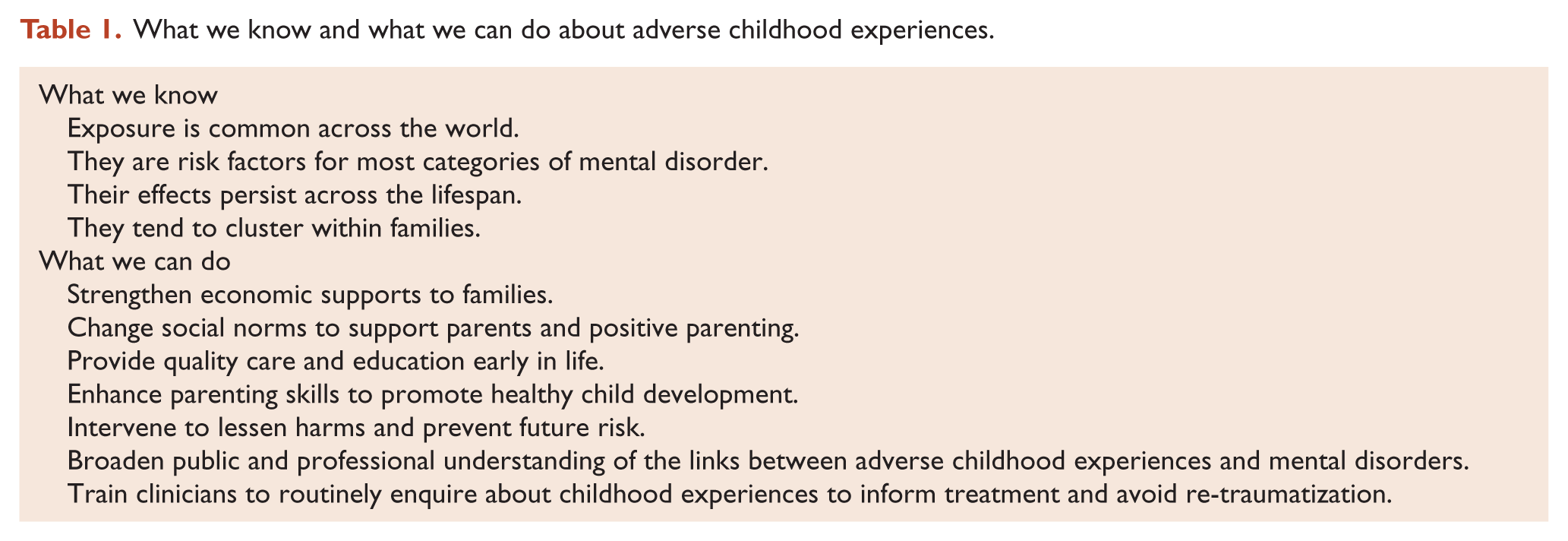
There are a number of facts about adverse childhood experiences which inform the need for action in this area (see Table 1):
Exposure is common across the world. The WHO World Mental Health Surveys found that exposure to adverse childhood experiences had a similar prevalence in high-income (38%), high-middle-income (39%) and low- and lower-middle-income countries (39%) (Kessler et al., 2010). It is this high exposure that is in large part responsible for the substantial population attributable risk.
Adverse childhood experiences are risk factors for most categories of mental disorder. They increase risk for mood disorders, anxiety disorders, behaviour disorders and substance use disorders (Kessler et al., 2010), for psychotic experiences (McGrath et al., 2017), for personality disorders (Afifi et al., 2011) and for suicidal behaviour (Brodsky and Stanley, 2008). Their effects extend beyond mental disorders. They are also associated with smoking, risky HIV behaviour, diabetes, cardiovascular disease and with use of special equipment due to disability (Campbell et al., 2016). However, a recent review and meta-analysis which attempted to look at the strength of the associations reported that the strongest relationships between adverse childhood experiences and health were for mental health, sexual risk taking, problematic alcohol and drug use, and interpersonal and self-directed violence (Hughes et al., 2017).
Their effects persist across the lifespan. Adverse childhood experiences increase risk of mental disorders across the lifespan through to old age (Kessler et al., 2010; Raposo et al., 2014). These lifespan effects are not simply the long-term consequences of mental disorders arising during childhood. Adverse childhood experiences increase risk of first onsets of mental disorders during adult life.
They tend to cluster within families. Around two-thirds of children with an adverse childhood experience have multiple types of adverse experiences (Kessler et al., 2010). A factor analysis of exposure to these experiences found a large general factor representing maladaptive family functioning, with loadings on parental mental illness, substance misuse, criminal behaviour, domestic violence, physical and sexual abuse and neglect (Kessler et al., 2010).
What we know and what we can do about adverse childhood experiences.
What can be done to reduce adverse childhood experiences?
While eliminating adverse childhood experiences would in principle have a major impact on the prevalence and burden of mental disorders, the question is how much of this exposure could be reduced in practice. In contrast to the situation with preventive psychological interventions, the evidence base from trials is thin. However, the US Centers for Disease Control and Intervention have recently produced a report reviewing the evidence on preventing child abuse and neglect (Fortson et al., 2016). This report concluded that there were five strategies that have some evidence from trials that they either directly reduce child abuse and neglect or else have evidence that they reduce risk factors for child abuse and neglect (e.g. parenting stress or parental mental health). These strategies are (see Table 1) as follows:
Strengthen economic supports to families. This includes strengthening household financial security through child support and other payments to reduce poverty, assistance to move out of high-poverty neighbourhoods, and subsidized childcare. It also includes family-friendly work policies, including livable wages, paid leave, and flexible and consistent work schedules.
Change social norms to support parents and positive parenting. This includes campaigns and community-based efforts to change public thinking about child abuse, and also legislation to reduce corporal punishment.
Provide quality care and education early in life. This strategy includes high-quality early education to children from economically disadvantaged families and improving the quality of childcare by licencing and accreditation.
Enhance parenting skills to promote healthy child development. This includes early childhood home visiting programmes and training programmes to improve parenting.
Intervene to lessen harms and prevent future risk. This includes enhanced primary care to identify and address risk factors for child abuse and neglect, behavioural parent training programmes to reduce recurrence, and treatment for children and families to reduce harms and to prevent behaviour problems associated with child abuse and neglect.
While this report shows the possibility of effective preventive action in this area, this is clearly a relatively neglected area of research. Furthermore, much of the evidence that does exist is specific to the situation in the United States, showing the need for a more global effort to investigate what works.
What role can mental health professionals play?
Many of the above strategies lie outside the domain of the health system, showing that any systematic effort to reduce adverse childhood experiences must involve a broad range of human services. However, there is considerable scope for mental health professionals to play a role. One of the most obvious is to raise awareness of the major role adverse childhood experiences play in the aetiology of all mental disorders. Despite the robustness of the evidence that we have presented, treatment often focusses on cross-sectional symptoms. Mental health professionals should be trained to routinely enquire about childhood experiences during an assessment. This could inform treatment by integrating knowledge about adverse childhood experiences into procedures and practices while seeking to actively avoid re-traumatization: a process sometimes conceptualized as trauma-informed care (Oral et al., 2016). Practical measures could include training professionals dealing with children to enquire about parental well-being, identify and treat post-natal depression and other mental health concerns. The ante- and post-natal periods offer the opportunity to address a range of adverse childhood experiences, including parental substance use and domestic violence, as well as increasing parental skills.
Motivating action
It can be a challenge to advocate for increased resources for prevention, given that the benefits are in the long-term future and have to compete with the relief of current suffering. However, advocating for reducing adverse childhood experiences may be easier than for other approaches to prevention of mental disorders, because they also cause immediate distress, they affect vulnerable children and they affect risk for such a wide range of mental and physical disorders across the lifespan.
In Australia, a major opportunity for action in this area has come with the Royal Commission into Institutional Responses to Child Sexual Abuse (Berk et al., 2014). The recently-released final report of the Commission recommends a national strategy to prevent child sexual abuse to be administered by a proposed National Office for Child Safety (Royal Commission into Institutional Responses to Child Sexual Abuse, 2017). Activities recommended for the national strategy include a social marketing campaign to change attitudes and behaviour in relation to child sexual abuse, prevention education in educational and community settings, online safety education for children, parents and schools, help-seeking services for cases of possible abuse, building the evidence based on interventions, and a regular national study on the prevalence of child maltreatment. Although this report deals with only one class of adverse childhood experiences, it does allow for a broader approach by recommending ‘aligning with and linking to national strategies for preventing violence against adults and children, and strategies for addressing other forms of child maltreatment’ (p. 5). It remains to be seen how many of the recommendations will be implemented by the Australian government.
In New Zealand, the Crimes Act removed the legal defence of ‘reasonable force’ for parents prosecuted for assault on their children in 2007. However, there is no good evidence of the effect that this has had on adverse childhood experiences or their consequences.
Conclusion
The importance of early adversity has never been clearer with numerous studies consistently demonstrating that adverse childhood experiences have major detrimental effects on mental and physical health throughout people’s lives. This is a global issue on which mental health professionals, consumers and carers need to unite and work with the broader human services sector to demand action. Efforts need to be made to broaden public and professional understanding of the links between adverse childhood experiences and mental disorders in order to encourage preventive strategies and inform treatment. It may be our best chance of emulating the success of public health action to prevent chronic physical diseases and thereby reduce the large global burden of mental disorders.
Footnotes
Declaration of Conflicting Interests
The author(s) declared no potential conflicts of interest with respect to the research, authorship and/or publication of this article.
Funding
The authors disclosed receipt of the following financial support for the research, authorship, and/or publication of this article: Anthony Jorm was supported by an NHMRC Senior Principal Research Fellowship.