




Abstract

Welcome to our readers at home and all those ‘watching’ around the world. The excitement here within the journal pages is at fever pitch as the long-awaited Psychiatry Ashes Test finally gets underway. As the captains reveal the handpicked batting papers (BPs) of their respective teams and release them into the field of citations – everyone is poised for the first ‘key-strokes’, having inked their quills or charged their computers – depending on how they choose to bat.
As the game gets underway, this first of many exciting updates provides details of the selected BPs (see Table 2) and the rules for scoring (see below). From time to time expert commentators will be invited to provide their opinion on how the game is progressing, and players will be asked to share their own personal insights into the game and any strategies they may be exemplifying.
Scoring Example.
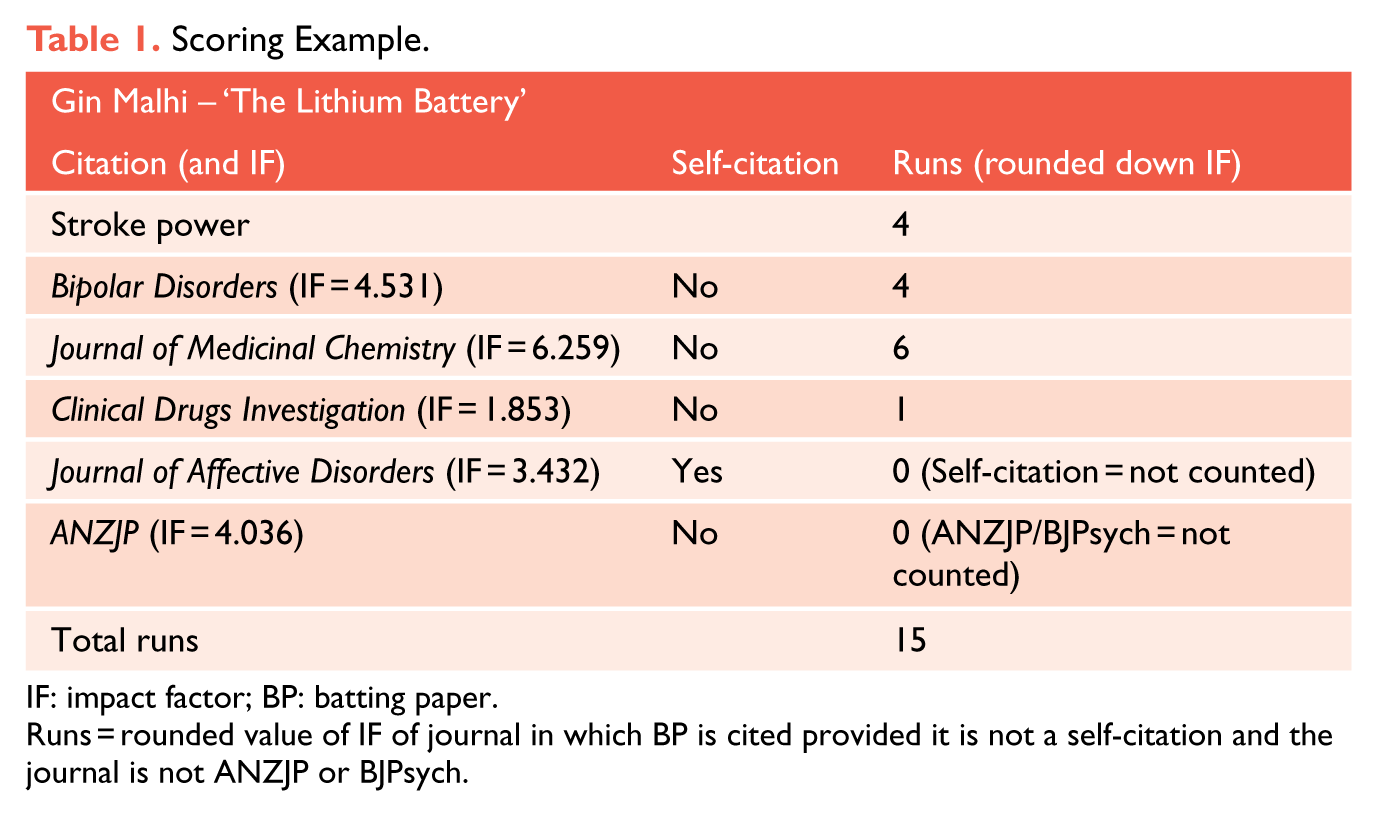
IF: impact factor; BP: batting paper.
Runs = rounded value of IF of journal in which BP is cited provided it is not a self-citation and the journal is not ANZJP or BJPsych.
Stroke power for the Psychiatry Ashes batting papers
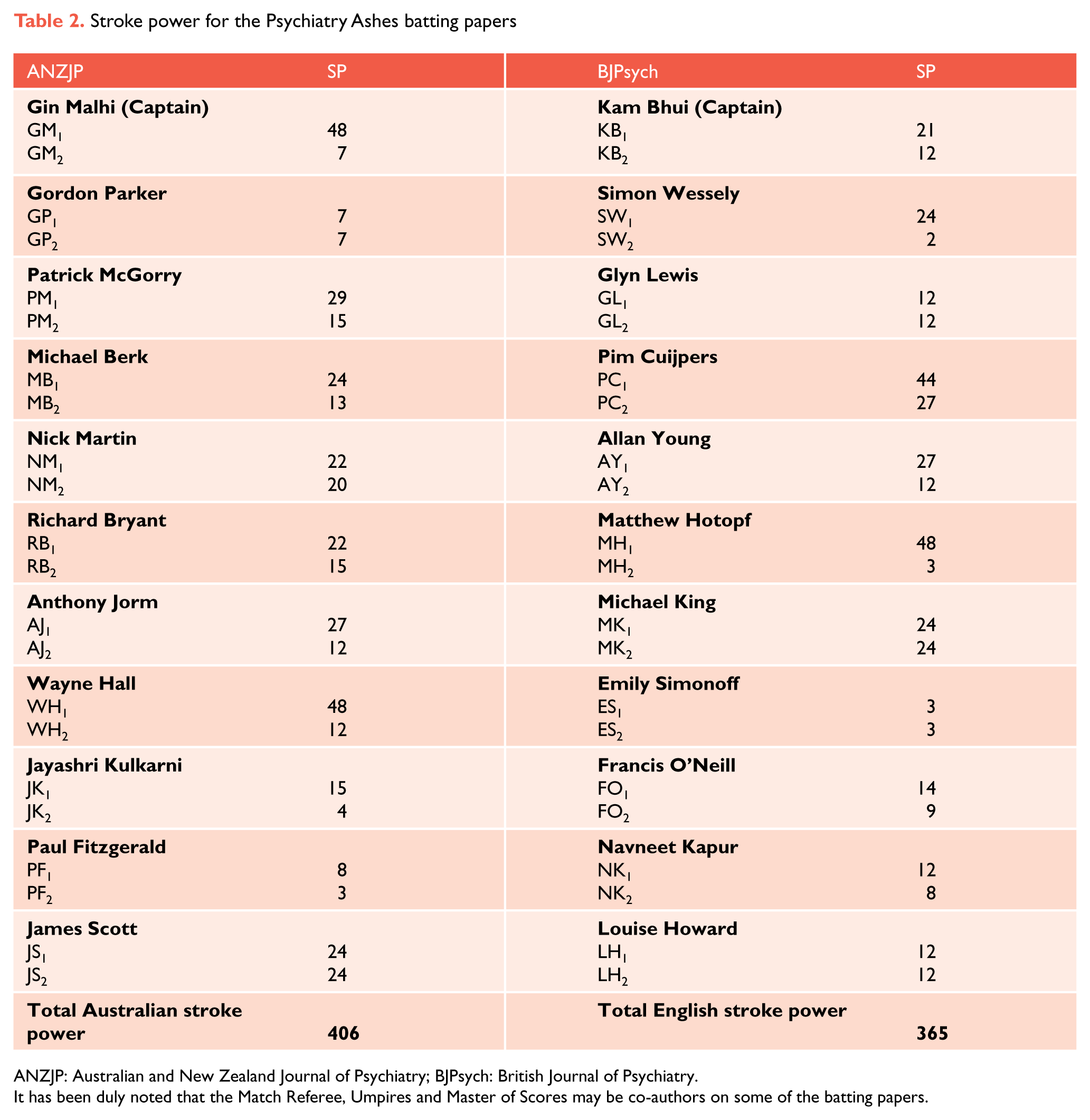
ANZJP: Australian and New Zealand Journal of Psychiatry; BJPsych: British Journal of Psychiatry.
It has been duly noted that the Match Referee, Umpires and Master of Scores may be co-authors on some of the batting papers.
Scoring rules
The total score that each BP earns will be based on two components: its stroke power, and the number of citations it attracts.
‘Stroke power’
Each BP has been assigned a fixed score that reflects its initial impact. This is termed its stroke power (SP) and has been determined using the formula A × B. A was derived by halving the numerical impact factor (IF) of the journal in which the BP is published. The B value (either 1 or 2) was assigned according to the hierarchy of authorship. For example, if the player was the first or last author on their BP, the B value was 2, whereas if they were a co-author B was 1. Therefore, SP = A × B.
Scoring ‘runs’
The ‘runs’ that each BP accrues over the course of the year shall be based on its citations. The number of runs each citation earns will be determined by the IF of the journal in which the BP is being cited rounded down to a ‘cricket score’ of 1, 2, 3, 4 or 6. For example, a citation in Psychological Medicine (IF = 5.23) will count as 4 runs. Any ‘self-citations’ (i.e. where a player is an author on a paper that cites their own BP) will not be counted towards their run score. That is, the citation factor score will be 0 for self-citations. Furthermore, any citations of BPs in Australian and New Zealand Journal of Psychiatry (ANZJP) or British Journal of Psychiatry (BJPsych) will not be counted at all. The runs scored by a BP will be cumulatively added to the initial SP score (see Table 1).
Example
If the paper ‘The Lithium Battery: Assessing the neurocognitive profile of lithium in bipolar disorder’ published in 2016 in Bipolar Disorders by Malhi et al. had been selected as one of the ANZJP Team’s BPs, then its SP would be 4.
SP Component A – the IF for Bipolar Disorders is 4.531, and so when halved the IF score is 2.27, which will attract an A score of 2. Component B – Gin is the first author so this will attract a B score of 2. SP (A × B) – this will give it an SP of 2 × 2 = 4.
Scoring runs – if the paper attracts five citations in five journals and one of these is a self-citation, the ‘runs’ attracted will be calculated accordingly. See Table 1 for the breakdown of how ‘runs’ will be calculated.
Losing wickets
Each month (apart from the first month of the year) a BP from each team will be randomly selected to be ‘bowled out’, meaning that this BP will be out of the competition. In this manner, by the end of the match, 11 papers from each team will have been dismissed (i.e. 1 paper per month for 11 months). When a paper is ‘bowled out’, the runs it has accumulated to that point in the match will remain and continue to be counted as part of the total score, but any further citations generated by this BP will not be counted towards the team’s run score. Once a player has lost one of their BPs they will be exempt from losing another BP. This will ensure that each player will have lost only one of their BPs over the course of the match.
Comment
As can be seen from the total scores thus far (derived solely from the SP of the BPs), the two teams are reasonably evenly matched – meaning we have a real test on our hands. Time for a cucumber sandwich.
Footnotes
Declaration of Conflicting Interests
The author(s) declared no potential conflicts of interest with respect to the research, authorship and/or publication of this article.
Funding
The author(s) received no financial support for the research, authorship and/or publication of this article.