




Abstract

To the Editor
The Australian Bureau of Statistics (ABS) released their Cause of Death statistics up to the year 2014 on 8 March 2016, prompting concern about an increase in suicides, particularly among working-aged males (25–54 years). Not unreasonably, this increase focuses attention on whether current investments in suicide prevention are effective.
The ABS only displays suicide rates over the past 10 years. Australia has experienced a record low population burden of suicide over this period. Suicide rates fluctuate year to year due to their low base rate, and changes based on single-year comparisons can be over-interpreted. When considering suicide rates from the beginning of the 20th century, the increase in the total suicide rate from 2013 to 2014 is less noteworthy.
There was a statistically significant increase in age-standardised rates (per 100,000) in males from 19.8 (95% confidence interval [CI] = [18.8, −20.8]) in 2013 to 22.2 (95% CI = [21.2, −23.3]) in 2014, a relative increase of 12%. However, this increase occurred in the context of suicide rates that have been the lowest since World War II (Figure 1(A)). Suicide rates were higher during the 1980s and 1990s, during the 1960s (in both males and females) and also during the Great Depression in 1929 (Figure 1(A)).
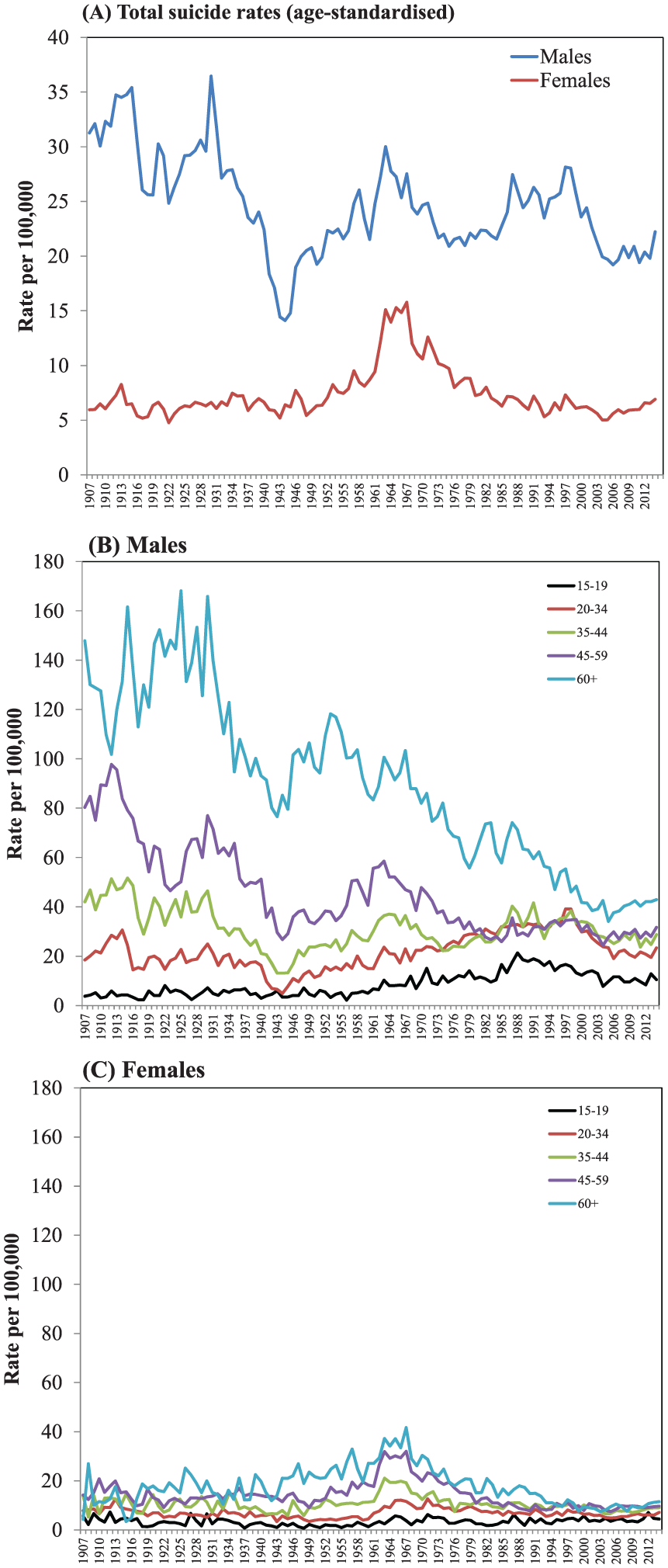
Australian suicide rates, 1907–2014: (A) total suicide rates (age-standardised), (B) males and (C) females.
Perhaps the more important message from the most recent statistics is that suicide among older age males (⩾60 years) and middle-aged males (45–59 years) continue to increase (Figure 1(B)). This latter age group is the same cohort (when aged in their 20s and 30s) that experienced the young adult suicide ‘epidemic’ peaking in the 1990s, a period characterised by high unemployment and shifts to under-employment (Page et al., 2013). If this birth cohort is experiencing a higher suicide rate across the life-span, then it is expected that male suicide rates in older age groups will continue to increase.
Prevention activities for this cohort need to be holistic and focus on both stressors and protective factors. It is also important that we consider integrating prevention initiatives into the workplace, given that the majority of suicides among Australians occur among those who are employed at the time of death (Milner et al., 2014). Workplace suicide prevention activities show promise, but more rigorous evaluation is needed (Milner et al., 2015).
An increase in Australian suicide rates is a cause for concern, but not alarm, and an opportunity for those working in suicide prevention to re-focus on developing and evaluating evidence-based approaches to suicide prevention across the life-course.
Footnotes
Declaration of Conflicting Interests
The author(s) declared no potential conflicts of interest with respect to the research, authorship and/or publication of this article.
Funding
The author(s) received no financial support for the research, authorship and/or publication of this article.