




Abstract

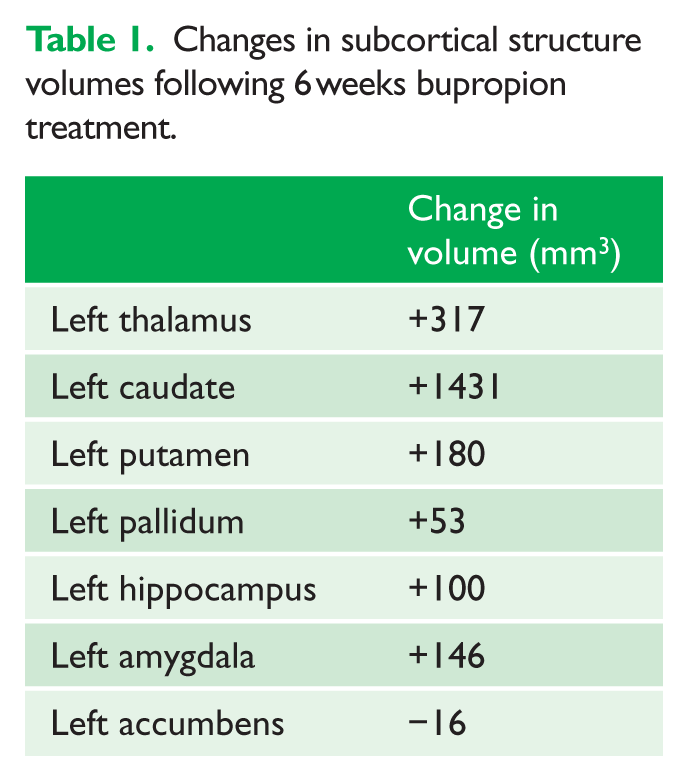
Mrs H, a first-episode medication-naïve depression patient received bupropion treatment 300 mg/day for 6 weeks to reach remission status (Hamilton Rating Scales for Depression [HRSD] scores: 29 => 7). She also underwent three-dimensional fast spoiled gradient-echo recovery T1W1 structural magnetic resonance imaging (MRI) scanning at baseline and 6 weeks later using a 3T Siemens scanner within the Magnetic Resonance (MR) Center at the National Yang-Ming University. The duration of untreated depression was 3 months and the symptoms included depressed mood, suicide ideation, lack of energy, worthlessness, psychomotor agitation and significant occupational function impairment. She did not have other psychiatric or medical co-morbidities. No significant side effects or body weight changes were noted during bupropion treatment. Structural MRI data were analyzed by the FMRIB’s Integrated Registration & Segmentation Tool (FIRST) function of FMRIB Software Library (FSL) toolbox, which used a Bayesian model of shape and appearance for quantification of subcortical brain compartments. We found significant increases in the volumes of all subcortical structures after bupropion treatment except bilateral nuclei accumbens, right caudate and pallidum (Table 1).
Changes in subcortical structure volumes following 6 weeks bupropion treatment.
Bupropion is a dopamine and norepinephrine reuptake inhibitor. Dopamine can trigger heterosynaptic plasticity via activation of the subcortical system (Ishikawa et al., 2013). Depression is associated with impairment of structural plasticity and neural cellular resilience. Treatment with an antidepressant may reverse the dysfunction via its action on neurotransmitters (Fuchs et al., 2004). Dopamine dysregulation in the subcortical system is also known to contribute to depression pathophysiology. The social isolation model for depression also implicates decreased volume in subcortical structures (Wang et al., 2012). The increase in the volume of the majority of subcortical structures might reflect the downstream effects of dopamine and norepinephrine reuptake inhibitions resulting in structural plasticity and neurogenesis. Our finding underscores the importance of investigating the effects of psychotropics on brain structure and function.
Footnotes
Acknowledgements
The author states that he is the first and corresponding author of this manuscript. All individuals included as authors have contributed substantially to the scientific process leading up to the writing of the paper. In addition, the author has made a substantial contribution to drafting or critical revision of the manuscript for important intellectual content. This article was not presented anywhere previously. The author has no disclaimer or statement of interest to declare.
Declaration of interest
The authors report no conflicts of interest. The authors alone are responsible for the content and writing of the paper.
Funding
Sources of financial and material support: the grant from the Cheng Hsin General Hospital and National Yang-Ming University cooperative project 103F003C02.