




Abstract
Objective:
To systematically review research on how people use the Internet for suicide-related reasons and its influence on users. This review summarises the main findings and conclusions of existing work, the nature of studies that have been conducted, their strengths and limitations, and directions for future research.
Method:
An online search was conducted through PsycINFO, PubMed, Ovid MEDLINE and CINAHL databases for papers published between 1991 and 2014. Papers were included if they examined how the Internet was used for suicide-related reasons, the influence of suicide-related Internet use, and if they presented primary data, including case studies of Internet-related suicide attempts and completions.
Results:
Findings of significant relationships between suicide-related search trends and rates of suicide suggest that search trends may be useful in monitoring suicide risk in a population. Studies that examine online communications between people who are suicidal can further our understanding of individuals’ suicidal experiences. While engaging in suicide-related Internet use was associated with higher levels of suicidal ideation, evidence of its influence on suicidal ideation over time was mixed. There is a lack of studies directly recruiting suicidal Internet users. Only case studies examined the influence of suicide-related Internet use on suicidal behaviours, while no studies assessed the influence of pro-suicide or suicide prevention websites. Online professional services can be useful to suicide prevention and intervention efforts, but require more work in order to demonstrate their efficacy.
Conclusions:
Research has shown that individuals use the Internet to search for suicide-related information and to discuss suicide-related problems with one another. However, the causal link between suicide-related Internet use and suicidal thoughts and behaviours is still unclear. More research is needed, particularly involving direct contact with Internet users, in order to understand the impact of both informal and professionally moderated suicide-related Internet use.
Introduction
The Internet is easily accessible, widely available and often unregulated, allowing individuals to access information on a variety of topics and to communicate with strangers around the world. Its capabilities have attracted concerns over how it may negatively impact vulnerable individuals, such as people who are suicidal. Work on suicide and the media has predominantly focused on traditional forms of media, particularly surrounding the issue of suicide contagion (Pirkis et al., 2006). The Internet raises additional questions of not just how individuals are affected through passive exposure to suicide-related content, but also the ways in which it can be actively used for suicide-related reasons.
Daine et al. (2013) conducted a systematic review investigating the influence of the Internet on self-harm and suicide in young people. There was evidence of both positive influences, such as online media being used as a form of support, and negative influences, such as Internet addiction, cyberbullying, and the Internet being a source of information on suicide and self-harm.
While Daine et al. (2013) reviewed the influences of Internet use in general, the present review aimed to extend their work by focusing specifically on suicide-related Internet use. We define suicide-related Internet use as use of the Internet for reasons relating to an individual’s own feelings of suicide. The aim was to summarise and assess the existing work on not only the influence of suicide-related Internet use but also the nature of suicide-related Internet use by presenting the main findings and discussing the types of studies that have been conducted, their strengths and limitations, and directions for future research. In order to provide as comprehensive an overview as possible, no age restriction was included.
Method
A literature search was conducted on 19 August 2014 through PsycINFO, Ovid MEDLINE, PubMed and CINAHL databases. Following the search strategy used by Daine et al. (2013), studies from 1991 (the year that the Internet became publicly available) to 2014 were included.
The search used the terms “suicid* AND (Internet OR online OR discussion forum OR online forum OR online support group OR Internet support group OR search engine* OR chat room OR chatroom OR virtual OR website OR web site)” and restricted papers to those published in English. A total of 1840 papers were returned across the four databases. Abstracts and papers were screened and reviewed by one author. A total of 361 duplicates were identified and removed. During initial screening of titles and abstracts (n=1479), papers that were not relevant to the area of suicide and the Internet, papers that examined those bereaved by suicide and papers that only focused on general Internet use, rather than suicide-related Internet use, were removed. In the second stage of screening (n=122), the full texts were assessed and studies were excluded if they did not examine the nature of suicide-related Internet use or its effects or if they did not present primary data. Case studies of Internet-related suicides were included, given that they demonstrate the various ways in which the Internet can facilitate suicide. After screening, a total of 52 papers were included in the review. The PRISMA flow diagram showing the searching and screening process can be seen in Figure 1.
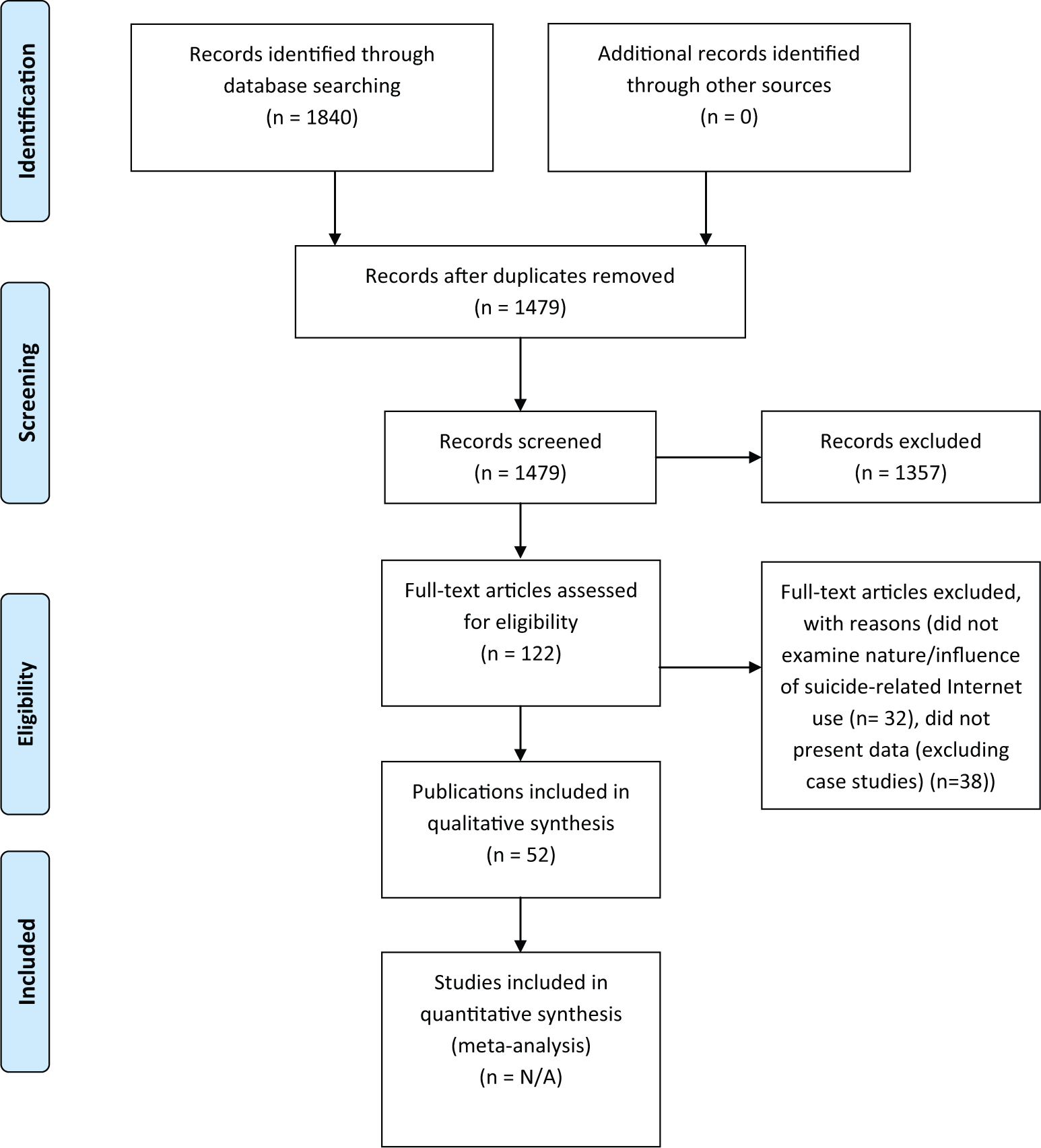
PRISMA diagram of the searching and screening process.
Results
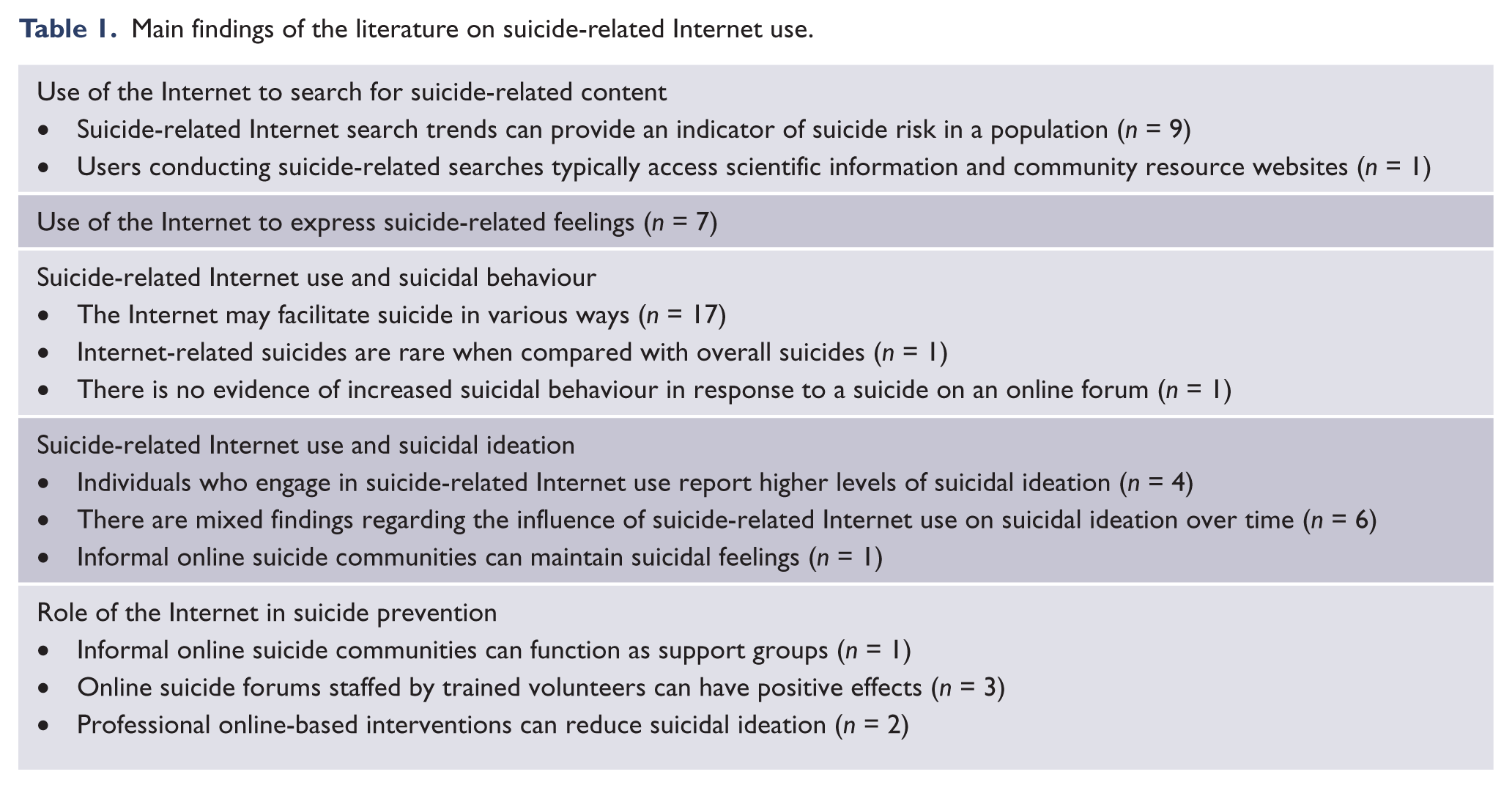
The main findings and conclusions of the literature are summarised in Table 1, with the number of papers supporting each conclusion in parentheses.
Main findings of the literature on suicide-related Internet use.
Use of the Internet to search for suicide-related content
Suicide-related Internet search trends can provide an indicator of suicide risk in a population
Findings of significant associations between trends for suicide-related search terms and rates of suicide, as well as observed increases in certain search terms following suicide-related media reports, suggest that search trends may be useful for monitoring suicide risk within a population.
Online searches conducted within the US for “commit suicide”, “suicide prevention” and “how to suicide” were significantly positively related to rates of suicide in the corresponding year (Chen, 2013; Gunn and Lester, 2013). In Japan, monthly search trends for “hydrogen sulfide”, “hydrogen sulfide suicide” and “suicide hydrogen sulfide” were significantly positively associated with monthly rates of suicide for people in their 20s and 30s, while searches for “BBS (bulletin board system) for suicide” and “suicide by jumping” were significantly associated with rates of suicide for people in their 30s, but not their 20s (Hagihara et al., 2012).
Other studies have shown that the relationship between suicide-related searches and rates of suicide can vary not only across age, but also culture and sex. In the US, searches for “suicide” were significantly negatively related to general population suicide rates, but significantly positively related to rates of suicide in youths. By contrast, searches for “depression” and “teen suicide” were not significant in either age group (McCarthy, 2010). Conversely, significant positive links were found between suicide death rate and searches for “depression” while searches for “suicide” and “suicide method” were not significant in both Japan (Sueki, 2011) and England and Wales (Bruckner et al., 2014).
Yang et al. (2011) assessed search terms representing various domains of suicide risk, including psychiatric, medical, and familial. The study, conducted in Taipei City, found that searches for “major depression” and “divorce” together accounted for 30.2% of the variance in population suicide rates. However, while “major depression” and “divorce” were only associated with adult and male suicides, searches for “anxiety” were only associated with female suicides.
Search trends can also provide a potential indicator of suicide contagion. In February 2008 in Japan, and September 2010 in the UK, news outlets reported on several cases of hydrogen sulfide-related suicides. While search trends for the term “suicide” remained stable before and after the news reports, searches for “hydrogen sulfide” increased up to 50 times in April 2008 in Japan and over nine times in the UK in the same week as the initial reports (Chang et al., 2011). Online searches for “how to commit suicide”, “ways to kill yourself”, “suicide pact” and “suicide hanging” have also been found to increase following high-profile reports of suicide in Australia (Page et al., 2011). However, there are limitations of search trend studies. Such studies cannot establish a causal link between online searches and suicide deaths. While they may be useful in monitoring population suicide risk at a particular time, the statistical relationship between suicide-related search trends and rates of suicide can be affected by the increasing rates of Internet use around the world. Additionally, although studies have found significant relationships between various search trends and rates of suicide, the reasons for these findings are unclear. Search trends alone provide insufficient information to determine the characteristics of the user and their motivations for conducting suicide-related Internet searches.
Users conducting suicide-related searches typically access scientific information and community resource websites
Wong et al. (2013) obtained information from an AOL data set and examined users’ browsing behaviours after searching for suicide-related terms. Between March and May 2006, there were a total of 5526 suicide-related queries. Excluding entertainment-related searches (e.g. suicide girls), the most frequent searches were for the terms “suicide” (9.79%), followed by “how to commit suicide” (2.17%). Users searching for “suicide” were more likely to access scientific information and community resource websites, while those who searched for “how to commit suicide” were more likely to access websites on specific means. Though examination of browsing behaviours can provide some indication of the motivations behind conducting searches for particular suicide-related terms, Wong et al.’s (2013) study had similar limitations to other studies of online search trends. That is, it was unclear whether individuals conducting searches were attempting to seek help for themselves, seek help for others, looking to attempt suicide, or simply had general interest or curiosity.
Use of the Internet to express suicide-related feelings
People experiencing suicidal thoughts use the Internet to post a variety of comments on their suicide-related feelings, providing significant insight into the lives and experiences of these individuals. All studies that have examined how individuals use the Internet to express their suicide-related feelings have used data from comments posted publicly on the Internet, finding that people who are suicidal use both suicide-specific and non-suicide-specific websites to express themselves. On Myspace, 64 adolescents who posted suicidal statements referred to relationship issues (42.2%), with a minority referencing mental health problems and substance use (6.3%) (Cash et al., 2013). Comments posted in response to a two-part radio program broadcast by the ABC in Australia titled ‘Thinking about suicide’ discussed triggers of suicidal feelings, experiences with having suicidal feelings, experiences with treatment, as well as the importance of accepting people who are suicidal (Dodemaide and Crisp, 2013). Horne and Wiggins (2009) found that through online self-expression, suicide forums were used to construct the identities of users as authentically suicidal and to receive validation of this identity from other forum members.
Ikunaga et al. (2013) conducted a content analysis of posts on a Japanese suicide forum in order to explore the phenomenon of group suicide or online suicide pacts in Japan. They argued that the frequency of themes relating to interpersonal connection reflected Japanese cultural values emphasising group experience and belongingness, which could account for the popularity of online suicide pacts in Japan.
Online posts can also provide information about the suicidal process itself. Analyses of the blog entries of a Chinese adolescent who had died by suicide revealed that more positive emotion words were used when posts were less frequent, while more negative emotion words were used when posts were more frequent (Li et al., 2014).
Other studies of the online writing characteristics of people who are suicidal show that there are significant differences when compared with distressed and non-distressed people who do not feel suicidal. For example, posts of people who are suicidal are shorter in length, have more polarised expressions (e.g. ‘always’, ‘never’), have a higher use of negatives (e.g. ‘no’, ‘never’, ‘nothing’) (Fekete, 2002), include more global and stable causal attributions to negative life events, and show more unbearable psychological pain and negative constriction (i.e. rigid thinking) (Barak and Miron, 2005).
Suicide-related Internet use and suicidal behaviour
The Internet may facilitate suicide in various ways
A number of case studies demonstrate the ways in which the Internet might facilitate or encourage suicidal behaviour. Baume et al. (1997, 1998) presented three cases of individuals who had attempted or died by suicide after posting suicide notes to a suicide newsgroup. The notes themselves included statements of the intention to die and sought others’ advice on effective methods. Responses included both discouragement and discussions over the advantages or disadvantages of specific methods. They were, however, unable to show whether these online interactions actually influenced the suicide attempts.
Other cases in the literature describe individuals who have attempted or died by suicide after using the Internet to obtain information on suicide methods (Alao et al., 1999; Cantrell and Minns, 2011; Corkery et al., 2010; Gallagher et al., 2003; Gosselink et al., 2012; Haut and Morrison, 1998; Musshoff et al., 2010; Prior, 2004; Schneider et al., 2010), to obtain methods themselves (Becker et al., 2004), to form online suicide pacts (Birbal et al., 2009; Laberke et al., 2011; Mehlum, 2000) and to broadcast their suicide (Birbal et al., 2009). In their examination of group suicide in Japan, Naito (2007) discussed four cases of online suicide pacts. In one case, the strangers had met through a website for suicide prevention.
In interviews with 22 participants who had previously made near-fatal suicide attempts, 13 were found to have used the Internet as a source of information on suicide, with the Internet having shaped the attempts of eight participants. These individuals predominantly accessed professional information resources, general knowledge sites and news websites, rather than suicide-specific websites (Biddle et al., 2012).
Internet-related suicides are rare when compared with overall suicides
Although the Internet can indeed be used to facilitate suicide, Gunnell et al. (2012) found that Internet-related suicides were rare when compared with overall suicides. Using information obtained from coroners’ reports of 593 completed suicides in England in 2005, only nine were identified as having moderate or strong links to the Internet. These suicides involved searching online for particular methods, accessing websites containing information on methods and visiting euthanasia websites. None of the suicides were found to be the result of online pacts. However, the number of Internet-related suicides could have been underestimated if coroners did not or could not include it in their reports.
There is no evidence of increased suicidal behaviour in response to a suicide on an online forum
In light of concerns over the ease of locating and communicating with people who are suicidal online, Hsiung (2007) investigated the potential of an online suicide contagion effect by analysing comments posted in reaction to the suicide of a prominent member on a mental health forum. He found no evidence of increases in self-harm or suicidal behaviour. Rather, individuals showed grief, anger, and sadness in response, and used the event to reflect on their own suicidality.
Suicide-related Internet use and suicidal ideation
Individuals who engage in suicide-related Internet use report higher levels of suicidal ideation
Those who use the Internet for suicide-related reasons have been found to be more likely to report higher levels of suicidal ideation than those who do not. Sueki (2013) surveyed participants recruited from a Japanese Internet survey company about suicidal ideation and their suicide-related Internet behaviours (consulting about mental health, sharing suicidal ideation, searching suicide methods and viewing suicide methods). Internet behaviours were rated on a scale of frequency from 1 (not at all) to 6 (every day), while suicidal ideation was measured using the Beck Scale for Suicidal Ideation. Participants were surveyed at baseline and again 3 months later. Though the design of the study was longitudinal, suicide-related Internet behaviours did not predict suicidal ideation at follow up. The model assessing the relationship between online suicide-related behaviours at baseline and suicidal ideation 3 months later was found not to have an adequate goodness of fit. Rather, participants who reported consulting about mental health, searching suicide methods, and viewing suicide methods at follow up were also more likely to report higher levels of suicidal ideation at follow up.
Cross-sectional surveys in Japan have also shown that accessing suicide websites or searching online for information about suicide or self-injury are associated with higher levels of suicidal ideation (Aiba et al., 2011; Katsumata et al., 2008), but do not establish a causal link. These studies were conducted among community samples and included both suicidal and non-suicidal participants. Harris et al. (2009) instead restricted their sample to people identified as at risk for suicide (using the Suicide Behaviors Questionnaire–Revised) and compared those who reported going online for suicide-related reasons and those who did not. Suicide-related users reported significantly higher severity of depressive symptoms, higher risk for suicide, lower perceived social support, higher likelihood of not seeking help for suicide from anyone, and a lower likelihood of seeking help for suicide from friends.
There are mixed findings regarding the influence of suicide-related Internet use on suicidal ideation over time
Dunlop et al. (2011) examined young people’s exposures to stories of suicide from various online sources and their levels of suicidal ideation 12 months later. Suicidal ideation was assessed by participants’ ratings of how often they had felt suicidal within the past 12 months. Of all online sources, only forums were found to significantly predict increases in suicidal ideation at follow up. The researchers argued that online forums can negatively influence people with thoughts of suicide because they allow free discussion of suicide-related issues or mental health problems. However, it was not possible to conclude from their data how the forums were used, the types of forums used or the nature of suicide story exposure.
Cross-sectional studies have used participants’ retrospective ratings of suicidal thoughts to investigate the influence of their Internet use. Two papers, using the same data set, reported significant decreases among users of a German suicide forum in retrospective ratings of suicidal thoughts on a scale from 0 (absolutely no suicidal thoughts) to 6 (very strong suicidal thoughts) from before first using the forum to the time of the survey (Eichenberg, 2008; Kral, 2006). Significant decreases were also found in those with destructive motivations (e.g. searching for information on suicide methods) for using Japanese and German suicide forums (Sueki and Eichenberg, 2012). Generalisability of these findings is, however, limited, given that they sample from single suicide forums rather than a wide variety of websites. Additionally, as recruitment notices are posted on the forums themselves, those who use the forum more frequently or who have more positive experiences with the forum can be more likely to respond.
Harris et al. (2009) adopted a wider recruitment strategy, obtaining participants through email, blogs, newsgroups, search results, universities and Google advertisements. When participants were asked whether they felt more or less suicidal after going online for suicide-related reasons, 69.7% of suicide-related Internet users reported that they felt less suicidal.
Conversely, Sueki et al. (2014) found that disclosing suicidal feelings to anonymous others over the Internet and browsing online for information about suicide methods significantly predicted increases in suicidal ideation 7 weeks later. Participants were recruited from a Japanese Internet survey company and administered various measures, including the Beck Scale for Suicidal Ideation, to assess outcome.
Informal online suicide communities can maintain suicidal feelings
While informal online suicide communities (i.e. not moderated by professionals) can be used in a positive manner, they can also maintain suicidal feelings rather than lead to recovery. Miller and Gergen (1998) examined posts on a suicide forum and found that the forum validated the experiences of members, and offered sympathy, acceptance, and encouragement to continue living. Through additional interviews with forum members, they concluded that while there were subtle, yet valuable, effects of the suicide forum, the forum nevertheless maintained, rather than transformed, users’ suicidality.
Role of the Internet in suicide prevention
Informal online suicide communities can function as support groups
Email interviews with users of suicide and self-harm websites revealed that the most common themes in participants’ discussions of their website use were the empathic understanding offered by other members, use of the websites to cope, and the sense of community offered to participants (Baker and Fortune, 2008).
Online suicide forums staffed by trained volunteers can have positive effects
Based on analyses of messages posted to an online suicide forum staffed by trained volunteers, Greidanus and Everall (2010) found that members used the forum to both seek and provide help. Gilat et al. (2012) assessed posts in an online support group and compared the number of response strategies used between trained volunteers and laypeople. The trained volunteers used significantly more strategies in their responses, particularly emotional support, empowerment, interpretation, and cognitive change inducement. On the other hand, laypeople offered significantly more self-disclosure.
Additionally, more frequent activity in online forums staffed by trained volunteers and professionals may help in alleviating distress. Barak and Dolev-Cohen (2006) qualitatively measured levels of distress (via thematic coding) in messages posted over the course of 3 months. They compared the level of distress in messages between each of the 3 months and correlated the number of messages with level of distress. Although there was no significant difference in level of distress between each month, there was a significant negative relationship between the number of messages posted in the first month with level of distress in the third month. As posting frequency increased, levels of distress decreased.
Professional online-based interventions can reduce suicidal ideation
Two papers were identified that evaluated online-based interventions specifically targeted towards reducing suicidal thoughts. Both included a series of modules based on cognitive behavioural therapy (CBT) principles to be completed by participants each week. The Reframe-IT intervention was conducted among Australian secondary students aged 14–18 years (Robinson et al., 2014). The intervention website also included an online adult character who verbally delivered therapy, video diaries of young people, a message board, factsheets, downloadable MP3s, and a list of helplines. Participants completed modules on school premises in the presence of a member of the research team. The Suicidal Ideation Questionnaire was used as the primary outcome measure and administered to participants at pre-test and at post-test 8 weeks later. Participants reported a significant decrease in suicidal ideation with a moderate effect size (d = 0.66). However, the sample size in this study was small (n = 21) and there was no control group.
The second study involved Dutch adults aged 18 years and over recruited via the Internet (van Spijker et al., 2014). In order to ensure the safety of participants, the researchers monitored participants’ levels of suicidal ideation and depression during the intervention and contacted those with particularly high scores. Thus, as participants were required to disclose their identity, the study was not anonymous, which could account for the 32.9% of eligible participants who declined to participate. Participants were randomised into an intervention group (n = 116) and a waitlist control group (n = 120). Both groups reported decreases in suicidal ideation at the end of the intervention period (6 weeks) compared with baseline scores. However, the intervention group reported significantly greater decreases in suicidal ideation than the control group, with a small effect size (d = 0.28) (van Spijker et al., 2014).
Discussion
The present review aimed to provide an in-depth overview of the existing literature on suicide-related Internet use. In their review, Daine et al. (2013) found that there were both positive and negative influences of the Internet in general. Similarly, this review revealed positive and negative influences of suicide-related Internet use. Furthermore, it showed the ways in which people use the Internet for suicide-related reasons, the potential of the Internet in suicide prevention, as well as limitations and under-researched areas of previous work.
Individuals use the Internet for suicide-related reasons in a number of ways, including searching for information about suicide and going online to discuss or express their suicidal feelings. Research investigating online suicide-related behaviours can offer valuable information while also being conducted using non-invasive methods and easily obtainable data (e.g. search trends and publicly available posts). Although search engine studies have not shown whether conducting suicide-related Internet searches leads to suicide attempts, studying search trends and comparing them with other readily available suicide data can potentially provide an indicator of the risk for suicide in the population at a particular time. Insight into the suicidal process, the suicidal experience and suicide phenomena, such as online pacts, can also be obtained through assessing the online posts of people expressing suicidal feelings. Nevertheless, there are also several limitations of this research. As they do not involve participants, they are unable to examine passive forms of suicide-related Internet use or collect information (e.g. characteristics of users, motivations for use, etc.) that would be useful in interpreting their findings.
Evidence of the Internet’s influence on suicidal behaviours is predominantly composed of case studies. They illustrate occasions where individuals have either attempted or died by suicide after using the Internet to obtain information on suicide methods, obtain suicide methods themselves, or to form online pacts with strangers. While the findings are concerning, they neglect those who engage in suicide-related Internet use but do not subsequently attempt suicide.
Using larger samples and surveys with Internet users, cross-sectional studies have investigated the link between suicide-related Internet use and suicidal ideation. People who engage in suicide-related Internet use tend to report decreases in suicidal thoughts at the time surveyed compared to before first going online for suicide-related reasons. Thus, although those who use the Internet for suicide-related reasons may be more likely to report higher levels of suicidal ideation than those who do not, it is not necessarily the result of their Internet use. A number of these studies, however, are limited in their recruitment method. As they tend to solely recruit users from suicide forums, their findings do not generalise to those who engage in other forms of suicide-related Internet use. Furthermore, they prevent comparisons between different types of websites. For example, it is unknown whether pro-suicide websites can increase the risk for suicide and whether suicide prevention websites can decrease risk, or whether experiences may differ between those who use interactive compared to non-interactive forms of suicide-related Internet use. In some studies, it was not specified whether the websites used were pro-suicide sites, suicide prevention/support sites or both (Eichenberg, 2008; Harris et al., 2009; Sueki and Eichenberg, 2012). Additionally, there is also potential recall bias associated with using retrospective ratings to assess the effects of suicide-related Internet use. One longitudinal study using established measures conversely found that suicide-related Internet use significantly predicted increases in suicidal ideation at follow up (Sueki et al., 2014). The reasons for this inconsistency are unclear due to a number of differences in methodology.
Although it would be beneficial to conduct more longitudinal studies with large, widely recruited samples and use psychometrically validated tests to measure outcome, such studies are difficult to conduct in practice due to potential threats to the privacy and anonymity of users, as well as research-related ethical concerns. This is reflected in the lack of work directly surveying Internet users. Consequently, little is known about the characteristics of users, despite findings that those who engage in suicide-related Internet use are at significantly higher risk for suicide, report significantly higher severity of depressive symptoms and perceive significantly lower social support.
Overall, the literature indicates that informal online suicide communities do not necessarily pose a risk to participants, and can offer valuable support by providing users with a place to share problems and feel accepted and understood. They are, however, unable to replace professional services in terms of promoting recovery among people who are suicidal. There is evidence suggesting that online communities staffed by trained volunteers can have a useful role in suicide prevention and that online-based interventions can reduce suicidal ideation. However, more research is needed to examine and demonstrate the efficacy of such services.
Although the present review intended to provide a summary of the existing work on suicide-related Internet use, some relevant papers may not have been included due to limitations in the search strategy. Papers were only identified through database searches and were excluded if they were not in English. Nevertheless, this review has presented a number of major findings of past research, as well as highlighted important issues to be addressed by future work.
Technology is continually advancing, facilitating the ways in which people obtain and disseminate information and communicate with others. Websites such as Twitter and Tumblr provide an abundance of valuable information about people that is easily accessible to researchers. However, other websites or online activities such as chat rooms, virtual worlds (e.g. Second Life), password-protected social networking profiles and online smartphone apps can be harder to access. In order to investigate diverse forms of suicide-related Internet use, both examinations of publicly available data and surveys with Internet users are necessary. User surveys can not only provide information about the characteristics of users and their experiences with different types of suicide-related Internet use, but they may also inform researchers of how newer online technologies are being used in suicide-related ways.
Conclusion
The present review has provided a summary of the existing work investigating the nature of suicide-related Internet use and its influence on users by describing its main conclusions and findings. In some cases, conclusions were only supported by one study, demonstrating the lack of research in the area of suicide and the Internet. While studies using publicly available data are able to provide important information, direct contact with diverse samples of Internet users is also needed in order to fully understand how various forms of suicide-related Internet use can impact individuals. More research needs to be conducted, addressing the limitations of previous studies, as well as evaluating the efficacy of existing online professional services.
The Internet can be a powerful resource for professionals. In order to truly integrate the Internet into suicide prevention and intervention, it is necessary to understand the role that the Internet currently plays in the lives of people experiencing suicidal feelings, the type of people who are likely to engage in suicide-related Internet use and for what reasons, and how or if different online suicide resources can impact the risk for suicide.
Footnotes
Funding
This research received no specific grant from any funding agency in the public, commercial, or not-for-profit sectors.
Declaration of interest
The authors report no conflicts of interest. The authors alone are responsible for the content and writing of the paper.