




Abstract

To the Editor,
We read with interest the report by Cuykx et al. discussing possible causes affecting variability of total carbon dioxide (tCO2) measurements in serum. 1 We were particularly intrigued by the fact that, in the authors’ experiments, the systematic closure of analyser lids appeared to reduce measurement variance. Therefore, we would like to provide our experience about the estimate of random sources of measurement uncertainty (uRw) of tCO2 in serum performed on different generations of chemistry analysers equipped with different options of closing lids.
In the recent years, our total laboratory automation system was first equipped by two Architect c16000 platforms (in which in daily practice reagent chamber lids were often not closed) and then replaced with two Alinity c analysers and lately by two platforms of the new generation of Alinity cic series, in which the lids close automatically (all instruments by Abbott Diagnostics, IL, US). For the three generations of analysers, Abbott provided the same enzymatic method (phosphoenolpyruvate carboxylase-based) and a dedicated calibrator (ref. 08P72/1E64) with values traceable to NIST SRM 351. As per laboratory accreditation duties, we routinely investigated uRw by daily measurements of a third-party liquid frozen commutable internal quality control (IQC) material (Liquichek Chemistry Control Level 2, Bio-Rad Laboratories, CA, US) randomly analysed during ordinary laboratory activities. 2 This material was previously tested for stability of tCO2 measurements to exclude the influence of unknown components potentially deteriorating it (data not shown). According to the ISO/TS 20914:2019, uRw should be estimated from six consecutive months IQC daily data to capture systematic sources of uncertainty, such as those caused by different lots of reagents, different calibrations, different environmental conditions, etc. 3 Steps to obtain the estimate of uRw have been previously described in detail. 4
Standard measurement uncertainty from random sources (uRw) for tCO2 in serum measured using Abbott diagnostics chemistry platforms available in the authors’ laboratory at different times.
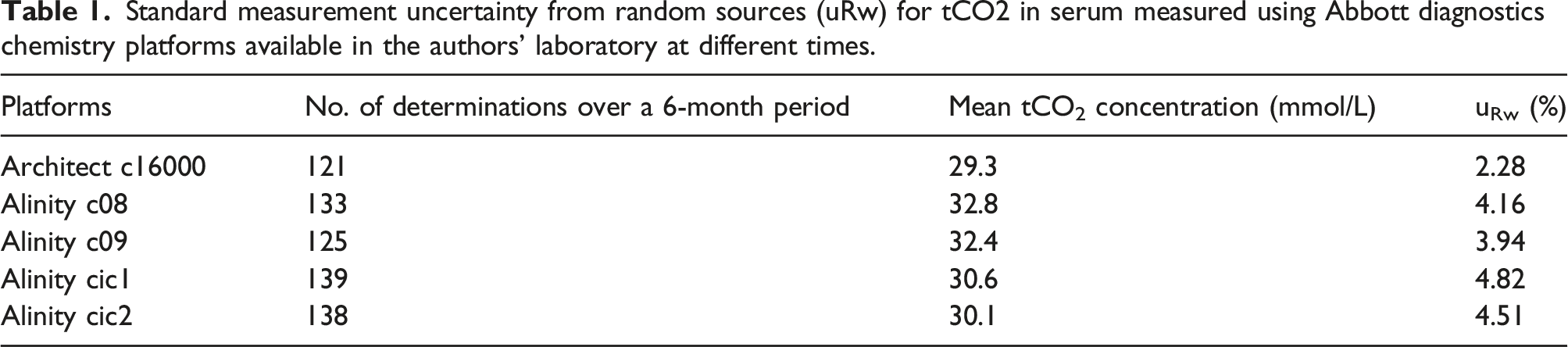
Our results show that the main contributor of tCO2 measurement variability is the reproducibility of the employed measurement system. Particularly, we highlighted the worsening of the analytical performance between successive generations of Abbott platforms. We already recommended that manufacturers, before releasing any kind of technological upgrade, should pay major attention to assuring an equivalent, if not better, analytical quality of provided measurements. 6 We therefore expect that the involved manufacturer should direct its efforts on improving performance of tCO2 measurements in terms of random variability to permit to fulfil suitable MAU.
Footnotes
Declaration of conflicting interests
The author(s) declared no potential conflicts of interest with respect to the research, authorship, and/or publication of this article.
Funding
The author(s) received no financial support for the research, authorship, and/or publication of this article.
Ethical approval
Not applicable.
Guarantor
MP.
Contributorship
FB coordinated the study and wrote the first draft of the article. AC and LR collected data. MP supervised the study and reviewed the article. All authors approved the final version of the article.
