




Abstract

Dear Editor,
We read with interest the editorial “Recent developments in the measurement and application of small dense LDL-cholesterol” published on 21 February 2022 in this journal. 1 In the editorial, Kotani suggested that the newly derived formula for calculation of small dense LDL-cholesterol will be useful in routine clinical practice. We agree. Here we describe our own observations regarding the association between small dense LDL-cholesterol and atherogenic index of plasma (AIP), which independently validate its utility in assessing cardiovascular risk in patients with diabetes mellitus.
The ability of AIP to predict the development of coronary artery disease has been validated. 2 The advantage of AIP lies in the fact that it uses only parameters that are commonly available in the standard lipid panel. The problem to date has been that although small dense LDL is the most atherogenic lipid parameter, 3 a gold standard method for its estimation has not been established, and existing methods have their challenges in clinical use. The formula recently derived by Sampson et al. for calculation of small dense LDL-cholesterol using results of standard lipid panel as its determinants 4 presents a potential solution to this problem. This formula also uses their previously validated formula for the calculation of LDL-C. 5
In the current report, we examined the relation between AIP and small dense LDL-C as estimated by the newly derived formula in patients with type 2 diabetes (T2DM). We collected serum from 410 patients attending our outpatient department and measured lipids and glycated haemoglobin. Lipid parameters, including triglycerides (TG), total and high-density lipoprotein cholesterol (TC and HDL-C) and LDL-C (by direct assay), were measured on a Beckmann AU 680 clinical chemistry analyser. We used American Diabetes Association (ADA) diagnostic criteria based on glycated haemoglobin to classify patients as healthy (n = 65), prediabetic (n = 113) and diabetic (n = 232). We calculated small dense LDL using the formula derived by Sampson.4,5
As anticipated, triglyceride (P = 0.0001) and calculated small dense LDL (P = 0.0110) increased across the three groups, with T2DM patients having the highest levels. We likewise observed an increasing trend (P = 0.0001) in AIP across the three groups, with T2DM patients having the highest levels. We performed a group-wise correlational analysis using the Spearman method in order to explore the relationship between AIP and calculated small dense LDL. We observed a significant positive correlation (P ≤ 0.0001) between the two in all three groups (Figure 1). Our findings confirm that the newly derived formula for calculating small dense LDL can be used to assess atherogenic potential in T2DM. Scatter plots depicting the correlation between calculated small dense LDL using Sampson’s formula and atherogenic index of plasma.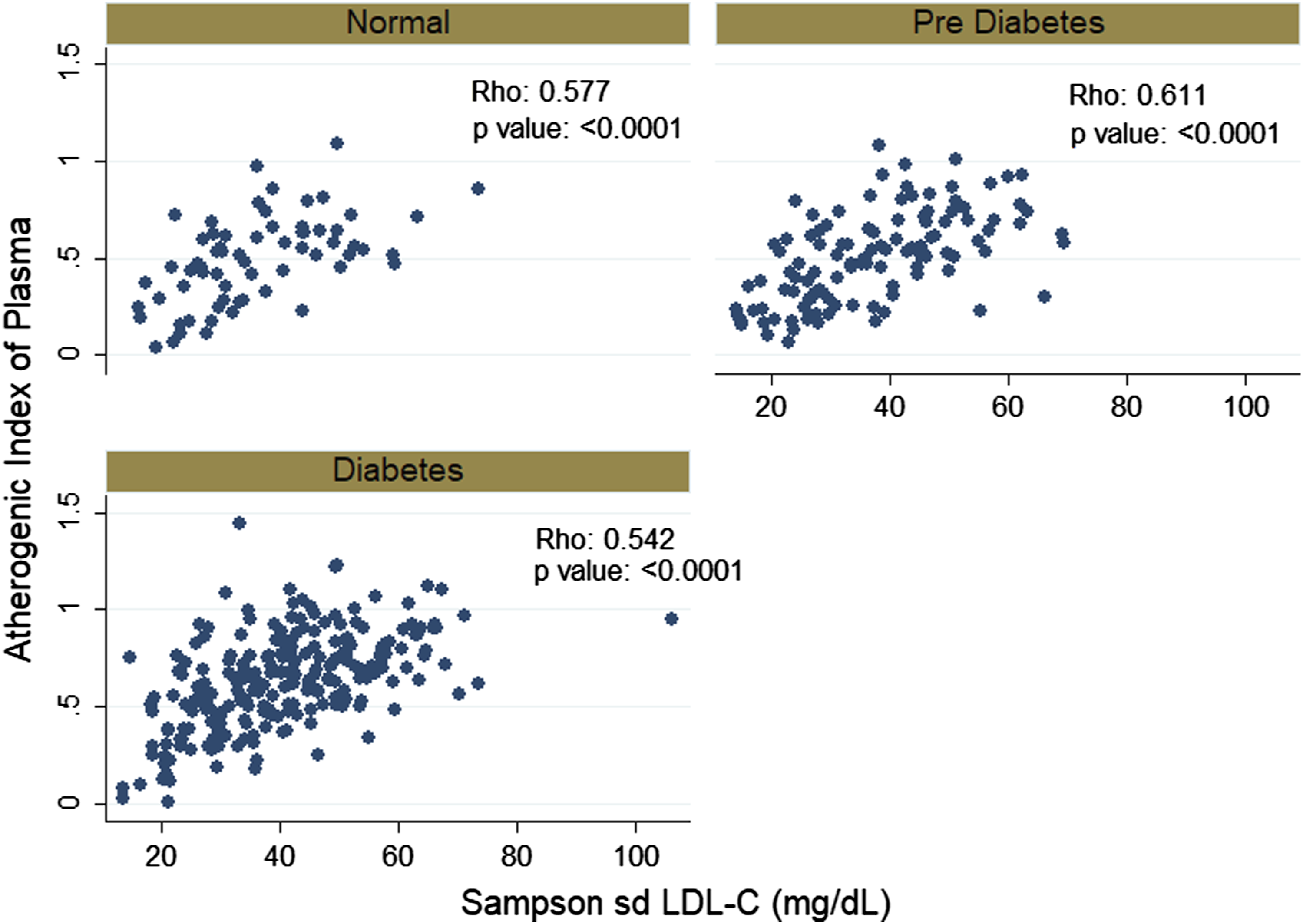
Footnotes
Declaration of conflicting interests
The author(s) declared no potential conflicts of interest with respect to the research, authorship, and/or publication of this article.
Funding
The author(s) received no financial support for the research, authorship, and/or publication of this article.
Ethical approval
The ethics committee of All India Institute of Medical Sciences (AIIMS), Jodhpur, approved this study (AIIMS/IEC/2020-21/2060).
Guarantor
SS.
Contributorship
ST and SS researched literature and conceived the study. SS was involved in protocol development, gaining ethical approval, patient recruitment and data analysis. ST wrote the first draft of the manuscript. SS, RS and PS reviewed and edited the manuscript. All authors approved the final version of the manuscript.
