




Abstract
Background
The Spearman rank correlation test under classical statistics cannot be applied when the paired data is in interval or indeterminacy is presented in the paired data.
Methods
In this paper, the Spearman rank correlation test under neutrosophic statistics will be introduced. The proposed Spearman rank correlation test will be a generalization of the existing Spearman rank correlation test.
Results
The proposed test is supposed to be more informative, flexible, and adequate to apply for the analysis of the measurement data. The application of the proposed test is given using the measurement of luteotropichormone data obtained from the clinical laboratory. Based on the information, the probability of accepting the null hypothesis
Conclusions
From the analysis, it is noted that the proposed test is more efficient in terms of the measure of indeterminacy as compared with the existing test. From the study, it is concluded that the proposed test is more informative, applicable and useable under an indeterminate environment as compared with the existing test under classical statistics. Therefore, it is recommended to apply the proposed test in clinical laboratories for testing the correlation between instruments.
Keywords
Introduction
Data that are obtained from the same subjects on two different occasions, instruments and methods are known as the paired data. The t-test is applied for testing the significance of the difference in mean of the methods applied to the paired data.1–3 The paired t-test is applied under the assumption that the data should be indeterminate and normally distributed. Westgard and Hunt 4 and Ceriotti et al. 5 worked on the applications of paired t-test. The Spearman rank correlation test is also applied to the paired data to test the correlation between two series of data (paired data). The Spearman rank correlation test is applied to test the null hypothesis that the data in two series are independent vs. the alternative hypothesis that the data in two series are correlated. For example, the Spearman rank correlation test can be applied in the clinical laboratory where the measurement data are obtained from the different instruments. Some authors4–9 have discussed the applications of statistical tests in a variety of fields.
Traditional Spearman rank correlation tests under classical statistics are applied when the paired data have the exact, certain and précised observations. As suggested by Viertl, 10 ‘statistical data are frequently not precise numbers but more or less non-precise, also called fuzzy. Measurements of continuous variables are always fuzzy to a certain degree’. When the measurement data are imprecise or obtained from a complex process, the traditional Spearman rank correlation test cannot be applied or may mislead the decision-makers if applied. In this situation, the statistical tests under fuzzy logic or interval-based approach can be applied. Some authors11–18 have proposed various statistical tests using fuzzy logic.
Smarandache 19 introduced the neutrosophic logic which is more efficient than the fuzzy logic and interval-based approach. 20 The neutrosophic logic is more informative than fuzzy logic and interval-based analysis. The application of neutrosophic logic attracts research due to many applications.21–25 Smarandache 26 introduced the neutrosophic statistics using neutrosophic logic. A branch of mathematical sciences that deal with the presentation, analysis and interpretation of data under indeterminacy is called neutrosophic statistics. The neutrosophic statistics that deals with the imprecise and indeterminate data is efficient than classical statistics.27–29 Aslam and Albassam 30 and Aslam 31 introduced statistical tests under neutrosophic statistics and proved the efficiency of the existing tests.
The existing Spearman rank correlation test cannot be applied for testing the correlation between the paired data having indeterminate observations. By exploring the literature and best of our knowledge, no work on the Spearman rank correlation test under the neutrosophic test is available in the literature. In this paper, we will introduce the Spearman rank correlation test under neutrosophic statistics for the first time. Two methods of the proposed test are introduced and compared with each other and the existing test. The application of the proposed test will be given using the measurement data obtained from the clinical laboratory. It is expected that the proposed test will efficient in information than the existing test.
Design of the proposed test
The existing Spearman rank correlation test for the paired data under classical statistics can be applied only when the observations in the paired data are determined, exact and certain. As mentioned earlier, the existing test cannot be applied when the pair data is in neutrosophic number. The application of the existing test when the pair data is in-interval may mislead the decision-makers. In this section, the design of the proposed Spearman rank correlation test under neutrosophic statistics will be presented. The purpose of the proposed test is to investigate the relationship between paired data having neutrosophic numbers. The proposed test is applicable under the assumption that the paired data are continuous and have inexact, uncertain and interval observations. The proposed test can be implemented in two ways are discussed in the subsequent sections.
Method 1
Suppose that


Note that
The test statistic

The neutrosophic form of statistic

Note that
Method 2
Suppose that


Note that
The test statistic

The proposed test will be implemented as follows
Application of the proposed tests
The applications of the proposed tests are given using the internal quality control (IQC) of luteotropichormone clinical laboratory data measured by the same operator. According to https://www.britannica.com/science/prolactin ‘Prolactin, also called luteotropichormone (LH) or luteotropin, a protein hormone produced by the pituitary gland of mammals that acts with other hormones to initiate secretion of milk by the mammary glands’. According to Feng et al. 2
The results of IQC about luteotropichormone (LH) were collected from July 1, 2015, to July 31, 2015, in the Clinical Laboratory Center of Tumor Hospital Affiliated to Xinjiang Medicine University. LH in the laboratory was tested on two same-type of instruments (Roche Cobas e602 electrochemistry luminescence immunity analyzer, Switzerland), and the IQC of LH on the two instruments was measured by the same operator. The IQC substance was divided into two duplicates which were tested on the two instruments respectively every time. The IQC substance was LiquichekTM Immunoassay Premium Quality Control product of Bio-Rad Laboratories, Inc. (USA), and the lot numbers of IQC substance were 40,303 (high level) and 40,302 (middle level), respectively.
The company is interested to check either the imprecise measurements obtained by two different instruments are correlated or not. The IQC data obtained by instrument 1 (middle level) in mIU/mL, instrument 1 (high level) in mIU/mL, instrument 2 (middle level) in mIU/mL, instrument 2 (high level) in mIU/mL are shown in Table 1. From Table 1, it is quite clear that the data obtained by two instruments are in intervals and the existing test under classical statistics cannot be applied or may mislead if apply for the data in indeterminate intervals. The proposed test under neutrosophic statistic is an alternative to the existing test under classical statistics and even a test designed under fuzzy logic. The data are analysed by two methods in the subsequent sections.
The IQC of clinical laboratory data.
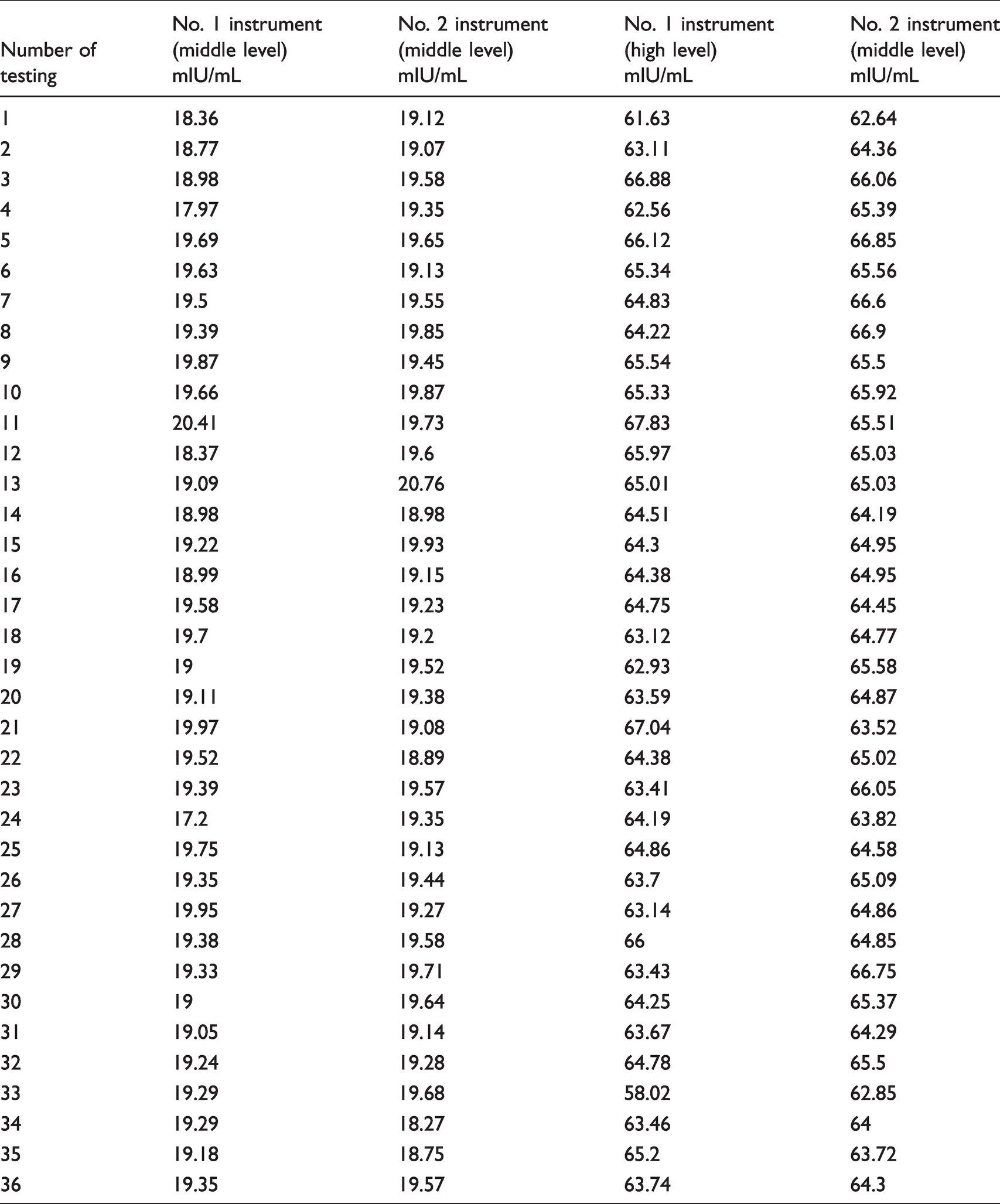
Analysis of measurement data using method 1
Let 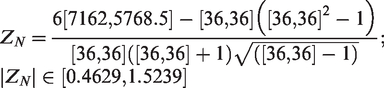

Note that
Analysis of measurement data using method 2
Suppose that 
Comparative study
Firstly, the two proposed methods will be compared and then the advantages of the proposed methods will be discussed over the existing test under classical statistics. From the proposed method 1, it can be seen that the proposed method accepted
Conclusions
Spearman rank correlation test under classical statistics has been widely applied for testing the correlation between two series or the paired set of data. In this paper, a generalization of the Spearman rank correlation test under neutrosophic statistics was presented. Two methods of the proposed test were given and discussed with the help of real laboratory measurement data. From the analysis, it is found that the proposed test provided the results in indeterminate intervals, while the existing test gives only the determined values of the test. In addition, the proposed test found to be more informative than the existing test. Based on the real example, it is suggested to apply the proposed test in the laboratories for testing the relationship between measurements obtained from different instruments. The proposed test under repetitive sampling can be considered as future research. The proposed test can be applied for big data as future research. The combination of Spearman and Pearson correlation coefficients under neutrosophic statistics can be considered as future research. 32
Footnotes
Acknowledgements
The author is deeply thankful to the editor and reviewers for their valuable suggestions to improve the quality of the paper.
Declaration of conflicting interests
The author(s) declared no potential conflicts of interest with respect to the research, authorship, and/or publication of this article.
Funding
The author(s) received no financial support for the research, authorship, and/or publication of this article.
Ethical approval
Not applicable.
Guarantor
Sole author.
Contributorship
MA wrote the paper.
