




Abstract
Many health issues that we currently face are related to our lifestyle choices. Educating patients can help them to make better informed health decisions. The internet and smartphones, mobile telephones that perform many of the functions of a computer, are becoming more accessible to the majority of the population. Applications on smartphones and professional health websites can signpost patients to trusted information and allow them to co-produce records. Empowering patients, staff and organizations through enabling access to records and understanding, building a partnership trust and the use of social media can enable people to do more and hopefully improve outcomes. In this article, I describe the steps we have taken to facilitate such interactions within our own primary care practice and the response of patients to these initiatives.
It is not the strongest of the species that survive, nor the most intelligent, but the one most responsive to change – Charles Darwin
Example of an Information Prescription.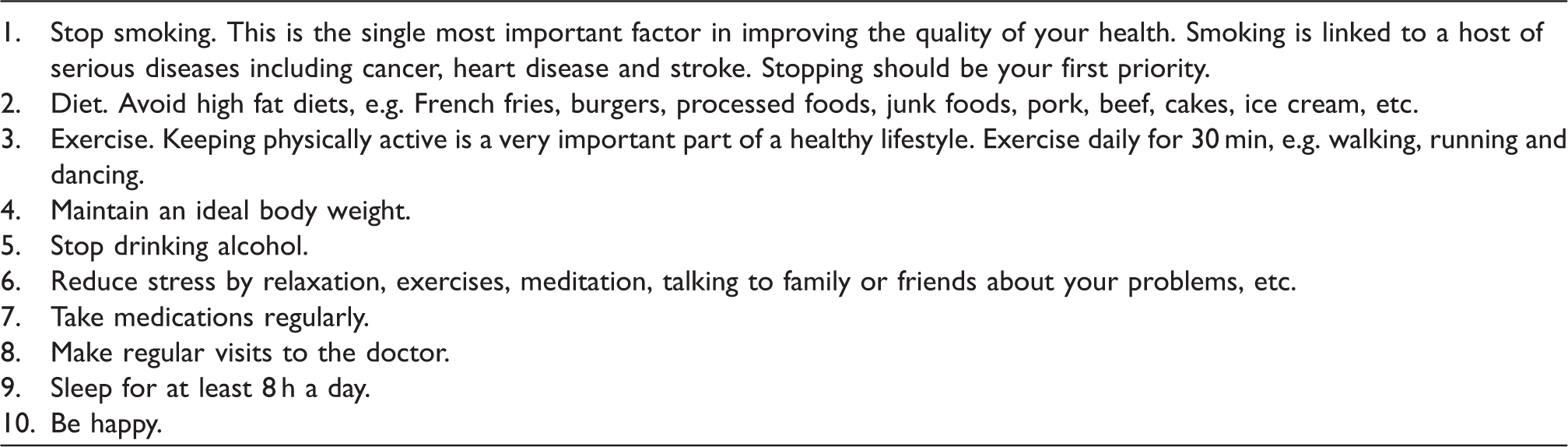
Patients may have very different responses to medical conditions. Let us consider a patient who starts with a cough. One patient tries to self-treat the cough, but after a day loses confidence in his ability to manage the problem. As soon as this happens, the patient attempts to get help as soon as possible, contacting the general practitioner (GP), attending the out of hours’ medical service or the accident and emergency (A&E) department. Another patient chooses to soldier on for months until he presents in extremis to see his GP or attends A&E. A third patient seeks help at a level somewhere between the first two. What is the explanation for the difference between the three patients? The difference between them lies in their level of education about their health and what choices they make. Education is the most powerful weapon which we can use to change the world – Nelson Mandela
Consumer experience in the United Kingdom.
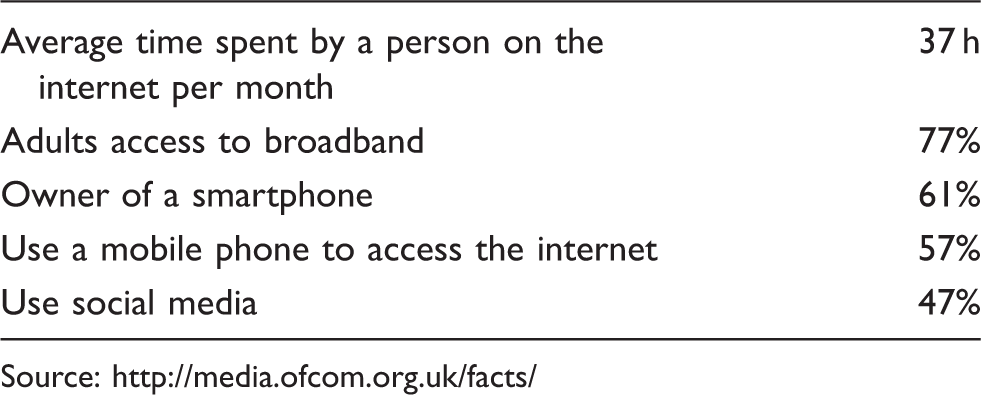
Source: http://media.ofcom.org.uk/facts/
At Haughton Thornley Medical Centres in Hyde, Manchester, UK, over the past 10 years, we have enabled patients to access their records and help understand them through a partnership of trust. The practice is in a semi-urban area including many socially deprived patients whose life expectancy is almost 10 years less than the national average. Clinicians and staff encourage patients and families to visit the practice-based web portal (www.htmc.co.uk) 1 to view their electronic health records. They are signposted to trusted information developed by patients and staff alongside local, regional and national information. We hope patients may then make better health choices. A test patient record may be viewed at http://tinyurl.com/q7x8uag. Practices using widely available GP electronic health record systems including EMIS Web or SystmOne can activate patient records for patients to view if the practice offers the service. We recommend an explicit consent process (http://www.htmc.co.uk/GetAccessNow). This requires the patient to complete a questionnaire to check their understanding of what access to records means and issues they need to consider. Currently, over 37% of our patients have access to their records, including 37% of Bengali patients, many of whom do not cite English as their first language, illustrating what can be achieved with the right level of support and by activating the family with appropriate consent (http://tinyurl.com/7renb99).
Many clinician–patient interactions involve laboratory testing. Patients are encouraged to view their test results online. We explain why we are doing the tests and note this in the patient’s medical records, so that they can refer back to this discussion later when they view the results. Patients can later go online to check whether their results are back and view them. A recent survey of 287 practice patients showed that 95% of them were reassured by seeing their test results, although 2% reported distress when encountering unexpected abnormal results. Most (66%) patients read the comment the doctor had attached to the test result and 66% shared their results with family and friends. We also signpost patients to Lab Tests Online (http://www.labtestsonline.org.uk) which provides up-to-date, peer-reviewed information relating to tests: 7% reported using this resource. Following the survey, we showed how patients can understand their results better and what support is available (see http://tinyurl.com/q8h5znp).
Applications (‘Apps’, small, specialized computer programs downloaded onto mobile devices) on smartphones could keep people safe by providing targeted information and storing personal care plans for emergency use. For example, the Haughton Thornley Depression Care and ‘Stay Alive’ app can be used as soon as patients feel the urge to self-harm (see http://tinyurl.com/pt9ve8d). In the future, we will enable patients to add to their electronic health record. The website ‘askmyGP’ enables a comprehensive branched logic questionnaire that patients are asked to complete (http://askmygp.uk). This converts into a detailed medical history, which the clinician can then see prior to contacting the patient. This could save time, improve continuity, safety and quality and be forwarded to other providers, including laboratories. As we look into the next century, leaders will be those who empower others – William Gates
Will it take a revolution for these changes to happen or do we wait for the evolutionary process of gradual change? Perhaps, #empowerlution is the way forwards – empowering patients, staff and organizations and the use of social media such as twitter, facebook and others? (N.B. the hashtag # indicates a term that can be searched for on twitter for all related tweets. See ‘What does social media offer the NHS’, http://tinyurl.com/qgpvgb4). Logic will get you from A to B. Imagination will take you everywhere – Albert Einstein
The patients in the practice who have become empowered through accessing their records, understanding them and then taking actions to help improve their outcomes are developing new thinking and ways of working. Health Pledge, an initiative of Thornley House Patient Participation Group, is a further example of a modern way of making a lifestyle change that could impact on our health (http://www.healthpledge.co.uk/pledge). Now mobile phones can help to inform, educate and empower us to deliver better outcomes for all!
Footnotes
Declaration of conflicting interests
The author is a board member of Tameside & Glossop Clinical Commissioning Group leading on Long Term Conditions, Information Management & Technology and Patient Engagement/Empowerment.
Funding
The author(s) received no financial support for the research, authorship, and/or publication of this article.
Ethical approval
Not applicable.
Guarantor
AH.
Contributorship
AH is sole author.