




Abstract

We read with interest the article by Cordova and Cordova describing a new formula to calculate low-density lipoprotein cholesterol (LDL-c). 1 Their aim was to overcome limitations reported for the Friedewald formula (FF), which is based on total cholesterol (TC), high-density lipoprotein cholesterol (HDL-c) and triglyceride (TG) concentrations. They used data obtained in 10,664 Brazilian individuals in which LDL-c was measured employing the Wako direct homogeneous method. They concluded that their ‘Brazilian formula’ (BF) LDL-c = 0.7516 x (TC – HDL-c) exhibited the highest accuracy of all formulae tested.
In our previous study, we compared four formulae with the LDL-c concentrations directly measured using the LDL-c plus assay developed by Kyowa Medex (Tokyo, Japan) in a Modular Analytics D/P/ISE (Roche Diagnostics GmbH, Mannheim, Germany). 2 We focused our analysis on the inability of these formulae to provide accurate LDL-c results in samples with extreme HDL-c concentrations. We have applied the BF to our data to check its performance in a different population and in comparison with another direct method.
Results for LDL-c mean values ± standard deviation, LDL-c mean differences in percentage, Passing–Bablok regression (confidence interval, CI, 95%) and Bland–Altman plot (CI 95%) using the Brazilian formula (BF) in each of the different HDL-c categories considered.
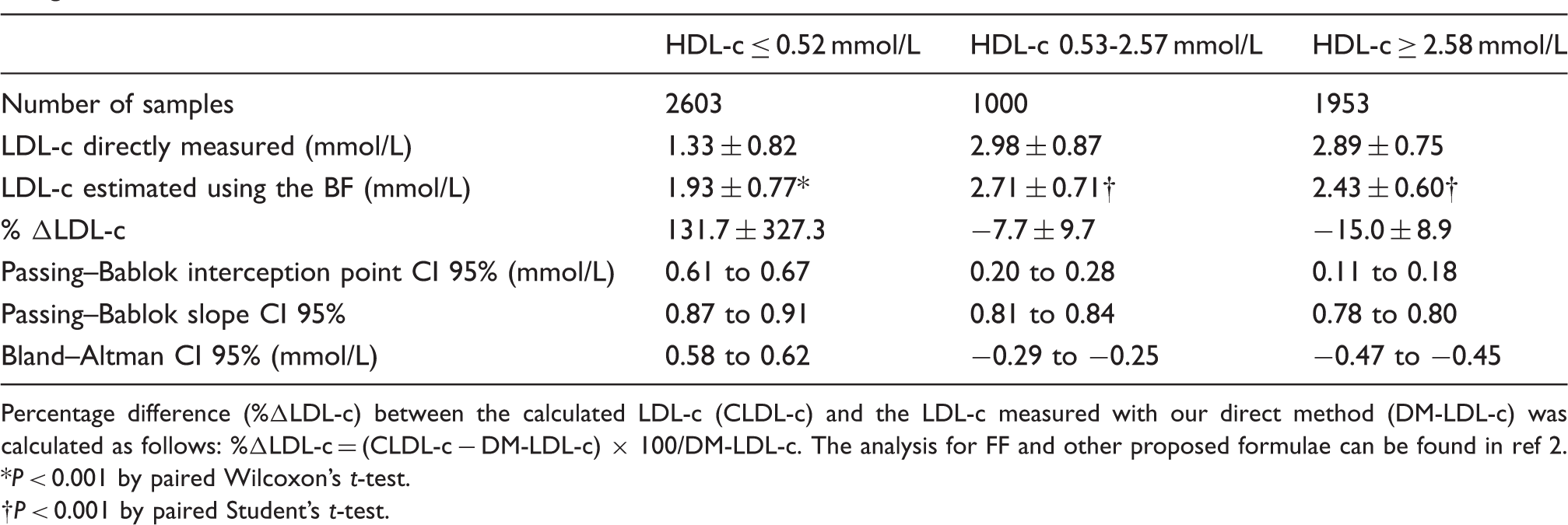
Percentage difference (%ΔLDL-c) between the calculated LDL-c (CLDL-c) and the LDL-c measured with our direct method (DM-LDL-c) was calculated as follows: %ΔLDL-c = (CLDL-c − DM-LDL-c) × 100/DM-LDL-c. The analysis for FF and other proposed formulae can be found in ref 2.
P < 0.001 by paired Wilcoxon’s t-test.
P < 0.001 by paired Student’s t-test.
In the comparison analysis for HDL-c ≤ 0.52 mmol/L, BF tended to overestimate LDL-c, as described for most previously studied formulae. For HDL-c concentrations between 0.53 and 2.57 mmol/L and ≥2.58 mmol/L, BF underestimated LDL-c concentrations compared with the direct method. BF did not improve the performance of the other formulae at both extreme low and high HDL-c concentrations. 2
Contrary to the results observed by Cordova and Cordova, FF and Chen formula (the two common formulae in both studies) performed better than BF in all the analysis that we carried out (ΔLDL-c, Passing–Bablok regression and Bland–Altman plot). 2 The differences between calculated LDL-c and our direct method were lower for all HDL-c categories if FF or Chen formula were used instead of BF. Indeed, FF showed a good statistical correlation with the direct method for ‘normal’ HDL-c range.
There are several explanations for these different findings. The BF was derived from their direct method. Thus, it seems likely that LDL-c concentrations calculated with their equation will be closer to directly measured LDL-c than when using other formulae. For example, the idea of removing TG from the formula is based on the poor correlation between LDL-c and TG observed with their homogeneous method.
In our opinion, the poor performance of the BF in our data may be mainly due to the different direct methods employed. Since homogeneous assays became available, variability in both LDL-c and HDL-c reagents has been reported.3,4 This heterogeneity could be explained by the distinct determination principles and the different reactivities to lipoproteins, especially towards various forms of modified LDL particles.
In conclusion, we believe that the generation of new formulae for LDL-c calculation based on the results measured by a single direct method could suffer poor applicability when compared with other homogeneous assays in different populations. Until better standardization of direct homogeneous assays can be achieved, a more reliable alternative would be the use of data obtained employing β-quantification, which is the accepted reference method for lipoprotein determination. Another possibility would be the development of several equations specific for extreme low and high concentrations of TG or HDL-c or for certain pathological states.
Acknowledgements
The authors thank the laboratory technical staff for their valuable assistance.
Footnotes
Declaration of conflicting interests
None.
Funding
None.
Ethical approval
Not applicable.
Guarantor
EJLM.
Contributorship
Both authors have contributed equally to the preparation of this letter.