




Abstract
The correlation filter (CF) technique is introduced as a versatile tool for data pretreatment to selectively attenuate interfering or overlapping signals of congested spectra. This technique leverages two-dimensional correlation spectroscopy (2D-COS) to create a filter multiplier that effectively addresses limitations inherent in traditional null-space projection (NSP) methods based on least-squares subtraction. We apply CF to the analysis of a model solution mixture system undergoing spontaneous evaporation, where volatile solvent concentrations change concurrently but at only slightly different rates. Despite the similarity of these parallel processes, CF successfully separates the overlapped dynamics of individual components by attenuating dominant signal contributions. CF also enables streamlined 2D codistribution spectroscopy (2D-CDS) analysis to determine the sequential order of component appearance. Multiple layers of CF can be applied to isolate individual component dynamics. Heterocomponent 2D correlation can then recover lost information by recombining CF-treated spectra. CF is applicable to two-trace two-dimensional (2T2D) correlation for comparative spectral analysis of a pair of spectra. CF treatment is expected to be a useful tool beyond 2D-COS applicable to many areas of spectral analyses, including the environmental and interfacial studies.
This is a visual representation of the abstract.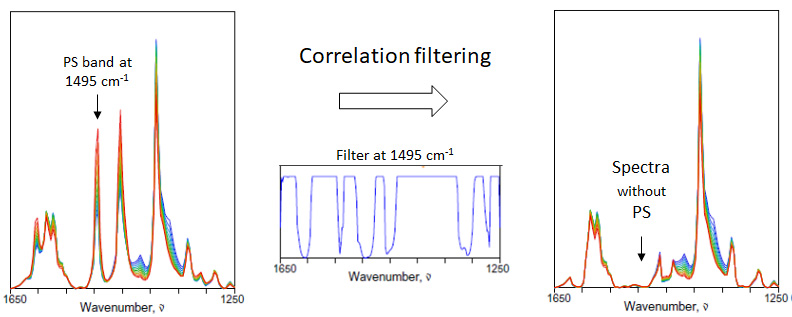
Keywords
Get full access to this article
View all access options for this article.