



Abstract
Optimal experimental conditions of indium tin oxide (ITO) as a thin-film supporting substrate for spectroscopically reliable infrared reflection–absorption (IR-RA) measurements are studied experimentally by the use of ITO substrates having a wide range of thickness from 50 to 500 nm. When the thickness is 300 nm or more, the reflectivity of ITO is close to that of a metallic substrate, but this is not solely due to the dielectric properties of ITO. This is an apparent reflectivity partly due to the RA-specific large angle-of-incidence. In fact, the observed RA spectra are quantitatively out of expectations significantly at 2000 cm–1 or higher, which means that the surface selection rules (SSRs) of RA spectrometry in the high wavenumber region are lost. With the optimized experimental conditions, an ITO substrate is employed for an actual application study of hole-collecting layer deposited on ITO. The IR-RA spectrum is beautifully obtained as if it were on a metallic substrate, and the SSR is also recognized properly.
This is a visual representation of the abstract.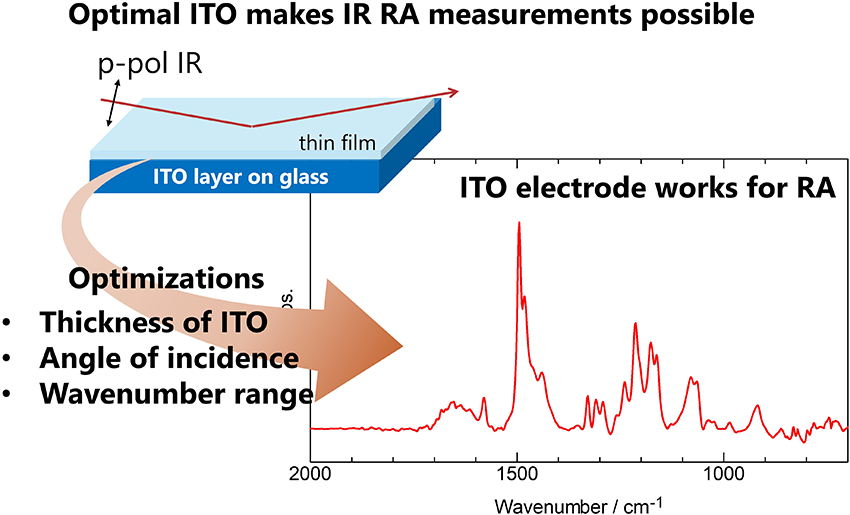
Keywords
Get full access to this article
View all access options for this article.