



Abstract
Infrared reflection absorption spectroscopy (IRRAS) is commonly used to study the structure and chemistry of molecules residing at surfaces, including water surfaces, which has far-reaching applications including atmospheric chemistry and food science. However, there is some debate regarding the surface-specificity of IRRAS when examining soluble surfactants on aqueous solutions, and there is some evidence that the surface-specificity may differ between IRRAS of ionic surfactants and soluble organic acids. This paper presents infrared reflection absorption (IRRA) spectra of soluble organic acids underneath monolayers of insoluble surfactants, where the contributions from the insoluble surfactants are subtracted from the spectra to capture “subsurface effects”. These “subsurface” spectra demonstrate that IRRA spectra of soluble organic acids are surface specific, and this observation is supported by a simplified model for reflections from “subsurface” layers. Finally, the observations presented here are compared to literature observations regarding the surface-specificity of IRRAS when studying ionic surfactants. Overall, this work demonstrates the utility of IRRAS for studying the structures and chemistry of soluble organic acids at aqueous surfaces.
This is a visual representation of the abstract.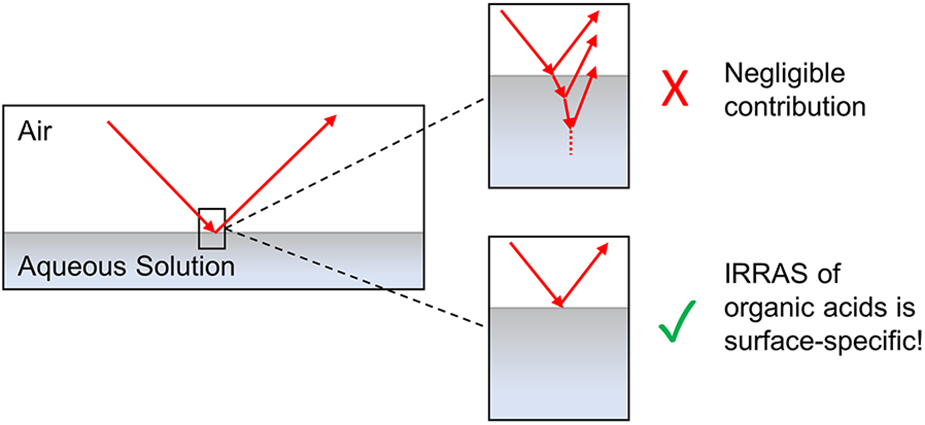
Keywords
Get full access to this article
View all access options for this article.
References
Supplementary Material
Please find the following supplemental material available below.
For Open Access articles published under a Creative Commons License, all supplemental material carries the same license as the article it is associated with.
For non-Open Access articles published, all supplemental material carries a non-exclusive license, and permission requests for re-use of supplemental material or any part of supplemental material shall be sent directly to the copyright owner as specified in the copyright notice associated with the article.
