




Abstract
This study assessed the feasibility of using portable infrared and handheld Raman devices for the rapid screening of alcohol-based gel hand sanitizers to detect potential adulteration or misbranding. Alcohol potency was estimated by analyzing the concentration-dependent hydrogen bond-induced peak shifting characteristic of alcohol–water mixtures. Specifically, alcohol concentration in water (v/v%) was plotted as a function of the ratio of two characteristic peak positions affected by this shifting, yielding linear responses between 30%–100% for infrared spectroscopy and 40%–100% for Raman spectroscopy. Calibration equations derived from these curves were applied to estimate alcohol concentration, resulting in average errors (± standard deviations) of 1.6% (1.2%) for infrared spectroscopy and 2.4% (1.7%) for Raman spectroscopy, compared to gas chromatography with flame ionization detection (GC-FID). A total of 24 products were analyzed using this screening workflow, with results used to prioritize samples for further analysis via official compendial methods. All 21 samples identified as violative or presumptively violative by the rapid screening devices were confirmed as violative using GC-FID, while all three samples classified as presumptively non-violative were confirmed as non-violative. This method may be suitable for field deployment at locations such as mail facilities, points of entry, and express courier hubs, where expedited screening of these products is beneficial. Its implementation could enhance regulatory enforcement efforts and support consumer safety by identifying non-compliant products more efficiently.
This is a visual representation of the abstract.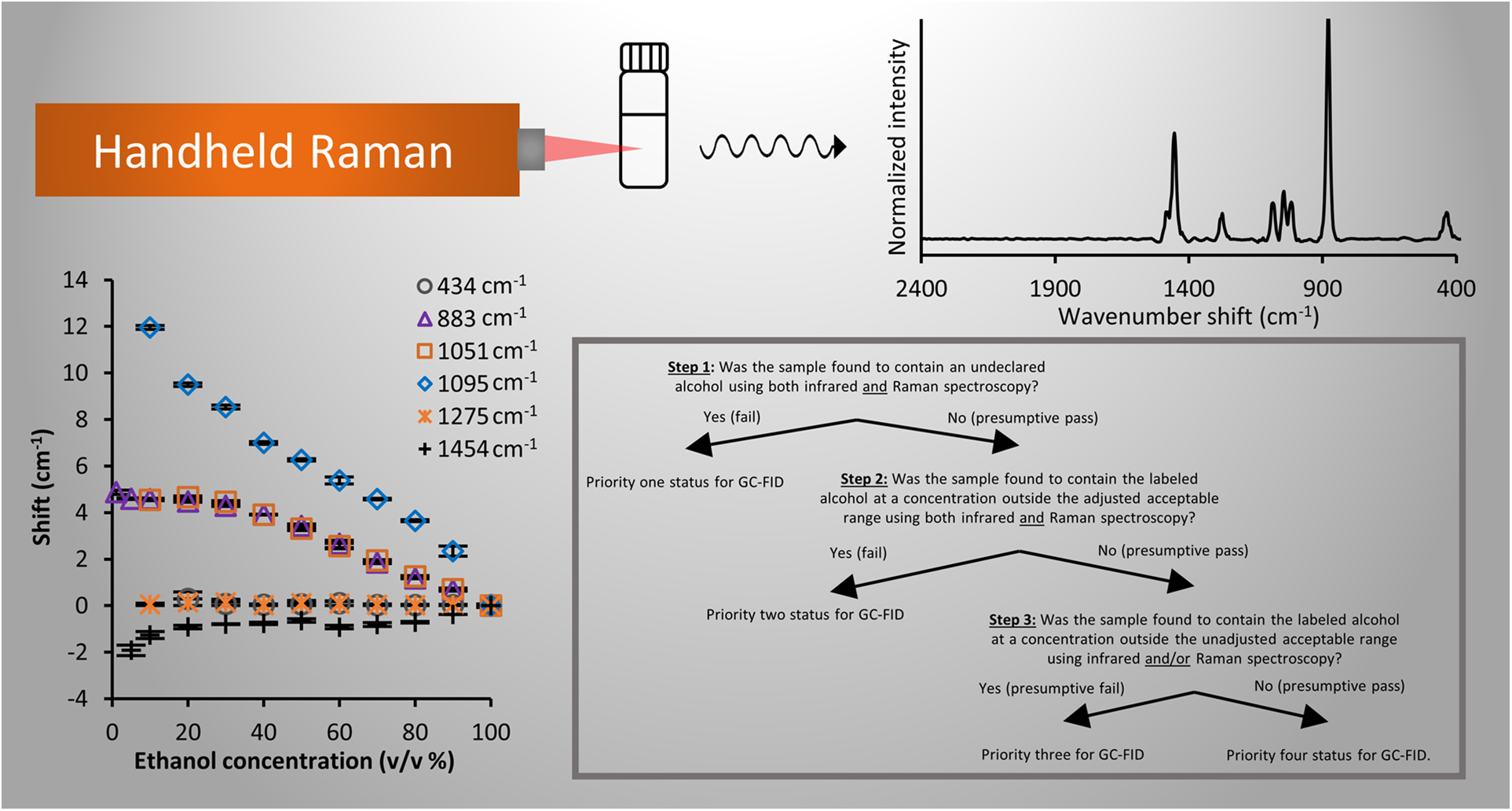
Keywords
Get full access to this article
View all access options for this article.
References
Supplementary Material
Please find the following supplemental material available below.
For Open Access articles published under a Creative Commons License, all supplemental material carries the same license as the article it is associated with.
For non-Open Access articles published, all supplemental material carries a non-exclusive license, and permission requests for re-use of supplemental material or any part of supplemental material shall be sent directly to the copyright owner as specified in the copyright notice associated with the article.
