




Abstract
Confocal Raman microscopy was applied to detect structural change within individual particles of low-density polyethylene (LDPE) following chemical and electrochemical processing steps that aimed to facilitate material decomposition. A high numerical aperture (NA) oil-immersion objective enabled depth-profiling through the near surface region (20 μm–40 μm) of irregularly shaped particles with an axial spatial resolution < 2 μm estimated from measurements of instrument detection efficiency profiles. Changes in vibrational bands sensitive to polyethylene crystallinity were evident following treatments and linked to the release of low molecular weight compounds present as additives and products of processing. Effects of processing were probed by monitoring the rise of Raman scattering intensity in vibrational modes associated with polyethylene chains in a zig-zag (trans) conformation near 1128 cm–1, 1294 cm–1, and 1418 cm–1, signaling chain clustering and development of organized, crystalline-like assemblies. Pristine LDPE particles displayed a uniform structure across the near surface region, while particles treated initially with chemical extractant and then further processed displayed increasingly enhanced crystallinity up to the maximum depth probed (40 μm). As a step toward measurements on ensembles of particles, least squares modeling was adapted to derive pure component spectra reflecting crystallinity change within spectral datasets. The work demonstrates high spatial resolution Raman depth-profiling for the characterization of processed polymers using a high NA immersion objective to overcome the limitations of air-objectives often used for confocal Raman microscopy.
This is a visual representation of the abstract.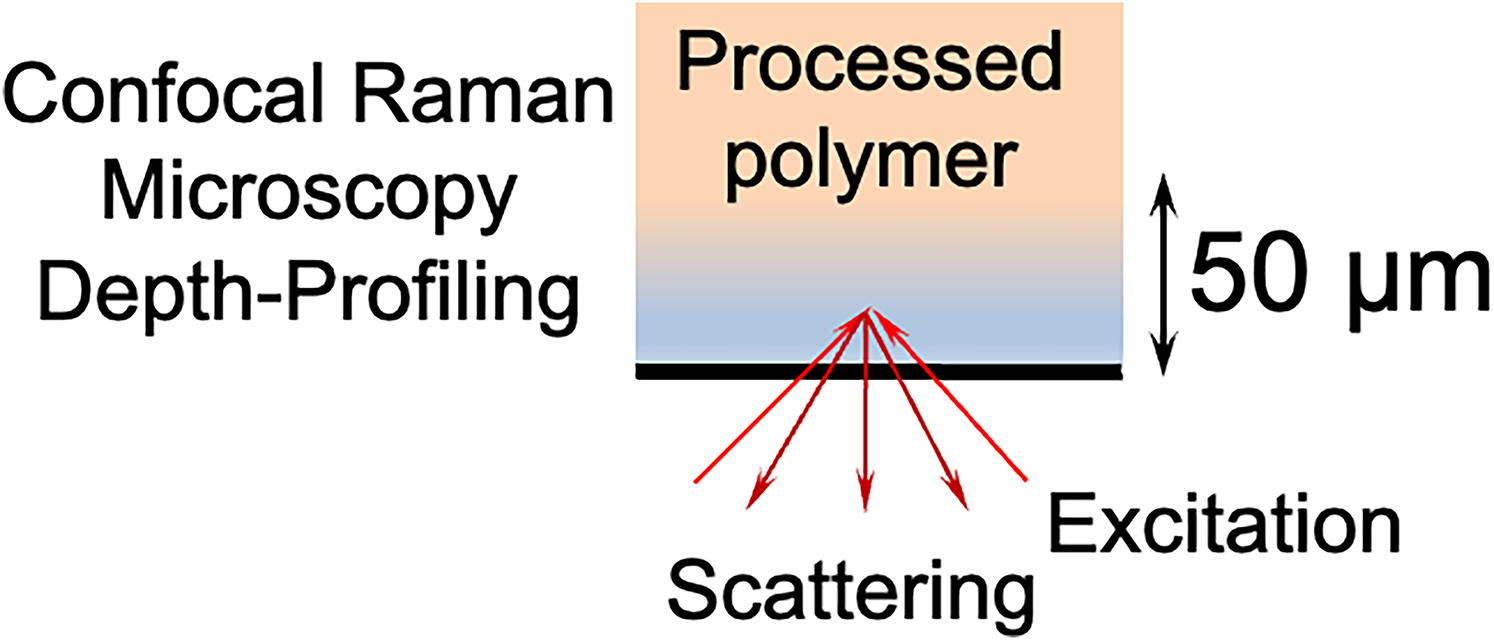
Keywords
Get full access to this article
View all access options for this article.
References
Supplementary Material
Please find the following supplemental material available below.
For Open Access articles published under a Creative Commons License, all supplemental material carries the same license as the article it is associated with.
For non-Open Access articles published, all supplemental material carries a non-exclusive license, and permission requests for re-use of supplemental material or any part of supplemental material shall be sent directly to the copyright owner as specified in the copyright notice associated with the article.
