




Abstract
Leptospirosis is an acute bacterial febrile disease affecting humans and animals in many tropical and subtropical countries. This work presents an optimization of surface-enhanced Raman spectroscopy (SERS) substrates to probe vibrational spectroscopic detail from Leptospira deoxyribonucleic acid (DNA). The pathogenic gene of LipL32 was used as a biomarker. The SERS substrates were based on a photonic crystal (PC) structure embedded with bi-metallic gold and silver nanoparticles (PC@AuAg NPs). The localized plasmonic resonance of AuAg NPs was coupled to the Raman modes of the target through SERS interaction. Prior to detection, the AuAg NPs were functionalized with chemical linkers to facilitate specific conjugation between metallic surfaces and DNA biomolecules. The immobilization and hybridization of probe DNA to their complementary target DNA (cDNA) created duplex formation for detection. The configuration was also tested with non-complementary DNA to verify detection specificity. Prominent SERS peaks were recorded, and the characteristic intensity decreased after cDNA hybridization due to less base interaction after complementary pairing. Distinct SERS behavior from the negative control test was also observed in non-complementary interaction. The configuration is highly attractive and can be potentially extended for sensitive and label-free detection of leptospiral DNA, paving the way for alternative diagnosis of leptospirosis.
This is a visual representation of the abstract.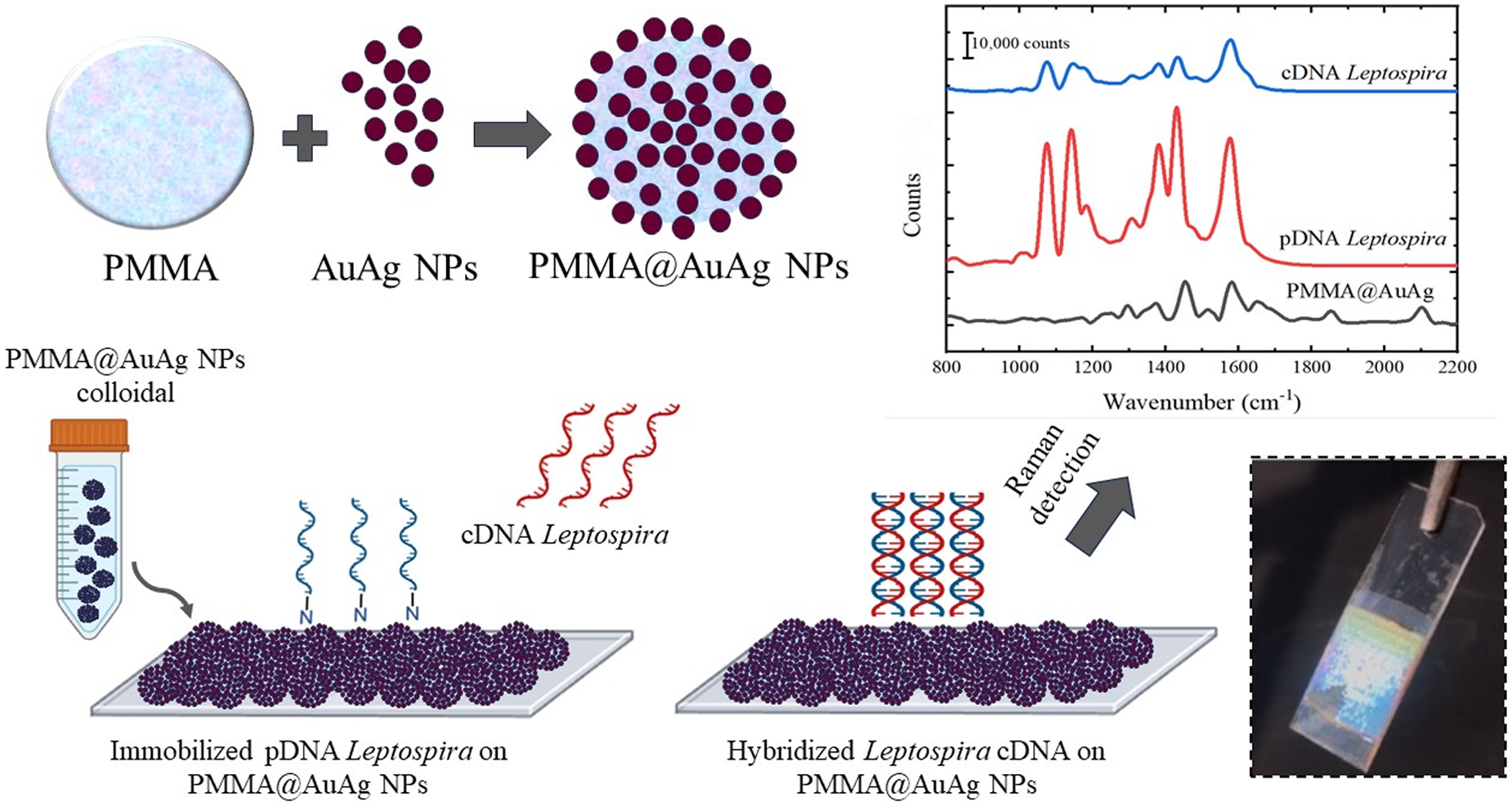
Get full access to this article
View all access options for this article.
References
Supplementary Material
Please find the following supplemental material available below.
For Open Access articles published under a Creative Commons License, all supplemental material carries the same license as the article it is associated with.
For non-Open Access articles published, all supplemental material carries a non-exclusive license, and permission requests for re-use of supplemental material or any part of supplemental material shall be sent directly to the copyright owner as specified in the copyright notice associated with the article.
