




Abstract
Analyzing the composition of animal hair fibers in textiles is crucial for ensuring the quality of yarns and fabrics made from animal hair. Among others, Fourier transform infrared (FT-IR) spectroscopy is a technique that identifies vibrations associated with chemical bonds, including those found in amino acid groups. Cashmere, mohair, yak, camel, alpaca, vicuña, llama, and sheep hair fibers were analyzed via attenuated total reflection FT-IR (ATR FT-IR) spectroscopy and scanning electron microscopy techniques aiming at the discrimination among them to identify possible commercial frauds. ATR FT-IR, being a novel approach, was coupled with chemometric tools (partial least squares discriminant analysis, PLS-DA), building classification/prediction models, which were cross-validated. PLS-DA models provided an excellent differentiation among animal hair of both camelids and eight animal species. In addition, the combination of ATR FT-IR and PLS-DA was used to discriminate the cashmere hair from different origins (Afghanistan, Australia, China, Iran, and Mongolia). The model showed very good discrimination ability (accuracy 87%), with variance expression of 94.88% and mean squared error of cross-validation of 0.1525.
This is a visual representation of the abstract.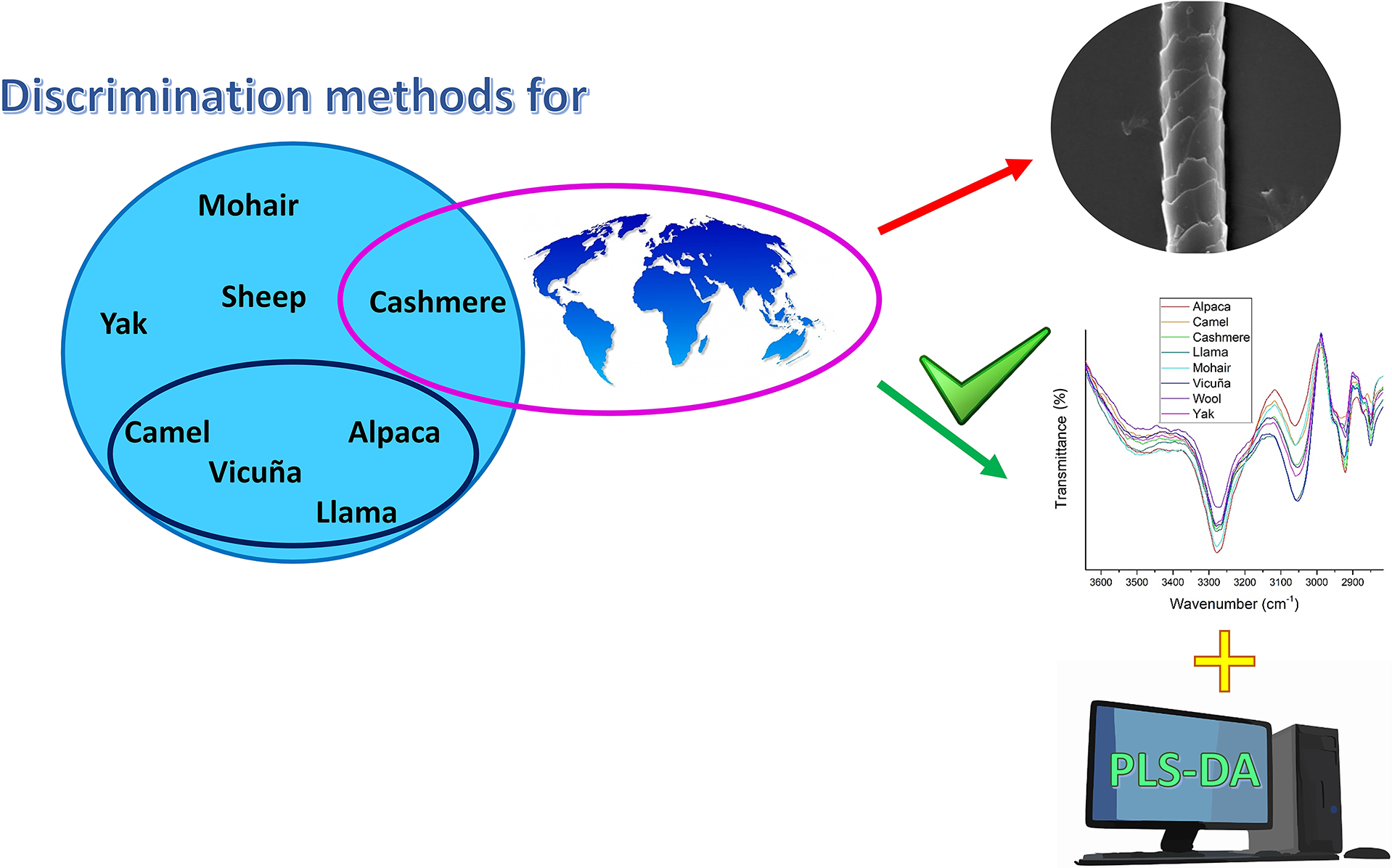
Keywords
Get full access to this article
View all access options for this article.
References
Supplementary Material
Please find the following supplemental material available below.
For Open Access articles published under a Creative Commons License, all supplemental material carries the same license as the article it is associated with.
For non-Open Access articles published, all supplemental material carries a non-exclusive license, and permission requests for re-use of supplemental material or any part of supplemental material shall be sent directly to the copyright owner as specified in the copyright notice associated with the article.
