




Abstract
Modern developments in autonomous chemometric machine learning technology strive to relinquish the need for human intervention. However, such algorithms developed and used in chemometric multivariate calibration and classification applications exclude crucial expert insight when difficult and safety-critical analysis situations arise, e.g., spectral-based medical decisions such as noninvasively determining if a biopsy is cancerous. The prediction accuracy and interpolation capabilities of autonomous methods for new samples depend on the quality and scope of their training (calibration) data. Specifically, analysis patterns within target data not captured by the training data will produce undesirable outcomes. Alternatively, using an immersive analytic approach allows insertion of human expert judgment at key machine learning algorithm junctures forming a sensemaking process performed in cooperation with a computer. The capacity of immersive virtual reality (IVR) environments to render human comprehensible three-dimensional space simulating real-world encounters, suggests its suitability as a hybrid immersive human–computer interface for data analysis tasks. Using IVR maximizes human senses to capitalize on our instinctual perception of the physical environment, thereby leveraging our innate ability to recognize patterns and visualize thresholds crucial to reducing erroneous outcomes. In this first use of IVR as an immersive analytic tool for spectral data, we examine an integrated IVR real-time model selection algorithm for a recent model updating method that adapts a model from the original calibration domain to predict samples from shifted target domains. Using near-infrared data, analyte prediction errors from IVR-selected models are reduced compared to errors using an established autonomous model selection approach. Results demonstrate the viability of IVR as a human data analysis interface for spectral data analysis including classification problems.
This is a visual representation of the abstract.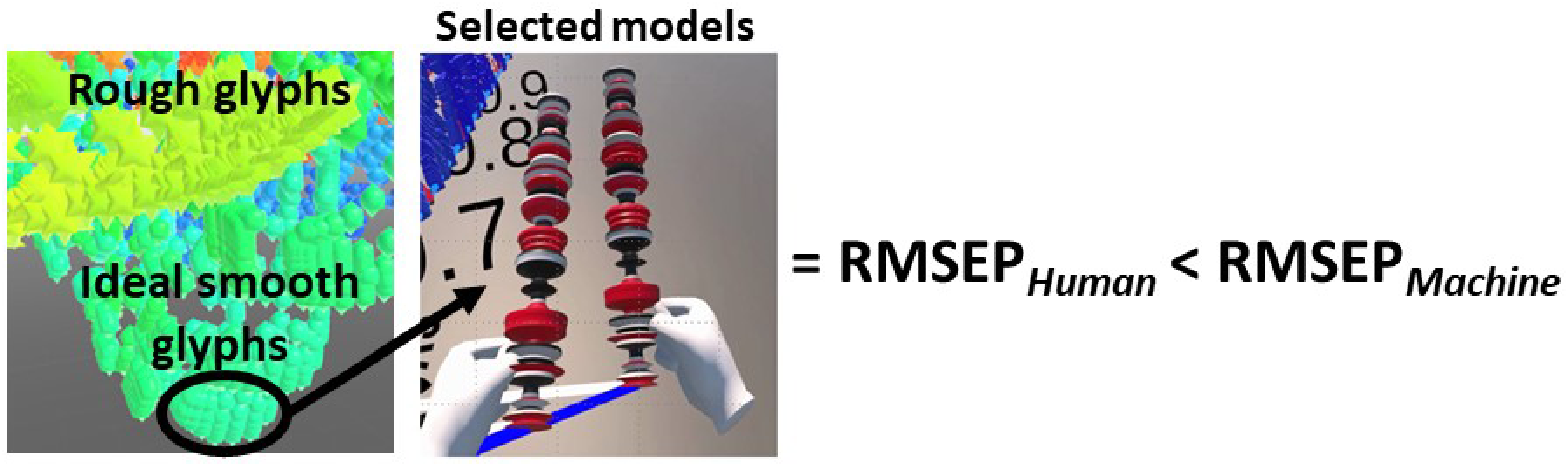
Get full access to this article
View all access options for this article.
References
Supplementary Material
Please find the following supplemental material available below.
For Open Access articles published under a Creative Commons License, all supplemental material carries the same license as the article it is associated with.
For non-Open Access articles published, all supplemental material carries a non-exclusive license, and permission requests for re-use of supplemental material or any part of supplemental material shall be sent directly to the copyright owner as specified in the copyright notice associated with the article.
