Restricted accessResearch articleFirst published online 2025-6
Spectral Background Calibration of Scanning Habitable Environments with Raman and Luminescence for Organics and Chemicals (SHERLOC) Spectrometer Onboard the Perseverance Rover Enables Identification of a Ubiquitous Martian Spectral Component
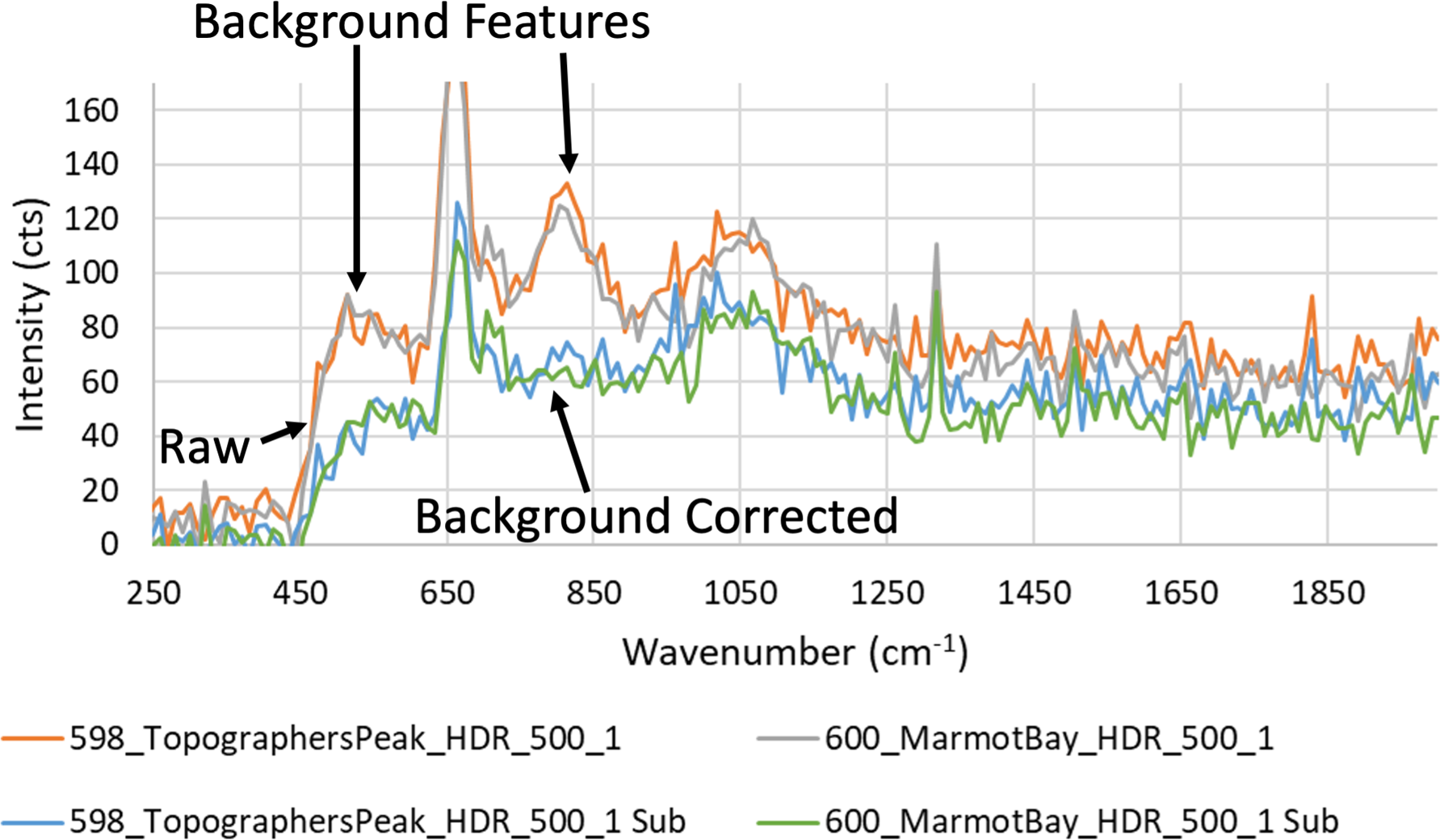
The Perseverance rover landed at Jezero Crater, Mars, on 18 February 2021, with a payload of scientific instruments to examine Mars' past habitability, look for signs of past life, and process samples for future return to Earth. The instrument payload includes the Scanning Habitable Environments with Raman and Luminescence for Organics and Chemicals (SHERLOC) deep ultraviolet Raman and fluorescence imaging spectrometer designed to detect, characterize, and map the presence of organics and minerals on the Martian surface. Operation and engineering constraints sometimes result in the acquisition of spectra with features near the detection limit. It is therefore important to separate instrumental (background) spectral components and spectral components inherent to Martian surface materials. For SHERLOC, the instrumental background is assessed by collecting spectra in the stowed-arm configuration where the instrument is pointed at the Martian nighttime sky with no surface sample present in its optical path. These measurements reveal weak Raman and fluorescence background spectral signatures as well as charged-coupled device pixels prone to erroneous intensity spikes separate from cosmic rays. We quantitatively describe these features and provide a subtraction procedure to remove the spectral background from surface spectra. By identifying and accounting for the SHERLOC Raman background features within the median Raman spectra of Martian target scans, we find that the undefined silicate spectral feature interpreted to be either amorphous silicate or plagioclase feldspar is ubiquitously found in every Mars target Raman scan collected through Sol 751.
BhartiaR.BeegleL.W.DeFloresL.AbbeyW., et al. “Perseverance’s Scanning Habitable Environments with Raman and Luminescence for Organics and Chemicals (SHERLOC) Investigation”. Space Sci. Rev. 2021. 217(4): 1–115. https://doi.org/10.1007/s11214-021-00812-z
3.
UckertK.BhartiaR.BeegleL.W.MonacelliB., et al. “Calibration of the SHERLOC Deep Ultraviolet Fluorescence–Raman Spectrometer on the Perseverance Rover”. Appl. Spectrosc. 2021. 75(7): 763–773. https://doi.org/10.1177/00037028211013368
4.
JakubekR.S.BhartiaR.UckertK.AsherS.A., et al. “Calibration of Raman Bandwidths on the SHERLOC Deep UV Raman and Fluorescence Instrument Aboard the Perseverance Rover”. Appl. Spectrosc. 2023. 78(10): TBD. https://doi.org/10.1177/00037028231210885
MorrisR.V.HaneyN.C.JakubekR.S.EckleyS.A., et al. “Deep UV Raman and Chemical Analysis of Crystalline Feldspar and Pyroxene in Polymict Martian Meteorite Northwest Africa 10922: An Analog Study for Mars 2020 SHERLOC and PIXL and MSL CheMin Instruments”. Paper presented at: 54th Lunar and Planetary Science Conference. The Woodlands, Texas; March 13–17, 2023. https://www.hou.usra.edu/meetings/lpsc2023/pdf/2748.pdf [accessed Aug 15 2024].
7.
CorpolongoA.JakubekR.S.BurtonA.S.BrownA.J., et al. “SHERLOC Raman Mineral Class Detections of the Mars 2020 Crater Floor Campaign”. J. Geophys. Res. Planets. 2023. 128(3): e2022JE007455. https://doi.org/10.1029/2022JE007455
8.
HollisJ.R.MooreK.R.SharmaS.BeegleL., et al. “The Power of Paired Proximity Science Observations: Co-Located Data from SHERLOC and PIXL on Mars”. Icarus. 2022. 387: 1–14. https://doi.org/10.1016/j.icarus.2022.115179
9.
RampeE.B.BlakeD.F.BristowT.F.MingD.W., et al. “Mineralogy and Geochemistry of Sedimentary Rocks and Eolian Sediments in Gale Crater, Mars: A Review After Six Earth Years of Exploration with Curiosity”. Chemie Erde. 2020. 80(2): 125605. https://doi.org/10.1016/j.chemer.2020.125605
10.
McCreeryR.L.. “Signal-to-Noise in Raman Spectroscopy”. In: Raman Spectroscopy for Chemical Analysis. Hoboken, New Jersey: John Wiley and Sons, Inc., 2005. Vol. 1. Chap. 4, Pp. 49–71. https://doi.org/10.1002/0471721646.ch4
11.
KashaM.. “Characterization of Electronic Transitions in Complex Molecules”. Discuss. Faraday Soc. 1950. 9: 14–19. https://doi.org/10.1039/DF9500900014
12.
FriesM.D.LeeC.BhartiaR.Razzell HollisJ., et al. “The SHERLOC Calibration Target on the Mars 2020 Perseverance Rover: Design, Operations, Outreach, and Future Human Exploration Functions”. Space Sci. Rev. 2022. 218(6): 46. https://doi.org/10.1007/s11214-022-00907-1
13.
MoellerR.C.JanduraL.RosetteK.RobinsonM., et al. “The Sampling and Caching Subsystem (SCS) for the Scientific Exploration of Jezero Crater by the Mars 2020 Perseverance Rover”. Space Sci. Rev. 2021. 217: 1–43. https://doi.org/10.1007/s11214-020-00783-7
14.
SharmaS.RoppelR.D.MurphyA.E.BeegleL.W., et al. “Diverse Organic-Mineral Associations in Jezero Crater, Mars”. Nature. 2023. 619(7971): 724–732. https://doi.org/10.1038/s41586-023-06143-z
15.
SchellerE.L.Razzell HollisJ.CardarelliE.L.SteeleA., et al. “Aqueous Alteration Processes in Jezero Crater, Mars: Implications for Organic Geochemistry”. Science. 2022. 378(6624): 1105–1110. https://doi.org/10.1126/science.abo5204
16.
AbbeyW.J.BhartiaR.BeegleL.W.DeFloresL., et al. “Deep UV Raman Spectroscopy for Planetary Exploration: The Search for In Situ Organics”. Icarus. 2017. 290: 201–214. https://doi.org/10.1016/j.icarus.2017.01.039
17.
LenzD.D.AyresT.R.. “Errors Associated with Fitting Gaussian Profiles to Noisy Emission-Line Spectra”. Publ. Astron. Soc. Pac. 1992. 104(681): 1104. https://doi.org/10.1086/133096
18.
MishchikK.d'AmicoC.VelpulaP.K.MauclairC., et al. “Ultrafast Laser Induced Electronic and Structural Modifications in Bulk Fused Silica”. J. Appl. Phys. 2013. 114(13): 133502. https://doi.org/10.1063/1.4822313
19.
BerglerM.CvecekK.WerrF.BrehlM., et al. “Cooling Rate Calibration and Mapping of Ultra-Short Pulsed Laser Modifications in Fused Silica by Raman and Brillouin Spectroscopy”. Int. J. Extreme Manuf. 2020. 2(3): 035001. https://doi.org/10.1088/2631-7990/ab9583
20.
FoxA.C.JakubekR.S.EigenbrodeJ.L.. “Changes in the Raman and Fluorescence Spectroscopic Signatures of Irradiated Organic-Mineral Mixtures: Implications for Molecular Biosignature Detection on Mars”. J. Geophys. Res. Planets. 2023. 128(2): e2022JE007624. https://doi.org/10.1029/2022JE007624
21.
LemailletP.PatrickH.J.GermerT.A.HanssenL., et al. “Goniometric and Hemispherical Reflectance and Transmittance Measurements of Fused Silica Diffusers”. In Reflection, Scattering, and Diffraction from Surfaces V SPIE2016. 9961. https://tsapps.nist.gov/publication/get_pdf.cfm?pub_id=921734 [accessed Aug 15 2023].
22.
LiL.DuZ.ZhangX.XiS., et al. “In Situ Raman Spectral Characteristics of Carbon Dioxide in a Deep-Sea Simulator of Extreme Environments Reaching 300 ˚C and 30MPa”. Appl. Spectrosc. 2018. 72(1): 1–12. https://doi.org/10.1177/0003702817722820
LongG.L.WinefordnerJ.D.. “Limit of Detection: A Closer Look at the IUPAC Definition”. Anal. Chem. 1983. 55(7): 712A–724A. https://doi.org/10.1021/ac00258a001
25.
ShrivastavaA.GuptaV.B.. “Methods for the Determination of Limit of Detection and Limit of Quantitation of the Analytical Methods”. Chron. Young Sci. 2011. 2(1): 21–25. https://doi.org/10.4103/2229-5186.79345
26.
McLaughlinG.SikirzhytskiV.LednevI.K.. “Circumventing Substrate Interference in the Raman Spectroscopic Identification of Blood Stains”. Forensic Sci. Int. 2013. 231(1–3): 157–166. https://doi.org/10.1016/j.forsciint.2013.04.033
27.
DayJ.S.EdwardsH.G.M.DobrowskiS.A.VoiceA.M.. “The Detection of Drugs of Abuse in Fingerprints Using Raman Spectroscopy II: Cyanoacrylate-Fumed Fingerprints”. Spectrochim. Acta, Part A. 2004. 60(8–9): 1725–1730. https://doi.org/10.1016/j.saa.2003.09.013
28.
L.Bellot-GurletBourdonnecF.X.L.PoupeauG.DubernetS.. “Raman Micro-Spectroscopy of Western Mediterranean Obsidian Glass: One Step Towards Provenance Studies?”. J. Raman Spectrosc. 2004. 35(8–9): 671–677. https://doi.org/10.1002/jrs.1195
29.
FuX.WangA.KrawczynskiM.J.. “Characterizing Amorphous Silicates in Extraterrestrial Materials: Polymerization Effects on Raman and Mid-IR Spectral Features of Alkali and Alkali Earth Silicate Glasses”. J. Geophys. Res. Planets. 2017. 122(5): 839–855. https://doi.org/10.1002/2016JE005241
30.
TiceM.M.HurowitzJ.A.AllwoodA.C.JonesM.W.M., et al. “Alteration History of Séítah Formation Rocks Inferred by PIXL X-ray Fluorescence, X-ray Diffraction, and Multispectral Imaging on Mars”. Sci. Adv. 2022. 8(47): eabp9084. https://doi.org/10.1126/sciadv.abp9084
31.
J.R.HollisAbbeyW.BeegleL.W.BhartiaR., et al. “A Deep-Ultraviolet Raman and Fluorescence Spectral Library of 62 Minerals for the SHERLOC Instrument Onboard Mars 2020”. Planet Space Sci. 2021. 209: 105356. https://doi.org/10.1016/j.pss.2021.105356
32.
RampeE.B.BristowT.F.MorrisR.V.MorrisonS.M.. “Mineralogy of Vera Rubin Ridge from the Mars Science Laboratory CheMin Instrument”. J. Geophys. Res. Planets. 2020. 125(9): e2019JE006306. https://doi.org/10.1029/2019JE006306
33.
TreimanA.H.BishD.L.VanimanD.T.ChiperaS.J., et al. “Mineralogy, Provenance, and Diagenesis of a Potassic Basaltic Sandstone on Mars: CheMin X-ray Diffraction of the Windjana Sample (Kimberley Area, Gale Crater)”. J. Geophys. Res. Planets. 2016. 121(1): 75–106. https://doi.org/10.1002/2015JE004932
34.
M.T.ThorpeBristowT.F.RampeE.B.ToscaN.J., et al. “Mars Science Laboratory CheMin Data From the Glen Torridon Region and the Significance of Lake-Groundwater Interactions in Interpreting Mineralogy and Sedimentary History”. J. Geophys. Res. Planets. 2022. 127(11): e2021JE007099. https://doi.org/10.1029/2021JE007099
35.
BishD.L.BlakeD.F.VanimanD.T.ChiperaS.J., et al. “X-ray Diffraction Results from Mars Science Laboratory: Mineralogy of Rocknest at Gale Crater”. Science. 2013. 341(6153): 1238932. https://doi.org/10.1126/science.1238932
McCubbinF.M.BoyceJ.W.Novák-SzabóT.SantosA.R., et al. “Geologic History of Martian Regolith Breccia Northwest Africa 7034: Evidence for Hydrothermal Activity and Lithologic Diversity in the Martian Crust”. J. Geophys. Res. Planets. 2016. 121(10): 2120–2149. https://doi.org/10.1002/2016JE005143
38.
HamiltonV.E.McSweenH.Y.Jr.HapkeB.. “Mineralogy of Martian Atmospheric Dust Inferred from Thermal Infrared Spectra of Aerosols”. J. Geophys. Res. Planets. 2005. 110(E12): 1–11. https://doi.org/10.1029/2005JE002501
39.
FreemanJ.J.WangA.KueblerK.E.JolliffB.L., et al. “Characterization of Natural Feldspars by Raman Spectroscopy for Future Planetary Exploration”. Can. Miner. 2008. 46(6): 1477–1500. https://doi.org/10.3749/canmin.46.6.1477
40.
Mosier-BossP.A.LiebermanS.H.NewberyR.. “Fluorescence Rejection in Raman Spectroscopy by Shifted-Spectra, Edge Detection, and FFT Filtering Techniques”. Appl. Spectrosc. 1995. 49(5): 630–638. https://doi.org/10.1366/0003702953964039
Please find the following supplemental material available below.
For Open Access articles published under a Creative Commons License, all supplemental material carries the same license as the article it is associated with.
For non-Open Access articles published, all supplemental material carries a non-exclusive license, and permission requests for re-use of supplemental material or any part of supplemental material shall be sent directly to the copyright owner as specified in the copyright notice associated with the article.