




Abstract
In this work, we derive a simple method for calibrating Raman bandwidths for the Scanning Habitable Environments with Raman and Luminescence for Organics and Chemicals (SHERLOC) instrument onboard NASA's Perseverance rover. Raman bandwidths and shapes reported by an instrument contain contributions from both the intrinsic Raman band (IRB) and instrumental artifacts. To directly correlate bandwidth to sample properties and to compare bandwidths across instruments, the IRB width needs to be separated from instrumental effects. Here, we use the ubiquitous bandwidth calibration method of modeling the observed Raman bands as a convolution of a Lorentzian IRB and a Gaussian instrument slit function. Using calibration target data, we calculate that SHERLOC has a slit function width of 34.1 cm–1. With a measure of the instrument slit function, we can deconvolve the IRB from the observed band, providing the width of the Raman band unobscured by instrumental artifact. We present the correlation between observed Raman bandwidth and intrinsic Raman bandwidth in table form for the quick estimation of SHERLOC Raman intrinsic bandwidths. We discuss the limitations of using this model to calibrate Raman bandwidth and derive a quantitative method for calculating the errors associated with the calibration. We demonstrate the utility of this method of bandwidth calibration by examining the intrinsic bandwidths of SHERLOC sulfate spectra and by modeling the SHERLOC spectrum of olivine.
This is a visual representation of the abstract.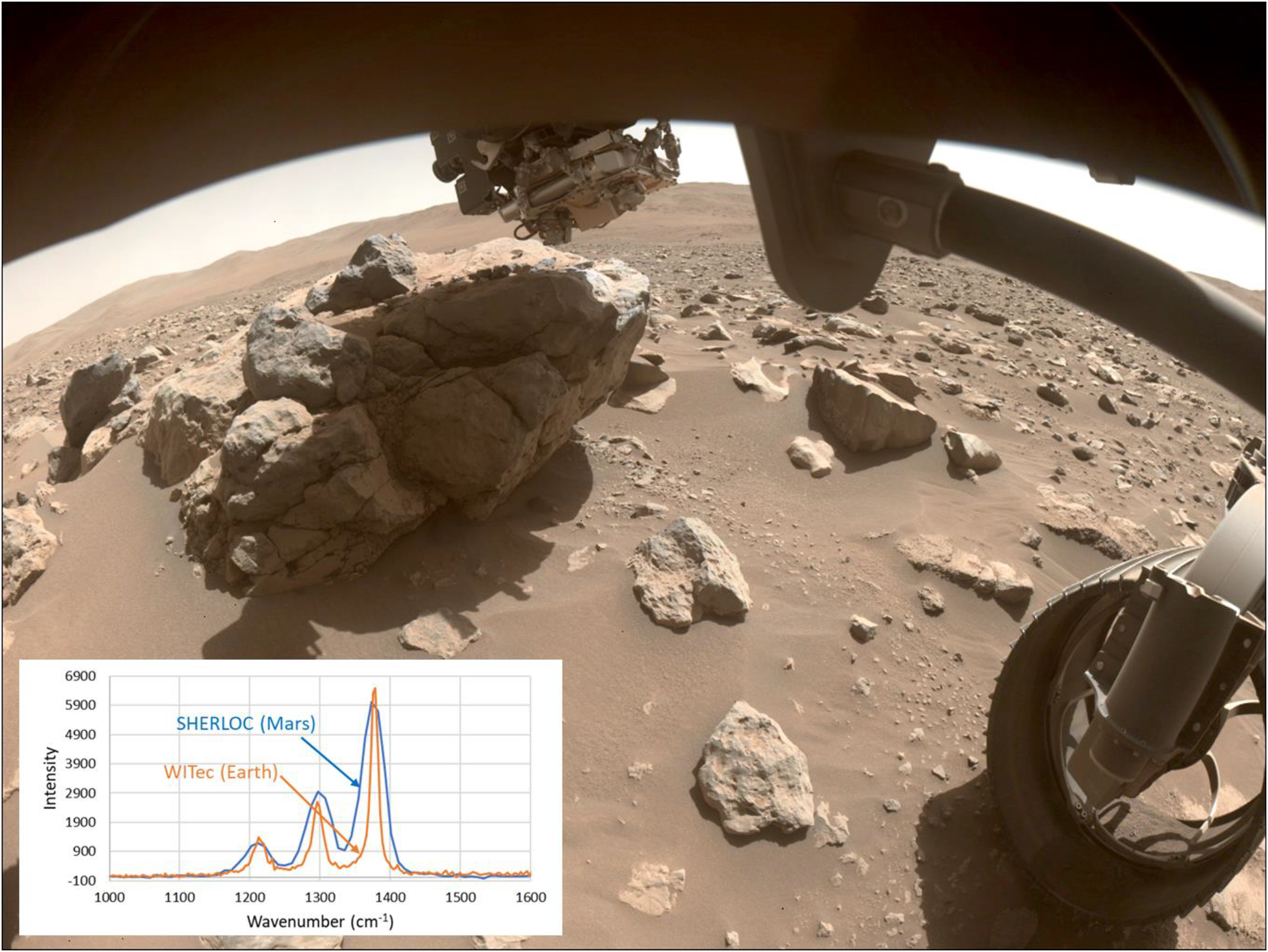
Keywords
Get full access to this article
View all access options for this article.
References
Supplementary Material
Please find the following supplemental material available below.
For Open Access articles published under a Creative Commons License, all supplemental material carries the same license as the article it is associated with.
For non-Open Access articles published, all supplemental material carries a non-exclusive license, and permission requests for re-use of supplemental material or any part of supplemental material shall be sent directly to the copyright owner as specified in the copyright notice associated with the article.
