



Abstract
A rheo-optical characterization technique based on the combination of near-infrared (NIR) spectroscopy and tensile testing was applied for the first time to an actual rubber sample based on styrene-butadiene rubber (SBR) including silica filler. When SBR samples were subjected to mechanical deformation, changes in the NIR spectral features were readily captured. Two-trace two-dimensional (2T2D) correlation analysis was then applied to the sets of NIR spectra to clearly reveal the subtle but pertinent difference between the NIR spectral features of the initial and deformed SBR. The initial deformation of the sample induces greater deformation of the soft butadiene groups than of the hard styrene groups. The inclusion of the silica filler and a coupling agent (CA) essentially develops firm links between the silica and butadiene using the CA to restrict the displacement of the butadiene during the tensile deformation of the system. The development of such linkage requires even more mechanical force to deform the SBR, which, in turn, improves Young's modulus of the rubber system. Asynchronous correlation spectra of SBR with no silica filler revealed that, during the deformation of the SBR, the butadiene groups were initially deformed, and this feature was then replaced by the predominant deformation of the hard styrene groups. On the other hand, this correlation feature became somewhat unclear when a similar analysis was applied to the SBR sample with silica filler, revealing subtle differences in interaction between individual comonomer functional groups distributed randomly along the copolymer chain and CA.
This is a visual representation of the abstract.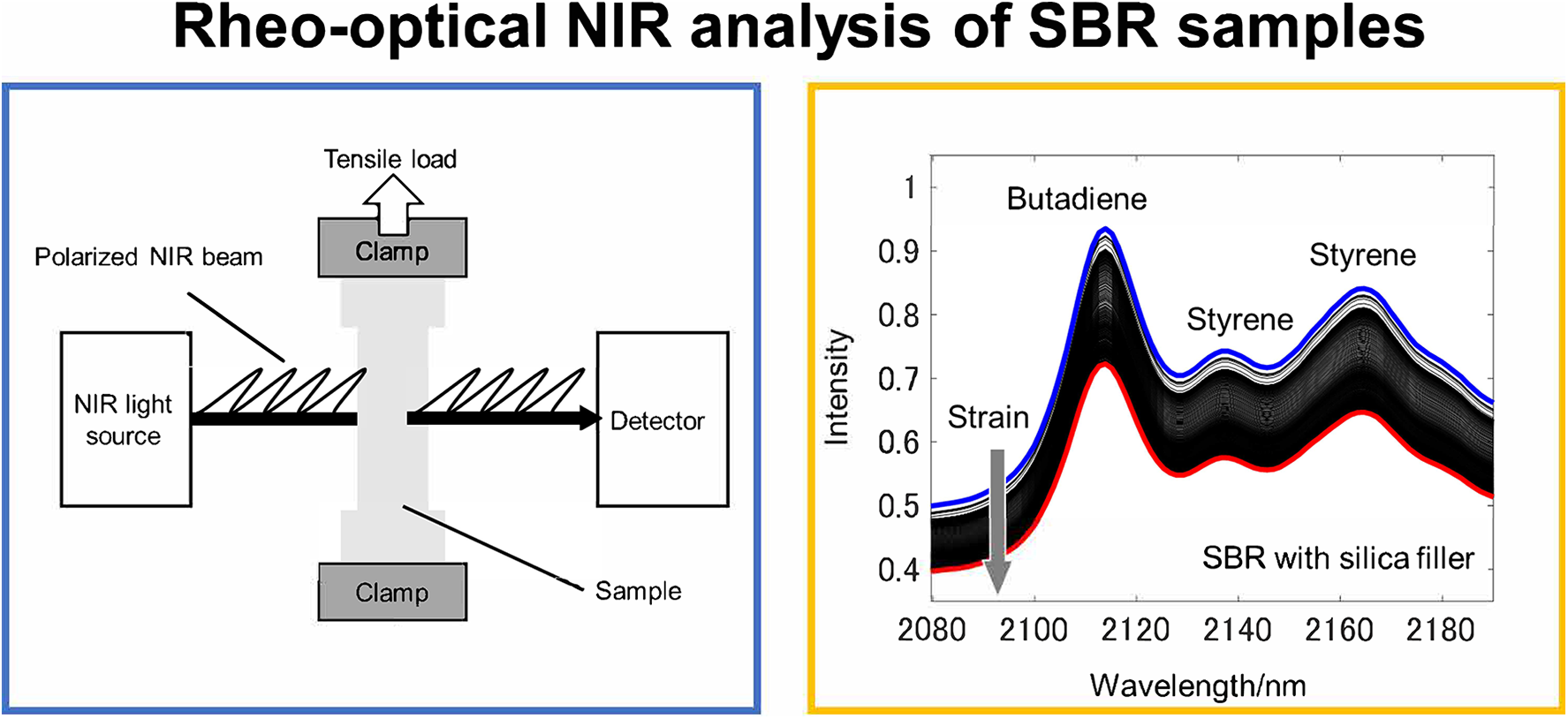
Keywords
Get full access to this article
View all access options for this article.
References
Supplementary Material
Please find the following supplemental material available below.
For Open Access articles published under a Creative Commons License, all supplemental material carries the same license as the article it is associated with.
For non-Open Access articles published, all supplemental material carries a non-exclusive license, and permission requests for re-use of supplemental material or any part of supplemental material shall be sent directly to the copyright owner as specified in the copyright notice associated with the article.
