



Abstract
Raman spectroscopy is an emerging technique for rapid and nondestructive analysis of nuclear materials for forensic and nonproliferation applications as it is a powerful tool for distinguishing multiple chemical forms of materials with similar stoichiometries. Recent developments in spectroscopic software have enabled rapid data collection with high-speed Raman spectroscopic mapping capabilities. However, some uranium-rich materials are susceptible to degradation in humid air and/or laser-induced phase transformations. To mitigate environmental or measurement-related sample degradation of potential samples of interest, we have taken a systematic approach to define optimized data collection parameters for high-throughput measurements of uranyl fluoride (UO2F2), which is an important intermediate material in the nuclear fuel cycle. First, we systematically describe the influence of optical magnification (5× to 100×), laser power, and exposure time on obtained signal for identical particles of UO2F2 and find that at low laser power and exposure times, comparable signal is obtained regardless of optical magnification. Second, we ensure sample integrity during data collection, and third, collect spectroscopic maps that employ optimized parameters to reduce the time required to obtain spatially resolved spectroscopic information. Reductions of 90% and 99% in measurement times are discussed as they relate to differences in resolving spectroscopic features of particles in identical mapping areas. During this work, we found that additional data processing options were needed and thus developed a customized Python script for importing, processing, analyzing, and visualizing Raman spectroscopic map data.
This is a visual representation of the abstract.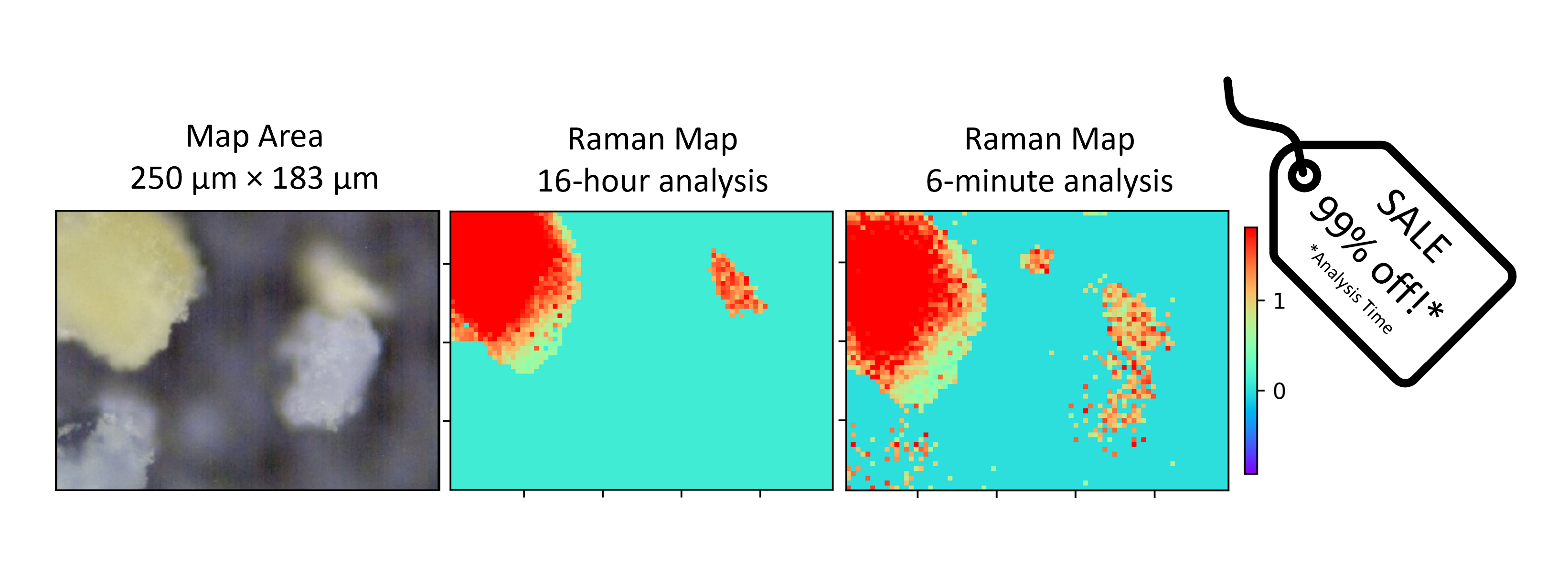
Get full access to this article
View all access options for this article.
References
Supplementary Material
Please find the following supplemental material available below.
For Open Access articles published under a Creative Commons License, all supplemental material carries the same license as the article it is associated with.
For non-Open Access articles published, all supplemental material carries a non-exclusive license, and permission requests for re-use of supplemental material or any part of supplemental material shall be sent directly to the copyright owner as specified in the copyright notice associated with the article.
