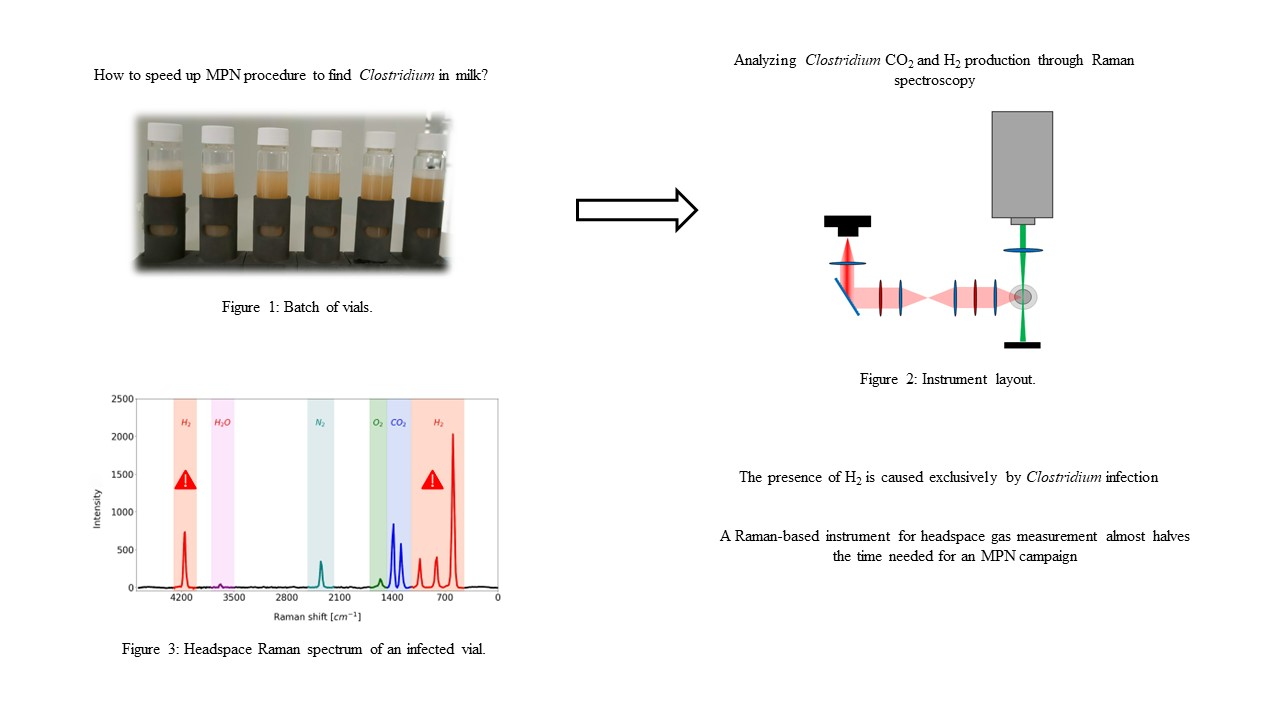
Detecting Clostridium in milk presents a significant challenge for the dairy industry given that traditional methods are time-consuming and not specific for these bacteria. Microbiological techniques are expensive and require qualified personnel. Clostridium, in the form of spores, can withstand pasteurization and revert to its vegetative form during cheese aging. These gas-producing bacteria are known for their production of carbon dioxide and hydrogen, causing the formation of slits, cracks, and irregular eyes in hard and semi-hard cheeses. However, gas analysis in the vial headspace of appropriate culture can be exploited to specifically detect Clostridium presence, since the closest competing bacterial Bacilli produces only carbon dioxide. The aim of this paper is to present a Raman-spectroscopy-based instrument for a rapid, inexpensive identification of Clostridium in milk with a limit of detection of 29 spores/L. The proposed measurement procedure is analog to that routinely used, based on the most probable number method. The Raman-based instrument speeds up the detection of a vial's positivity. A test conducted with Clostridium spores demonstrated its effectiveness in almost halving the time needed for the measurement campaign compared to the traditional method.
AndrighettoC.SpolaorD.De DeaP.FioravanzoE., et al. “Comparison of Two Analytical Methods for Detecting Clostridium Spores in Milk”. Int. Dairy J. 2023. 142: 105649. https://doi.org/10.1016/j.idairyj.2023.105649
2.
PostollecF.MathotA.G.BernardM.Divanac’hM.L., et al. “Tracking Spore-Forming Bacteria in Food: From Natural Biodiversity to Selection by Processes”. Int. J. Food Microbiol. 2012. 158(1): 1–8. https://doi.org/10.1016/j.ijfoodmicro.2012.03.004
3.
BrändleJ.DomigK.J.KneifelW.. “Relevance and Analysis of Butyric Acid Producing Clostridia in Milk and Cheese”. Food Control. 2016. 67: 96–113. https://doi.org/10.1016/j.foodcont.2016.02.038
4.
JulienM.C.DionP.LafrenièreC.AntounH.DrouinP.. “Sources of Clostridia in Raw Milk on Farms”. Appl. Environ. Microbiol. 2008. 74(20): 6348–6357. https://doi.org/10.1128/AEM.00913-08
5.
NishiharaM.TakahashiH.SudoT.KyoiD., et al. “Multilocus Variable-Number of Tandem Repeat Analysis (MLVA) for Clostridium tyrobutyricum Strains Isolated from Cheese Production Environment”. Int. J. Food Microbiol. 2014. 190: 61–65. https://doi.org/10.1016/J.Ijfoodmicro.2014.08.022
6.
CarminatiD.BonviniB.FrancolinoS.GhigliettiR., et al. “Low-Level Clostridial Spores’ Milk to Limit the Onset of Late Blowing Defect in Lysozyme-Free”. Grana-Type Cheese Foods. 2023. 12(9): 1880. https://doi.org/10.3390/foods12091880
7.
LavillaM.MarzoI.De LuisR.PerezM.D., et al. “Detection of Clostridium Tyrobutyricum Spores Using Polyclonal Antibodies and Flow Cytometry”. J. Appl. Microbiol. 2010. 108(2): 488–498. https://doi.org/10.1111/j.1365-2672.2009.04435.x
ÁvilaM.Gómez-TorresN.HernándezM.GardeS.. “Inhibitory Activity of Reuterin, Nisin, Lysozyme, and Nitrite Against Vegetative Cells and Spores of Dairy-Related Clostridium Species”. Int. J. Food Microbiol. 2014. 172: 70–75. https://doi.org/10.1016/j.ijfoodmicro.2013.12.002
10.
López-EnríquezL.Rodríguez-LázaroD.HernándezM.. “Quantitative Detection of Clostridium Tyrobutyricum in Milk by Real-Time PCR”. Appl. Environ. Microbiol. 2007. 73(11): 3747–3751. https://doi.org/10.1128/AEM.02642-06
11.
WeinzirlJ.. “Detection of Manural Pollution in Milk by the Anaerobic Spore Test”. Am. J. Public Health. 1921. 11(2): 149–152. https://doi.org/10.2105/AJPH.11.2.149
12.
ŞahinerA.ÇalışkanS.HalatE.. “Development of a New Multiplex Quantitative Real-Time Polymerase Chain Reaction Method for Clostridium butyricum, Clostridium sporogenes, and Clostridium tyrobutyricum Detection in Cheese”. LWT. 2022. 155: 112914. https://doi.org/10.1016/j.lwt.2021.112914
13.
CecereP.GattoF.CortimigliaC.BassiD., et al. “Colorimetric Point-of-Care Detection of Clostridium tyrobutyricum Spores in Milk Samples”. Biosensors (Basel). 2021. 11(9): 293. https://doi.org/10.3390/bios11090293
14.
Bogovič MatijašićB.Koman RajšpM.PerkoB.RogeljI.. “Inhibition of Clostridium tyrobutyricum in Cheese by Lactobacillus gasseri”. Int. Dairy J. 2007. 17(2): 157–166. https://doi.org/10.1016/j.idairyj.2006.01.011
15.
BanadaP.P.BhuniaA.K.. “Antibodies and Immunoassays for Detection of Bacterial Pathogens”. In: ZourobM.ElwaryS.TurnerA., editors. Principles of Bacterial Detection: Biosensors, Recognition Receptors, and Microsystems. New York: Springer, 2008. Pp. 567–602.