



Abstract
Using linear dichroism theory, one would assume that a z-cut of a uniaxial crystal is equivalent to an x-cut to determine the perpendicular component of the dielectric tensor and the corresponding oscillator parameters. However, Fresnel's equations show that the effect of interfaces in the form of the continuity relations of the different components of the electric field must be considered. A consequence of the continuity relations is that perpendicular modes increase less significantly in strength with increasing angle of incidence than expected. This is a consequence of the fact that it is the inverse of the perpendicular component of the dielectric function that increasingly becomes important with a growing angle of incidence. An inverse dielectric function, however, has typically much smaller values than the dielectric function. An additional consequence is that perpendicular modes are blueshifted and coupled in such a way that oscillator strength is transferred to the higher wavenumber mode. Thus, the spectral signatures of perpendicular modes are often weak and masked by the parallel modes when two modes overlap. Accordingly, to enable dispersion analysis, it is suggested to use a hybrid of the conventional residual sum of squares and the two-trace two-dimensional (2T2D) smart error sum, which can correct systematic multiplicable errors in the experimental spectrum. As demonstrated for fresnoite (Ba2TiSi2O8), this is an important step toward determining the perpendicular component of the dielectric tensor and the corresponding oscillator parameters using dispersion analysis, since asynchronous 2T2D correlation spectra are, in particular, sensitive to perpendicular modes.
This is a visual representation of the abstract.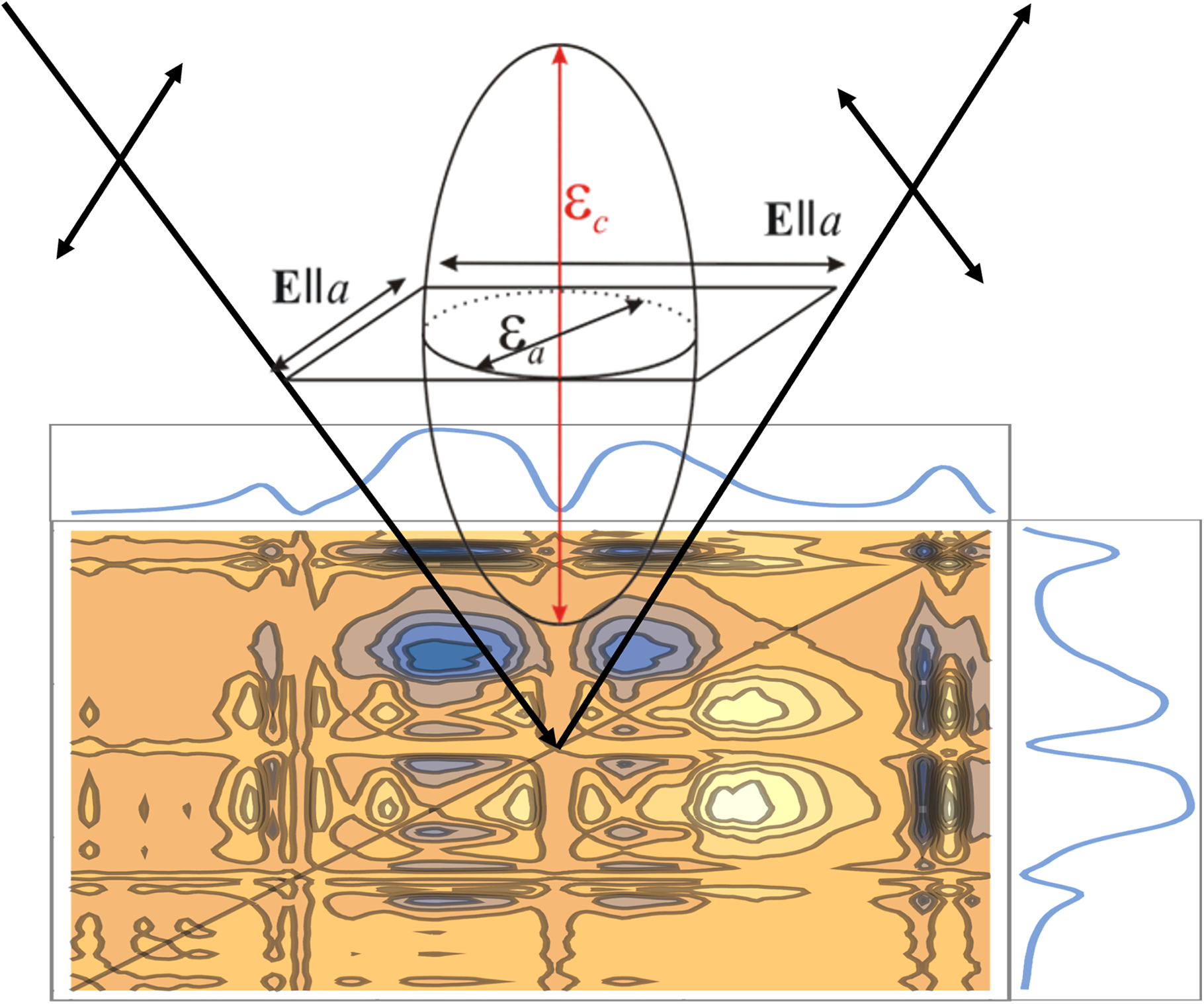
Keywords
Get full access to this article
View all access options for this article.
References
Supplementary Material
Please find the following supplemental material available below.
For Open Access articles published under a Creative Commons License, all supplemental material carries the same license as the article it is associated with.
For non-Open Access articles published, all supplemental material carries a non-exclusive license, and permission requests for re-use of supplemental material or any part of supplemental material shall be sent directly to the copyright owner as specified in the copyright notice associated with the article.
