



Abstract
Spectral multivariate calibration aims to derive models characterizing mathematical relationships between sample analyte amounts and corresponding spectral responses. These models are effective at predicting target domain sample analyte amounts when target samples are within the analyte and spectral calibration source domain. Models fail when target samples shift (analyte amounts and/or spectra) from the original calibration domain model. A total recalibration solution requires acquisition of new sample reference values and spectra. However, obtaining enough reference values to distinguish the target domain may be challenging or expensive. A simpler approach adapts the original model to the target domain using target sample spectra without analyte reference values (unlabeled). Analytical chemists have developed several machine learning algorithms using unlabeled regression domain adaptation processes. Unfortunately, prediction accuracy declines for these methods depending on how much the target domain analyte distribution has shifted from the calibration distribution, and regression transfer learning methods are instead needed. Regression domain adaptation and transfer learning are often referred to as model updating in analytical chemistry, but regression domain adaptation only applies to spectral shifts. The regression transfer learning method presented in this paper named null augmentation regression constant analyte (NARCA) leverages unlabeled repeat spectra of a single target sample to update an original calibration model to the shifted target domain sample. With sample repeat spectra, the analyte amount can be assumed constant or nearly constant for NARCA and because models are formed for one sample, NARCA operates as a local modeling method. The performance of NARCA as a regression transfer learning method is evaluated using five near-infrared data sets.
This is a visual representation of the abstract.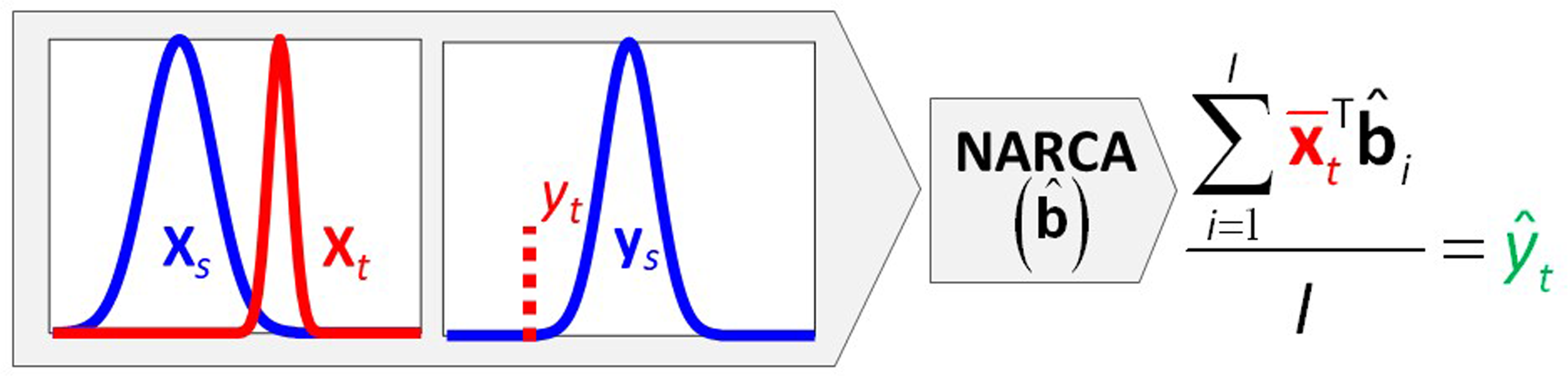
Get full access to this article
View all access options for this article.
References
Supplementary Material
Please find the following supplemental material available below.
For Open Access articles published under a Creative Commons License, all supplemental material carries the same license as the article it is associated with.
For non-Open Access articles published, all supplemental material carries a non-exclusive license, and permission requests for re-use of supplemental material or any part of supplemental material shall be sent directly to the copyright owner as specified in the copyright notice associated with the article.
