




Abstract
Plutonium research has been stifled by the significant number of administrative controls and safety procedures, space and instrumentation limitations in radiological gloveboxes, and the potential for personnel and equipment contamination. To address the limited number of spectroscopic studies in Pu-bearing compounds in the current scientific literature, this work presents the use of double-walled cells (DWCs) in “clean” buildings/laboratories as an alternative to research in radiological gloveboxes. This study reports the first laser-induced breakdown spectroscopy (LIBS) experiments of a PuO2 pellet contained within a DWC, where the formation of elemental (atomic and ionic) species as well as the evolution from elemental to molecular products (Pu x O y ) was measured. Raman spectroscopy was also used to characterize the surface of the ablated pellet and the particulates deposited on the window of the inner cell. The full width half-maximum of the T2g band enabled us to obtain an estimate of the temperature at the pellet surface after the ablation pulse and the particulates based on the crystal lattice disorder. Particulates deposited on the window of the DWC during laser ablation were characterized using scanning electron microscopy, where molten irregular particulates and spheroids were observed. This exciting research conducted in a DWC describes our initial attempts to incorporate LIBS in the arsenal of spectroscopic tools for nuclear forensics applications.
This is a visual representation of the abstract.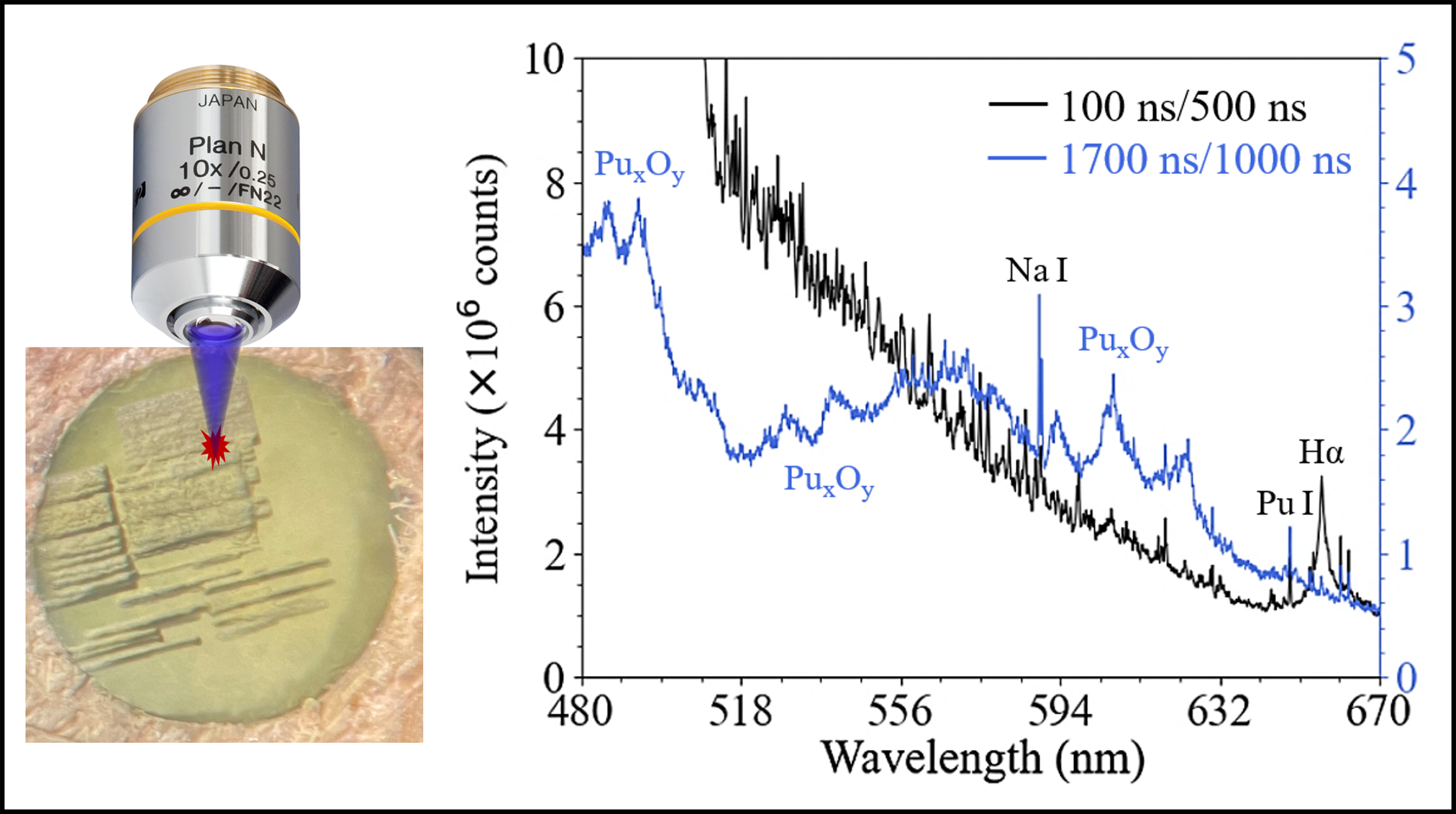
Keywords
Get full access to this article
View all access options for this article.
References
Supplementary Material
Please find the following supplemental material available below.
For Open Access articles published under a Creative Commons License, all supplemental material carries the same license as the article it is associated with.
For non-Open Access articles published, all supplemental material carries a non-exclusive license, and permission requests for re-use of supplemental material or any part of supplemental material shall be sent directly to the copyright owner as specified in the copyright notice associated with the article.
