




Abstract
In situ optical analytical spectroscopies offer great geochemical insights due to their capability to resolve the chemical composition of regolith surfaces of rocky celestial bodies. The use of suitable calibration targets improves the precision of mineral determination, which is of critical importance for short-living, low-mobility landers, and enables, in special cases, determination of elemental composition. We investigate the capabilities of three space-relevant optical analytical techniques used for in situ mineralogical analysis, i.e., mid-infrared reflection, Raman light scattering, and laser-induced plasma spectroscopies, to predict the chemical composition of olivine under a limited calibration input, namely using two bulk samples of natural olivine, chemically close to the end-members of the mineral group. We determine the accuracy of the forsterite numbers obtained with each technique and discuss the choice of calibration methods applicable to limited in situ calibration input, which are summarized in recommendations for space instrumentation.
This is a visual representation of the abstract.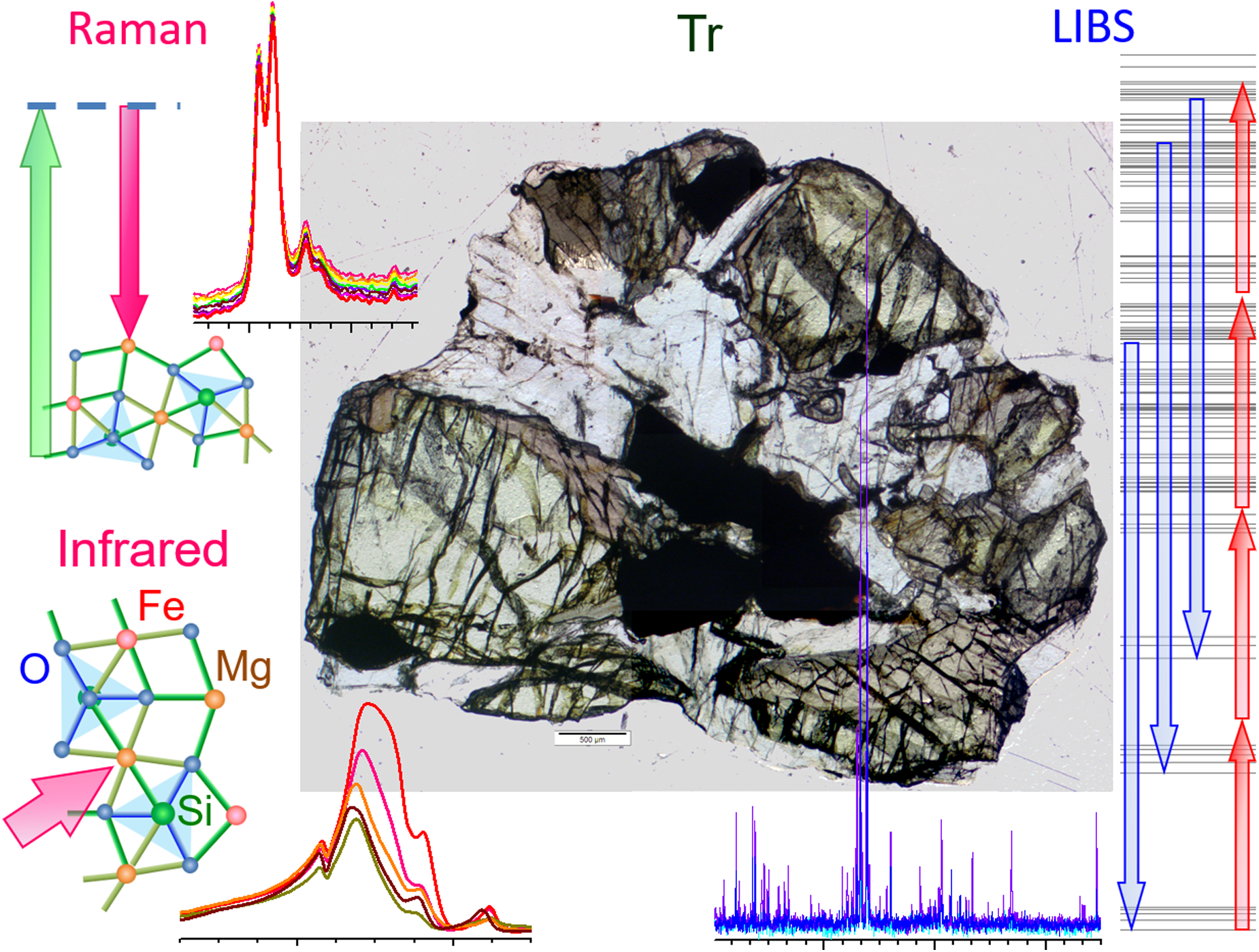
Keywords
Get full access to this article
View all access options for this article.
References
Supplementary Material
Please find the following supplemental material available below.
For Open Access articles published under a Creative Commons License, all supplemental material carries the same license as the article it is associated with.
For non-Open Access articles published, all supplemental material carries a non-exclusive license, and permission requests for re-use of supplemental material or any part of supplemental material shall be sent directly to the copyright owner as specified in the copyright notice associated with the article.
