



Abstract
Probes such as carbon dots (C-dots) have extensive and important applications in the quantitative analysis of complex biological and environmental systems. However, the development of probes is often hindered by incomplete selectivity, i.e., a probe that responds to one substance is also prone to respond to coexisting structurally similar substances. Therefore, the above dilemma often leads to be developed as semi-selective probes, so that the development of probes is abandoned halfway. This work shows how a semi-selective probe can enhance selectivity by combining a proper multivariate calibration model. Primarily, we developed a semi-selective fluorescent probe that responded to tetracyclines (TCs) with discarded tobacco leaves. Then, we introduced the multivariate quantitative fluorescence model (QFM) to enhance its selectivity and solve the problem of fluorescence spectral shift. For the determination of chlortetracycline (CTC) with this semi-selective C-dots probe in mineral and lake water samples and compared to the traditional quantitative model, the introduced QFM resulted in an average relative predictive error (ARPE) in mineral water spiked samples decreased from 57.1 to 5.6%, which reduced the ARPE in the lake water spiked samples from 18.1 to 4.7%. The above results show that the QFM-assisted semi-selective probe C-dots strategy (QFMC−dots) can enhance selectivity, and QFMC−dots achieved high-selective and accurate determination of CTC in interfering mineral and lake water samples, with the limit of detection and limit of quantitation of 0.55 and 1.66 μM, respectively. The proposed strategy of enhancing selectivity by introducing a proper multivariate calibration model can reduce the difficulty and increase success rate of developing probes, which can be expected to provide an interesting alternative for the development of probes, especially when encountering semi-selective problems.
This is a visual representation of the abstract.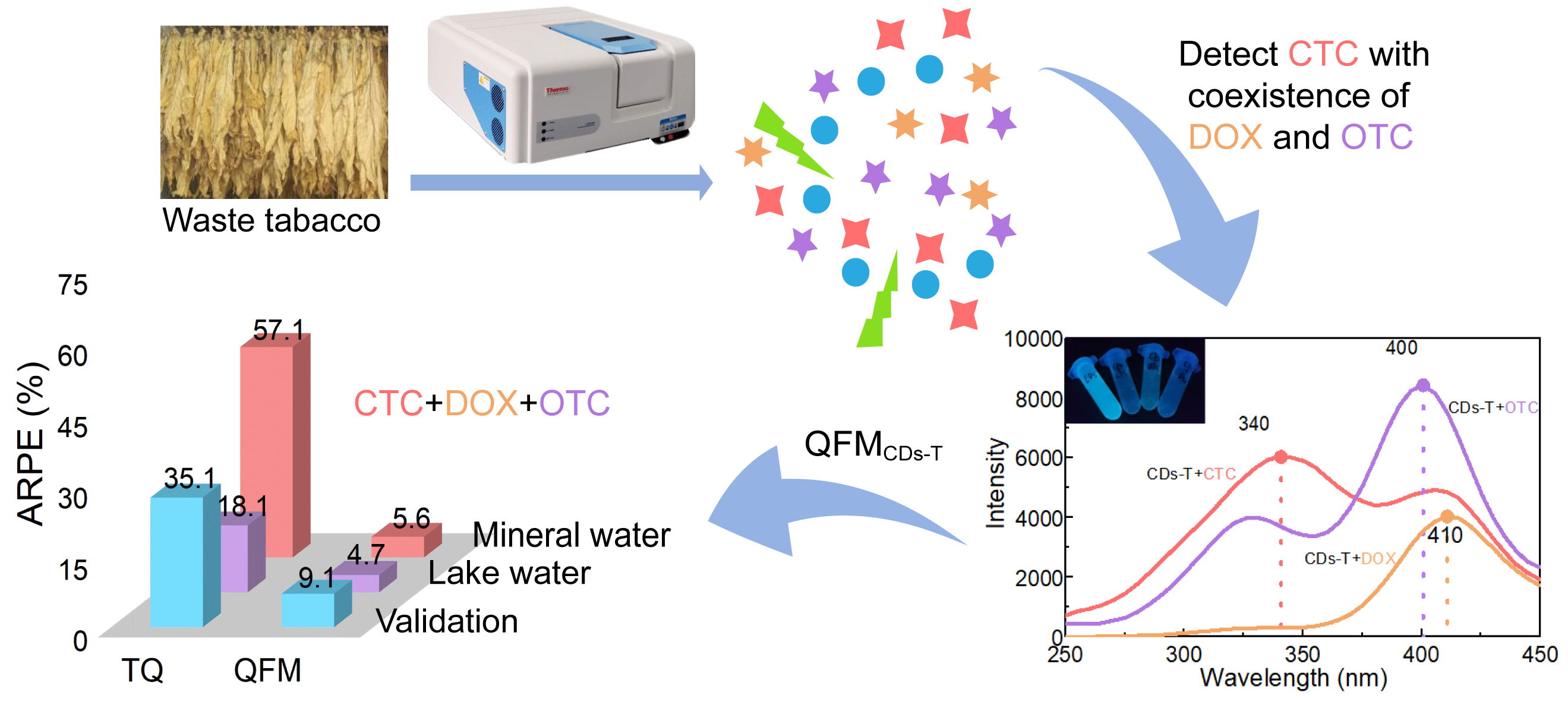
Keywords
Get full access to this article
View all access options for this article.
References
Supplementary Material
Please find the following supplemental material available below.
For Open Access articles published under a Creative Commons License, all supplemental material carries the same license as the article it is associated with.
For non-Open Access articles published, all supplemental material carries a non-exclusive license, and permission requests for re-use of supplemental material or any part of supplemental material shall be sent directly to the copyright owner as specified in the copyright notice associated with the article.
