



Abstract
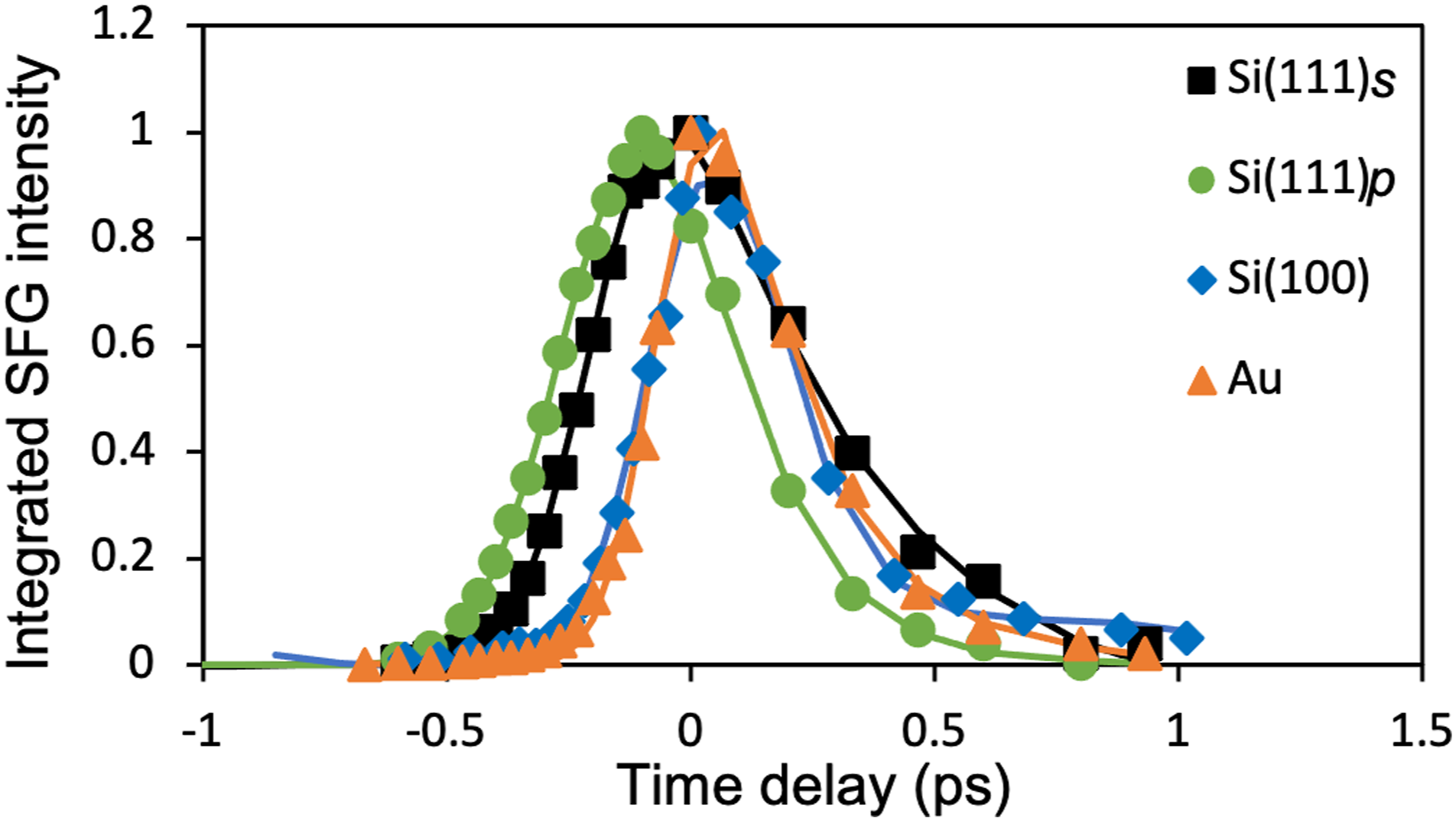
Proper analysis of vibrational sum-frequency generation (VSFG) spectra requires that the nonresonant contribution be dealt with correctly. This work shows that the temporal profile of the nonresonant SFG response varies with crystal facing and sample orientation for single-crystal Si and is significantly different than what is observed with polycrystalline Au. These considerations will affect the use of time-delay methods to experimentally suppress the nonresonant signal in broadband SFG measurements. Time-resolved or phase-sensitive SFG measurements will also need to properly account for these effects in post-processing.
Get full access to this article
View all access options for this article.
References
Supplementary Material
Please find the following supplemental material available below.
For Open Access articles published under a Creative Commons License, all supplemental material carries the same license as the article it is associated with.
For non-Open Access articles published, all supplemental material carries a non-exclusive license, and permission requests for re-use of supplemental material or any part of supplemental material shall be sent directly to the copyright owner as specified in the copyright notice associated with the article.
