




Abstract
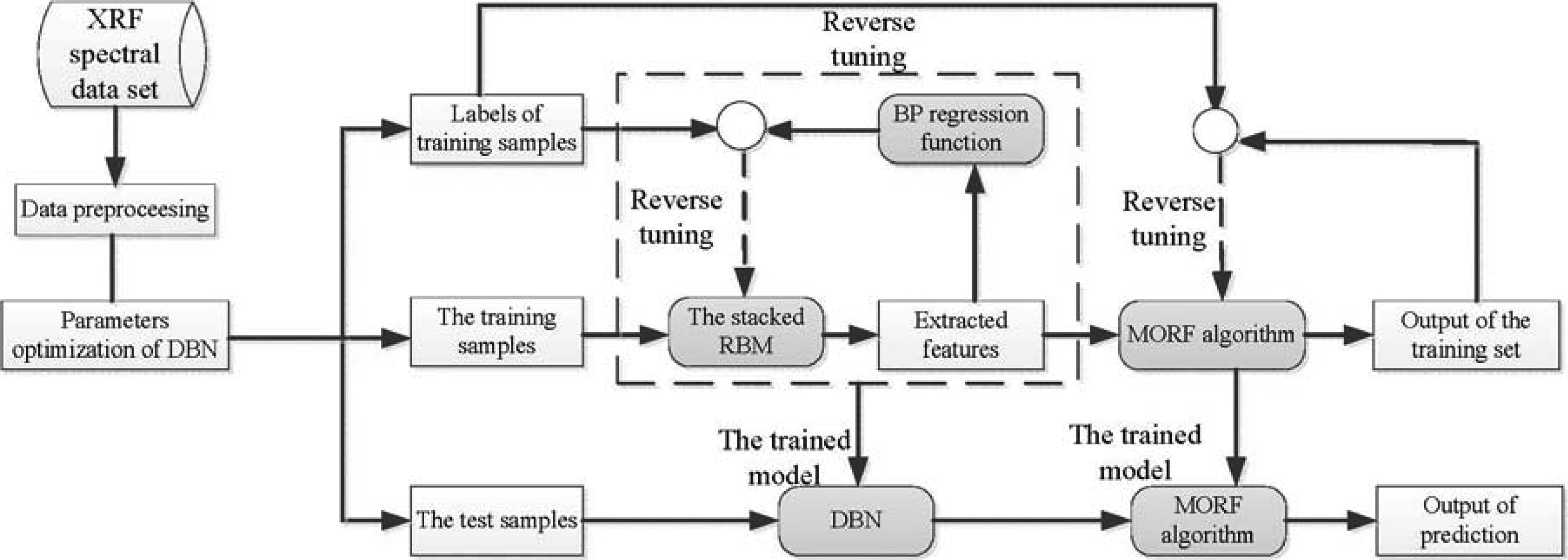
In order to extract useful information from X-ray fluorescence (XRF) spectra and establish a high-accuracy prediction model of soil heavy metal contents, a hybrid model combining a deep belief network (DBN) with a tree-based model was proposed. The DBN was first introduced into feature extraction of XRF spectral data, which can obtain deep layer features of spectra. Owing to the strong regression ability of the tree-based model, it can offset the deficiency of DBN in prediction ability so it was used for predicting heavy metal contents based on the extracted features. In order to further improve the performance of the model, the parameters of model can be optimized according to the prediction error, which was completed by sparrow search algorithm and the gird search. The hybrid model was applied to predict the contents of As and Pb based on spectral data of overlapping peaks. It can be obtained that R2 of As and Pb reached 0.9884 and 0.9358, the mean square error of As and Pb are as low as 0.0011 and 0.0058, which outperform other commonly used models. That proved the combination of DBN and tree-based model can obtain more accurate prediction results.
Keywords
Get full access to this article
View all access options for this article.
References
Supplementary Material
Please find the following supplemental material available below.
For Open Access articles published under a Creative Commons License, all supplemental material carries the same license as the article it is associated with.
For non-Open Access articles published, all supplemental material carries a non-exclusive license, and permission requests for re-use of supplemental material or any part of supplemental material shall be sent directly to the copyright owner as specified in the copyright notice associated with the article.
