




Abstract
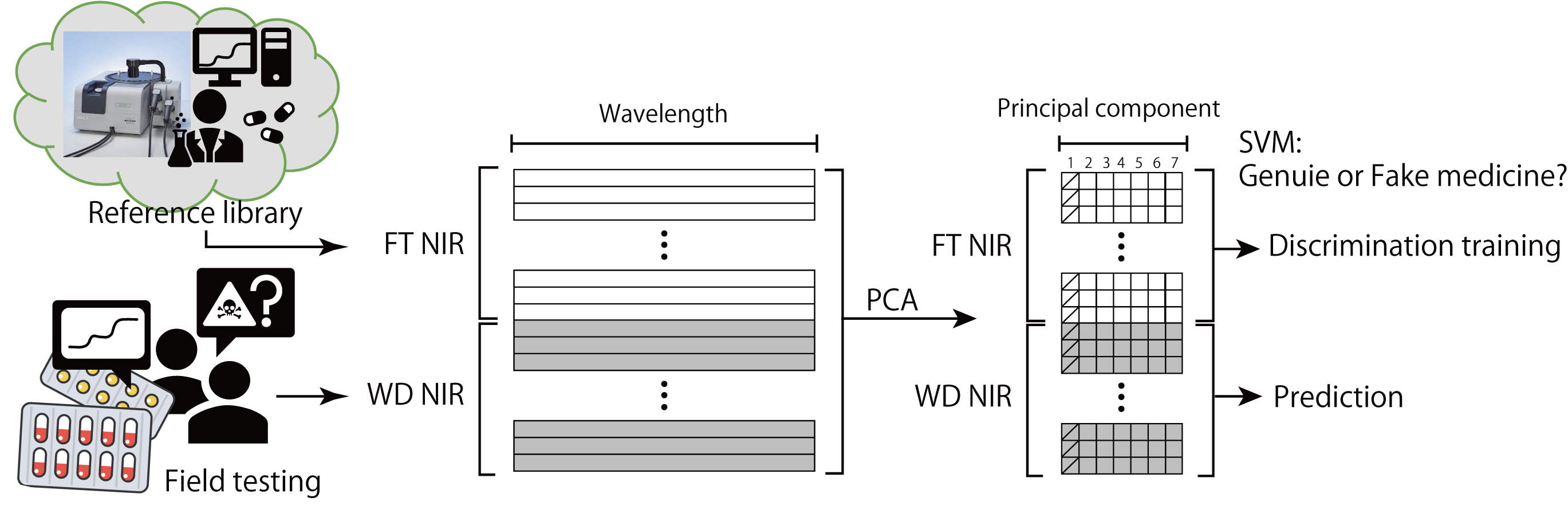
The objective of this work is to demonstrate the potential of near-infrared spectroscopy for common screening of falsified medicines in the field by means of a device-independent universal discrimination approach. In order to provide a useful discrimination tool to protect people from low-quality medical products, not only is a low-cost and portable screening device necessary, but a reference library is also essential. The authors believe that a device-dependent reference library inhibits near-infrared spectroscopy from becoming a popular screening tool. In this study, to develop a device-independent method, discrimination performance is evaluated using different devices for training and testing. The training data sets for the reference library were prepared using a bench-top Fourier transform near-infrared spectrophotometer, and predictive discrimination was performed using the spectral data by a low-cost and portable wavelength dispersive near-infrared spectrophotometer. A near-infrared spectrum-based support vector machine was used for these purposes, but the screening resulted in low accuracy thought to be caused by the intrinsically device-dependent features of the spectra data. Thus, principal component analysis was performed to collect the proper components to discriminate low-quality products from standard products. The principal component score-based support vector machine was able to produce highly accurate results, identifying falsified products with no false positive cases.
Keywords
Get full access to this article
View all access options for this article.