



Abstract
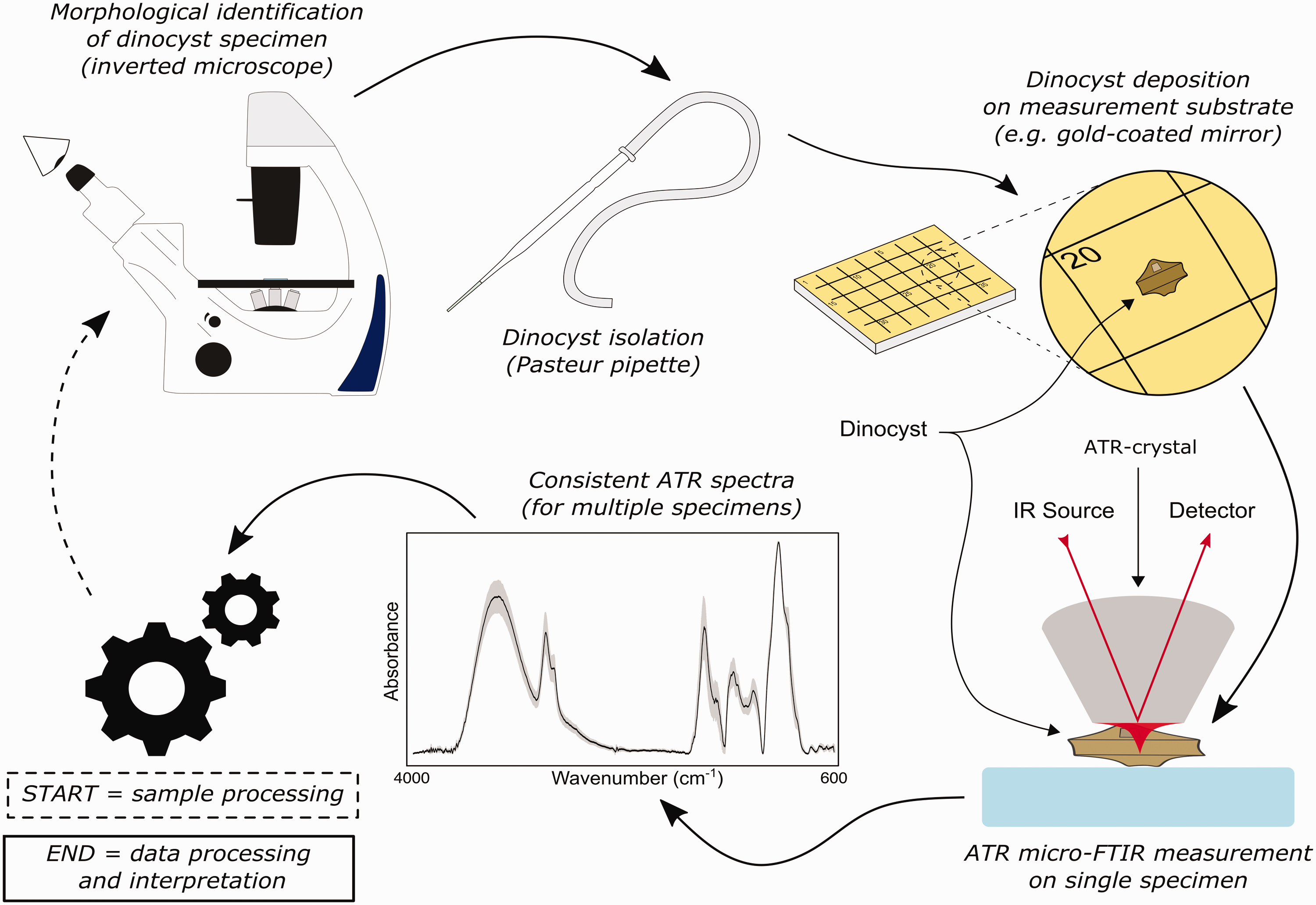
The chemical composition of recent and fossil organic-walled dinoflagellate cyst walls and its diversity is poorly understood and analyses on single microscopic specimens are rare. A series of infrared spectroscopic experiments resulted in the proposition of a standardized attenuated total reflection micro-Fourier transform infrared-based method that allows the collection of robust data sets consisting of spectra from individual dinocysts. These data sets are largely devoid of nonchemical artifacts inherent to other infrared spectrochemical methods, which have typically been used to study similar specimens in the past. The influence of sample preparation, specimen morphology and size and spectral data processing steps is also assessed within this methodological framework. As a result, several guidelines are proposed which facilitate the collection and qualitative interpretation of highly reproducible and repeatable spectrochemical data. These, in turn, pave the way for a systematic exploration of dinocyst chemistry and its assessment as a chemotaxonomical tool or proxy.
Keywords
Get full access to this article
View all access options for this article.
References
Supplementary Material
Please find the following supplemental material available below.
For Open Access articles published under a Creative Commons License, all supplemental material carries the same license as the article it is associated with.
For non-Open Access articles published, all supplemental material carries a non-exclusive license, and permission requests for re-use of supplemental material or any part of supplemental material shall be sent directly to the copyright owner as specified in the copyright notice associated with the article.
