



Abstract
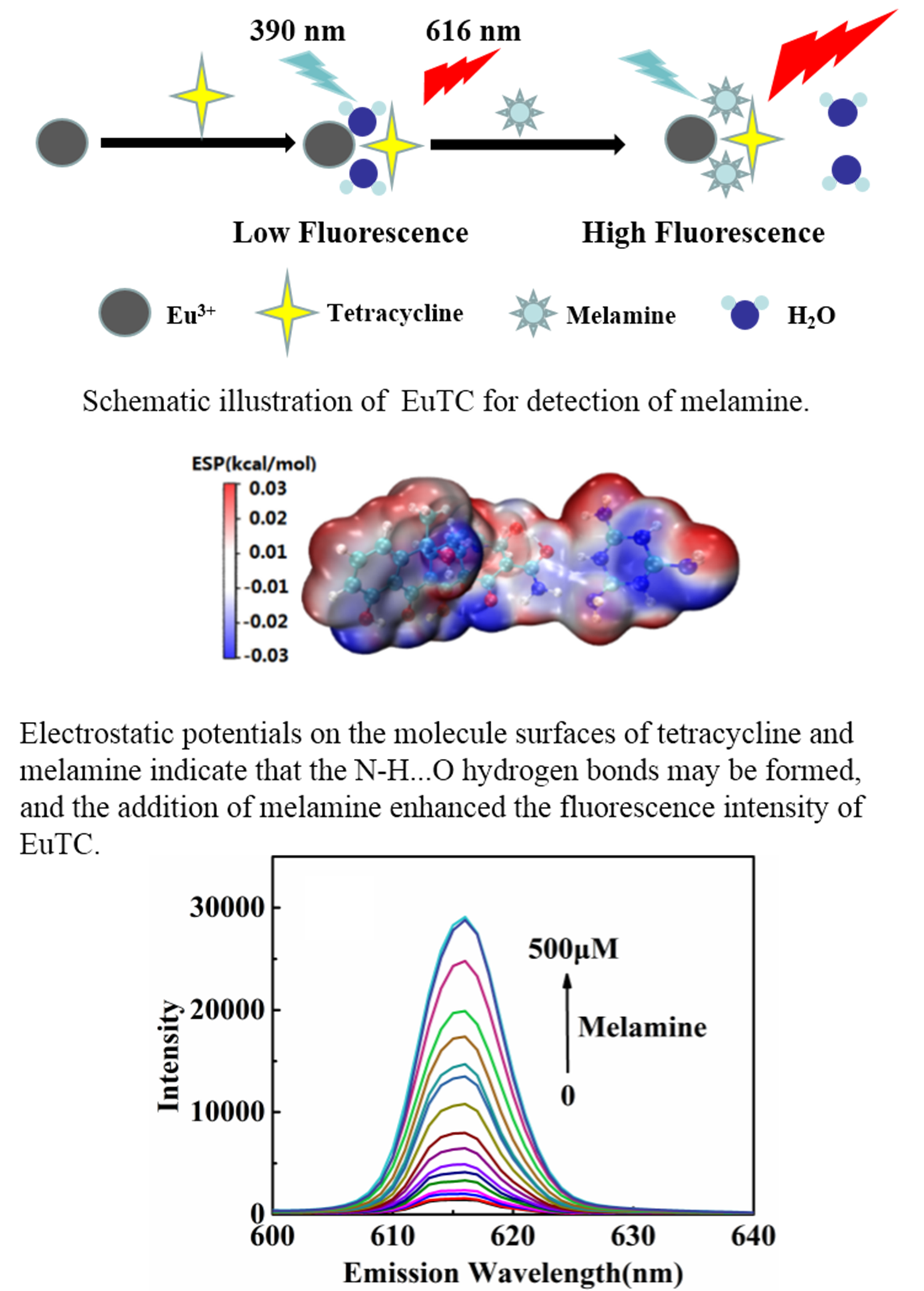
Melamine has been illegally adulterated in dairy food because of the rich nitrogen content and stable chemical properties in recent years. Therefore, the detection of melamine is of great significance for food safety supervision and human health protection. As melamine is a weak fluorescent substance, it is difficult to detect melamine directly by fluorescence spectroscopy. In this work, we found that melamine can significantly enhance the emission of the tetracycline–europium (EuTC) complex at 616 nm. Therefore, we took EuTC complex as a fluorescent probe to detect melamine. According to the characterizations of absorption spectra, molecular electrostatic potential distribution, and the time-resolved spectra, we speculated that tetracycline and melamine may form a complex through hydrogen bonding interaction in the melamine-EuTC reaction system, causing the melamine closer approach to Eu3+ and reducing the non-radiative energy loss of water molecules to Eu3+, which significantly enhanced the fluorescence intensity of EuTC. The fluorescence intensity of EuTC complex with melamine concentration in the range of 0.5–40.0 μM shows a good linear relationship, and the correlation coefficient is 0.9951 with the detection limit of 7.85 × 10⁻⁸ M. It shows a high sensitivity for the EuTC complex as a fluorescent probe to detect melamine, which provides a supplement and extension for the detection of melamine by fluorescence spectroscopy.
Get full access to this article
View all access options for this article.
References
Supplementary Material
Please find the following supplemental material available below.
For Open Access articles published under a Creative Commons License, all supplemental material carries the same license as the article it is associated with.
For non-Open Access articles published, all supplemental material carries a non-exclusive license, and permission requests for re-use of supplemental material or any part of supplemental material shall be sent directly to the copyright owner as specified in the copyright notice associated with the article.
