



Abstract
The ubiquitous pollution of the environment with microplastics, a diverse suite of contaminants, is of growing concern for science and currently receives considerable public, political, and academic attention. The potential impact of microplastics in the environment has prompted a great deal of research in recent years. Many diverse methods have been developed to answer different questions about microplastic pollution, from sources, transport, and fate in the environment, and about effects on humans and wildlife. These methods are often insufficiently described, making studies neither comparable nor reproducible. The proliferation of new microplastic investigations and cross-study syntheses to answer larger scale questions are hampered. This diverse group of 23 researchers think these issues can begin to be overcome through the adoption of a set of reporting guidelines. This collaboration was created using an open science framework that we detail for future use. Here, we suggest harmonized reporting guidelines for microplastic studies in environmental and laboratory settings through all steps of a typical study, including best practices for reporting materials, quality assurance/quality control, data, field sampling, sample preparation, microplastic identification, microplastic categorization, microplastic quantification, and considerations for toxicology studies. We developed three easy to use documents, a detailed document, a checklist, and a mind map, that can be used to reference the reporting guidelines quickly. We intend that these reporting guidelines support the annotation, dissemination, interpretation, reviewing, and synthesis of microplastic research. Through open access licensing (CC BY 4.0), these documents aim to increase the validity, reproducibility, and comparability of studies in this field for the benefit of the global community.
Keywords
Introduction
The state of method reporting for investigations on microplastic pollution is currently at a turning point. 1 As this new research field evolves, it is striving to establish a harmonized community approach to developing, applying, and reporting methodologies. Two of the main purposes for reporting scientific methods are to allow for their replication and enable data to be directly comparable among studies. For example, in the environmental sciences, data from studies might be compared during risk assessments, synthesized for meta-analyses, or used to inform policy creation and monitoring guidelines. Issues with reproducibility and comparability of both data and methods are common across all scientific fields,2–4 including microplastic research.1,5,6 Here, this diverse group of 23 microplastic researchers from around the world, present a proposed step towards addressing this issue for microplastics, first by capturing what is already in published literature, and then by prioritizing which types of information should be included in research to reach this goal. Our four aims are to (i) review key reproducibility and comparability problems and solutions for microplastic research; (ii) discuss the open science framework used to identify and prioritize key methodological parameters suggested here; (iii) develop reporting guidelines for researchers to use when reporting, comparing, and developing methods; and (iv) present our vision for future microplastic research.
The Reproducibility and Comparability Turning Point in Microplastics Research
It is well known that microplastics have a ubiquitous presence in the environment,7–10 and the potential harm microplastics can cause to species across trophic levels has been recently reviewed.11,12 While there is mixed evidence for effects, a range of suborganismal, organismal, and population-level responses have been reported.6,11,13 These results have spurred substantial research activity, as evidenced by the continued exponential growth in the published literature on the topic of microplastics (Fig. 1).
Data acquired from Scopus on 8 April 2020 using the search term “microplastic*” and querying the field of environmental sciences. Publications are annual sums. The figure was created using Python 3.6.9.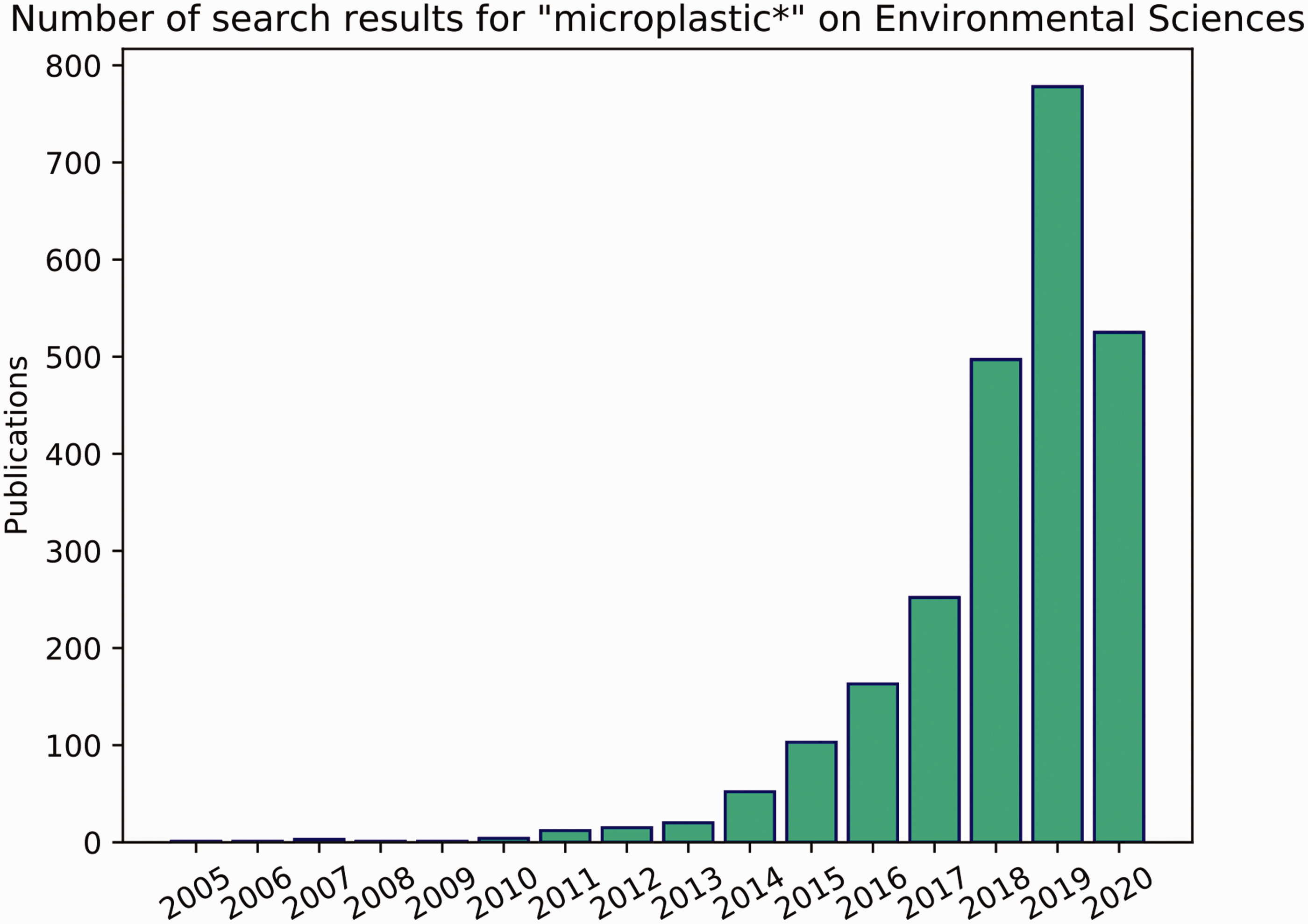
The rapid expansion of research activities and the resulting data generated in the field of microplastics has resulted in a diverse suite of methods and non-standardized approaches to reporting sample collection, extraction, and analysis.1,14–21 Each method has its strengths and weaknesses, and there are continued efforts to optimize existing methods and develop new ones that may improve throughput, detection limit, and reproducibility. The development of new methods continues because currently there is no “catch-all” combination of methods for sampling, extracting, analyzing, and reporting microplastics that is capable of accurately characterizing and quantifying all microplastics present in a sample.22,23 This is because microplastics are a diverse suite of contaminants that vary greatly in morphology, chemical properties, texture, color, density, and size. 24 Moreover, environments and research goals are diverse and a universal solution is unable to capture this diversity, especially as research matures in this rapidly expanding field. With this in mind, methods should be chosen based on the scientific question and reported with enough detail to be comparable and reproducible.
Comparability between studies facilitates meta-analysis,25,26 which has been difficult for microplastics due to the diversity of methods employed and study details reported.17–21 Incomparability is caused by studies published without documenting the elements essential for translating units and metrics to others that are commonly used in the field. For example, studies that employ Raman spectroscopy might not be comparable to those that employ Fourier-transformed infrared (FT-IR) spectroscopy if neither describes their analysis and data transformation steps.18,27 Additionally, aquatic studies that use water volume grab sampling are not comparable to studies that use net sampling if the studies do not describe the mesh size used, depth of sample collection, or the sample volume. 28 In another example, ingestion studies on the same species of animal are not comparable if they fail to mention which part of the gastrointestinal tract was analyzed (e.g., just the gizzard or the gizzard and proventriculus of birds).15,17 Moreover, a study using different chemical digestion methods to measure ingestion may be incomparable because some digestion procedures destroy certain plastics. 29 Regardless of diverse methods and wherever possible, reporting raw - or less processed - data would allow reverse engineering and harmonization of some techniques. Still, raw data are seldom reported.16,30
Factors that cause incomparability can also hinder the reproducibility of research. Irreproducible research occurs, in part, when the elements that are critical for reproducing similar results are not elucidated. Reproducibility allows responsible decision-making and expansion of protocols. For example, software names should be reported when used because software often has proprietary algorithms and may not be reproducible unless the same software is used. In another example, if a study that employs organic matter digestion does not describe the chemical solution used, its manufacturer, and concentration used to digest the sample, the study cannot be reproduced.
Reporting guidelines provide a structured framework where method information critical to comparing and reproducing research can be referenced. There is a critical need for reporting guidelines in microplastic research as already initiated with the Minimum Information for Microplastic Studies (MIMS) concept for the study of microplastics in seafood, 1 the minimum information for publication of infrared-related data, 27 and other works assessing data quality in microplastic studies.31–33 The reporting guidelines we developed attempt to build on previous work and expand the scope to more methodological components in microplastic research. This study leverages the expertise of a diverse group of researchers from around the world to cover the breadth of the field. To be as transparent as possible, we elaborate on the reasons why each reporting guideline is necessary and provide examples for each. Other fields, like molecular biology, 34 proteomics, 35 and transcriptomics, 36 already have highly successful examples of reporting guidelines that have been widely adopted by their field, and we hope this work serves a similar purpose in our field.
Methods
As a scientific community, we recognize that the need for reporting guidelines for microplastic methods is best addressed through a collaborative open science framework. With this goal in mind, the lead author sent out the following request on Twitter, and tagged several scientists in the microplastic community with a link to a collaborative document: Frustrated with the reproducibility crisis in #microplastics research from poor method descriptions? Now is your chance to change that. I will publish this collaborative document OA [Open Access]. Add method considerations to this document and cite yourself in the Ack [Acknowledgements].—Win Cowger, @Win_OpenData, 13 June 2019
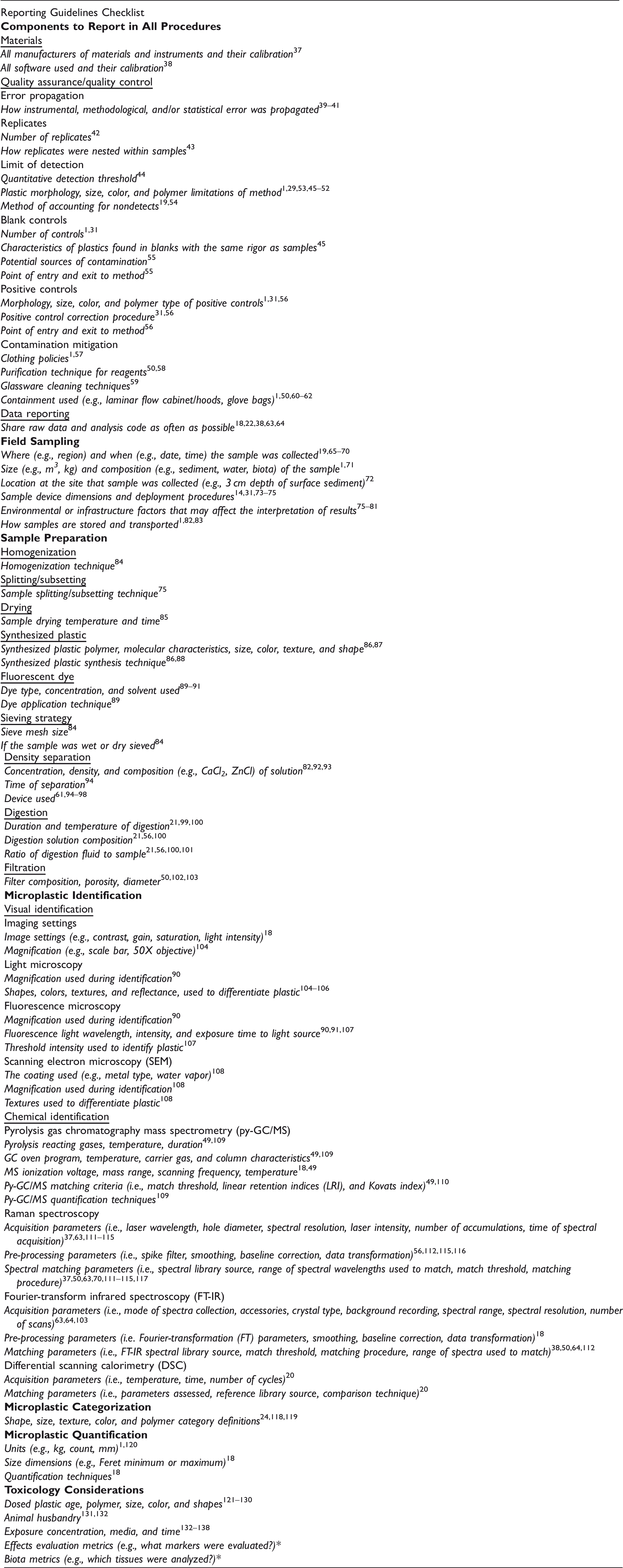
The reporting guidelines were identified by referencing standard operating procedures used by various authors and other peer-reviewed publications. All authors agreed not to use language that would imply an intent to standardize methodology or recommend specific methods over others; this was beyond the scope of the work. The task of the authors in developing the reporting guidelines was to outline what should be reported about a method when the method was used to make the method reproducible and comparable. To determine which guidelines were essential to add to the documents, each author was asked to fill out a Google Form survey where they designated each reporting category as required or not. The final reporting guidelines were formed by keeping only the guidelines that 51% or more of the authors agreed upon. During the review process, we received requests by reviewers to add additional reporting requirements. Where they were not already accounted for, we added them to the reporting guidelines and indicated those additions using an asterisk throughout the produced documents. The final reporting guidelines were packaged into three documents which have the same information summarized with specific user groups in mind: (i) thorough, a Detailed Document, (ii) quick and simple, a Checklist (Table 1), and (iii) interactive, an online Mind Map (Fig. 2).
A screenshot of the Mind Map (LINK) showing the components and flow of reporting guidelines for microplastic studies. The first nodes branching off of “Microplastic Reporting Guidelines” are the general groups of the guidelines, subgroups follow in bold until the second to last nodes are the reporting guidelines (in italic) and the terminal node is the description of the guideline. This is the Checklist of the reporting guidelines. Asterisks (*) indicate that the guideline was added as part of peer review; all other guidelines were voted on by a majority of the coauthors. The guidelines are grouped using bolded and underlined, and normal formatted labels. The guidelines are italicized. Citations correspond to additional information related to the guideline and good examples of reporting.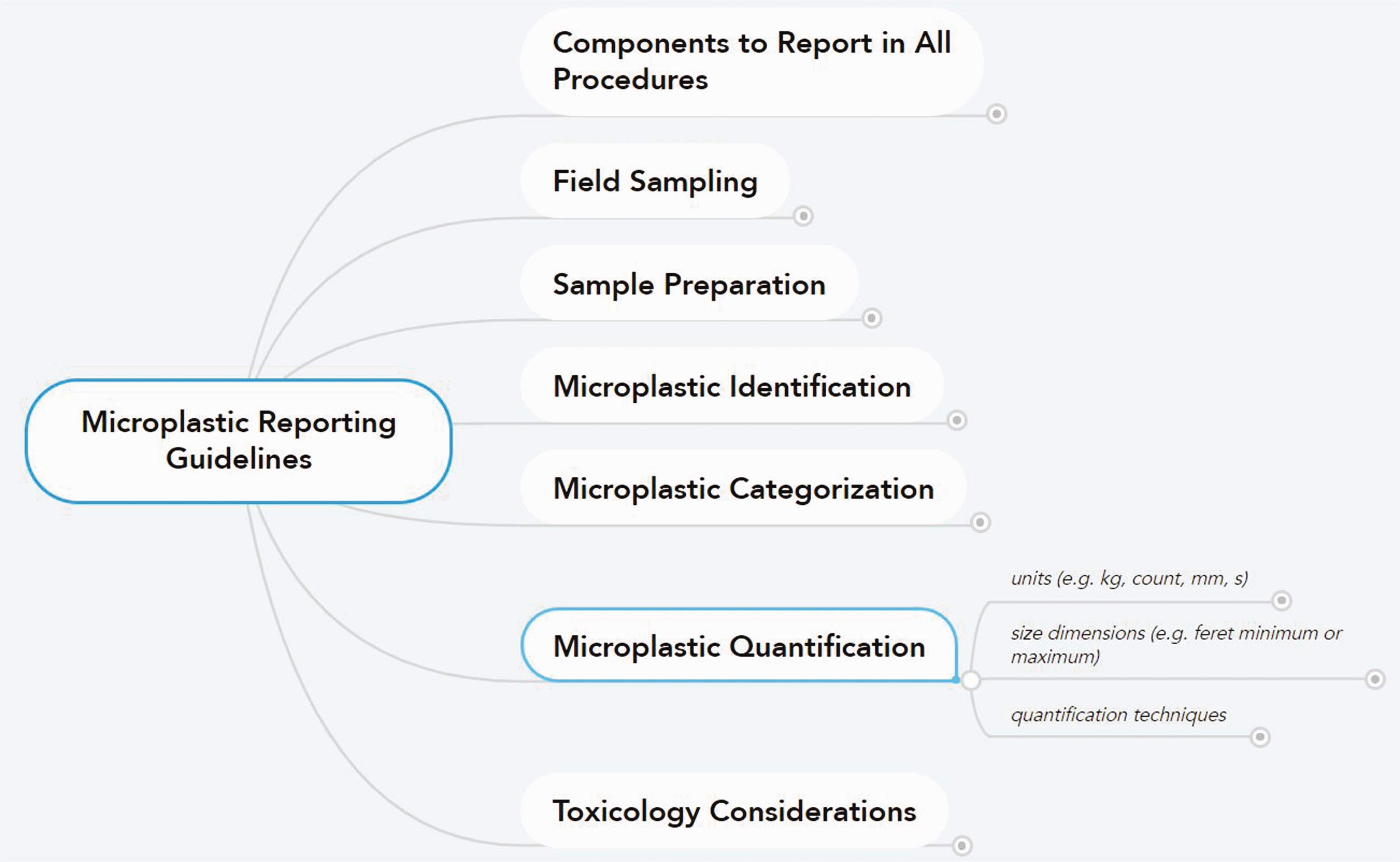
The reporting guidelines were sent out to other colleagues in the field for an endorsement and critique designated as signatories in the acknowledgments. The manuscript and supporting information were also subject to internal review at the National Institute of Standards and Technology (NIST) and single blind peer review from Applied Spectroscopy. In these ways, we attempted to receive as much feedback as we could to develop reporting guidelines that reflect the diverse group of experts and the broad scope of methods in microplastic research. This framework represents an example of a way that scientists in any field can develop robust collaborations by sharing ideas and learning from one another while developing useful reference documents, even if they have not met before.
Reporting Guideline Document Descriptions
The three documents we created of the reporting guidelines include a (i) Detailed Document, (ii) Checklist (Table I), and (iii) online Mind Map (Fig. 2). Each document has the same information summarized with different users in mind. These documents are expected to be useful for scientists researching microplastics, peer reviewers asked to evaluate research, and users of the data. These documents outline what needs to be reported for common methods in microplastic research to be reproducible and comparable. The documents can also be used when developing methods internally to quickly identify the essential components of a method to calibrate and control in a lab. The Detailed Document can be used when every detail listed in the reporting guidelines are important to know. The Checklist can be used to quickly reference the reporting guidelines and check off the guidelines relevant to a specific study. The Mind Map is useful for those who prefer interactive information workflows and want to be able to quickly summarize and expand the reporting guidelines at any level of detail.
Any of these documents can be used to reference the report guidelines. All of the documents contain the same information reformatted and summarized. In the documents, the general method groups we define are: Materials, Quality Assurance/Quality Control (QA/QC), Data Reporting, Field Sampling, Sample Preparation, Identification, Categorization, Quantification and Toxicology Considerations. Subgroups describe specific method techniques within each group. Some of the groups may be used more than once in a study while some may not be used at all. It is important to note that these documents are templates and one need only consider the guidelines from the groups of methods relevant to a given study. When using the documents, first, assess which groups of methods apply to the study. Subgroups of methods are tab separated to indicate more detailed levels of grouping. Next, assess which of the subgroups apply. These can be highlighted or opened for easy reference. Where the most detailed subgroups apply, all italicized reporting guidelines must be defined, described, or discussed for that method to be reproducible and comparable. All reporting guidelines always apply to groups that do not have subgroups. Importantly, these reporting guidelines are not meant to completely define what should be reported but are a proposal for the minimum guidelines. Below we detail each document individually and outline a path forward for the documents to be updated.
Detailed Document
The Detailed Document (Supplemental Material 1; OSF) is the plain-text thorough version of the reporting guidelines containing the identical information, groups, and order to the Checklist and Mind Map described below. While this document is the primary result of this project, its length precludes including it in the main manuscript. The Detailed Document is meant for those who are new to the methods or want a detailed description and reference examples of the reporting guideline. This document may also be useful to those who find the Mind Map format to be challenging to navigate. The Detailed Document is easily printed for reference, which can be especially useful during the design stage of a study. The format of this document follows that the highest level of method grouping is in the largest text font and bolded. Subgroups of methods are in bold and identical font size but further indented if they are a subgroup of a subgroup. The essential elements to report are italicized and all the same font size. The explanation, reason, and examples for each essential element immediately follow the element and are light gray in color.
The Checklist
The Checklist (Supplemental Material 2; OSF; Table I) is meant for those already familiar with the methods and reasons for reporting outlined in the other documents. The format follows the Detailed Document but the explanation, reason, and examples for each reporting guideline are removed for quick reference and reading so that the elements can be checked off when reviewing or writing documents. Citations used in the Detailed Document are added at the end of each guideline. The reporting guidelines are italicized and all the same font size as in the Detailed Document.
Mind Map
The Mind Map (Supplemental Material 3; LINK; OSF; Fig. 2) was developed because we recognized a need to have many intermediate levels of detail between the detail provided by the Detailed Document and the Checklist. Interactive mind map documents allow the user to query to the level of detail they need quickly. This is meant for users who prefer spatially structured interactive information queries. The Mind Map was formatted using www.mindmeister.com, a free collaborative mind map creator that can reformat mind maps into tiered documents. The Mind Map is structured the same as the Detailed Document, where general method groups flow from the primary term “Microplastics Reporting Guidelines”. These general groups are further refined by subgroups of method types and instrument groups, where the terminal node of every branch leads to essential methodology elements (italicized) that should be reported. Each reporting guideline is described by an explanation, reasons to report, and/or examples from published microplastic literature.
Strategy for Updating the Reporting Guidelines
The field of microplastic research is rapidly evolving, and we expect that our documents, like most things in science, will need to be adapted, expanded, and revised. We recognize that as the field of microplastic pollution develops and grows, there will be new techniques and methods developed that will have reporting guidelines. We also acknowledge other methods are already useful to report that are not yet covered here. These documents are expected to be updated over time as new techniques are developed. That is why all documents are completely free and hold open access licenses (CC BY 4.0). The license allows for redistribution and adaptation with attribution to the original document. Additionally, we created an Open Science Framework project (OSF) for each document where researchers can reach out with suggestions and comments to update future editions of these documents. The authors will monitor the comments on the project and respond, as necessary. Future versions will be updated periodically on the OSF project site using version control. Additionally, we submitted this reporting guideline and others reported in the literature1,27 to the reporting guideline portal at https://fairsharing.org/. We hope that these documents and online forums are widely used for the benefit of the global community.
Our Vision of the Future of Research on Microplastics
We envision a future where research on microplastics is comparable, reproducible, and transparent. We aim for researchers in the field to be able to read a paper and use the methods for their work and/or use the data in a synthesis paper or meta-analysis. We aim for policymakers and managers to be able to review the literature and have the ability to compare data across sources, pathways, and geographies to inform the decision-making process. We envision a field where communication is clear amongst different stakeholders in the world of microplastics and where collaboration and research translation are made simpler. With our collaborative and open access framework, we aim to improve future work on microplastics and provide a framework for other emerging contaminants.
Disclaimer
Certain commercial equipment, instruments, or materials are identified in this paper to specify adequately the experimental procedure. Such identification does not imply recommendation or endorsement by the National Institute of Standards and Technology, nor does it imply that the materials or equipment identified are necessarily the best available for the purpose.
Supplemental Material
sj-pdf-1-asp-10.1177_0003702820930292 - Supplemental material for Reporting Guidelines to Increase the Reproducibility and Comparability of Research on Microplastics
Supplemental material, sj-pdf-1-asp-10.1177_0003702820930292 for Reporting Guidelines to Increase the Reproducibility and Comparability of Research on Microplastics by Win Cowger, Andy M. Booth, Bonnie M. Hamilton, Clara Thaysen, Sebastian Primpke, Keenan Munno, Amy L. Lusher, Alexandre Dehaut, Vitor P. Vaz, Max Liboiron, Lisa I. Devriese, Ludovic Hermabessiere, Chelsea Rochman, Samantha N. Athey, Jennifer M. Lynch, Hannah De Frond, Andrew Gray, Oliver A.H. Jones, Susanne Brander, Clare Steele, Shelly Moore, Alterra Sanchez and Holly Nel in Applied Spectroscopy
Supplemental Material
sj-pdf-2-asp-10.1177_0003702820930292 - Supplemental material for Reporting Guidelines to Increase the Reproducibility and Comparability of Research on Microplastics
Supplemental material, sj-pdf-2-asp-10.1177_0003702820930292 for Reporting Guidelines to Increase the Reproducibility and Comparability of Research on Microplastics by Win Cowger, Andy M. Booth, Bonnie M. Hamilton, Clara Thaysen, Sebastian Primpke, Keenan Munno, Amy L. Lusher, Alexandre Dehaut, Vitor P. Vaz, Max Liboiron, Lisa I. Devriese, Ludovic Hermabessiere, Chelsea Rochman, Samantha N. Athey, Jennifer M. Lynch, Hannah De Frond, Andrew Gray, Oliver A.H. Jones, Susanne Brander, Clare Steele, Shelly Moore, Alterra Sanchez and Holly Nel in Applied Spectroscopy
Footnotes
Acknowledgments
The authors would like to thank Justine Ammendolia, Sarah Nelms, Kristian Parton, Jessica Melvin, Matthew Cole, Shannon Tarby, and Alexander Turra for their helpful input throughout the writing and envisioning process. Additionally, we would like to thank those who endorsed the document that we developed: Greg Sambrook Smith, Claire Gwinnett, Dorthy Horn, Katie Allen, Jesse Vermaire, Garth Covernton, Francois Galgani, Pernilla Carlsson, Zacharias Steinmetz, Tanja Kögel, Louise Feld, Jakob Strand, Meredith Seeley, Bethanie Carney Almroth, Timothy Hoellein, Jessica Melvin, Katrin Wendt-Potthoff, Scott Coffin, and Susannah Bleakley.
We also thank our funders. W. Cowger was funded by the National Science Foundation Graduate Research Fellowship Program. A. Booth received funding from the Research Council of Norway through the Joint Programming Initiatives (JPI) Oceans project 'PLASTOX: Direct and indirect ecotoxicological impacts of microplastics on marine organisms' (grant agreement No. 257479) and the project 'MICROFIBRE: Evaluating the fate, effects and mitigation measures for microplastic fiber pollution in aquatic environments' (grant agreement No. 268404). C. Thaysen was funded by the Herbert W. Hoover Foundation. S. Primpke was funded by the German Federal Ministry of Education and Research (Project BASEMAN (JPI-Oceans) - Defining the baselines and standards for microplastics analyses in European waters; Federal Ministry of Education and Research (BMBF) grant 03F0734A). A. Dehaut is thankful to the French National Research Agency (ANR-15-CE34-0006-02), as part of the Nanoplastics project. He is also grateful to different bodies, as his contribution has been carried out thanks to the financial support of the European Union (ERDF), the French State, the French Region Hauts-de-France and Ifremer, in the framework of the project CPER MARCO 2015-2020. V. Vaz was funded by Coordenação de Aperfeiçoamento de Pessoal de Nível Superior (CAPES). M. Liboiron was funded by the Office of the Vice President Research, Memorial University; Social Sciences and Humanities Research Council; Northern Contaminants Program (NCP), and Memorial's Undergraduate Career Experience Program (MUCEP) program. A. Gray was funded in part by the United States Department of Agriculture's (USDA) National Institute of Food and Agriculture, Hatch and Multistate W4170 programs [project numbers CA-R-ENS-5120-H and CA-R-ENS-5189-RR]. S. Brander was funded by National Oceanic and Atmospheric Association grant #NA17NOS9990025, Oregon Agricultural Research Foundation, and NSF Growing Convergence Research grant #1935028. A. Sanchez was funded by the National Science Foundation Graduate Research Fellowships Program (No. DGE 1322106) and DC Water Blue Plains Advanced Wastewater Treatment Plant. H. Nel received funding from the Leverhulme Trust.
ORCID iDs

References
Supplementary Material
Please find the following supplemental material available below.
For Open Access articles published under a Creative Commons License, all supplemental material carries the same license as the article it is associated with.
For non-Open Access articles published, all supplemental material carries a non-exclusive license, and permission requests for re-use of supplemental material or any part of supplemental material shall be sent directly to the copyright owner as specified in the copyright notice associated with the article.
