




Abstract
Introduction
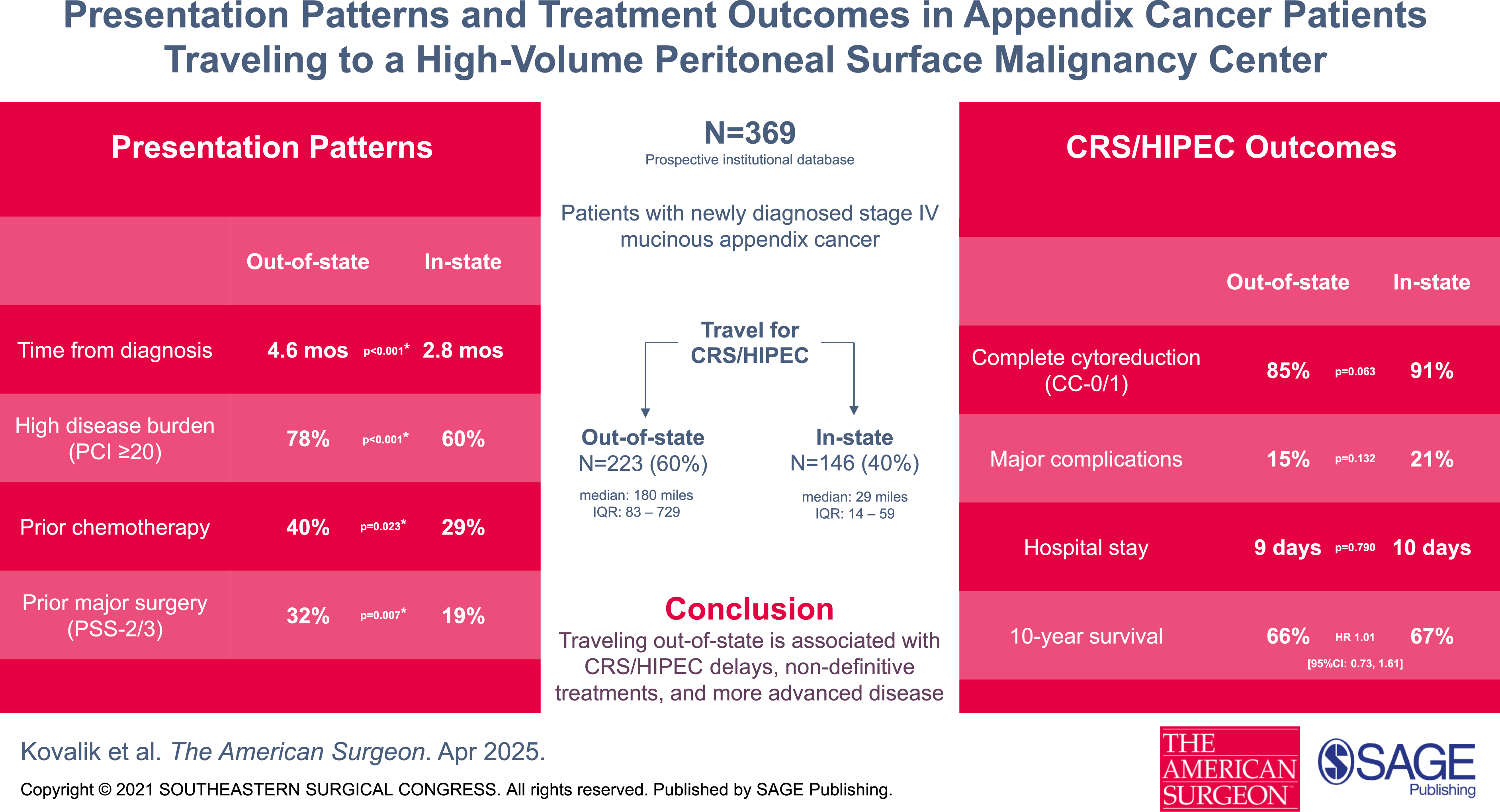
Mucinous appendix cancer (MAC) treatment is centralized at peritoneal surface malignancy centers (PSMCs), requiring patients to travel for cytoreductive surgery and hyperthermic intraperitoneal chemotherapy (CRS/HIPEC). We compared presentation patterns and outcomes for patients accessing a high-volume PSMC from in-state (I-S) vs out-of-state (O-S).
Methods
This cohort study of MAC patients with peritoneal metastases treated with CRS/HIPEC (1998-2023) used a prospective database. Travel distance, presentation (time from diagnosis [TFD], peritoneal cancer index [PCI], prior surgery score [PSS], and systemic chemotherapy [SCh]), quality (complete cytoreduction [CC-0/1] and grade III/IV Clavien-Dindo complications), and overall survival (OS) were compared between O-S and I-S patients. A hazard ratio (HR) with 95% confidence interval (CI) for 10-year OS was evaluated using Cox regression for O-S travel, adjusting for age, histology, PCI, and prior treatment.
Results
Overall, 369 patients were included: 223 (60.4%) O-S and 146 (39.6%) I-S, with median travel distances of 180 [IQR: 83-729] and 29 [IQR: 14-59] miles, respectively. Compared to I-S, O-S had longer TFD (median: 4.6 vs 2.8 months, P < 0.001), higher PCI (median: 32 vs 24, P = 0.001), and higher rates of PSS-2/3 (40.4% vs 28.6%, P = 0.023) and SCh (31.8% vs 19.2%, P = 0.007). CC-0/1 (84.8% vs 91.4%, P = 0.063) and major complication (15.2% vs 21.4%, P = 0.132) rates were comparable. O-S travel did not affect OS (HR: 1.08 [95% CI: 0.73, 1.61]).
Conclusion
Traveling to a PSMC is associated with delayed presentation, more advanced disease, and prior treatments. However, quality and survival outcomes remain unaffected. Early referral and support for travel are essential.
Get full access to this article
View all access options for this article.
References
Supplementary Material
Please find the following supplemental material available below.
For Open Access articles published under a Creative Commons License, all supplemental material carries the same license as the article it is associated with.
For non-Open Access articles published, all supplemental material carries a non-exclusive license, and permission requests for re-use of supplemental material or any part of supplemental material shall be sent directly to the copyright owner as specified in the copyright notice associated with the article.
