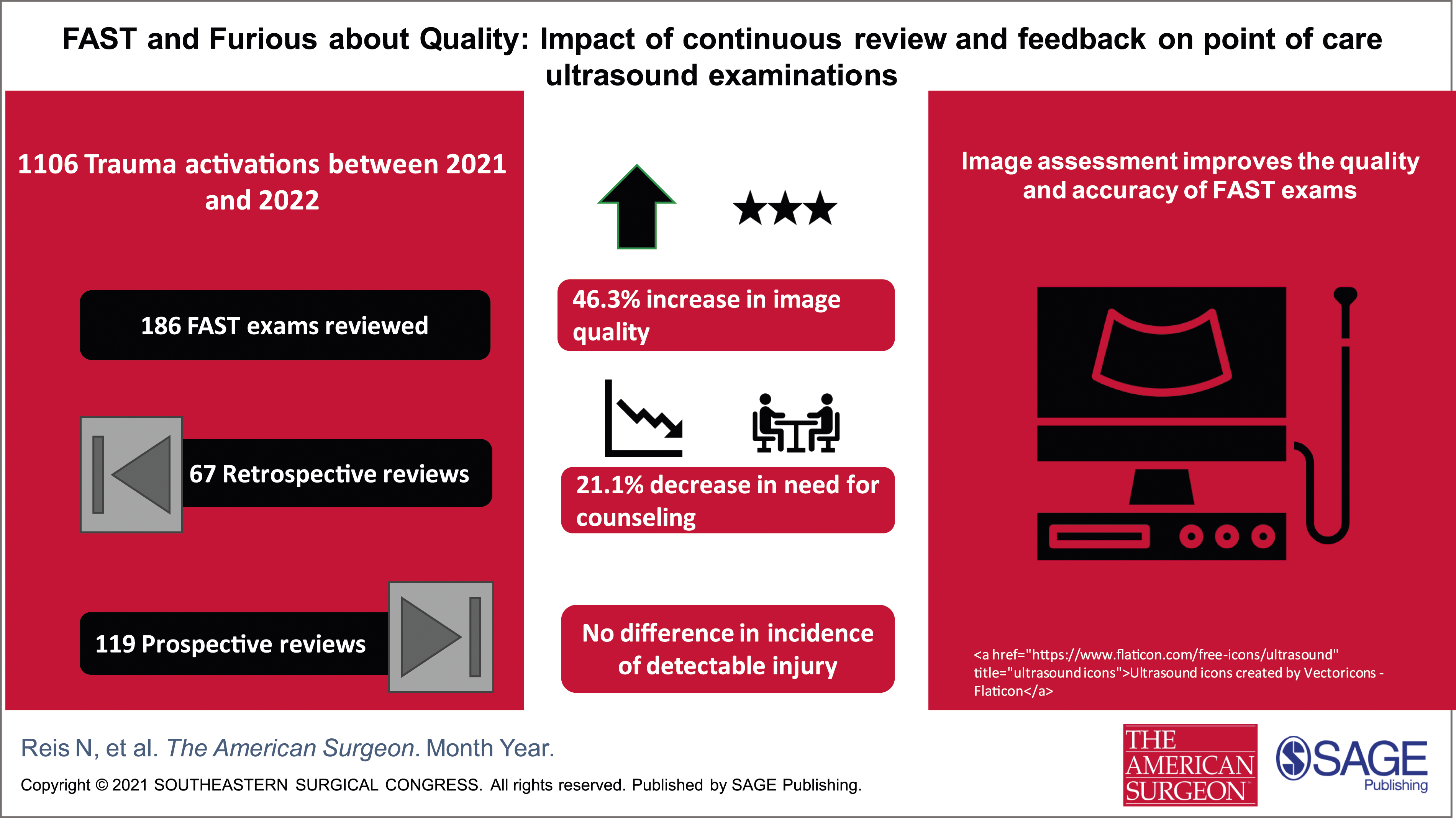
Background: Focused Assessment with Sonography in Trauma (FAST) examination is a point-of-care ultrasound study used to evaluate for abdominal hemorrhage, pneumothorax, or pericardial blood in trauma patients as an adjunct to their initial assessment. The quality of the image can be limited, and its diagnostic value is heavily dependent on operator skill. Our objective was to determine whether a standardized review process improved image quality and reduced incidence of nondiagnostic or insufficient imaging by 10% over a 6-month period.
Study Design: Between July 1, 2021, and March 31, 2022, we evaluated 1106 trauma activations at our level II trauma center. Two exams per practitioner per month were reviewed by an emergency medicine trained traumatologist with specialized training in point-of-care ultrasound and board certification in echocardiography. Priority was given to exams on patients with known injuries identified on other studies. If there were no exams that matched these criteria, random exams were selected. Images were reviewed for image quality, diagnostic accuracy, and labeling with counseling given to the provider if indicated. Categorical variables were compared using chi squared analysis, while continuous non-normally distributed variables were compared using the Mann-Whitney U test.
Results: A total of 305 FAST exams were reviewed (186 pre-intervention and 119 during intervention). Image quality improved from 46.3% (n = 31/65) to 79.0% (n = 94/119) (P < .01) with need for counseling falling from 63.1% (n = 41/65) pre-QI to 42.0% (n = 50/119) post-QI (P < .01). Incidence of detectable injury, BMI, ISS, and AIS body regions were consistent across the study period. This was seen in both the geriatric and non-geriatric cohorts despite a significant increase in ISS in the post-intervention geriatric patients.
Discussion: A FAST review program is associated with improvement in image quality and decreased need for counseling of trauma providers.
TsuiCLFungHTChungKLKamCW. Focused abdominal sonography for trauma in the emergency department for blunt abdominal trauma. Int J Emerg Med. 2008;1(3):183-187. doi:10.1007/s12245-008-0050-2
Cibulas ShumwayMGranetJSolomonRJ, et al.Using right-sided roll to improve reliability of focused assessment with sonography in trauma: an eastern association for the surgery of trauma multicenter prospective study. J Am Coll Surg. 2023;236(1):99-104. doi:10.1097/xcs.0000000000000443
4.
PigneriDABehmRJGranetPJ. Rolling a trauma patient onto the right side increases sensitivity of FAST examination. J Clin Ultrasound. 2020;48(3):152-155. doi:10.1016/s0196-0644(96)70273-1
5.
PearlWSToddKH. Ultrasonography for the initial evaluation of blunt abdominal trauma: a review of prospective trials. Ann Emerg Med. 1996;27(3):353-361. doi:10.1016/s0196-0644(96)70273-1
6.
LeoMMPotterIYZahiriMVaziriAJungCFFeldmanJA. Using deep learning to detect the presence and location of hemoperitoneum on the focused assessment with sonography in trauma (FAST) examination in adults. J Digit Imaging. 2023;36:2035-2050. doi:10.1007/s10278-023-00845-6
7.
SjogrenARLeoMMFeldmanJGwinJT. Image segmentation and machine learning for detection of abdominal free fluid in focused assessment with sonography for trauma examinations: a pilot study. J Ultrasound Med. 2016;35(11):2501-2509. doi:10.7863/ultra.15.11017
8.
IngemanJEPlewaMCOkasinskiREKingRWKnottsFB. Emergency physician use of ultrasonography in blunt abdominal trauma. Acad Emerg Med. 1996;3(10):931-937. doi:10.1111/j.1553-2712.1996.tb03322.x