



Abstract
In the 20 years since the American College of Surgeons outlined the first research agenda for surgical palliative care, there has been immense growth in the evidence. In this article, we briefly review the state of the science and priority research areas in surgical palliative care.
In 2005, the American College of Surgeons (ACS) Task Force on Surgical Palliative Care and the Committee on Ethics issued a Statement of Principles of Palliative Care. 1 Research priority areas have been previously identified in 2003 by the ACS 2 and in 2017 by the National Institute on Aging and the National Palliative Care Research Center. 3 Since that time, research on the benefits of integrating these palliative care principles into surgical practice and the processes to accomplish that integration has grown rapidly. This tremendous growth calls for a reassessment of what the research priorities in the field of surgical palliative care should be. In considering these research priorities, we will ask you to take the following three points to be true and at the core of surgical palliative care research: (1) improving access to palliative care for surgical patients is an issue of quality; (2) we cannot define quality without engaging patients and their families; and (3) practice changes should be driven by evidence.
The need for evidence-based change is demonstrated in the failings of advance care planning (ACP). Advance care planning includes advance directives created to document patients’ preferences for future end-of-life care. The process of filling out and filing advance directives considers future hypothetical preferences for care and is distinct from the conversations patients and their families have in response to specific circumstances that arise from immediate potential clinical scenarios. In past decades, ACP has emerged as a potential solution to poor quality end-of-life care that patients receive. In addition, there have been major investments in research and quality improvement initiatives and trials of physician reimbursement for such efforts. The rationale for these initiatives had been that ACP would improve end-of-life care. However, a 2018 analysis of 80 systematic reviews encompassing more than 1600 original articles demonstrates that ACP does not influence medical decision-making, enhance goal-concordant care at the end of life, or improve patient or family perceptions on the quality of care received. 4 In discussing the unintended consequences of the ACP movement, Morrison and colleagues 5 noted that scarce and limited resources were diverted away from other potential opportunities to improve patient care. This underscores the need for research to identify focus on areas that meaningfully impact patient care.
Well-crafted research priorities focus attention and resources on specific knowledge gaps, which ensures that high impact areas are being targeted. Further, refined research priorities can also minimize redundant work in areas where the existing evidence is sufficient to prompt practice change. While a 2020 systematic review examined published palliative care research priorities, articles focusing on surgical patient populations were excluded from their search. 6 This review identified eight major themes, including service models, continuity of care, training and education, inequality of access, communication, patient preference and experience, and recognizing the needs and importance of families. The authors noted that the reviewed articles were dominated by the provider’s voice and that engagement of patients and families was needed.
Surgical patients represent a unique population. Most palliative care research focuses on patients with cancer across clinical specialties. In comparison, surgical patients have different and often unpredictable disease trajectories, particularly in the face of complications. The immediacy of surgical illness and decision-making creates a unique relationship between surgeons and their patients. These surgery-specific issues make it challenging to extract and apply lessons from existing palliative care research in nonsurgical populations. Consequently, research priorities specific to surgical practice are needed.
In 2003, the ACS Palliative Care Workgroup identified seven priority areas for research: surgical decision-making, patient-oriented decision-making, end-of-life decision-making, symptom management, communication, processes of care, and surgical education about palliative care.
7
However, a 2016 systematic review of palliative care interventions for surgical patients identified only 25 studies and cited persistent knowledge gaps.
8
A 2017 collaborative effort from the National Institute on Aging and the National Palliative Care Research Center commissioned research priorities from subspecialty palliative care work groups.
9
The surgical work group identified eight priorities across three domains: defining outcomes that matter to patients, communication and decision-making, and delivery of palliative care to surgical patients (Figure 1).
3
Notably, all three domains emphasized identifying answerable questions that would have immediate impact. Surgical palliative care research priorities. Adapted from Lilley et al. Palliative care in surgery: defining the research priorities. Annals of Surgery. 2018; 267(1): 66-72.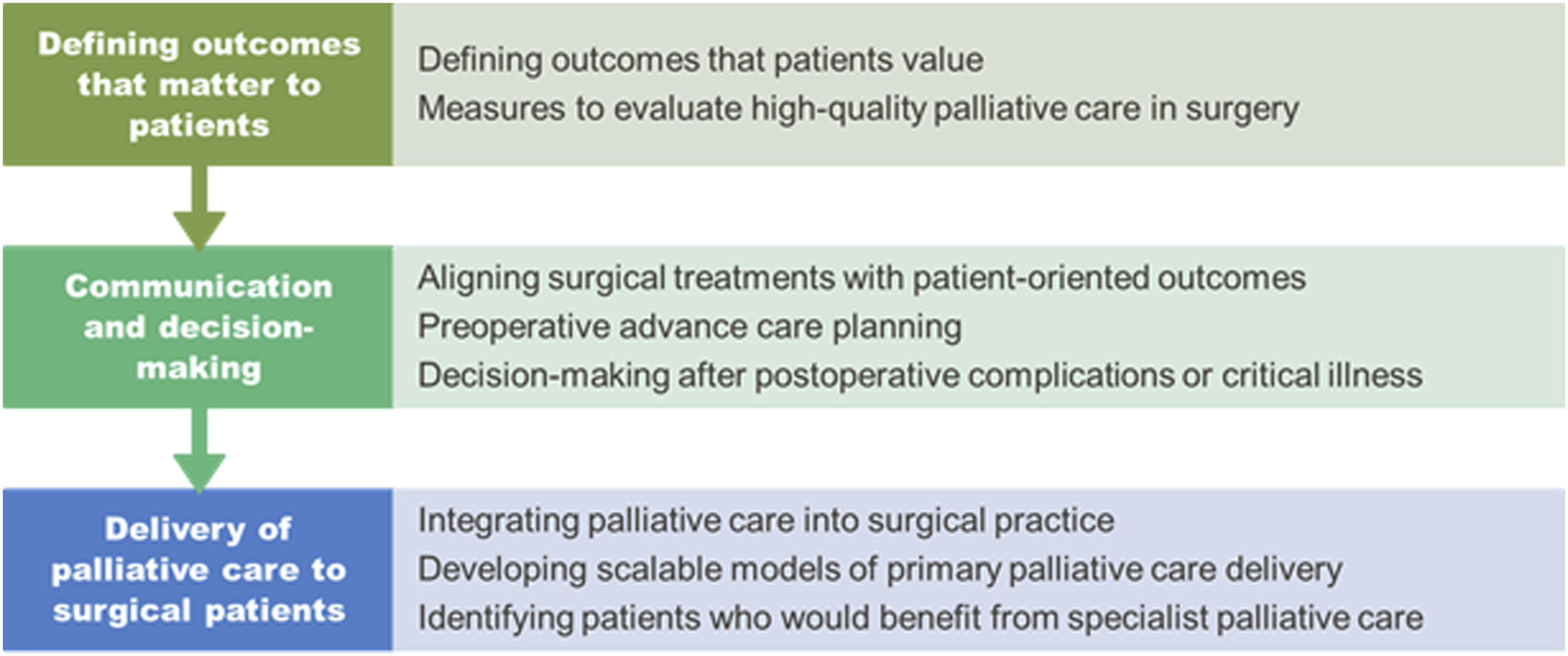
Looking to the future, the nascent Surgical Palliative Care Society will serve an important and impactful role in promoting the principles of research, advocating for inclusion of the patient and family voice, and shining a light on studies with practice implications. When surgeons, patients, and their loved ones align and focus their efforts to redesign systems based on best evidence and best practice, we have an opportunity to improve care in the ways that matter most.
Footnotes
Declaration of Conflicting Interests
The author(s) declared no potential conflicts of interest with respect to the research, authorship, and/or publication of this article.
Funding
The author(s) received no financial support for the research, authorship, and/or publication of this article.