



Abstract
Identification of surgical mentors is associated with medical student interest in surgical careers. Small group learning has been a fundamental component of the surgical clerkship at the University of North Carolina (UNC) School of Medicine for 14 years. The curriculum was standardized on 2018 and has long been hypothesized to facilitate mentoring relationships. In this brief report, we administered a survey that assessed the relationship between students and surgical faculty serving as small group tutors. Analysis was performed by descriptive statistics and chi-square analysis. The survey yielded an 18.8% response rate. Greater than 50% of students identified their tutor as a surgical role model. Greater than 60% of students affirmed that their tutor at least somewhat influenced their interest in surgery. Larger longitudinal studies with higher response rates are needed to assess relationships over time, and if these relationships ultimately correlate with applications made to surgical residency programs.
Small group learning at the University of North Carolina (UNC) School of Medicine has been integrated into the surgical clerkship for 3rd year medical students since 2007. 1 At initial conception, its aim was to provide students with exposure to foundational procedural skills; however, in 2018, the curriculum was standardized and expanded to include seven one-hour sessions covering a broad range of surgical topics. All surgical faculty at the UNC Chapel Hill Department of Surgery participate as small group tutors in a rotating schedule every 8 weeks and are assigned to 3-4 students during the 3rd year clerkship. Students prepare in advance for these sessions and participate in a flipped classroom style of learning. Interest in surgery among medical students appears highest at the start of medical school and gradually wanes over time, with a temporary increase in interest demonstrated during the surgical clerkship. 2 Intuitively, Ravindra et al found that students who identified a surgical role model or mentor were significantly more likely to express interest in a surgical career (41 vs 17%, P = .0006). 3 Taken together, it is plausible that surgical mentors identified could be helpful in sustaining student interest and providing needed guidance between the time of the clerkship and application to residency. We administered a student survey to investigate the hypothesis that students identify mentors during the small group tutorial curriculum.
The study protocol was reviewed and approved by the UNC Institutional Review Board. A voluntary post-clerkship survey to assess the relationship between a structured tutor program and the development of surgical mentors and role models was used. All third and fourth year medical students from the UNC School of Medicine during the 2020-2021 academic year were eligible for inclusion. Students who completed their surgery clerkship at a UNC branch campus outside of Chapel Hill were excluded from this study, as they did not participate in the tutor program. The survey was administered between February and March 2021, which occurred between 1 and 11 months after the clerkship for 3rd year students, and between 12 and 24 months after the clerkship for 4th year students. The average age of survey respondents was 28.9 years; 52.2% were female; 80.4% were White or Caucasian; 6.52% were African American or Black; and Asian, Middle Eastern, and multiracial respondents each made up 4.4%. The 27-question survey consisted of a combination of 7 Likert scales, 11 drop-downs, and 9 demographic items. This survey was internally generated (DRB, LP) and utilized a Likert scale to capture data on the following five topics: (1) quality of relationship with small group tutor, (2) extent to which relationship with small group tutor influenced interest in surgery, (3) perceptions of tutor as a role model, (4) level of comfort seeking out tutors for professional and academic guidance, and (5) understanding of the lifestyle of an academic surgeon. Descriptive statistics and chi-square analyses were conducted using RStudio v 1.4.1103. A P-value of α < .05 was considered to be significant.
Student to Small Group Tutor Relationship.
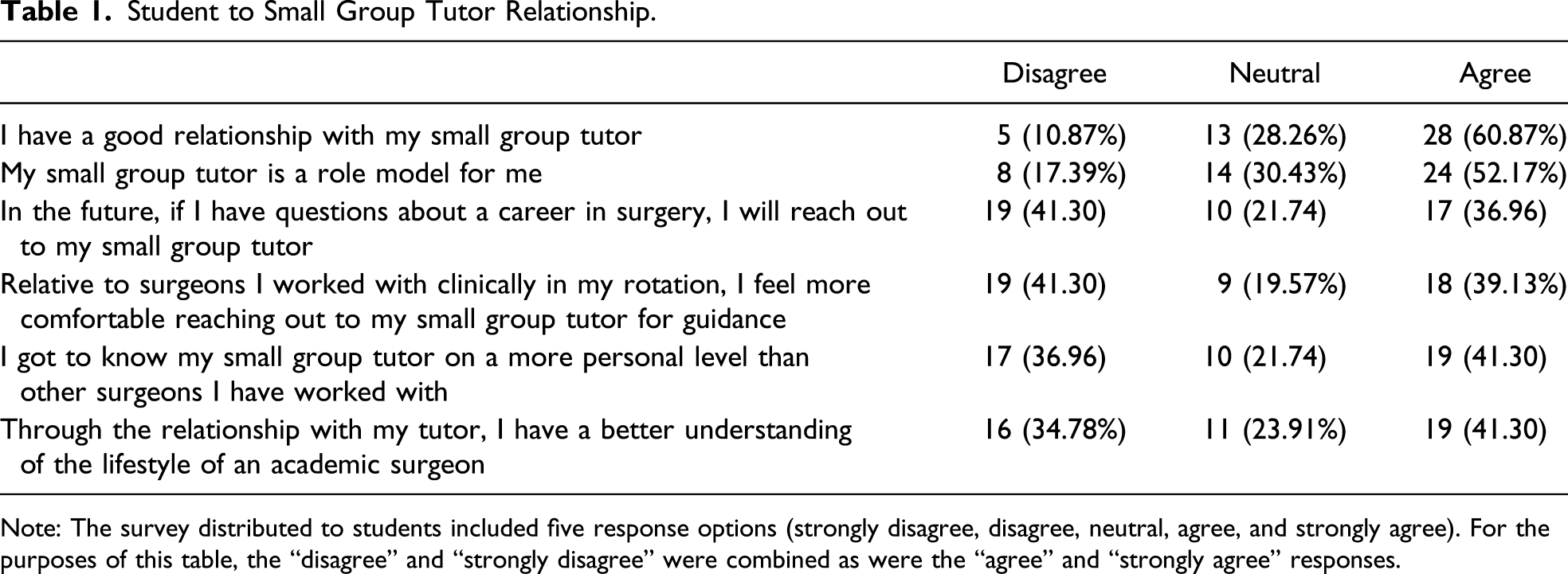
Note: The survey distributed to students included five response options (strongly disagree, disagree, neutral, agree, and strongly agree). For the purposes of this table, the “disagree” and “strongly disagree” were combined as were the “agree” and “strongly agree” responses.
We describe the evolution of the small group tutorial program within the department of surgery at the UNC School of Medicine from its conception to present and report an initial assessment of its impact on facilitating surgical mentorship. Initially designed as a means to developing technical skills, the curriculum has been reshaped to encompass a wide range of clinical topics which has afforded ample opportunity for 3rd year medical students to interface with faculty. Anecdotally, since its initiation, the tutorial program has been noted to facilitate mentoring relationships between surgeons and medical students. In this preliminary survey, with a limited response rate, we found that more than half (52.17%) of students agreed or strongly agreed with the statement, “My small group tutor is a role model for me.” This is notable given the above cited findings that identification of a surgical mentor was significantly associated with interest in a surgical career. 3 Furthermore, because interest in surgery has been noted to gradually diminish after the clerkship, 2 it is reasonable to hypothesize that surgical role models could blunt this waning in interest through career discussion and mentorship. Overall, around 40% of students agreed that they got to know their small group tutor on a more personal level than other surgeons they worked with and felt more comfortable reaching out to them for guidance than they would with other faculty. Additionally, about 37% agreed they would reach out to their small group tutor if they had questions about a career in surgery.
Anecdotally, since the expansion and standardization of the small group tutor program, we have seen an increase in student applications to surgical residency programs. 4 In particular, the low preceptor/learner ratio may have increased the visibility of surgeons to medical students, and thereby provided facilitated needed mentorship and counseling, although the decision to pursue a surgical career is nuanced and multifactorial.
This preliminary brief report has several limitations. Most significantly, our response rate was low, and this introduced selection bias with students more likely to answer the survey if they had a positive experience with their tutor. Another limitation was that the vast majority of students completing the survey were 4th year medical students; it would have been beneficial to assess 3rd year student perceptions who more recently participated in the curriculum. Our findings are also limited by the use of an internally generated survey, which will need to undergo future validation. Last, this survey was not able to capture how student interest changes over time.
The UNC small group tutorial curriculum has been expanded and standardized. Recent changes have increased opportunities for surgical faculty to develop meaningful mentoring relationships with 3rd year medical students. Overall, these findings are preliminary and hypothesis generating. Future longitudinal studies with higher response rates are needed to assess if students do reach out to their tutor for career guidance, and if these relationships ultimately correlate with application to surgical residency programs. Regardless of career decisions, it is important for students interested in a surgical career to have role models with whom they can discuss opportunities openly, and the small group tutorial curriculum appears to be meeting this need.
Footnotes
Declaration of Conflicting Interests
The author(s) declared no potential conflicts of interest with respect to the research, authorship, and/or publication of this article.
Funding
The author(s) received no financial support for the research, authorship, and/or publication of this article.