




Abstract
Power is central to sociological accounts of economic inequality; however, buyer power—market conditions in which one or a few dominant employers can limit workers’ outside options for employment—has received little attention relative to worker power. We study how the entry of Walmart Supercenters, the archetype of a high-buyer-power employer, affects the size and protective strength of union membership (a key dimension of worker power). We analyze (1) whether greater worker power dissuades Walmart Supercenters from entering a local labor market, (2) whether a successful Supercenter entry subsequently erodes local union membership, and (3) whether unions provide a protective effect against declining earnings after a successful Supercenter entry. We apply stacked difference-in-differences estimates based on county-year variation in Walmart Supercenter openings using restricted-access Panel Study of Income Dynamics data. We find that Walmart Supercenters are less likely to enter a local labor market that has high levels of union membership, even when conditioning on attempted Walmart entries. When Walmart Supercenter openings do occur, union membership declines by an average of 3.5 percentage points, and this is channeled through declining union membership in retail. Remaining union members are not protected against Walmart’s downward pressure on earnings; in fact, annual earnings among workers who were unionized pre-treatment decline faster than for non-union members after a Walmart Supercenter opens. Worker power can be effective at preventing a rise in buyer power, but conditional on increases in buyer power, worker power tends to decline in terms of both size and protective strength. The sociological study of labor market power ought to consider how prevailing levels of buyer power can moderate the ability of organized labor to achieve its social and economic aims.
Introduction
The study of power is central to sociological accounts of economic inequality. Specifically, scholars have linked the relative power of labor (in the United States, most often proxied through union membership) to levels of earnings inequality, in-work poverty, working standards, and more (Brady, Baker, and Finnigan 2013; VanHeuvelen 2023; Western and Rosenfeld 2011). A separate form of labor market power, however, has received much less attention in sociological research: buyer power, or market conditions in which one or a few dominant employers can limit workers’ outside options for employment and, in turn, pay workers below market value. In this study, we argue that buyer power and worker power ought to be studied as distinct forms of labor market power that operate in conjunction to influence labor market inequalities. Empirically, we analyze the collision of buyer power and worker power through a novel analytic strategy focused on the size and strength of labor unions when a Walmart Supercenter enters, or attempts to enter, a local labor market.
Our work expands the sociological study of labor market power conceptually and empirically. From a conceptual perspective, we advance understanding of the role of buyer power relative to worker power in shaping distributional outcomes. Worker power and buyer power are two distinct concepts, rather than two ends of the same spectrum. As we detail, high worker power can co-exist with high buyer power, just as low worker power can be found in a context of low or high buyer power. Buyer power (largely synonymous with monopsony power) is less often operationalized in sociological studies of labor market outcomes, yet it is critical to study for at least three reasons: (1) buyer power, which is rising across local labor markets in the United States, is likely to affect wages and wage growth (Wilmers 2018), (2) prevailing levels of buyer power may moderate unions’ ability to achieve earnings premia for their members, and (3) rising buyer power may, in certain contexts, lead to lower levels of worker power, and vice versa.
Our focus on buyer power as a distinct dimension of labor market power allows us to challenge and refine more commonly applied perspectives on power in the sociological literature. Power Resource Theory (PRT), for example, is a frequently applied perspective to examine how organized labor and left-leaning political coalitions can exert power to achieve more egalitarian economic outcomes (Baker 2020; Brady 2022; Korpi 1983). Frameworks such as PRT have primarily focused on worker–firm conflict (often recognizing the state as a crucial mediator), yet do not generally incorporate how the outcomes of between-firm competitions may influence the worker–firm power struggle. Returning to Korpi’s (1983) original insights on PRT regarding the role of context in shaping the translation of power into economic outcomes, we study how local labor market features, such as prevailing levels of buyer power, moderate the ability of organized labor to achieve its social and economic aims.
Analytically, we advance beyond point-in-time snapshots of labor market power imbalances to instead study collisions of power and their economic implications. Specifically, we study (1) how worker power responds to the threat of increases in buyer power, (2) how an increase in buyer power subsequently affects worker power, and (3) whether any remaining worker power can protect against the economic consequences of rising buyer power. In our applied examples, we focus on how the openings of Walmart Supercenters in local labor markets affect the size and strength of labor unions. Walmart is the largest private employer in the world and accounted for half of all retail growth between 1990 and 2005 (Wiltshire 2023). Past research has established that Walmart Supercenters exert substantial buyer power and act as a monopsonistic employer (Dube, Manning, and Naidu 2018; Wiltshire 2023), which we confirm in a set of independent analyses. As a clearly identifiable case of a high-buyer-power employer, the study of Walmart Supercenters allows us to focus analytically on states of active conflict between worker power and buyer power.
Using restricted-access data from the Panel Study of Income Dynamics (PSID), we merge information on the county and year of Walmart Supercenter openings. We then apply matching techniques to create comparable groups of workers (based on pre-treatment characteristics) who were exposed to Walmart Supercenter openings relative to those who were not. We apply stacked difference-in-differences estimates on this matched sample to understand how a Supercenter opening affects outcomes related to earnings, employment, and union membership. Our event study analyses, as well as models that directly account for differential pre-trends, allow us to ensure our estimates of Supercenters’ effects are not due to differential trends in outcomes that predate the Supercenter entries. To the best of our knowledge, our study is among the first to apply the latest advancements in the difference-in-differences literature to quantitative sociological research, and particularly for the study of labor market power.
Our findings emphasize the importance of studying buyer power and worker power in conjunction. Can stronger worker power prevent an increase in buyer power? Yes, as we find that a stronger presence of union members effectively acts as a deterrent to the entry of a Walmart Supercenter. These findings not only hold when focusing on geographic variation in Supercenter openings overall but, perhaps more critically, also when studying failed Walmart Supercenter entries among a subset of counties where Walmart publicly expressed plans to open a Supercenter. Conditional on demographic and geographic differences, we find that unionized workers are up to 6 percentage points less likely to be exposed to the opening of a Walmart Supercenter. We support this associative evidence with documented evidence of labor unions protesting against the planned entries of Walmart Supercenters.
When buyer power does increase in a local labor market, does worker power subsequently decline? Yes: our stacked difference-in-differences estimates reveal that the first opening of a Supercenter in a county subsequently leads to a 3.5 percentage-point (20 percent) decline in union membership during the 10 years following the entry. Event studies support our parallel trends assumptions; in other words, workers in counties that received a Supercenter were not experiencing differential trends in union membership relative to workers in non-Supercenter counties prior to treatment. We find that declining union membership is not primarily driven by stronger negative employment effects for unionized workers, nor occupational restructuring toward jobs that are less likely to be unionized; instead, we find evidence of declining unionization among workers who are employed in retail jobs both before and after Supercenter openings.
Does any remaining worker power protect against the economic consequences of rising buyer power? No, our results suggest. Walmart Supercenter openings depress annual labor earnings (compared to individuals in the non-Supercenter counties) for workers who were unionized prior to the Supercenter opening. As a result, the union wage premium declines by around $3,000 in annual earnings (or about $1.40 per hour for a full-year, full-time worker), with the strongest negative effects for unionized workers in retail.
We conclude our study with guidance for future research to study the concept of buyer power and how it shapes social and economic outcomes. As we emphasize, the introduction of Walmart Supercenters is one clear example of an increase in buyer power, but the concept can be applied across a wide range of data sources. We elaborate on these possibilities with the aim of further advancing the theoretical and empirical contributions of the present study.
Power in Labor Markets
Power and conflict are central to sociologists’ accounts of pay-setting and earnings-related outcomes. As Rosenfeld (2021:6) succinctly describes, “Power is the ability to get one’s way even in the face of opposition.” Struggles for power underpin resource-claiming mechanisms such as exploitation and social closure (Tomaskovic-Devey and Avent-Holt 2019) and are directly linked to patterns of economic inequality (Rosenfeld 2021). Even when conflict is dormant, past power struggles dictate present pay standards through organizational inertia and mimicry (Rosenfeld 2021).
Class-oriented sociologists have predominantly studied worker power, a dimension of power largely focused on how organized labor can advance the interests of the working class and achieve more egalitarian economic outcomes. Beyond worker power, recent literature has given increased attention to another dimension of power: buyer power (Stansbury and Summers 2020). 1 Buyer power, in contrast to worker power, is largely a product of between-firm competition: a single firm becomes the sole buyer of workers’ labor (or of a given good or service in product markets). 2 In practice, buyer power is rarely limited to the “pure monopsony” case of a single employer; rather, the concept encompasses any market condition where a firm possesses the ability to set wage rates below the marginal productivity of labor.
Worker power and buyer power all exist within (and can directly influence or be influenced by) regulatory and policy frameworks. In the United States, for example, 27 states had right-to-work laws as of 2024, effectively generating additional barriers for workers to collectively organize (VanHeuvelen 2020, 2023). The strength of antitrust regulation can also dictate firms’ success in achieving dominant levels of buyer power in a given market. In this study, however, we largely take these overarching regulatory frameworks as fixed, in order to study how collisions of worker power and buyer power within the United States influence patterns of labor market inequality. We discuss these dimensions of power in turn.
Worker Power
Worker power is perhaps the most frequently studied form of market power in the sociological literature, and strong labor unions are the primary proxy of, and mechanism underpinning, high levels of worker power. Within a fixed regulatory environment, union strength is derived in part from limiting competition by controlling the supply of labor (Caplow 1954; Fligstein and Fernandez 1988). “Craft” unions of skilled workers seek to maintain a monopoly on specialized skills by controlling access to jobs via training and credentialing requirements (Form and Huber 1976; Lazear 1983), and “general” unions of less-specialized workers typically organize coalitions of workers who cooperate and exert power through strikes and collective bargaining (Fligstein and Fernandez 1988; Streeck 2010). Union activity often has the seemingly counterintuitive, “two-faced” (Freeman and Medoff 1984) effect of imposing market rigidities while promoting efficiency by improving communication between workers and firms, stabilizing employment relations, and reducing turnover.
When unions are strong, inequality is lower (Brady 2022); the precipitous decline in the share of U.S. workers who are unionized has contributed meaningfully to rising earnings and income inequality (Parolin 2021; Western and Rosenfeld 2011). Unions are forceful not only in generating earnings premia for their own workers, but also for generating stronger welfare states and institutionalizing norms of equality within society (Western and Rosenfeld 2011). Sociologists have documented that stronger unions contribute to lower levels of in-work poverty (Brady et al. 2013; VanHeuvelen and Brady 2022), stronger earnings trends for workers at risk of automation (Parolin 2021), lifetime earnings advantages that can exceed the returns to a college degree (Parolin and VanHeuvelen 2023), and more. 3
Often, the role of unions in shaping more egalitarian outcomes is framed within Power Resource Theory (PRT). PRT offers a class-based perspective on how politics and power contribute to inequality (Korpi 1983). Latent coalitions of workers organize, often through unions, to exert power in the form of strikes, collective bargaining negotiations, or state-mediated policy changes (as some examples) to generate distributional shifts in income and other resources (Korpi 2006). PRT has been influential in placing workers’ power relative to that of firms at the forefront of distributional analyses (Baker 2020; Brady 2022; VanHeuvelen 2020). That said, the applied versions of the theory often overlook how external conditions, such as between-firm power struggles, influence labor’s ability to achieve gains. Indeed, the emphasis of Walter Korpi—whose work is recognized as the intellectual origin of PRT—on potential contextual moderators is often lost in PRT research. As Refslund and Arnholtz (2022:1961) write, PRT’s “strong emphasis on unions has led to the misunderstanding that it claims that union power determines labor and social policy.” For Korpi, though, it was the “specific power configuration and distribution of power” that influenced the economic outcomes of interest, not unions’ power resources on their own (Refslund and Arnholtz 2022:1961).
Put differently, labor unions and left-leaning political coalitions do not operate in a contextual vacuum. It is well understood that policy context—such as right-to-work laws—can influence workers’ ability to organize and negotiate better labor standards. Moreover, cross-national evidence has made clear that sectoral-wide collective bargaining agreements can achieve more egalitarian outcomes even when prevailing levels of union membership are small or declining (Thelen 2014). One contextual force remains largely understudied as a potential moderator of unions’ ability to achieve their social and economic aims: prevailing levels of buyer power. Specifically, we pose that both the size and protective strength of worker power may be conditional on the relative buyer power in the market in which workers operate.
Buyer Power and Its Collision with Worker Power
Whereas worker power captures the negotiating strength of employees relative to their employers, buyer power represents market conditions in which one or a few dominant employers can limit workers’ options for employment and, in turn, pay workers below market value (Manning 2013; Robinson 1933). 4 Monopsony (a market dominated by a single buyer) is the most acute form of buyer power, yet real-world labor markets often feature weaker versions of monopsony, where multiple buyers exist yet one or a few possess particularly strong control over a market. Monopsonist labor markets tend to manifest as either natural (quasi-) monopsonies, where only one or a few firms operate in the labor market due to high fixed costs and economies of scale, or as a public monopsony, where the only hiring firm is directly owned by the government. Under these conditions, workers often have few options outside of the dominant employer(s) to find employment in their field.
The role of buyer power has received some theoretical attention in the economic sociology literature (Fligstein 2002; Fligstein and Fernandez 1988; Wilmers 2018). Fligstein and Fernandez (1988), for example, offer a theoretical account of firm power that includes, but is not exclusive to, our focus on buyer power. 5 Markets are socially-constructed institutions within which some firms act to reduce competition through strategies that centralize power (Fligstein 2002). One limitation of this work, however, is a lack of empirical assessment on the consequences of this reduced competition for workers and their ability to exert power within organizations. If sociological studies of worker power are overly focused on within-firm power dynamics, traditional studies of firm power in sociology are arguably overly focused on between-firm power dynamics; the present study, in contrast, is interested in how these between-firm power struggles affect the outcomes of workers’ within-firm negotiations and, specifically, the ability of organized labor to improve economic outcomes for its workers.
Like Fligstein and Fernandez (1988), we recognize that buyer power is not simply an antonym of worker power; rather, the two are distinct concepts that can coexist at varying degrees. Moreover, the level of buyer power in a given labor market can influence the extent to which the prevailing level of worker power can lead to more worker-friendly outcomes. Table 1 illustrates this point, documenting four scenarios in which high or low worker power can overlap with high or low buyer power.
Ideal Types of Combinations of Worker Power and Buyer Power.
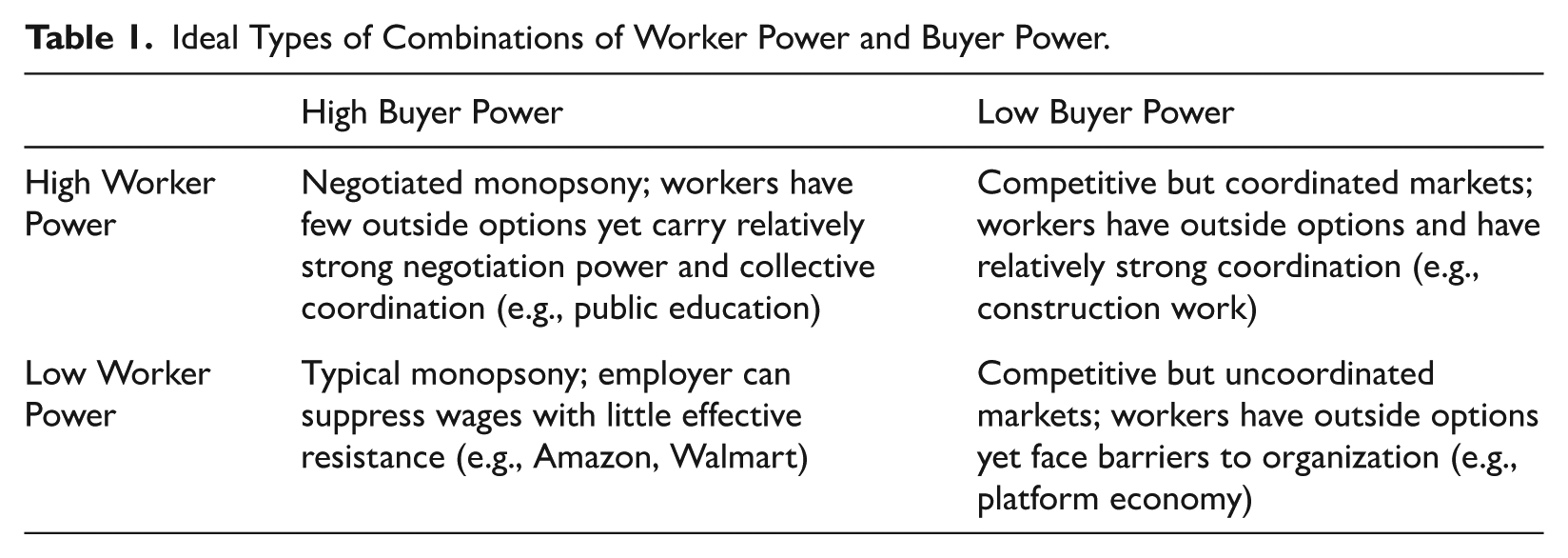
The upper-left quadrant of Table 1 represents a scenario in which both worker power and buyer power are high. We refer to this as “negotiated monopsony,” in which workers competing for a certain occupation type often have few options for employment outside their current employers, yet bargaining power is still relatively strong. In these labor markets, buyer power typically derives from either a natural or government monopoly in the product market, and worker power from either a craft union of skilled workers or a deeply institutionalized broad union. Public-school educators are a prototypical example: the state is the dominant buyer of school teachers’ labor (particularly in contexts where private school options are scarce), yet public educators in the United States are often unionized. Teacher unions control the labor supply with training and credentialing requirements and threaten to disrupt production with strikes. The U.S. automotive industry in the mid-twentieth century provides a private-sector example: Ford, General Motors, and Stellantis (formerly Chrysler) held an oligopsony in the labor market for automotive workers, due to the high fixed costs and massive economies of scale in the product market, yet automotive workers were well organized in the United Auto Workers union, which forged worker solidarity across the automotive industry and used sitdown strikes to affect costly disruptions to production.
The lower-left quadrant of Table 1 features a traditional monopsony scenario: low worker power and high buyer power. Employees not only have few outside options, but workers possess little power for intra-firm bargaining. This scenario is most common in labor markets where large firms are the dominant buyers of relatively low-skill general labor. Worker power is limited in these labor markets in part because workers are easily replaced, allowing firms to quickly eliminate threats of worker organizing. Weak social welfare institutions in the United States also undermine organizing efforts among these workers by raising the personal costs of work stoppages and unemployment. In this scenario, workers are at particular risk of suppressed wage growth. Such is the case in the retail labor market, which is dominated by large buyers like Walmart, where workers are relatively lower-skilled and unorganized, and where there is a large pool of under- and unemployed workers that firms can draw on to fill vacancies as needed.
Low worker power can also exist in a context of low buyer power (lower-right quadrant of Table 1). In this scenario, many small employers compete to hire workers, and many uncoordinated workers compete for jobs and bargain independently for wages and working conditions. The online platform economy is merely one example: workers compete for “gigs” requested by thousands of buyers, yet barriers to worker coordination, such as fragmented and spatially disparate employment structures, contribute to weak levels of worker power and suppressed ability to negotiate with firms for better working conditions.
Finally, the upper-right quadrant of Table 1 represents what we call a “competitive but coordinated market,” in which workers have more outside options (low buyer power), along with relatively strong coordination and potential leverage for intra-firm bargaining. This scenario is most common in “craft internal” or “guild” labor markets (Doeringer and Piore 1971; Kerr 1977), where worker power is derived from workers’ possession of specialized skills, and worker organizations control access to training, certification, and jobs. This constellation of worker and buyer power is typical of construction work in the United States. Construction workers are unionized at 2.5 times the national average (Bureau of Labor Statistics 2025), indicating relatively high levels of worker power. Construction workers also hold skills that require specialized training, making them difficult to replace. Moreover, construction unions restrict the labor supply by establishing systems of apprenticeship and training, seniority-based advancement, and job allocation. Labor demand is spread across many employers, including small firms and individuals (Bilginsoy 2003; Stinchcombe 1959; Waddoups 2014).
These four quadrants present distinct ideal types of power combinations for the purpose of exposition, but power struggles are, in reality, often more dynamic and less clear cut. One should envision regular fluctuations of power that consistently push a given labor market along the x- and y-axes of our table, rather than being permanently fixed at one point. Power dynamics are constantly changing; thus, a central focus of our analysis is how collisions of worker and buyer power (i.e., movements across the different dimensions in Table 1) can affect inequality.
Although worker power and buyer power are distinct concepts, buyer power has received scant attention in applied, sociological literature on labor markets. 6 The primary exception (with respect to applied empirical work) is Wilmers (2018), who finds that suppliers that become dependent on large buyers tend to reduce their worker wages, and that rising buyer power in the United States since the 1970s has contributed meaningfully to wage stagnation. There are at least three reasons for supplementing studies of worker power with an assessment of buyer power. First, as Wilmers (2018) finds, high and rising levels of buyer power may suppress wages, suggesting that prevailing levels of buyer power may have direct implications for social and economic inequality. Second, prevailing levels of buyer power may moderate unions’ ability to achieve earnings premia for their members (particularly for private-sector employment). Should a dominant buyer absorb an increasing share of market opportunities, workers’ intra-firm bargaining ability may suffer as a result, essentially, of weakening between-firm competition. Third, rising buyer power may, in certain contexts, lead to lower levels of worker power, and vice versa. If organized labor knows that a rise in buyer power may suppress their ability to negotiate for better working conditions, they may be particularly interested in maintaining strong between-firm competition; conversely, dominant firms may be interested in weakening workers’ ability or will to organize in order to more forcefully exert their market power.
Walmart Supercenters’ Buyer Power
Walmart Supercenters serve as a prime example of how large organizations can wield considerable buyer power in both labor and product markets. As the world’s largest retailer, Walmart wields extensive buyer power, leveraging its size to shape the competitive dynamics of both its suppliers and its workforce (Azar et al. 2024; Dube et al. 2018; Naidu, Posner, and Weyl 2018; Reich and Bearman 2018). This power has become particularly pronounced with the expansion of Walmart Supercenters, which combine large-scale retail and grocery operations, resulting in the company’s dominance in local markets.
Walmart’s buyer power in the United States is rooted in its vast scale and the extensive reach of its Supercenters. Since the opening of the first Supercenter in 1988, Walmart has grown exponentially, expanding from 68 Supercenters in 1994 to over 3,500 by 2019. This rapid growth coincided with a drastic decline in the market share of traditional grocery stores, which plummeted from 90 percent in 1988 to 44 percent by 2019 (Redman 2019). The company’s growth has been so significant that it accounted for roughly half of all retail employment growth in the United States between 1990 and 2005 (Wiltshire 2023).
The rapid expansion of Walmart Supercenters and Walmart’s dominance in U.S. retail employment is facilitated by its relationships with suppliers. By purchasing goods in massive volumes, Walmart secures favorable pricing terms that few suppliers can refuse, often dictating conditions that require cost reductions and operational efficiency (Wilmers 2018). This pressure disproportionately affects small and mid-sized suppliers, which may resort to drastic cost-cutting measures, including wage reductions for their own workers, to meet Walmart’s demands. The ripple effects of this dynamic reinforce Walmart’s influence on market pricing while perpetuating economic pressures on its supply chain.
Due to Walmart’s supply chain advantages, Walmart Supercenters can out-compete incumbent retail establishments on price. The arrival of a Walmart Supercenter thus frequently results in the closure of other retail and department stores, reshaping local economies and consolidating Walmart’s influence over retail markets (Artz and Stone 2006; Atkin, Faber, and Gonzalez-Navarro 2018; Basker and Noel 2009; Hicks, Keil, and Spector 2012; Matsa 2011). Since Walmart began opening Supercenters, 31 supermarket chains have sought bankruptcy protection and 27 have directly attributed their decline to Walmart (Fishman 2006). In Table E1 in the online supplement, we offer our own evidence that the opening of Walmart Supercenters leads to a decline in the number of retail firms within a county and an increase in the share of retail establishments operated by large firms, supporting claims from prior research (Wiltshire 2023).
Walmart’s buyer power in the product market undergirds its buyer power in local retail labor markets (Carré and Tilly 2017). By utilizing its pricing advantages to drive out its competitors, Walmart becomes the dominant buyer of retail labor in local markets and secures wage-setting power. Incumbent firms that do not close are often unable to match Walmart’s scale and price pressure, leading them to reduce wage growth relative to their pre-Walmart trend (Dube, Lester, and Eidlin 2007; Dube et al. 2018; Wiltshire 2023).
In turn, Walmart’s buyer power in a product and labor market offers protection against increases in worker power. Before Walmart began opening Supercenters, retail grocery workers were heavily unionized. Grocery unionization persisted well into the 1980s because, unlike other sectors that saw significant de-unionization, grocery remained highly regulated and was more insulated from global competition (Milkman 2022). Consolidation in the 1990s reduced union power: labor relations in the grocery sector were once highly localized, but threats of work stoppages at individual establishments posed a much smaller threat to multinational firms’ bottom lines (Hurd 2008). In addition, Walmart has historically been an anti-union organization (Reich and Bearman 2018), with company executives threatening the employment status of employees who attempt to unionize (Lichtenstein 2006). These tactics have contributed to the company’s ability to maintain its low-wage, low-cost business strategy, albeit while facing dozens of formal complaints of its anti-union activities at the National Labor Relations Board (Lichtenstein 2006). These factors suggest the entrance of Walmart Supercenters into local U.S. labor markets may precipitate a decline in worker power and move labor markets away from negotiated monopsonies and toward typical monopsonies (to use the terms we put forth in Table 1).
Context in Which Supercenters Operate
We acknowledge that Walmart’s strategy is heavily shaped by local institutional and competitive environments (Carré and Tilly 2017; Gupta, Govindarajan, and Wang 2008), and Walmart should not be universally associated with high buyer power. Instead, Walmart’s buyer power and its ability to resist worker power are highly unique to the U.S. context, where weakly institutionalized unions and massive buyer power in the product market allow Walmart to squeeze suppliers, undercut competitors on price, and enact monopsony power in the labor market. Internationally, Walmart has been less successful in building buyer power in product markets and weakening worker power in labor markets, in part due to different institutional and cultural contexts. Outside of the United States, Walmart tends to compete in the mid-market and consequently hires relatively skilled workers who require higher wages and are more difficult to replace (Carré and Tilly 2017; Gereffi and Christian 2009; Tilly 2006). In Germany, for example, grocery unions are traditionally more powerful and entrenched, and Walmart failed to keep them out despite its best efforts (Carré and Tilly 2017). In Chile, Walmart acquired already-unionized retailers, and Chilean unions have been particularly successful due to their strong associational and structural power (Bank Munoz 2017). The U.S. context is thus unique in being a place where the opening of a Walmart Supercenter is so clearly associated with an increase in buyer power.
Even within the United States, the consequences of Supercenter openings may vary across time. 7 From approximately 2005 to 2015, Walmart faced sustained pressure from organized labor movements, including the United Food and Commercial Workers (UFCW) and OUR Walmart campaigns, which actively sought to deter new store openings and organize Walmart employees (Reich and Bearman 2018). 8 These years of “active resistance” contrast sharply with the period that followed, when such campaigns were defunded and largely disappeared. Beginning in 2015, Walmart implemented a company-wide minimum wage increase, followed by additional wage hikes in subsequent years, altering its wage-setting behavior and potentially moderating its local labor market effects. These overlapping developments—heightened union opposition followed by an internal wage increase—suggest the consequences of Walmart Supercenter entry may differ across time. We account for this in our empirical strategy.
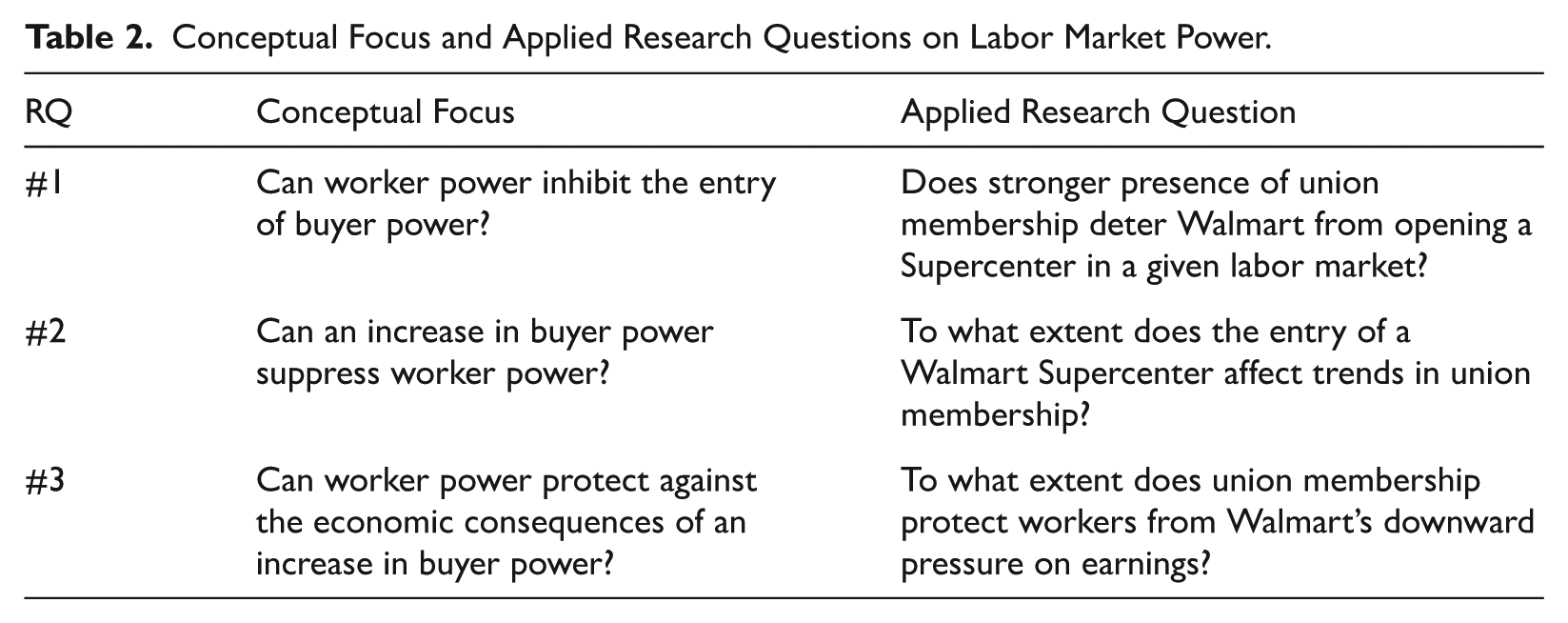
Table 2 outlines our conceptual focus and research questions, with the applied example of Walmart Supercenter openings in mind. Specifically, we study (1) whether worker power can inhibit increases in buyer power, (2) how an increase in buyer power subsequently affects worker power, and (3) whether any remaining worker power can protect against the economic consequences of rising buyer power. In our applied examples, we focus on (1) whether stronger labor unions can deter the entry of Walmart Supercenters, (2) how the successful entry of a Supercenter affects trends in union membership, and (3) changes in the protective effect of unionization on workers’ wages after a Supercenter opens. From an analytic perspective, we advance beyond point-in-time snapshots of labor market power imbalances to instead study collisions of power (or states in which worker and buyer power are in active conflict) and their economic implications.
Conceptual Focus and Applied Research Questions on Labor Market Power.
Data and Methods
Data
Our analysis draws on data from the Panel Study of Income Dynamics (PSID), a longitudinal household survey that has tracked persons and families in the United States since the late 1960s. The PSID provides extensive information on household composition, union membership, employment information, earnings and wages, and more. Importantly, we use a restricted-access version that includes county identifiers, allowing us to examine the state and county in which a respondent lives during each observation in the panel data. We use this information on year and county of residence to achieve variation in our primary treatment of interest: the first introduction of a Walmart Supercenter into a county.
We merge in data on the timing of Walmart Supercenter openings by county using the dataset from Schultz (2025), which offers a more complete and up-to-date account of Supercenter openings relative to the more-often used Holmes (2011) dataset. The dataset includes the openings of 3,612 Walmart Supercenters across 1,789 counties. We only use the first Supercenter opening in a county. After merging, the dataset contains 966 valid treatment events, defined as counties with a first Walmart Supercenter opening and available PSID data (see Table A1 in the online supplement). The PSID shifted from annual to biennial data collection in 1997, but as we will discuss, we ensure this change does not affect the comparability of outcomes over time.
Given that our first usable Supercenter entry occurs in 1993, our data environment spans 1983 (10 years prior to treatment) to 2019, the final year of PSID data prior to the COVID-19 pandemic. As previewed earlier, temporal context may matter when interpreting Walmart’s consequences; we thus offer two versions of most analyses, documenting the effects of Supercenter openings across our full period (1983 to 2019), but also when excluding 2015 onward, given the store-wide minimum wage and declining union pressure during that period. 9
Outcomes of Interest
Recall that our three RQs focus on (1) whether unions can inhibit the opening of a Supercenter, (2) whether the opening of a Supercenter subsequently affects trends in union membership, and (3) whether the opening of a Supercenter reduces unions’ ability to protect their workers’ earnings. As such, our primary outcomes of interest are (1) a binary indicator equal to one if a Supercenter never opened in a given county, (2) union membership as a binary indicator at the person level, and (3) personal earnings as a continuous variable at the person level. We supplement these primary analyses with several supporting analyses, in part to explore potential mechanisms. In the supporting analyses, we also examine outcomes such as employment status (binary), hourly wages (continuous), and hours worked (continuous).
Methodological Approach for RQ1
In investigating whether unions can inhibit the opening of a Walmart Supercenter, we rely on a non-causal OLS estimate that assesses how union membership is associated with the likelihood a respondent’s county ever opened a Walmart Supercenter. Our outcome is a binary indicator set to one if a Supercenter never opened in the county. We include all working-age individuals in our sample (ages 18 to 64). Given that the opening of a Supercenter may lead to changes in union membership or other compositional features, we only use pre-Supercenter observations for counties that ever receive a Supercenter; this ensures our estimated association of Supercenter entry with union membership is not capturing any decline in union membership that occurred after a Supercenter entry. For individuals in counties that never received a Supercenter, we use all years of observation. 10 Our simplest set of estimates is specified as

Union is the binary, person-level indicator of union membership, and
Walmart’s selection of entry counties is non-random, and our association of union membership with Walmart entry may be capturing unobserved factors associated with place that are due to this non-random Walmart selection. We thus replicate the models above while taking one extra step: limiting our sample of non-Walmart counties to those where Walmart publicly declared intention to open a Supercenter yet failed to do so. We use the dataset from Wiltshire (2023), which includes 34 counties where Walmart intended to, yet failed, to open a Supercenter. We refer to these as “failed openings.” These counties should be more similar to successful-entry counties, given that Walmart considered entering them. In our revised sample of counties, we include individuals in the “failed” counties and successful-entry counties, so
Methodological Approach for RQs 2 and 3
Our approach to answering RQs 2 and 3 allows us to shift toward producing plausibly-causal estimates of the effects of a Walmart Supercenter on union membership (RQ2) and earnings (RQ3). We emphasize that RQ2’s analytic focus on union trends is not the same as RQ1’s focus on pre-treatment union levels: it is plausible that RQ1 could find that levels of union membership are associated with reduced likelihood of Supercenter entry, yet, conditional on Supercenter entry, trends in union membership may decline (despite having comparable trends relative to persons in non-Supercenter counties prior to the Supercenter entry).
Our approach to RQs 2 and 3 follows Wing, Freedman, and Hollingsworth (2024) in using a stacked difference-in-differences (DiD) framework to estimate a trimmed average treatment effect. This method addresses issues of compositional imbalance in the PSID, where attrition could bias event-study estimates by altering the composition of the control group over time. Stacked DiD constructs stacks of treatment and control units observed around treatment events with inclusion criteria that reduce compositional imbalances across time.
We define treatment as the year a person resides in a county experiencing the entry of its first Walmart Supercenter. 11 We exclude persons previously residing in counties with Supercenters. Control persons are drawn exclusively from those “never treated” to avoid contamination from earlier exposures. We provide the list of variables by which we match our samples, as well as a comparison of means, in Table A2 and Figure B1 in the online supplement.
To analyze the effects of Walmart Supercenter openings, we create separate “stacks” for each year in which treatments take place. Each stack includes persons observed at least five years before and five years after that event. Persons are assigned as treated if their county experiences its first Supercenter opening in a given year and assigned as controls if they were not exposed to a Supercenter at any point. We provide a formal annotation in Part A of the online supplement. The inclusion criteria ensure that both treated and control groups are observed well before and after the treatment actually occurs to ensure compositional balance. We then combine these stacks to estimate treatment effects within a 20-year window (10 years before and after treatment). Importantly, control individuals may appear in multiple stacks if they match the criteria for different treatment years, but treated individuals are included only once, ensuring clarity in treatment assignment and avoiding contamination of control groups. In all cases, we limit our sample to working-age adults (ages 18 to 64).
A key strength of our approach is the ability to leverage person-level data to select appropriate controls. We thus use kernel-based propensity score matching (Heckman, Ichimura, and Todd 1997) prior to estimating our stacked DIDs to improve comparability of treatment and control groups. Specifically, for each stack, treated persons are matched to controls with similar propensity scores calculated four years prior to treatment. Control weights are then adjusted based on the number of matches. We emphasize that this matching exercise is primarily a supplement to the stacked DID analysis, which, combined with our event study specifications, allows for a direct assessment of whether our parallel trends assumption is supported.
We estimate the following weighted ordinary least squares (OLS) model, clustering standard errors at the county level where treatment occurs:
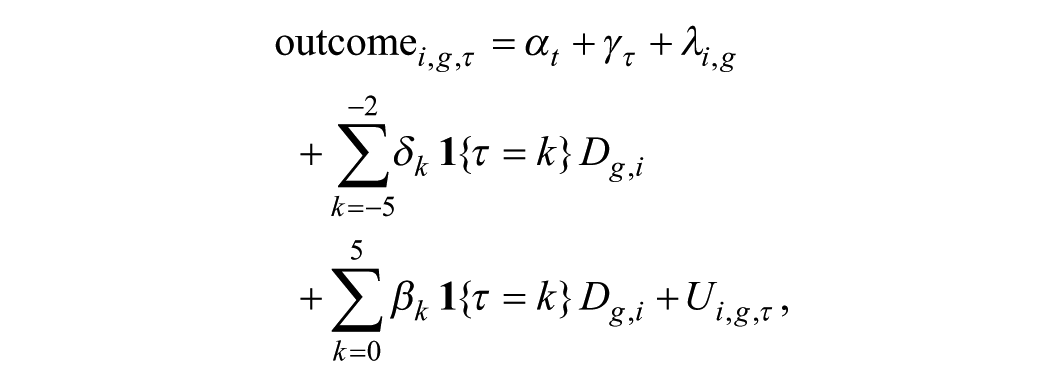
where
In our analysis, we group time periods into two-year intervals to account for how the PSID collects data every other year after 1997. We assign treatment one year ahead for those treated in even years after 1997. For example, when we refer to “
The primary threat to our analyses is Walmart’s non-random geographic selection of counties in which it opens a Supercenter, which we can account for in varying ways. As detailed above, we match workers in our treatment and control counties to ensure appropriate comparisons, and we can evaluate our parallel trends assumption in all relevant analyses. We also provide results that explicitly account for differential linear pre-trends in our core analyses. Figure B1 in the online supplement provides further evidence of parallel trends across a broader subset of demographic and economic indicators for workers who are in counties where a Supercenter opened compared to workers where a Supercenter did not open. Figure 5 will provide county-level evidence of higher labor market concentration precisely when Supercenters open. Thus, for our primary treatment effects to be driven by something other than Walmart Supercenter openings, one would need to demonstrate that unobserved features of workers in given counties (1) align precisely with the timing of Walmart Supercenter openings, (2) do not affect trends in outcomes in the treatment counties prior to Supercenter openings, and (3) only affect trends in outcomes in Supercenter counties after the Walmart opens. We are unaware of any such features, and we provide sensitivity tests to rule out several possibilities.
Findings
Can Worker Power Prevent Increases in Buyer Power?
We first investigate RQ1: to what extent can worker power prevent an increase in buyer power? More specifically, in our case, how is union membership associated with the likelihood of a Walmart Supercenter entry? Table 3 assesses the association of union membership with Supercenter openings in our PSID data. The first four models compare individuals who never had a Walmart enter their county to the pre-treatment characteristics of individuals in a county where Walmart did open; the final four models condition on attempted Walmart entry to provide a more appropriate comparison group when assessing where Walmart successfully entered.
Can Worker Power Inhibit Increases in Buyer Power? OLS Estimates of Association of Union Membership with Likelihood of Walmart Supercenter Entry (1983 to 2019).
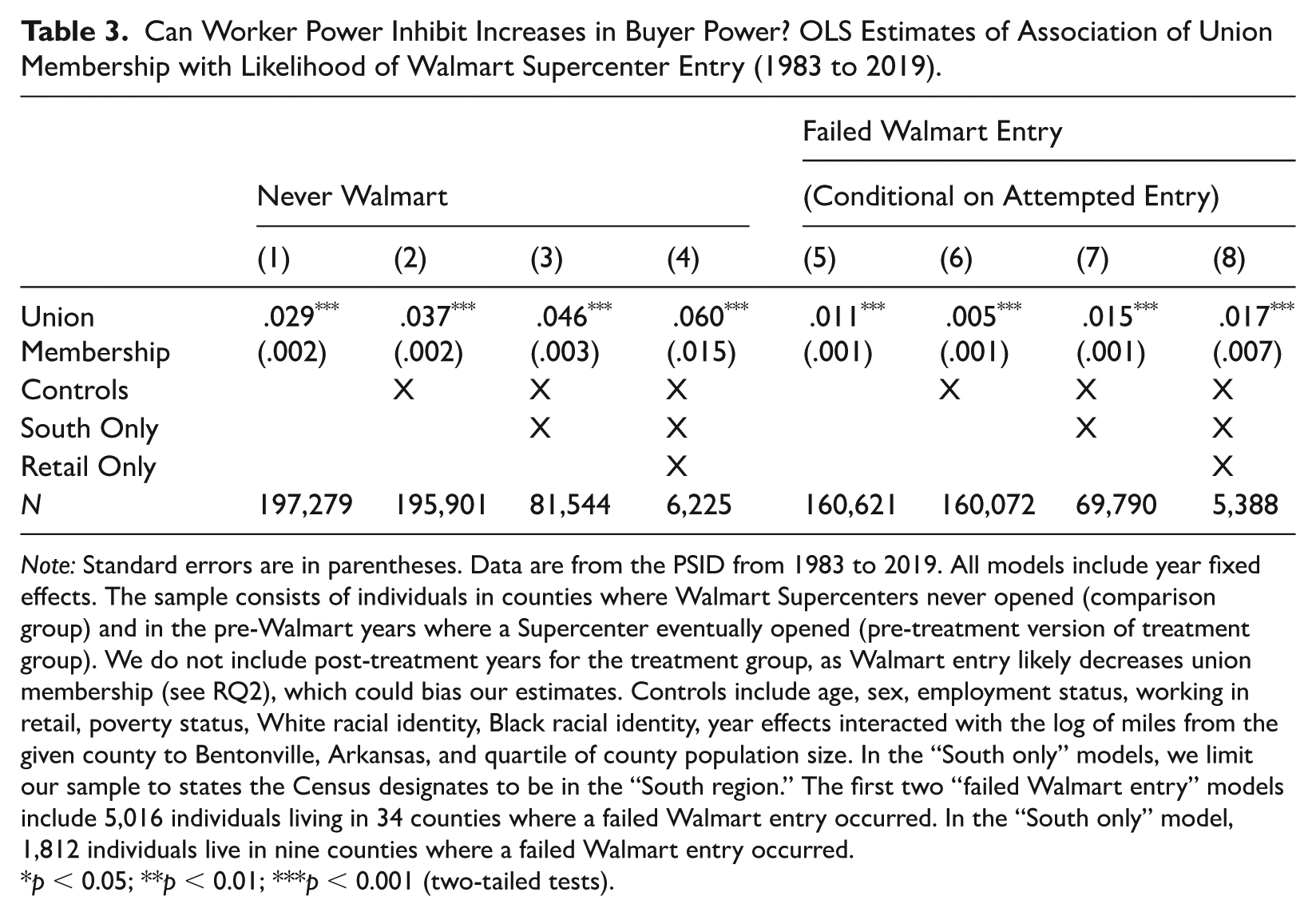
Note: Standard errors are in parentheses. Data are from the PSID from 1983 to 2019. All models include year fixed effects. The sample consists of individuals in counties where Walmart Supercenters never opened (comparison group) and in the pre-Walmart years where a Supercenter eventually opened (pre-treatment version of treatment group). We do not include post-treatment years for the treatment group, as Walmart entry likely decreases union membership (see RQ2), which could bias our estimates. Controls include age, sex, employment status, working in retail, poverty status, White racial identity, Black racial identity, year effects interacted with the log of miles from the given county to Bentonville, Arkansas, and quartile of county population size. In the “South only” models, we limit our sample to states the Census designates to be in the “South region.” The first two “failed Walmart entry” models include 5,016 individuals living in 34 counties where a failed Walmart entry occurred. In the “South only” model, 1,812 individuals live in nine counties where a failed Walmart entry occurred.
p < 0.05; **p < 0.01; ***p < 0.001 (two-tailed tests).
Model 1 shows that union members are 2.9 percentage points less likely to be exposed to a Walmart Supercenter entry. When controlling for a set of individual and place-based covariates (age, sex, employment status, retail employment, poverty status, race/ethnicity, and distance-by-time interactions for the log of miles from Bentonville, Arkansas, interacted with the calendar year; see Model 2), the association increases slightly to 3.7 percentage points. In Model 3, we limit the sample to states in the geographic South to better ensure we are not merely capturing regional differences in union membership and Walmart entry; here, the association of union membership and Supercenter opening increases slightly to 4.6 percentage points. In Model 4, we further limit the sample to individuals in retail employment—the sector Walmart most directly affects. Unionized retail workers in the South were 6 percentage points less likely to have a Supercenter enter their county relative to non-unionized retail workers.
Models 5 through 8 repeat these analyses while limiting the non-Walmart counties to those where Walmart attempted to open a Supercenter. Recall that this restriction helps filter our concerns of Walmart’s geographic selection, given that Walmart expressed a desire to open in all the locations included in this sample. All coefficients remain positive and statistically significant at conventional levels. In our final model, we find that retail workers in the South are 1.7 percentage points less likely to be exposed to a Walmart Supercenter entry, even conditional on Walmart attempting to open a Supercenter in the given county. In Table E3 in the online supplement, we replicate these findings on a sample in which each respondent is only observed once; results are comparable. In Table E2, we replicate the findings but exclude 2015 onward, when Walmart increased a store-wide minimum wage and when Walmart union drives were weaker; we find even stronger associations of union membership with lack of Walmart entry, suggesting that labor’s deterrence may have been stronger prior to 2015.
These findings support our first hypothesis that stronger worker power—in this case, higher levels of union membership—can inhibit an increase in buyer power (here, the entry of a Walmart Supercenter). We lack data on the mechanisms through which unions deter Supercenter entries, but theory and public anecdotes point to two likely pathways: active and passive resistance. First, unions and labor organizations are often vocal activists against the entry of new Supercenters. The United Food and Commercial Workers (UFCW), for example, contributed to a successful referendum campaign to prevent a Walmart Supercenter from opening in Inglewood, California, one of the places in our dataset where Walmart attempted but failed to enter a local labor market (UFCW 2004). Ingram, Yue, and Rao (2010) also provide evidence that local protests are often effective at encouraging Walmart to withdraw plans to open a store in a given area, and Rao, Yue, and Ingram (2011) suggest that protests encourage Walmart to open stores in anti-union states (i.e., states with right-to-work laws). A Bank of America research note in 2007 explicitly credits union threats as costing Walmart “real-estate sites in key locations,” consistent with the deterrence effects our findings suggest (Hudson 2007). The stronger association between union membership and lack of Walmart openings prior to 2015, when anti-Walmart labor organizing was stronger, may speak to the role of active resistance during that time period.
But the deterrent effect of worker power can occur even without active mobilization against Walmart Supercenters. This relates to our passive resistance pathway: Walmart’s business model has historically relied on low-cost and obedient labor, and Walmart’s understanding that labor unions inhibit their ability to pay workers a low wage is well documented (Lichtenstein 2006; Reich and Bearman 2018). Thus, one likely mechanism is simply that Walmart is less likely to enter a Supercenter where the company knows it will face greater resistance to achieving its low-wage, low-cost labor strategy (Reich and Bearman 2018). “Union threat” effects typically refer to unions’ ability to prompt wage gains for non-unionized workers (in part so that firms reduce the “threat” of their own workers unionizing), but high levels of prevailing union membership can also pose a “threat,” and eventually a deterrent, to low-cost retailers seeking to enter a local labor market (Western and Rosenfeld 2011).
Can an Increase in Buyer Power Suppress Worker Power?
We now turn to RQ2: When a Walmart Supercenter does succeed in entering a local labor market, does it lead to a decline in union membership? More broadly, to what extent does an increase in buyer power subsequently suppress worker power?
We first present descriptive evidence among individuals who are exposed to a Supercenter opening. Figure 1 documents trends in union membership for this group before and after a Supercenter opening for workers in (a) retail and (b) non-retail services. Walmart’s arrival is likely to generate spillover effects that extend beyond retail workers (Wiltshire 2023), but it is reasonable to expect retail workers would be more immediately and directly affected (thus making non-retail services a useful placebo; we provide further placebo tests for other industries in Part C of the online supplement).The left panel of Figure 1 presents levels of union membership per group; the right panel presents percent changes relative to the pre-treatment mean for each group. In line with expectations, Figure 1 documents declining levels of union membership in retail after a Supercenter opening (the vertical red line before the first treatment year). For non-retail services, we see no immediate decline in union membership, and a slight decline starting only eight years after a Supercenter entry. 12
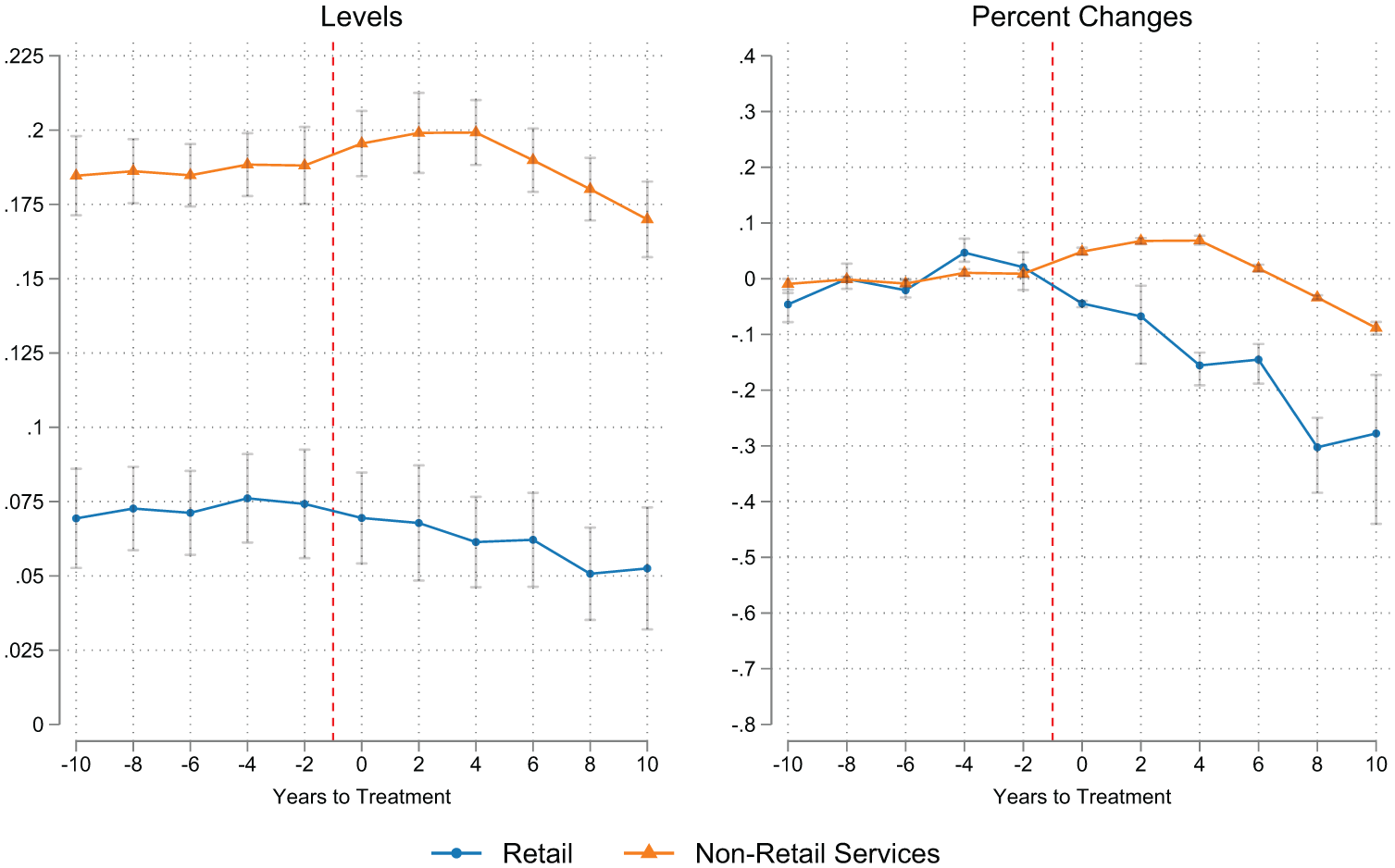
Descriptive Trends in Union Membership by Industry Before and After Walmart Supercenter Entry among Individuals in Treatment Counties.
We emphasize that these are purely descriptive trends and exclusively among the treatment group. Any appropriate assessment of Walmart’s effects on union membership must also consider how these trends compare to workers who are not affected by retail. Figure 2 presents our primary event study plots comparing union membership trajectories for individuals in counties where Walmart Supercenters opened versus individuals in counties where Supercenters did not open. Recall that these estimates are based on our stacked DiD estimates. The upper-left panel presents estimates for all individuals. The upper-right panel presents estimates when limiting the sample to individuals who ever worked in retail during the 20-year treatment window, and the lower-left panel limits the sample to individuals who worked in retail in the pre-treatment window.
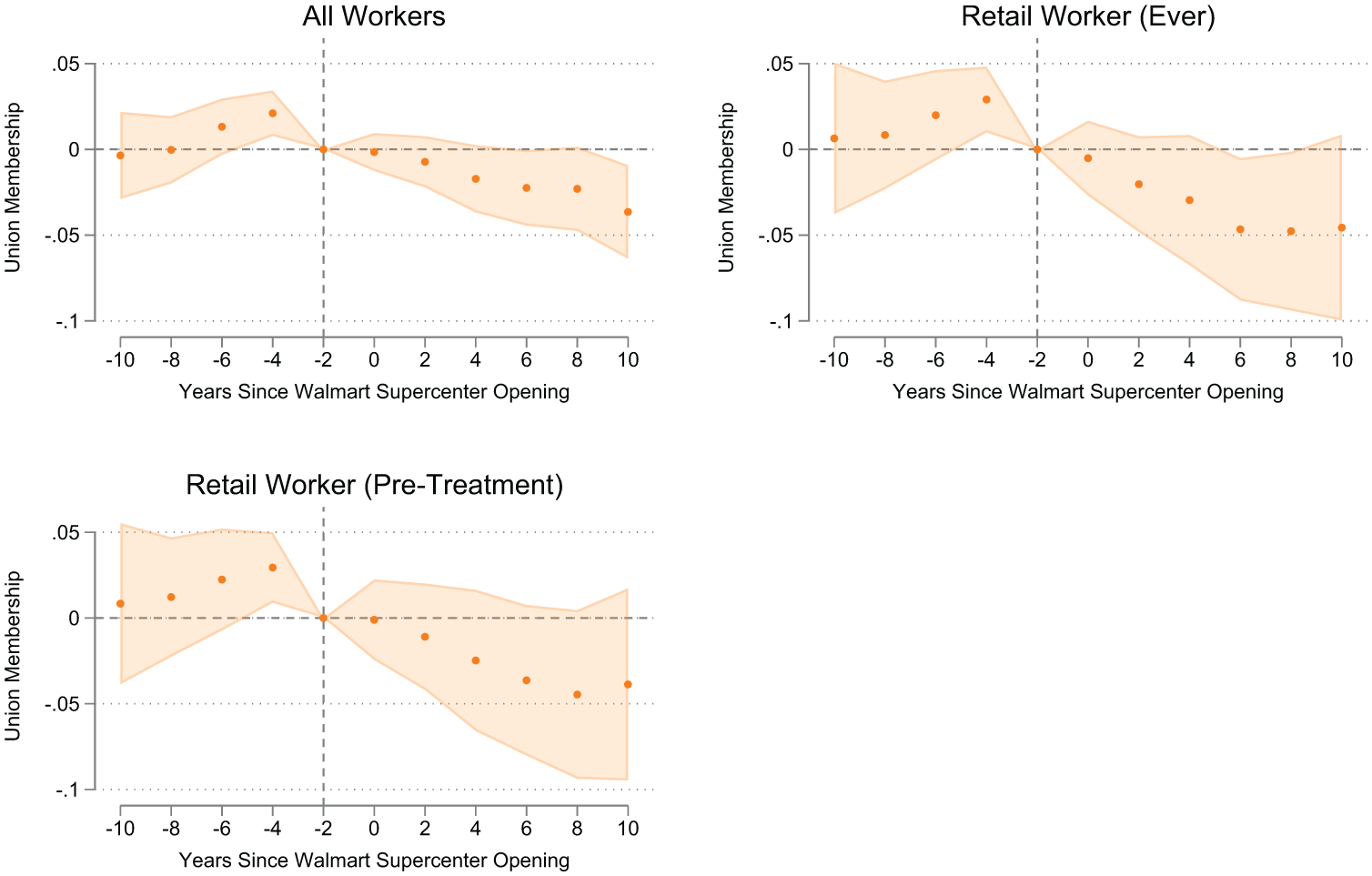
Does an Increase in Buyer Power Subsequently Suppress Worker Power? Event Study Estimates of Effects of Supercenter Openings on Union Membership.
In all three panels, we find evidence to support our pre-treatment parallel trends assumptions; put differently, union membership was on a similar pre-treatment trajectory for individuals who were eventually exposed to a Walmart Supercenter versus those who were not. All three panels also show declines in union membership in the treatment groups after a Supercenter opens. Among “all workers,” the decline in union membership starts in the year of Supercenter entry (albeit only a small decline in the initial year) and increases over the subsequent 10 years (a decline of 5 percentage points relative to individuals in non-Supercenter counties at 10 years post-Supercenter entry). When limiting the sample to workers who ever worked in retail, the trajectory of the decline is similar but slightly larger, peaking at a 5 percentage-point loss in union membership at eight years post-Supercenter entry. The lower-left panel shows similar trends, albeit with less precision, when conditioning the sample to workers who were employed in retail prior to the Supercenter’s entry.
Table 4 provides precise estimates of union decline in the post-treatment window, and it also presents estimates when adjusting for differential linear pre-trends. This latter step allows us to more confidently rule out that our results are vulnerable to differential trends in union membership for individual Supercenter versus non-Supercenter counties prior to treatment. We present analyses from models spanning all years (1983 to 2019) and from models that end prior to 2015, with the aim of providing initial evidence on the role of temporal context in shaping our conclusions.
Stacked Difference-in-Differences Estimates of Effect of Walmart Supercenter Entry on Union Membership.
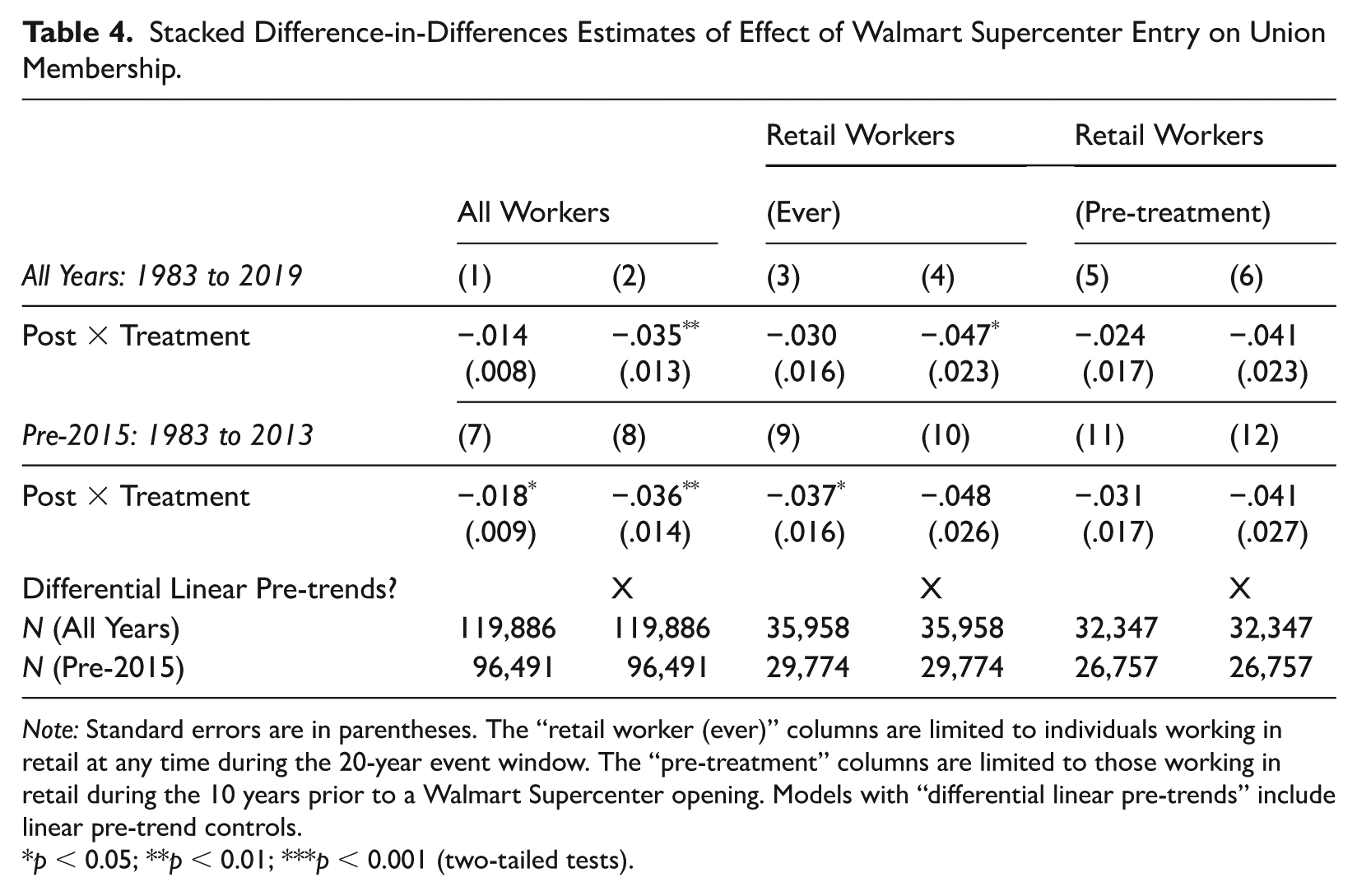
Note: Standard errors are in parentheses. The “retail worker (ever)” columns are limited to individuals working in retail at any time during the 20-year event window. The “pre-treatment” columns are limited to those working in retail during the 10 years prior to a Walmart Supercenter opening. Models with “differential linear pre-trends” include linear pre-trend controls.
p < 0.05; **p < 0.01; ***p < 0.001 (two-tailed tests).
Among all individuals in our primary analysis, the opening of a Walmart Supercenter leads to a decline in union membership that averages at 1.4 percentage points in the 10-year post-treatment window. When accounting for pre-trends, this increases to 3.5 percentage points. Given that pre-treatment union membership in the treated counties averaged at 16.1 percent, these percentage-point declines amount to a relative loss in union membership of 9 to 21 percent. Among individuals who ever worked in retail during the 10 years before or after Supercenter entry, Supercenter openings led to a decline in union membership of 3.0 to 4.7 percentage points (Models 3 and 4). When conditioning on pre-treatment retail employment, we find that Supercenters led to a decline in union membership that ranges from 2.4 to 4.1 percentage points. The bottom panel of Table 4 suggests that patterns were generally similar if we exclude 2015 onward (when labor campaigns against Walmart were weaker).
Why do Supercenter openings lead to a decline in union membership? Analytically, we find that Supercenters do not affect union membership primarily through aggregate employment losses among union workers in affected counties, nor via large-scale occupational restructuring among workers in affected counties. Instead, we find evidence of declining union membership even among employed adults within industries after a Supercenter opening. Figure 3 provides visual support of this evidence.
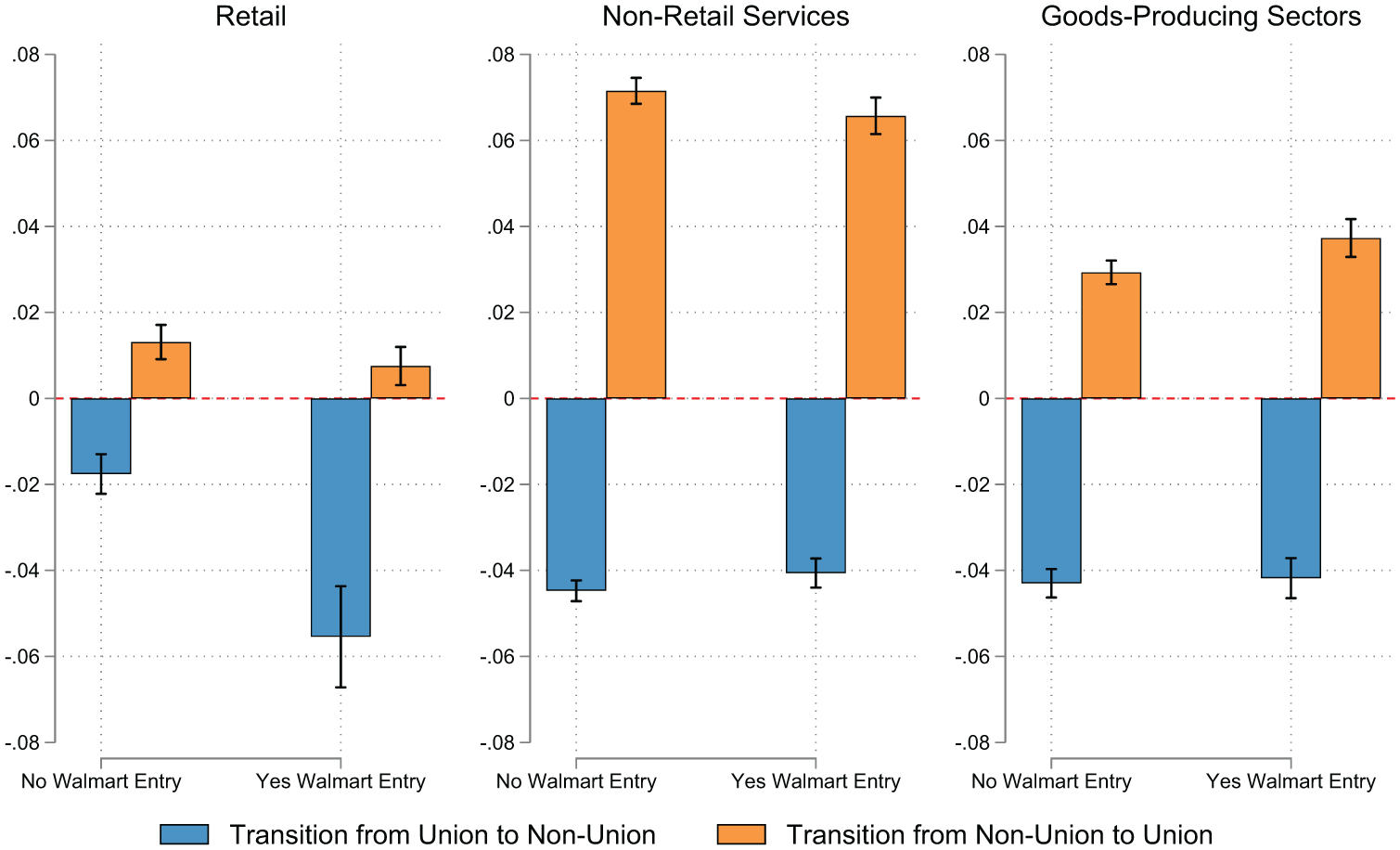
Descriptive Summary of Union Transitions among Workers in the Same Industry Before and After Treatment.
Specifically, Figure 3 presents descriptive evidence on union transitions for workers who were employed in the labeled industry both before and after a Supercenter entry. The two sets of bars in each panel depict union transitions for workers in counties where Walmart did not open, and where Walmart did open. The blue bars extending downward represent the share of workers who transition from (pre-treatment) union to (post-treatment) non-union, and the orange bars extending upward represent the share of workers transitioning from non-union to union. In the retail industry, where a Supercenter did open, we find a 6 percentage-point shift from workers being unionized to non-unionized, and only a small countervailing increase in non-union to union transitions. In contrast, where a Supercenter did not open, we find a 1.8 percentage-point shift from union to non-union, which is mostly offset by a 1.5 percentage-point increase in the share of non-unionized workers who were subsequently unionized. The net difference in transitions between the Walmart and non-Walmart groups—around 5 percentage points—is near-identical to the estimated declines in union membership among retail workers from our stacked DiD models.
Note that our within-retail focus does not rule out that our observed retail workers switched jobs or employers after Supercenters entered their counties. In fact, supplemental analyses show that unionized retail workers in counties where Supercenters opened were 27 percentage points more likely to change jobs after a Supercenter opening compared to unionized retail workers in non-Supercenter counties. 13 These job transitions, which include switches to non-union retail work at new employers, align with evidence of (1) high turnover within retail employment (Lichtenstein 2006), but perhaps more significantly, (2) the fact that entry of a Supercenter is likely to push out incumbent (and potentially pro-union) retail firms, leading workers to rely more heavily on (anti-union) Walmart as their employer.
The middle and right panels of Figure 3 present similar trends for workers in non-retail services and goods-producing sectors. In both, the share of workers transitioning from union to non-union does not differ meaningfully between individuals where Walmart does versus does not open. Together, these results suggest that Walmart Supercenters lead to declining union membership, particularly among retail workers. The declines are channeled through within-industry changes in the likelihood that workers are unionized; specifically, retail workers are particularly likely (compared to similar workers in counties where Walmart does not open) to transition from being unionized during the 10 years prior to Walmart’s entry to being non-unionized in the 10 years after Walmart enters their county. Related to RQ2, we conclude that an increase in buyer power can, indeed, subsequently suppress worker power.
Can Worker Power Protect Against the Economic Consequences of an Increase in Buyer Power?
Our final RQ examines the protective effect of worker power against the potentially negative consequences of a rise in buyer power. As operationalized in this study, we assess how the entry of a Supercenter affects earnings and wages for unionized workers relative to non-unionized workers. Figure 4 presents descriptive trends in logged annual earnings for non-unionized (left panel) and unionized (right panel) workers by whether or not they were exposed to a Walmart Supercenter. The x-axis is our time-to-treatment indicator, identical to that of our event study specification. We emphasize that we focus here on current union membership in the observed year.
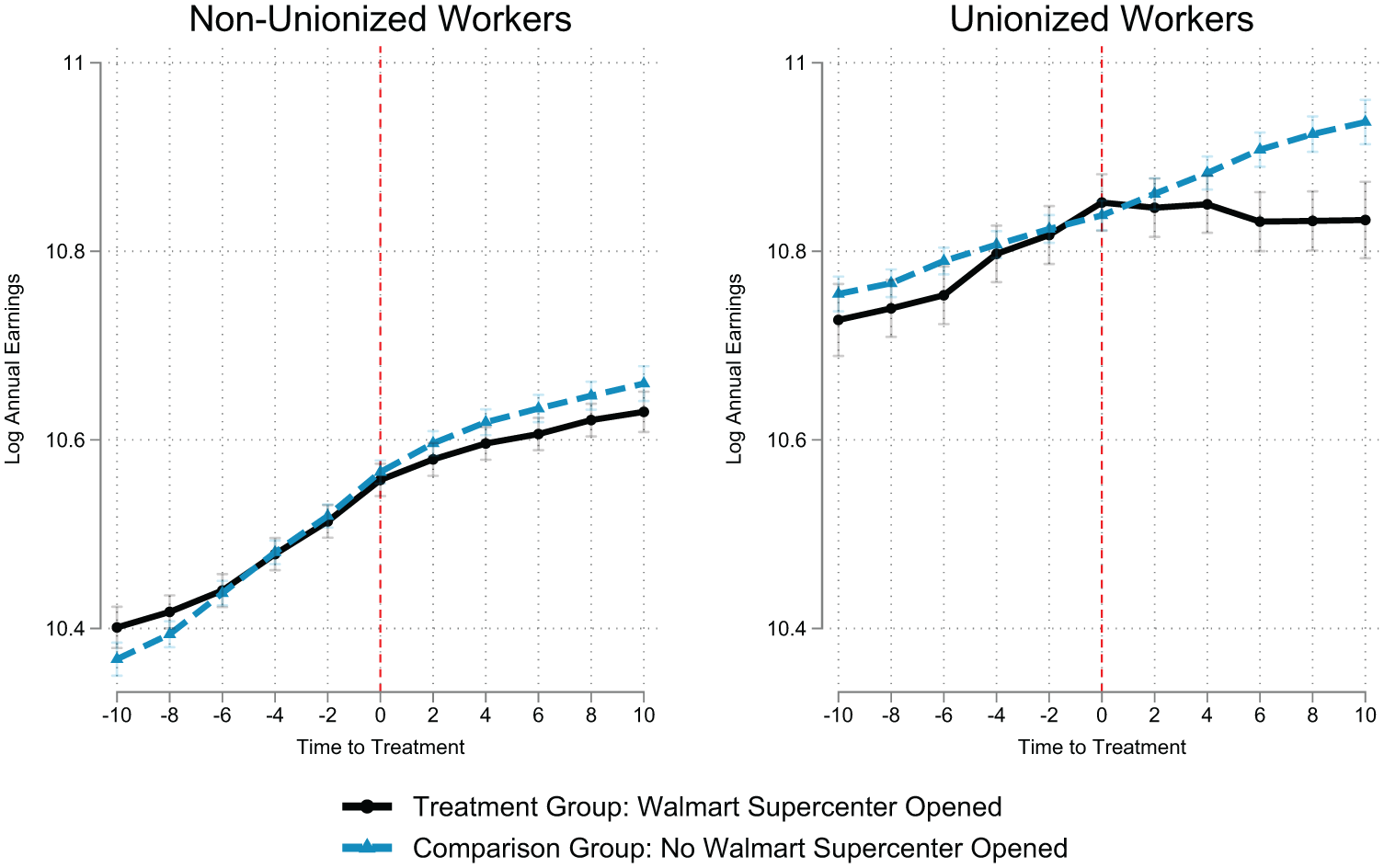
Descriptive Summary of Trends in Earnings by Union Membership, Exposure to a Walmart Supercenter, and Year Relative to Treatment.
Among non-unionized workers, upward trends in annual earnings growth are largely comparable for workers in the treatment and comparison groups (i.e., Walmart and non-Walmart counties) prior to Supercenter openings. After Walmart enters, the treated group of non-unionized workers experiences a slight decline in its earnings trajectories relative to the control group. Among unionized workers, however, the flattening of earnings growth for treated workers is notably stronger (see right panel of Figure 4). Workers in the treatment and comparison groups experience upward earnings growth prior to treatment. Once a Walmart Supercenter opens in the treated county, the earnings trend flattens for unionized workers in the treatment group (where a Walmart Supercenter opened), but appears to have no meaningful effect on trends for unionized workers in the comparison group (where a Walmart Supercenter did not open). These descriptive trends suggest unions are less able to protect the earnings of their members after a Supercenter enters a local labor market (compared to unionized workers in non-Walmart counties and prior to the entry of a Walmart Supercenter).
Table 5 more formally tests this claim, presenting results from our stacked DiD estimates. As before, we present results for all years and then results that exclude 2015 onward. We interpret the differential effects for unionized versus non-unionized workers; a negative, significant coefficient reflects a decline in the union earnings premium. Figure E5 in the online supplement presents event study results; these event study estimates support our assumption of parallel trends for unionized versus non-unionized workers prior to a Supercenter’s opening.
Can Worker Power Protect Against the Consequences of Increases in Buyer Power? Stacked Difference-in-Differences Estimates of Effect of Walmart Supercenter Entry on Earnings By Union Status.
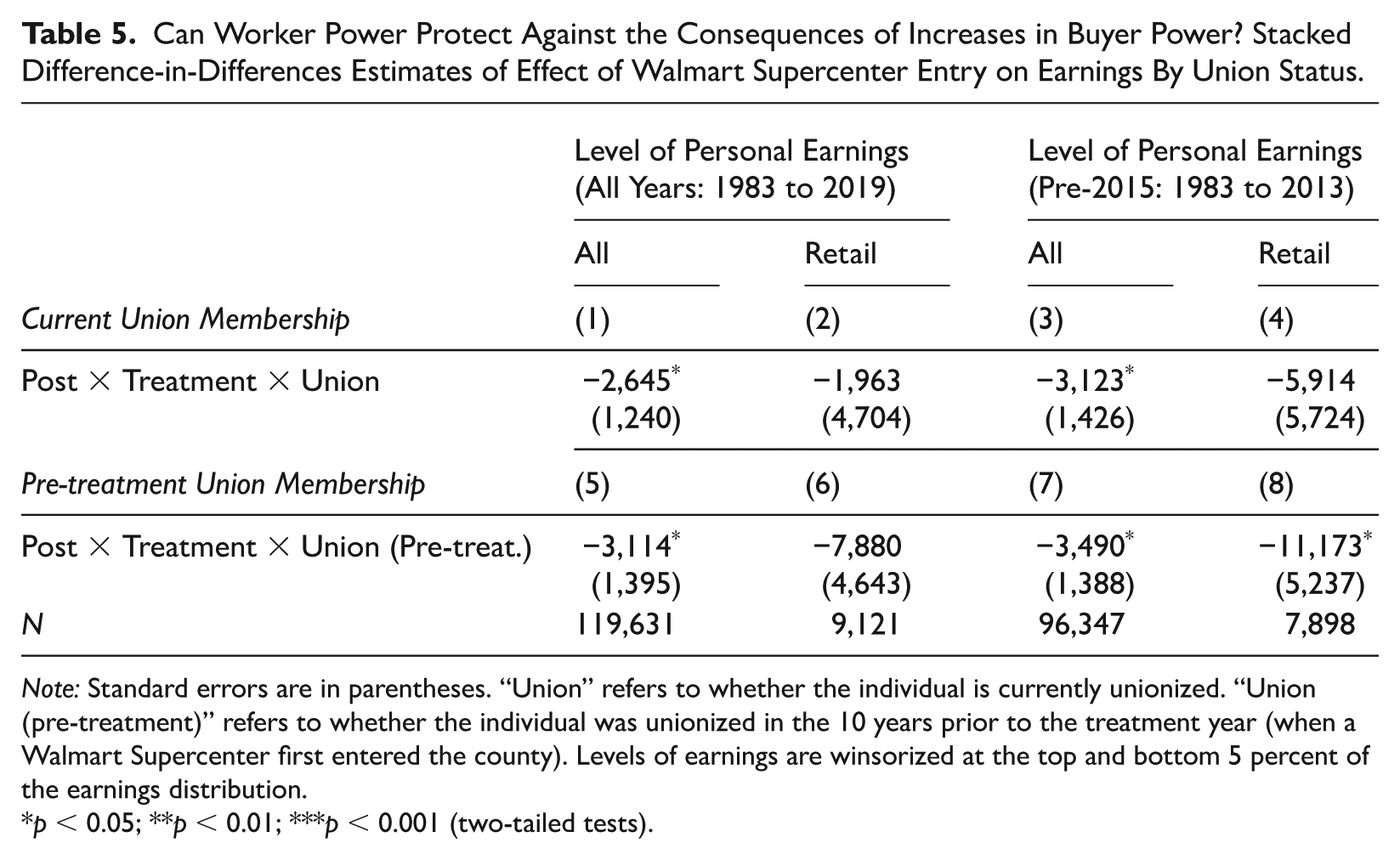
Note: Standard errors are in parentheses. “Union” refers to whether the individual is currently unionized. “Union (pre-treatment)” refers to whether the individual was unionized in the 10 years prior to the treatment year (when a Walmart Supercenter first entered the county). Levels of earnings are winsorized at the top and bottom 5 percent of the earnings distribution.
p < 0.05; **p < 0.01; ***p < 0.001 (two-tailed tests).
Model 1 in Table 5 shows that Supercenter entries lead to a decline in the earnings advantages of unionized workers of $2,645 per year (in 2021 USD); Model 2 shows a decline in earnings within retail (although less precise). Models 5 and 6, which focus on a fixed measure of pre-treatment unionization (rather than contemporaneous union membership) show even stronger negative consequences, especially for retail workers: a $7,880 decline in annual earnings, nearly twice the estimate effect as for workers in general who were unionized pre-treatment ($3,114, see Model 5). Were Walmart’s effects even stronger prior to its store-wide minimum wage and when labor campaigns were stronger? Our evidence from subsequent models suggests this may be the case: point estimates become more strongly negative when excluding 2015 to 2019. Specifically, Model 8 shows that prior to 2015, retail workers who were unionized prior to Walmart’s entry faced an estimated loss of $11,173 per year relative to retail workers who were not unionized prior to treatment. This treatment effect is large in magnitude, but recall these estimates are not limited to employed adults; declines in employment and work intensity largely drive the strong, negative effect for retail workers. 14
The fact that losses are stronger when operationalizing union membership specifically as pre-treatment unionization suggests that compositional declines in union membership after treatment explain a large share of this group’s relative decline in earnings. However, we also find declining relative earnings and wages even for workers who remain unionized before and after Supercenter entries. Our descriptive trends (see Figure 4) suggest these workers experienced flattened earnings growth after Supercenter entry (whereas unionized workers in non-affected counties experienced no such flattening), consistent with rising buyer power negatively moderating the ability of worker power to maintain higher earnings growth for unionized workers. In Table D1 in the online supplement, we further decompose the earnings losses into changes in employment, hours worked, and hourly wage. We find negative effects of Supercenter entries on hours worked and hourly wages for workers who were unionized prior to Walmart’s entry.
Together, our results suggest unions are not able to protect against the economic effects of a Walmart Supercenter entry; instead, union members lose (relatively) the most when a Supercenter enters a local labor market. Not only does union membership decline in size (the focus of RQ2), but the unions that survive Walmart’s entry decline in their protective power, at least with respect to achieving higher wage and earnings growth for union members.
Sensitivity Tests and Additional Analyses
We perform several sets of sensitivity tests to evaluate the robustness of our results. Table E1 in the online supplement provides direct evidence to confirm that Walmart Supercenter entries do lead to increases in buyer power. Prior research has established this fact in various ways (Wiltshire 2023), but we offer independent evidence from County Business Patterns data that the opening of a Walmart Supercenter in a county leads to a large relative increase in the share of retail establishments in the county operated by large firms (i.e., firms with 250 or more employees). Specifically, we use county-level data from the County Business Patterns (CBP) dataset, which provide total retail establishments by size for each county from the 1980s through 2019. Figure 5 presents event study estimates from stacked DiD analyses to show that, prior to Walmart Supercenters entering counties, treatment and control counties were on similar trajectories regarding the size of existing retail establishments. After Supercenters enter, we see clear and persistent evidence of a rising concentration of retail jobs in larger firms. As we document in Table E1, this shift occurs while the total number of retail establishments within counties declines, confirming that our results capture the effect of Supercenters displacing other, usually smaller, retail establishments. These patterns further support our focus on Walmart Supercenters as a clearly identifiable proxy of buyer power.
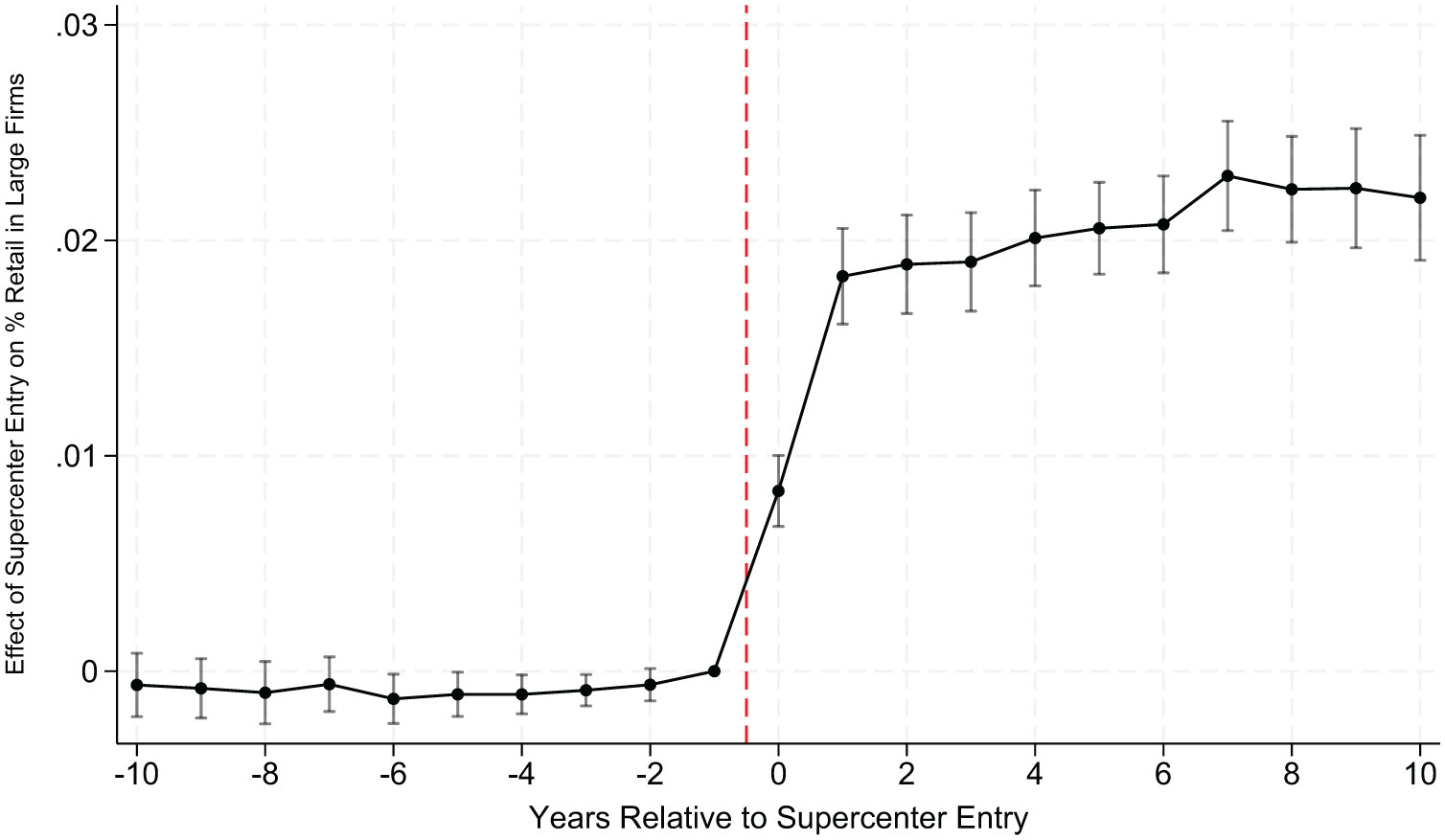
Event Study Estimates of Walmart Supercenter Entry Effect on Share of Retail Establishments Operated by Large Firms in a County.
Part B of the online supplement provides further evidence that Walmart’s non-random geographic selection of counties is not driving our conclusions. Recall that our primary analyses sidestep concerns of geographic selection in several ways: we compared failed Supercenter openings among counties where Walmart expressed intention to open a Supercenter (RQ1), we matched workers in our treatment and control counties to ensure appropriate comparisons (RQs 2 and 3), we evaluated support for our parallel trends assumption in all relevant analyses, and we provided results that explicitly account for differential linear pre-trends in our core analyses. Nonetheless, Figure B1 provides further evidence of parallel trends across a broader subset of demographic and economic indicators for workers who are in counties where a Supercenter opened compared to workers where a Supercenter did not open. Across a range of outcomes—age, sex, college degree attainment, family structure, employment, annual earnings, hourly wage, retail employment, union membership, and post-tax/transfer poverty—we find no evidence of differential pre-trends that should invalidate our primary conclusions. Thus, for our primary treatment effects to be driven by something other than Walmart Supercenter openings, those unobserved features of workers in given counties would need to (1) align precisely with the timing of Walmart Supercenter openings, (2) not affect trends in outcomes in the treatment counties prior to Supercenter openings, and (3) only affect trends in outcomes in the Supercenter counties after the Walmart opens.
In Part C of the online supplement, we conduct a set of placebo tests in which we replicate RQs 2 and 3 on workers in three industries that should not be directly affected by Supercenter openings: public administration, agriculture/energy, and banking/finance. Table C1 shows Supercenters did not lead to meaningful or statistically significant reductions in union membership within these three industries. In Table C2, we find no evidence to suggest Supercenters negatively affect the relative earnings of unionized workers in these industries. These placebo tests give greater confidence that our primary results, and especially those focused on retail workers, are capturing real effects of Walmart Supercenter entries. In Figures C1 and C2, we re-estimate our primary results for RQ2 and RQ3 while limiting the control individuals to counties that faced a “failed” Supercenter entry, consistent with some of our analyses in RQ1. Small sample sizes make this task more challenging in the difference-in-differences framework in RQ2 and RQ3, but we nonetheless find comparable results for RQ2 when limiting the control units to failed entries (albeit much less precise). For RQ3, results are less negative than our primary findings (i.e., Supercenters have weaker effects on annual earnings) but are imprecise and with point estimates that are not significantly different (at conventional confidence levels) from our primary findings.
In Tables E4 and E5 in the online supplement, we replicate our core analyses while controlling for state-level policy and institutional covariates, including minimum wage levels, levels of state supplements to the federal EITC, the share of low-income households receiving SNAP benefits, and the share of low-income households receiving TANF benefits. Consistent with the expectations set above, we find no meaningful differences in our conclusions.
In our primary results, we do not remove individuals who migrate across counties during the years after a Supercenter entry. Moving to a new county could be a direct or indirect effect of a Supercenter entry; therefore, excluding such individuals would provide biased estimates of our effects of Supercenter entries on workers. Nonetheless, Tables E6 and E7 replicate our core results when excluding individuals who did not consistently live in the same county from two years prior to Supercenter entry to eight years after entry. These models essentially estimate treatment effects for “stayers,” yet the patterns are consistent with our primary results.
In Figures E1 through E4, we perform four sets of leave-one-out estimations that replicate RQs 2 and 3 while dropping each state and/or each year during iterations of our analyses. That the primary point estimates are stable across all runs suggests our conclusions are not being driven by particular states or particular years.
Conclusions
Sociologists have long been interested in how power in labor markets affects economic and social outcomes. Most often, scholars have investigated the role of worker power, establishing that stronger labor unions are associated with lower economic inequality, lower poverty, more generous welfare states, and other egalitarian outcomes (Baker 2020; Brady et al. 2013; Korpi 1983). Here, we sought to expand sociologists’ understanding of labor market power to include buyer power, or the ability of powerful firms to reduce outside employment options for workers in a given labor market. We argued that buyer power is distinct from worker power, rather than merely its inverse, and we offer several rationales for studying how buyer power moderates organized labor’s ability to pursue its economic aims. Analytically, we investigated the interplay of buyer and worker power through a research design that can elicit causal effects related to the introduction of Walmart Supercenters—the big-box store of America’s largest private employer. Past research directly connects Walmart Supercenters to increases in buyer power (Wiltshire 2023), which our findings confirm (see Table E1 in the online supplement).
We asked, first: can stronger worker power inhibit increases in buyer power? Our empirical assessment of the association of union membership and Supercenter entry suggests an affirmative (but non-causal) answer. Even when compared to counties in which Walmart declared intent to open a Supercenter, yet failed, we find that stronger union membership is associated with lower likelihood of a Supercenter entry. Second, we asked: when buyer power does increase, does the strength of worker power subsequently decline? Yes, as we find that the introduction of a Supercenter leads to a 3.5 percentage-point decline in union membership for workers in affected counties, largely channeled through declines in retail. Finally, we asked: can worker power protect against the economic consequences of an increase in buyer power? No, our results suggest; when a Supercenter does open in a county, the relative earnings of unionized workers suffer the most, leading to a decline in the union earnings advantage. We offer a large set of sensitivity analyses and discussion of underlying mechanisms to support our top-line findings. Changes in prevailing levels of buyer power, we conclude, carry clear implications for the size and protective strength of organized labor.
Our main theoretical contribution is our advancement of buyer power as a distinct dimension of labor market power relative to worker power. Interrogating this concept allowed us to refine more commonly applied perspectives on power in the sociological literature. Relative to Power Resource Theory (PRT), which gives primary focus to worker–firm (or labor versus capital) conflict, our study emphasizes that the contextual labor market characteristics in which worker power operates likely matter. As highlighted by Korpi (1983) and Arnholtz and Refslund (2024), unions’ efficacy in generating egalitarian outcomes depends not solely on their own power resources but also on the configuration of external forces, including the between-firm competition that can shape prevailing levels of buyer power. Relative to the theoretical work on firm power in the economic sociology literature (e.g., Fligstein 2002; Fligstein and Fernandez 1988), our analysis connects between-firm power struggles to their implications for workers’ economic outcomes, as well as the efficacy of organized labor to achieve its social and economic aims. We were also able to directly theorize and test some of the social mechanisms through which buyer power shapes economic outcomes.
Our findings also speak to core themes of sociological research on unions and labor market power: how changes in power can institutionalize patterns of equality that carry implications for future generations (VanHeuvelen 2023), and how unions can contribute to the “moral economy” by upholding norms of equity in the labor market (Western and Rosenfeld 2011). Van Heuvelen’s (2023) work on right-to-work laws establishes that beyond first-order consequences for workers, the anti-union legislation institutionalizes norms and values that undermine future workers’ earnings and negotiation power. The rise of buyer power enacted through the introduction of Walmart Supercenters offers a non-policy example with similar economic implications: declining union membership and declining earnings growth for unionized workers in affected counties, with effect sizes that grow throughout our 10-year post-treatment period. In Western and Rosenfeld’s (2011) account, unions’ centrality in fostering norms of equity operates through cultural (e.g., public speeches regarding inequality), political (e.g., influencing public policy), and institutional (e.g., through rules, government, and markets) channels. Our study offers a fourth channel: through maintaining fair and competitive balance among local employers to inhibit the spread of buyer power. The UFCW’s successful advocacy against the opening of a Supercenter in Inglewood, California, was not merely a cultural win or a formal change in policy, but the maintenance of a local labor market context that more effectively allowed unions to pursue their economic aims.
Separately, our findings contribute to the broader set of evidence on Walmart specifically—a distinctly powerful firm that is perhaps the only company to be an exclusive focus of Annual Reviews in both sociology and economics (Gereffi and Christian 2009; Volpe and Lavoie 2008). In sociology, prior research has established Walmart’s sensitivity to protests (Ingram et al. 2010), its anti-union tactics and preferences (Rao et al. 2011), and why Walmart employees often fail to organize (Reich and Bearman 2018). Our contribution within this specific literature is to empirically assess Walmart’s implications for the strength and protective effect of labor unions, and to explicate how Walmart represents a broader trend of rising levels of buyer power that carries implications beyond this specific retail company.
Additionally, our analytic framework represents a separate contribution of our work. Whereas most sociological studies of labor market power are descriptive or associative in nature, we applied stacked difference-in-differences (following the state-of-the-art in the causal analysis literature) to produce plausibly causal estimates of how changes in labor market power affect economic outcomes.
In closing, we offer several potential pathways for future research to build on this study’s conceptualization of buyer power. First, future research should continue to investigate the role of political-institutional and temporal context in shaping the influence of buyer power. Our analysis of buyer power in the United States occurs in a context of weak institutionalized and essentially no sectoral-level bargaining. Just as researchers have documented how Walmart’s power varies across countries (Bank Munoz 2017; Tilly 2006), future research can investigate how broader measures of buyer power’s influence are curtailed by political-institutional context. This leads to our next point: the use of Walmart Supercenter entries provided us a clear “event” by which to causally assess the implications of the expansion of buyer power in a local labor market, but we cannot assume Supercenter entries are representative of all instances of buyer power. Future sociological research should produce broader proxies of buyer power to further understand how it may affect social and economic outcomes. As some examples, researchers may produce measures of local labor market concentration, perhaps through online advertisements data provided by aggregators such as Burning Glass (Azar et al. 2020). Alternatively, researchers may pursue more indirect measures, such as place- and time-variation in the frequency of employee quit rates, which are one signal of labor market concentration. Text-as-data approaches could also be used to detect buyer power in contract language, procurement networks, or merger filings that signal employer dominance. Even alternative firm-based analyses, such as a study of Amazon’s buyer power, may acknowledge subtle differences in the precise form of buyer power being applied. Finally, qualitative or comparative case studies could explore how collective resistance to buyer power varies across institutional settings. These broader analyses of buyer power could help sociologists further understand how buyer power interacts with worker power in shaping social and economic outcomes.
Supplemental Material
sj-pdf-1-asr-10.1177_00031224261437057 – Supplemental material for Countervailing Powers: Labor Unions Against the Buyer Power of Walmart Supercenters
Supplemental material, sj-pdf-1-asr-10.1177_00031224261437057 for Countervailing Powers: Labor Unions Against the Buyer Power of Walmart Supercenters by Joshua Choper, Lukas Lehner and Zachary Parolin in American Sociological Review
Footnotes
Acknowledgements
For helpful feedback, the authors thank Nathan Wilmers, Alexander Busch, and participants of seminar series at ILERA, the Labor Institutions Reading Group, Nuffield College at University of Oxford, and University College London. The authors also thank Rafael Pintro Schmitt for collaboration on research design.
Funding
Parolin acknowledges funding from the European Union (ERC Starting Grant, ExpPov, #101039655). Views and opinions expressed are those of the authors only and do not necessarily reflect those of the European Union or the European Research Council; neither the European Union nor the granting authority can be held responsible for them. Lehner acknowledges financial support from the OeNB Jubiläumsfonds (grant number: 18834) and the Norwegian Research Council (grant number 358025).
Supplemental Material
Supplemental material for this article is available online.
Data Note
The authors have stored their replication code at  . The authors cannot share the restricted-access Panel Study of Income Dynamics (PSID) data; instead, researchers seeking to use these data should apply for the necessary permissions with the PSID and import our code into the PSID’s Virtual Data Enclave.
Notes
Author Biographies
References
Supplementary Material
Please find the following supplemental material available below.
For Open Access articles published under a Creative Commons License, all supplemental material carries the same license as the article it is associated with.
For non-Open Access articles published, all supplemental material carries a non-exclusive license, and permission requests for re-use of supplemental material or any part of supplemental material shall be sent directly to the copyright owner as specified in the copyright notice associated with the article.
