




Abstract
Prior studies cast U.S. imprisonment as politically demobilizing. This article complicates that proposition by exploring when, and how, threat under penal confinement leads people to mobilize. Using interviews with currently incarcerated and recently released men across three states, I show that although imprisonment generally fosters political inaction, collective mobilization does arise under certain conditions. First, people in prison mobilize in response to embodied threats—fundamental threats eliciting visceral reactions that signal future harm (i.e., premature death or permanent incapacitation). Second, to collectively mobilize, a subpopulation of similarly threatened prisoners must be present and see the threats as a shared problem. Collective prisoner mobilization is more likely when both conditions are present; mobilization is unlikely when neither condition is present; and individual political contention is more likely when conditions are partially present. This range of political responses among incarcerated people is more dynamic than previously reported. Imprisonment has selective political effects, mobilizing the most repressed individuals within prison to devise new strategies to contest their repression.
Mass imprisonment is one of the most significant political developments in recent U.S. history, affecting nearly one in three Black males born between 1970 and 1984—and millions of others (Roehrkasse and Wildeman 2022; see also Roberts 2004). 1 Sociologists have responded to the rise of mass imprisonment by studying its origins and consequences as a political institution (Beckett 1997; Goodman, Page, and Phelps 2017; Manza and Uggen 2006). This body of research focuses largely on the buildup of the prison state by political elites (e.g., Campbell and Schoenfeld 2013) and, to a lesser extent, by rank-and-file agents of the prison state (e.g., Page 2011). However, little sociological work explores the political ideas and actions of incarcerated people in the United States (for a rare exception, see Wright 1973), and prominent studies that do explore the political experiences of individuals who have been to prison typically cast imprisonment as politically demobilizing (e.g., Calavita and Jenness 2015; Lerman and Weaver 2014; Manza and Uggen 2006).
The extant literature argues that prison reduces people’s sense of political efficacy, creates disincentives to political participation, and imposes barriers to gaining political representation or acquiring politically relevant information (e.g., prison grievance systems that limit prisoners’ rights activism within an intentionally curtailed legal sphere) (Barkow 2019; Calavita and Jenness 2015; Uggen and Manza 2004:175, 181; White 2022). As with other forms of carceral contact, moving through prison “demonstrably restructures individuals’ understanding of citizenship and empowerment,” leading Black people, among others, “to be less likely to engage in collective action or traditional methods of political participation” (Lerman and Weaver 2014:137, 198).
The qualitative studies in this literature are based on either single-state investigations or interviews and surveys with people about their political behavior post-incarceration (e.g., Calavita and Jenness 2015; Lerman and Weaver 2014; Uggen and Manza 2004). Absent from the literature is research on prison-based political action that spans multiple states. These research areas deserve more attention, considering that incarcerated people express a “diversity of political views and concerns,” and these sentiments are most salient among incarcerated people with “more pressing security and survival needs” (Uggen and Manza 2004:193). Moreover, past and recent cases from across the country show that people, even in the most incapacitated prison settings, engage in long-term collective mobilization (Berger and Losier 2018; Camon 2016; Kurshan 2013; Pelot-Hobbs 2013). 2 But under what conditions?
In this article, I take the above observations as a point of departure to complicate the theoretical narrative that prison is demobilizing. Treating high rates of racialized imprisonment as a case of widespread repression in the United States, 3 I use life history interviews across three states with 100 currently incarcerated and recently released Black and Latino men to explore both the circumstances whereby prisoners become mobilized, as well as how prisoners adapt and sustain their political strategies when faced with substantial barriers. Ultimately, I show that while repressive penal conditions tend to structure political quiescence, significant forms of prisoner mobilization do arise under conditions affecting specific prisoner subgroups.
First, I find that prisoner mobilization is more likely to occur in response to embodied threats—incapacitating circumstances that generate a visceral reaction (i.e., a deeply felt physical symptom or emotional response). Emerging from structural arrangements but distinct from other types of threat, 4 embodied threats mark the body in fundamental, perceptible ways that are viewed as signals of future harm. The embodiment of threat (i.e., the way threat is perceived on and through the body) becomes an important process that drives political action in repressive settings. Second, I find that collective mobilization is more likely when a subpopulation of similarly threatened prisoners sees the threat (or threats) as a shared problem. The structural context (or situation) then matters because it shapes how people process and react to a perceived threat, and social organization matters because it enables people to identify a threat as commonly felt.
Embodied threats were more likely to be perceived in adverse situations at the deepest ends of the penal system: solitary confinement, natural life in prison, placement on death row, and during personal or systemic health crises in prison. Besides affecting distinct prisoner subpopulations, these situations share the potential outcome of either permanent incapacitation or premature death. As my data show, embodied threats were more likely to be mobilizing in these situations because the threats (as perceived and experienced) tended to overlap, thus producing visceral reactions that motivated captives to organize despite not having activist backgrounds or networks. Subsequently, embodied threats that had a collective dimension—that were collectively felt and perceived as a shared problem—often prompted the creation of prisoner-led organizational structures that transformed incarcerated people’s injustice frames, sense of political efficacy, and capacity to build alliances.
These findings expand lines of sociological inquiry on the politics surrounding mass imprisonment as well as the micro-level processes whereby threat mobilizes action in highly repressive settings. First, the findings uncover a broader field of political contention in the prison state than is shown in prior studies of prisoner political behavior. The findings suggest imprisonment is more politically dynamic and varied in its effects than previously theorized. Second, the processes detailed here show how, in the case of U.S. prisoners, the feeling body is a primary medium through which threats are made politically salient and mobilizing. It is not so much economic or status-based threats that motivate action among people in prison, but threats that have life-and-death stakes and whose imminence is felt bodily and perceived consciously. For social movement scholars, this has implications for understanding how mobilization occurs among heavily repressed groups. Despite increasing interest in the role that threat plays in social movements, the embodied dimensions of threat (namely, visceral reactions to perceived threat) and how that experience motivates contention are not well understood or specified.
Situating the Body in Prisoner Mobilization
Prisons and Political Repression
Prisons are institutional sites of repression. Beyond their historical use as tools to suppress gains in Black political representation and economic power (Eubank and Fresh 2022; Muller 2018), U.S. prisons are designed to undercut the prospect of political mobilization among targeted populations inside and outside of prison (Berger and Losier 2018). For example, mass imprisonment arose from a state apparatus of countermobilization in which policing, arrest, and incarceration were “ramped up” in response to Black urban rebellions and radical Black movements of the 1960s and 1970s (Burton 2023; Hinton 2021; Oliver 2008). During that period, the federal government redeployed veteran soldiers, surplus ammunition, surveillance technologies, and military experiments of isolating prisoners abroad to wage a “war on crime” at home through U.S. prisons and targeted policing (Schrader 2019; see also Go 2023). The migration of these tactics, hardware, and military forces from the defense arena to the prison state facilitated the reinstitution of solitary confinement in the 1970s and the rise of supermax prisons in the 1980s.
Present-day prison architecture and prison management—involving the identification and removal of potential leaders, and isolation and segregation of would-be dissenters—are forms of “covert repression” (Earl 2011) that have long served as conscious efforts to curb organized political action (Burton 2023:14). For example, in a widely used 1970s manual, the American Correctional Association advised prison officials across the United States that prison rebellions are not spontaneous riots but “organized, calculated movements of massive resistance supported and assisted by outside groups” that should be met with tactical, militaristic force (Burton 2023:14). This policy made counterinsurgency a mainstream feature of prison management, where prison officials invest heavily in managing and segregating groups to suppress rebellion, while also anticipating how to quickly retake prisons in the event of an uprising (Burton 2023:14).
Repressive conditions are not equally imposed in prisons but are highly stratified. The resurgence of solitary confinement at the dawn of the mass imprisonment era was used as retaliation against political organizing—specifically, “as a tactic for repressing the organizing power of a rapidly growing prison population, mostly comprised of younger black men”—as well as against uprisings over worsening prison conditions (Cloud et al. 2023:2). Evidence from Pennsylvania’s prison system suggests isolation continues to be a tool imposed especially upon young Black men (Pullen-Blasnik, Simes, and Western 2021).
The death penalty is also highly racialized and tied to local politics. In the United States, the adoption of more severe sentencing policies (including the death penalty) is, like felon disenfranchisement laws, a method used in response to racial group threat to repress the competitive political power of Black populations (Duxbury 2021; see also Behrens, Uggen, and Manza 2003). The death penalty is also related to histories of white racial repression: U.S. localities with a history of lynching and that are currently experiencing racial group threat deploy the death penalty at higher rates (Jacobs, Carmichael, and Kent 2005).
These dynamics underscore how imprisonment is a “political tactic” (Foucault 1977:23). They showcase the role of racial criminalization (i.e., the attachment of Blackness with criminality) in the various forms imprisonment takes to “control the lives of people the state has defined as criminal” (Muhammad 2011; Wright 1973:22).
Threat and the Feeling Body
Threat is an important mechanism whereby repression shapes political action (Almeida 2018). For example, structural threats such as state repression “consistently drive defensive collective action” (Almeida 2019:53). In Europe in the 1940s, open prisoner revolt arose in Nazi death camps in response to genocide (Maher 2010), and in the 1970s, Irish political prisoners escalated their hunger strikes in response to increasingly repressive, threatening conditions (O’Hearn 2009). These cases suggest prisoner mobilization is more likely when threats are group-specific, because subgroups threatened with targeted repression acquire a “resister’s toolkit” (skills, knowledge, and networks) through those experiences (Finkel 2015). These cases also suggest that collective action is more likely, even in highly repressive settings, if threats are perceived as “immediate and lethal” (Maher 2010:255).
Yet, the interpretive and affective dimensions of threat are not much explored in the social movement literature. Rather, threat is defined through a rational choice model as “the costs that a social group will incur from protest, or that it expects to suffer if it does not take action” (Goldstone and Tilly 2001:183). This definition, which emphasizes rational calculations in decision-making, could be strengthened if it more explicitly accounted for the visceral reactions that are triggered when faced with a perceived threat (see Fricchione, Ivkovic, and Yeung 2016; Jasper 1998). For instance, recent descriptions of threat as “negative conditions that encourage collective action” (Almeida 2019:53), and as exposure to “real or perceived harms” that will worsen if no action is taken (Almeida 2019:7, 53), suggest a symbolic interactionist approach to threat could augment the rational choice model. Under this alternative approach, threat can be understood as an interactive process of interpretation and response to external forces that changes people’s perceptions of their circumstances (see Goldstone and Tilly 2001:193).
I thus use the term perceived threat to more precisely get at the subjective and interpretive processes that drive people’s threat responses. Although this social interactionist understanding of perceived threat is not typical in social movement scholarship (it is more common in studies of racial group threat, see Blumer 1958; Bobo 1999; Reichelmann 2021), it is useful for disentangling the general term “threat” into its processual components. In this model, perceived threats emerge from a process of social interaction between a person (or group), a new occurrence that befalls them, and the perceived meaning given to that occurrence, which leads the event to be interpreted as threatening (for background on Blumer’s conceptualization of threat, see Reichelmann 2021).
It follows, then, that perceived threats (referred to here as simply “threats”) differ in terms of their mobilizing potential. This variation in mobilizing potential likely has to do with the extent to which threat provokes a visceral reaction. For example, when a threat is perceived, the “moral shock” often needed to attribute blame for it is a “visceral bodily feeling” (Jasper 1998:409). People respond to this bodily feeling by channeling fear and anger into political action—“complex emotional processes that few researchers have described,” but that theoretically may motivate political action when the source of the threat is human and when the “direct embodiments” of the threat (i.e., the visceral signs of the threat) can be seen in oneself or others (Jasper 1998:409–10). Specifying threat in this way is relevant to social movement scholarship, as it is not well understood how micro-level threat processes motivate high-risk collective action. If threat is made known to people through the feeling body (see Russo 2014:68), then the body can be further theorized not only as a means through which to protest, but also as a means through which to determine the stakes of political action.
Additionally, abrupt or newly discovered threats may elicit visceral reactions (“hot cognition”) that spur political action, whereas “slowly unfolding, existing threats” may elicit resignation, denial, or other reactions associated with quiescence, inhibiting the extent to which problems are recognized as threats in need of political remedy (Jasper 1998:412). For instance, high-risk collective action was most likely to occur aboard eighteenth-century British navy ships when new, acute threats (namely, a high percentage of sick sailors) overlapped with long-standing grievances (Hechter, Pfaff, and Underwood 2016). Similar patterns are visible in today’s prisons, such as the wave of prison protest actions that followed the explosion of the COVID-19 pandemic in 2020 (see Figure 1). Long-standing, prison-based threats—referred to as “pains of imprisonment” (e.g., continuous surveillance, loss of bodily security) that are imposed on prisoners and “carry . . . profound hurt as a set of threats or attacks . . . against the very foundation of the prisoner’s person” (Sykes 1958:68)—generally do not rouse confrontational activism, but the new threat of COVID-19 alongside long-standing threats did generate such action. Qualitative evidence suggests visceral reactions likely played a role in both these historical cases (American Prison Writing Archive 2023; Pfaff and Hechter 2020). Thus, the overlap of new and long-standing, prison-based threats, which affect some prisoner subpopulations more than others (see Ghandnoosh 2022; Resnik et al. 2016), may elicit visceral reactions that are conducive to political contention.
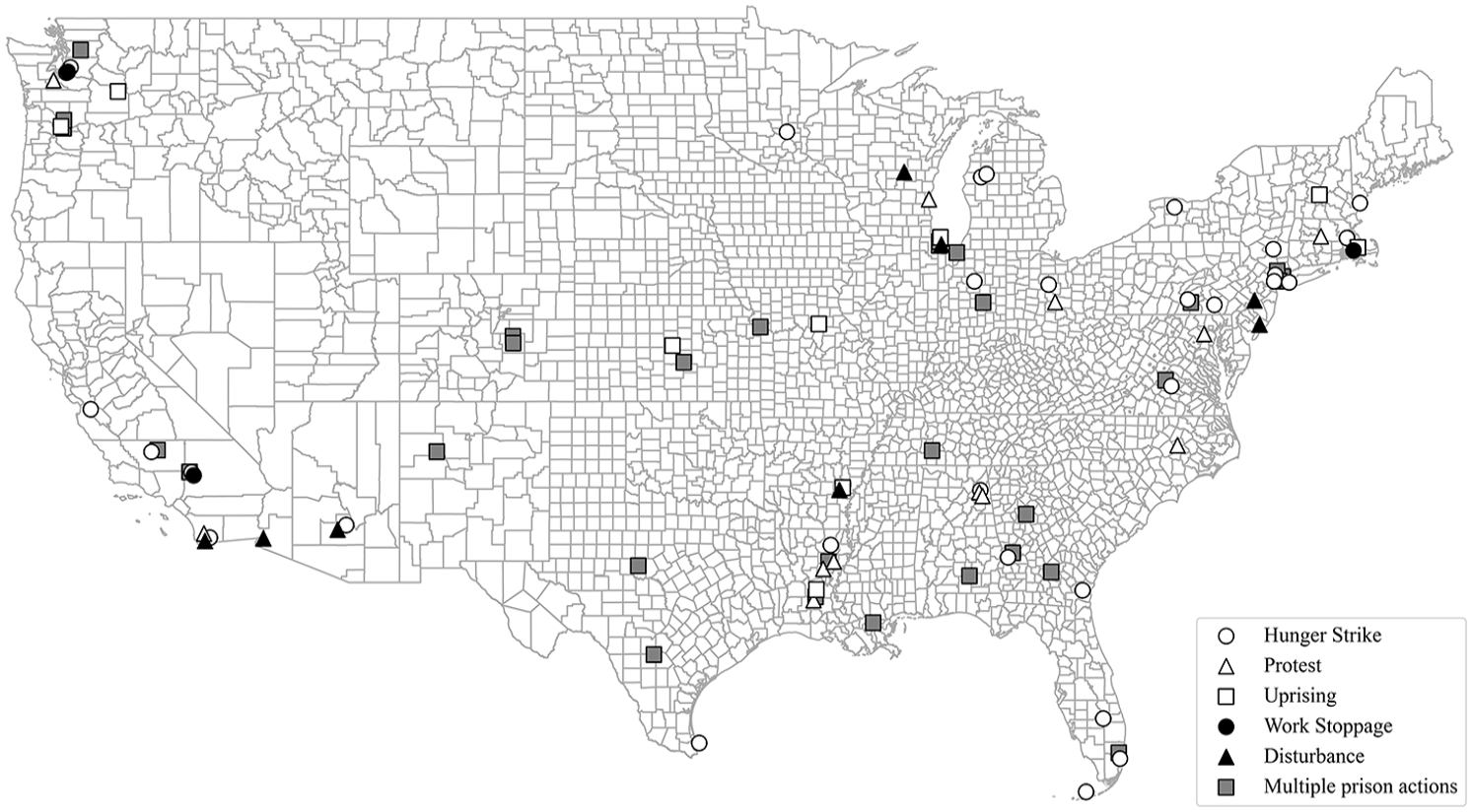
COVID-19-Era Prison Protest Actions in the United States by Type, March to June 2020
In short, threat can be politically motivating because it informs not only rational calculations but also perceptual and emotional responses. This may help clarify the puzzling effects of violent state repression—which can increase or decrease protest (Jasper 2018:39; Sullivan and Davenport 2017)—by showing how micro-level responses to threat can shape mobilization in multiple ways. Although violent state repression often triggers fear and quiescence through “the urge to avoid pain,” it may also elicit other visceral, affective reactions that surpass or transfigure those initial impulses in ways that lead people down different political paths (Jasper 2018:39).
Carceral Embodiment: From Subjection to Confrontation
An emphasis on the affective and corporeal dimensions related to threat likewise moves the study of carceral embodiment into new terrain by accounting for how visceral reactions motivate prisoner resistance. Prior research on the embodiment of incarcerated and criminalized people emphasizes the ways they internalize institutional forms of violence and discipline: forces that become inscribed on the body and made visible to others through bodily movement (Walker 2022), acts of self-injury (Cloud et al. 2023), and the perpetuation of violence in interactions with others (Anderson 1999; Collins 2004; Sabo, Kupers, and London 2001). This scholarly approach, which depicts embodiment as largely a process of domination, follows a similar line to much of the sociology of embodiment that emphasizes how bodies are disciplined and constructed to reinforce hegemonic power relations (Bobel and Kwan 2011).
For example, jail prisoners learn via “time and relentless reminders” to hold a “penal posture” (i.e., walking with one’s head bowed inside a red line with one’s fingers interlaced, learning to “fix” one’s body “without being told” and when deputies are not around) (Walker 2022:30). This embodiment of penal rules of comportment illustrates how individuals become objectified in prison. Time in prison can manifest in chronic conditions (“telltale inscriptions”) like high blood pressure, asthma, and cancer, as well as in exposure to disease and psychological trauma (Moran 2012:566; Smiley 2023). It can also manifest in how incarcerated people come to embody the harms they experience. Some long-term prisoners rationalize the childhood trauma and past incarceration that mark their bodies, interpreting these traumas as lessons in violence, which they then perpetuate in their dealings with others (Masters 2010).
But the body can also be a medium to both perceive the effects of power and enact resistance. Under this view, the body is a resource and site of knowledge from which to pursue various courses of action. In Discipline and Punish, Foucault (1977:30) observed that the prisoner’s body is “bound up” in power relations of not only subjection but also “confrontation.” Thus, prison-based movements fundamentally concern “the body and material things”: they are movements against “an entire state of physical misery . . . against suffocation and overcrowding, . . . hunger, physical mistreatment . . . isolation. They [are] revolts, at the level of the body, against the . . . prison[’s] . . . very materiality as an instrument and vector of power” (Foucault 1977:30).
And yet, little work specifies or advances Foucault’s hypothesis. Few studies explore activists’ embodied experiences or how embodiment shapes activists’ movements, in prison or otherwise; rather, prior studies emphasize the protesting body as a tool for shaping public consumption of political ideas (Hohle 2009; Russo 2023:203–4; Sasson-Levy and Rapoport 2003). For example, prisoners launch hunger strikes, a strategic use of the frailty of their bodies, to expose the violence of carceral regimes and destabilize public narratives surrounding the legitimacy of incarceration (Moran 2015; Yuill 2007). Here, the body is among the few resources that prisoners can readily access, becoming a “modality of resistance” with which to win concessions and transform incarcerated activists into martyrs (Yuill 2007). These and other “embodied practices” underscore how activist prisoners remake their bodies into sites of resistance rather than allowing them to be used by the penitentiary to achieve physical and psychological control (Rhodes 2004:45).
This form of carceral embodiment as resistance represents the instrumental use of the body in acts of performative protest, a practice that focuses on drawing public attention to issues raised by a specific action or campaign (see Jasper 2018:71–73). But the body has other political uses. As suggested above, the body “emit[s] signs” (Foucault 1977:25–26) that may be used in political decision-making. The emotional dimension of embodiment is important here because feelings like pain, fear, panic, and anxiety are how the intensity of affect registers in the body (Moran 2015:29). These feelings matter because they “do things for us” politically, helping connect bodily experience and cognition (Jasper 2018); they help focus people’s attention on specific problems in the world around them (Jasper 2011:292). Consider the reflex responses of fear and anxiety that people feel when they encounter a novel threat. People pay closer attention when facing new threats, switching from “preconscious routines” to “more thoughtful information gathering” (Jasper 2011:292). Feeling, in this sense, is a way of communicating with ourselves, of providing “rough-and-ready evaluations of what is happening,” and of “alerting us to what is important” (Jasper 2018:17).
Visceral feelings alert us to problems, changes, and threats in our environment and, in doing so, raise our consciousness around specific issues in ways that can motivate us to act politically. This embodied experience is likely more pronounced in prisons, and even more so among individuals enduring long sentences, given the constrictions placed on prisoners’ bodies—including the psychosomatic “shock” of incarceration, imposed isolation of long-term imprisonment, sensory deprivation of solitary confinement, and broader health threats to which prisoners are exposed—that raise the stakes of political contention (see, e.g., Camon 2016; Fassin 2017; Simon 2014).
Study Design and Analytic Approach
Case Selection
I conducted in-depth life history interviews with 100 African American, Afro-Latino, and Latino men to document political thought and action under penal confinement. The interview data include (1) interviews conducted between fall 2018 and spring 2020 with 46 African American and Afro-Latino men age 18 to 34 who were serving a decade or longer in Massachusetts’s prisons, and (2) interviews conducted between summer 2020 and spring 2024 with 54 African American, Afro-Latino, and Latino men in California and Illinois who were imprisoned beginning in their teenage and emerging-adult years and who were released no more than four years after spending a decade or longer in prison.
The focus on Black, Afro-Latino, and Latino men in this study is appropriate given the national statistics on long-term imprisonment. In the United States, Black prisoners comprise 46 percent of the penal population that has spent at least 10 years in prison (Ghandnoosh 2022), 55 percent of those with life without the possibility of parole sentences (Ghandnoosh 2022), and 40 percent of those on death row between 1976 and 2022 (Ghandnoosh and Barry 2023; Muhammad et al. 2022). In California, 69 percent of people who have been imprisoned for 15 years or longer are Black (34 percent) or Latinx (35 percent) (California Committee on Revision of the Penal Code 2021; Ghandnoosh 2022). This corresponds with other trends at the national level: more than two-thirds of all incarcerated people with life sentences are Black, Latinx, or other people of color (Ghandnoosh and Barry 2023). This racialization of long-term and severe prison sentences is important and relevant to this article because these sentences can be considered threatening circumstances that expose people—who are disproportionately Black and Latinx—to additional threatening situations such as solitary confinement (Pullen-Blasnik et al. 2021; Resnik et al. 2016).
The three-state data collection approach strengthens conceptual generalizability, or the ability to generalize to “abstracted concepts” (Collins, Neely, and Kahn 2024), while also investigating one of mass imprisonment’s most durable features—long-term imprisonment. Although the overall prison rate is declining in the United States, the long-term prison population continues to rise (Sentencing Project 2021). Thus, I selected the diverse states of Massachusetts, Illinois, and California to theoretically sample for the experiences of people enduring long-term sentences (Glaser and Strauss 1967). Originating as an investigation into coming-of-age in prison, the study first focused on interviewing incarcerated young men in Massachusetts because Massachusetts had (and continues to have) one of the highest proportions of life-sentenced prisoners in the United States (Sentencing Project 2021), many of whom were incarcerated in their youth.
After the COVID-19 pandemic began, however, I had to shift to remote research activities. I expanded the project to study the same processes among men sentenced to long terms as youth, but this time from the vantage point of men who were just leaving prison after a decade or longer inside. Specifically, I shifted to interviewing recently released men in Illinois and California because these two states are in different regions of the United States and have large long-term prison populations. In 2019, 29 percent of California’s prison population (n = 35,703) and 19 percent of Illinois’s prison population (n = 7,363) had served 10 years or longer (Ghandnoosh 2022). California (the epicenter of high-security and supermax prison construction in the 1990s) and Illinois (which placed its entire state prison system on lockdown in the mid-1990s) exemplify the nation’s turn to “total incapacitation” (Simon 2014). This three-state approach allowed me to comparatively study mobilization processes emerging from the interviews, thereby increasing my confidence in the generalizability of my observations to the context of long-term prison sentences.
Across these three states, all interview participants spent the vast majority of their adult imprisonment in maximum- and medium-security state prisons. This distribution is in concordance with national statistics—in 2019, 84 percent of the prison population was held in either a maximum-security (42.3 percent) or medium-security (41.7 percent) institution (Bureau of Justice Statistics 2021). This matters politically. Because they were sentenced to lengthy prison terms, the typical interview participant spent at least the first major phase of his imprisonment in maximum-security prison(s), followed by a second major phase in medium-security prison(s). Accordingly, initial forays into prisoner mobilization often occurred in maximum-security prisons and in response to conditions (e.g., solitary confinement, natural life in prison) heavily associated with life in such institutions.
Finally, because interviewees were incarcerated at young ages, no one had a history of activism or mobilization before their imprisonment, and, with one exception, no one had ties to activists before their imprisonment. Interviewees were not selected because they were activists or non-activists. Supplementary historical data came from newspapers, original oral histories, memoirs, case filings, and administrative prison records. The protocols used for this research received institutional review board (IRB) approval, and the Department of Correction in Massachusetts approved the protocol for the prison-based interviews.
Recruitment
I secured interview participants by recruiting in person, getting referrals from reentry service organizations, snowball sampling across formerly incarcerated networks, and posting contact information on legal defense mailing lists. Because the U.S. prison system is deeply racialized, I focused on the experiences of Black and Latino prisoners, and interviewees had to identify as Black and/or Latino to qualify. I also focused on the effects of long-term imprisonment, so interviewees had to be currently serving or to have recently served prison terms of 10 years or more to be eligible. Finally, because the project originated as a study of coming-of-age in prison, currently incarcerated men had to be under the age of 35 to qualify for an interview (recently released interviewees tended to be older). My position as a Black man in my early 30s was important for interviewee recruitment and retention. Ethics and confidentiality procedures were reviewed with each interviewee, and participants signed a consent form before the interview.
Currently incarcerated men were recruited and interviewed at a large, medium-security men’s prison outside of Boston, Massachusetts. I selected this prison because its population size and security level were similar to those of many other U.S. prisons (Bureau of Justice Statistics 2021), and my status as a volunteer in the prison and relationships with prisoners and staff facilitated access. Roughly two-thirds of the facility’s prisoner population was Black and/or Latino, and well over 40 percent had prison sentences of 15 years or more at the time of the interviews. Face-to-face interviews at the prison were conducted during the evenings in unused classrooms. Per IRB protocols, no correctional officer was present during the interviews; the only people present were myself and the incarcerated interviewee. This privacy standard was based on ethical considerations: the one-on-one interview setting was intended to prevent interview participants from being overheard, as sensitive information or critiques of the system could arise during interview sessions; to my and other people’s knowledge, cameras monitored movement in the prison but did not record sound. The prison also did not play a role in interviewee identification or recruitment; I managed these aspects of the study. On a weekly basis, I informed one prison staff member of which individuals I would be interviewing so they had permission to meet with me during their prearranged interview time.
I followed similar procedures for recently released interviewees. Because this research component was conducted at the height of the COVID-19 pandemic and research had to be done remotely, one-on-one interviews with this subgroup occurred on Zoom, an online video teleconference platform. Here, too, the interviewee and I were the only people in the interview space. Recently released participants were typically in the privacy of their own residences or own rooms. Since about half of the recently released interviewees were in halfway houses, I asked these participants to find a private space outside (often in the yard or recreational area of the facility), so they could speak with me on Zoom without being overheard.
Interviews covered various topics, including experiences during imprisonment, attitudes toward civic and political engagement, political action during prison, and access to services and programming during imprisonment. Each interview with currently incarcerated men lasted about one hour, and each interview with recently released men lasted about two hours. I applied a case logic to interviewing, treating each interview as a case and conducting interviews sequentially with the aid of an interview guide and goal of saturation; with each interview, I gained an increasing understanding of my research questions (Small 2009). I transcribed interviews verbatim. Table 1 presents relevant information about the interview cases.
Sociodemographic Information and Political Responses among Interview Participants
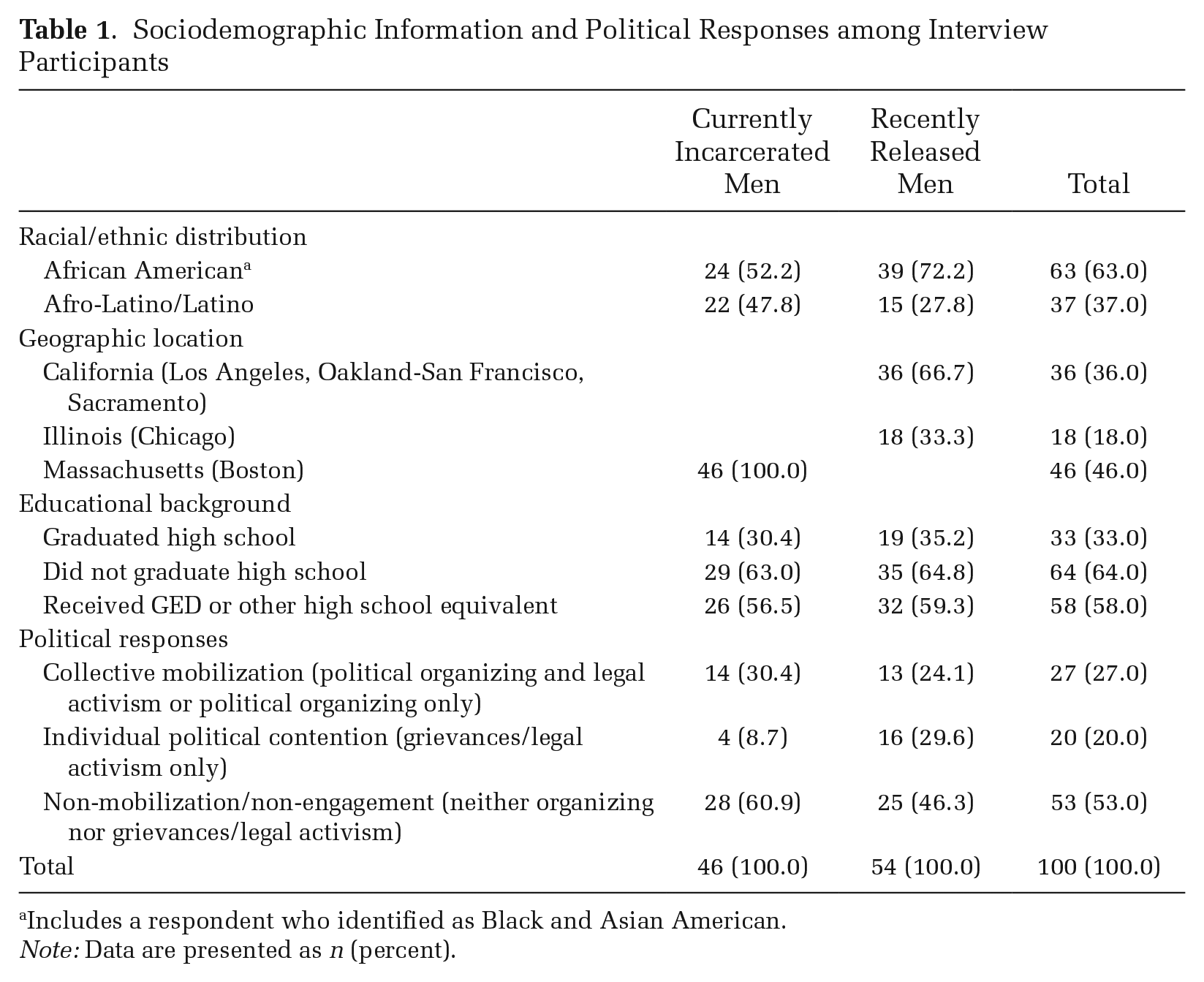
Includes a respondent who identified as Black and Asian American.
Note: Data are presented as n (percent).
Analysis Methodology
I took an abductive approach, iterating back and forth between unexpected patterns in my data and the existing literature to analyze and interpret the interview data. Drawing on grounded theory, abduction is useful for constructing new theory based on surprising and anomalous data (Timmermans and Tavory 2012). I used a flexible coding approach to create a comprehensive codebook and typological codes that mapped onto the research protocol, followed by the creation of inductive codes (Deterding and Waters 2018). These procedures helped me organize the data so I could iteratively code based on specific themes, questions, and mechanisms of interest. The process resulted in the creation of 215 codes, including 19 codes that specifically explored political issues such as “political consciousness,” “political education,” and “political organizing” (for an example of my coding scheme, see Table 2). I changed interviewees’ names, provided interviewees’ age ranges rather than exact ages, and masked other identifiable information to protect anonymity.
Sample Coding Scheme
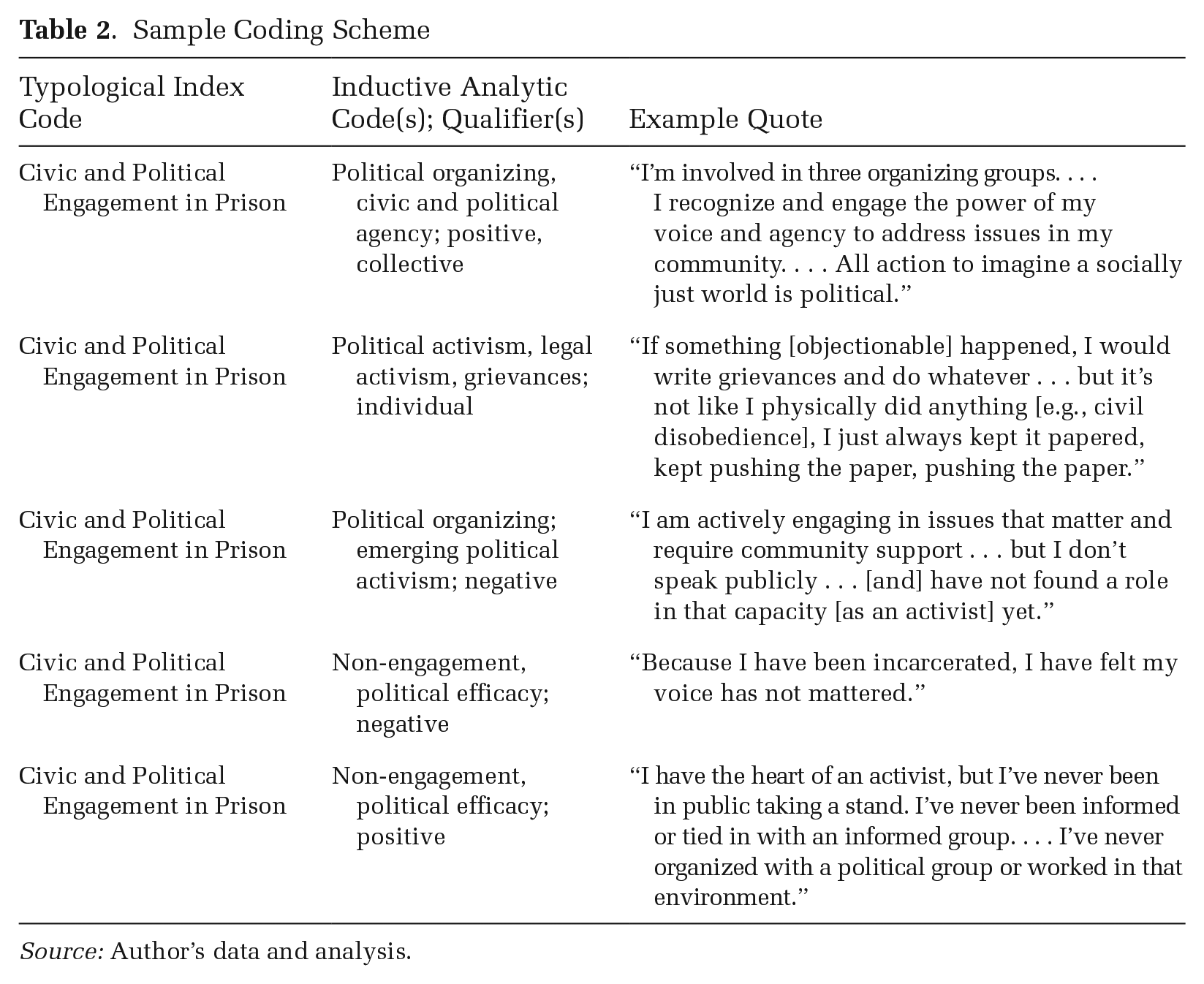
Source: Author’s data and analysis.
The Absence and Emergence of Prisoner Mobilization
Collective prisoner mobilization was more likely under two conditions. First, prisoners who mobilized collectively were, by and large, affected by embodied threats. Second, collective mobilization usually required a population of similarly affected people who understood the threats as a collective problem. Mobilization of any kind was unlikely when neither condition was present, but individual political contention was more likely when one, but not both, conditions was present.
In other words, incarcerated men developed differing “resister’s toolkits” depending on the conditions they encountered. When embodied threats were shared and recognized by a group of prisoners, men were able to develop the capacity to transform their injustice frames (Gamson 1992), build their sense of political efficacy, and adapt their strategies in response to the retaliation and structural barriers they faced. On the other hand, prisoners for whom only one condition was present—who either faced embodied threats that were not widely shared or who faced threats that were widely shared but not embodied—were usually unable to collectively organize. Instead, these men became experts in individual contentious strategies that sometimes changed the circumstances for many other incarcerated people. However, when acting individually, prisoner activists faced greater difficulties in sustaining their political efforts.
Below, I detail examples of mobilization and non-mobilization across three states. Beyond the narrative of prison as demobilizing, interview participants in this study varied greatly in their political responses. Table 1 shows that out of the 100 currently incarcerated and recently released men who were interviewed, 27 engaged in collective mobilization, 20 engaged in individual forms of political contention, and 53 were non-mobilized and did not engage in political action. I discuss non-mobilization at several points, but I give special attention to the nearly half of individual cases that involve political action, because those cases have important implications for understanding variation in prison-based contentious politics.
I also reference cases of collective prisoner mobilization at the prison level that emerged across individual interviews. These prison-level cases include political efforts (1) by Illinois death row prisoners to expose police torture in Chicago and stay their executions; (2) by Massachusetts prisoners to address the health risks of reportedly elevated levels of contaminants in their water supply; and (3) by California prisoners to address the health crisis and perceived neglect of the state penal system toward prisoners following the emergence of the COVID-19 pandemic. The evidence of a general model of mobilization across these diverse state contexts and issue areas lends further support to the conceptual generalizability of my findings to long-term prison contexts.
Repression and the Mobilizing Force of Embodied Threat
Embodied threats were important drivers of collective prisoner mobilization. Every interviewee discussed experiencing repressive circumstances in prison. Embodied threats, however, deviated from what can be considered “general prison conditions.” Rather, these threats were perceived under circumstances that affected distinct prisoner subgroups (e.g., solitary confinement, juvenile/natural life in prison, high-security prison contexts that held concentrations of life-sentenced prisoners) or that directly threatened prisoners’ lives (e.g., the death penalty, or a significant medical illness or systemic health crisis neglected by the institution). Subsequently, collective mobilization was more likely in cases where prisoners reported overlapping embodied threats (producing visceral reactions that motivated them to act), whereas mobilization was typically absent in cases where prisoners did not report overlapping embodied threats.
Circumstances Structuring Non-mobilization
Repressive penal conditions generally did not trigger mobilization. Harrowing experiences with violence and coercion were typical, but long-term prisoners shared they were less willing to take the risk of politically confronting the prison system because protesting or writing a grievance simply introduced new risks to men’s well-being without redressing their current problems.
Warren (late 40s, Los Angeles, released to a halfway house days before his interview after 25 years in prison) explained this common decision-making process among non-mobilized interviewees: There was this one officer [at my prison last year]. . . . He came to work from 12 midnight to six in the morning. It was like Vietnam. . . . He would snatch you out your bunk, strip you out naked, and then ransack all your property. . . . He’s not looking for anything. It’s just to humiliate you. . . . Just to hold that authority over you. . . . So when you know he’s in the building and you know he’s around, . . . you could not sleep. . . . So . . . you’re tired as hell, and [then] they force you to go to work, or you’re going to get a write-up. . . . [But if you] write him up, all that does is cause retaliation. Because the admin that oversees the complaint will let him know off the top that he’s been written up. . . . And that’s just one place. This is every prison I’ve been to. You have officers like this that would come in your cell and snatch you out your bunk and whoop your ass. . . . And then, if you . . . file a complaint, it gets worse.
These repressive episodes affected Warren’s sleep. But Warren did not perceive these episodes as posing a fundamental threat to his life or physical health. Instead, Warren viewed these occurrences as a quotidian feature of California’s prison system—something to be endured. The status quo was preferable to potentially triggering retaliation by filing a grievance.
Many incarcerated men also worried that political action in prison could threaten their visitation privileges, and thus their ability to see their loved ones. This was another factor men weighed about the costs and risks of contention. Because men were separated from their families and mobilization risked widening that separation, the desire to maintain communication with one’s family had the opposite effect on prisoners’ mobilization than it has had on people in some other highly repressive contexts (see, e.g., Soyer 2014). Desire for contact with family was a disincentive to collective action that “eroded” solidarity by causing people to withdraw from and lose their commitment to mobilization, even when that action was seen as important (see also Goodwin 1997).
For example, Godfrey (early 30s, Boston, a decade into his current incarceration) named his family as the reason why he was not politically active in prison: “To me . . . right now, my family is more important than the greater cause. . . . I’ll support a greater cause, but if it comes in between me and getting out [to my sister and other family], I can’t sacrifice that for nobody. I’ll pat you on the back, and I’ll wish you well, . . . but [no more than that].” When asked to explain why he made that choice, Godfrey mentioned a few prisoners who were penalized for their activism. One was transferred to another facility, and another was purportedly placed in solitary confinement several times, banned from prison programs, and prohibited from placing phone calls during his isolation. Such retaliation was widely recognized by other incarcerated men: “Let resisting, organizing, be for a good reason,” said another non-mobilized prisoner in the facility, “don’t let it be useless because everyone [who participates] is going to get shipped out.” These punishments were potentially racialized. As one California interviewee observed: I’m a Black man, and talking to other Black people about collectivizing, especially in my prison, can get you sent to the hole. . . . You get caught even with certain books, they will write you up and put you in the hole. Like the books by George Jackson, you get caught with any of that literature, you’re deemed a threat. You’re a revolutionary or BGF [Black Guerrilla Family] affiliate or sympathizer, and you’re put in the hole for investigation.
Sudden, population-wide repression also did not necessarily provoke political mobilization. The Illinois interviewees are instructive in this regard. Incarcerated across Illinois prisons throughout the 1990s, 2000s, and 2010s, these men recounted the sweeping change that occurred in the severity of control imposed over Illinois prisoners following the 1996 leak of a controversial tape of the infamous prisoner Richard Speck “snorting cocaine, engaging in sex, and bragging about living the good life at Stateville prison” (Johnson 1996). Embarrassed by the tape, prison administrators reportedly placed the entire state prison system on lockdown, transforming the system from an “open” to a “closed” environment: “It was the Richard Speck tape, everything changed after that. . . . When they shut [the prison] down, it was . . . no more free movement, keeping us locked in our cells. . . . You in a cell, period” (Lonnie, mid-40s, Chicago, released a few weeks ago after three decades in prison).
Responses to this new level of isolation varied depending on the other threatening conditions men encountered. Prisoners like Lonnie—who were in the general population and did not face the perils of the death penalty, natural life in prison, or a major health crisis—perceived the new level of isolation as a source of frustration or alienation but not as a viscerally felt threat to their lives. Thus, by increasing the costs of action, repressive penal conditions generally made people less likely to mobilize.
Circumstances Structuring Collective Mobilization
Prisoners’ assessments of the costs and benefits of political contention shifted when repressive circumstances became more acute and viscerally felt, that is, when men encountered incapacitating circumstances at the deepest ends of the penal system. Posing direct threats of premature death or a permanently incapacitated physical existence, these circumstances—referred to here as embodied threats—elicited visceral reactions in the form of deeply felt physical symptoms or emotional responses that, when they overlapped, made people more likely to politically act. Here, the mobilizing potential of embodied threats usually derived not from one such perceived threat, but from visceral reactions arising from the co-presence or overlap of multiple perceived threats affecting a collective of possible discontents. These conditions explain why some subpopulations of interviewees who experienced solitary confinement in prison turned to political contention, whereas others did not. Overlapping embodied threats were perceived as too great to go uncontested.
For example, prisoners with natural life sentences or on death row who were placed in isolation tended to engage in protest as an initial response to that isolation. In these contexts, prisoners had very few resources other than their bodies, which they used as vehicles to contest their circumstances (see Feldman 1991; Yuill 2007). In one instance, when Illinois prisons went on repressive lockdown, prisoners on death row staged hunger strikes and obstructed guards from counting men in the condemned unit. Because these men also faced the death penalty and had few contacts besides other men in the condemned unit, they felt that barriers to interacting and sharing knowledge with one another could greatly increase their chances of execution. Ivan (mid-50s, Chicago, recently released after three and a half decades of incarceration) explained the collective reasoning of death row prisoners and their response to the prison administration at the time: [We would say to the prison administrators] “Y’all trying to kill us, and you want us to be quiet waiting to die” [i.e., to not be able to meet and talk with one another about our legal situations]. . . . We was like, since y’all are trying to obstruct us from defending [ourselves], [we] . . . orchestrated hunger strikes [involving half the prison unit]. . . . So it made them go and have a meeting [with us] and ask, “What do y’all want?” And . . . they would come and negotiate. [We would say] “We want to be able to meet.”
These protests, particularly hunger strikes, were a form of resistance in which incarcerated men used the vulnerability of their bodies as an instrument to highlight the threats they faced (see Moran 2015:38). Ivan referred to this as “using my body as a weapon, and taking the prison’s power to do anything over me because I’m doing it to myself.” Yet, use of the body as a “protest weapon” (Feldman 1991:179) was also a more confrontational mode of contestation that men eventually discontinued because of reprisals.
Hunger strikes and other protest behavior under conditions of isolation were often men’s first forays into prisoner mobilization, and they typically resulted in some form of retaliation or penalty. In California, Vaughn (mid-50s, San Francisco, released a few months ago after over 25 years of incarceration) described solitary confinement as a radicalizing experience in part because he was heavily penalized for his participation in protests. Vaughn, originally sentenced to natural life in prison, started to engage in “serious” political contention when he was in 23-hours-a-day isolation, where he participated in his first-ever protest demanding access to showers and better living conditions in the solitary confinement unit. These protest activities included work stoppages, refusing direct orders, and, similar to the men on Illinois’s death row, delaying (or what the prison called “obstructing an officer’s duties”): We had some [protests] where you board up [the door to the unit], where you obstruct the officer from doing count, and those were just simply because we wanted to shower. [We’d say,] “It’s been three days [and] we want a shower. . . . So we’re not going to let you open the door, and you’re not going to see us to count us unless you bring a captain or a warden . . . to talk to us about getting our showers.” So we had a few of those. . . . Or we would take over a day room, we would just refuse to lock up, [in addition to] work strikes. . . . And it was scary sometimes because . . . they can shoot you. People get shot.
According to Vaughn, these protest actions triggered further repression. In addition to more time in solitary, Vaughn “got denied parole for all the write-ups for protests . . . for refusing to work.”
This circumstance generated visceral reactions that were telltale features of embodied threat. Because Vaughn had life without the possibility of parole, he faced an ongoing fear (perceived threat) that he was going to “die in prison” and continue to be drawn into daily violence until his demise: “It’s like I was at a heightened stage of anxiety at all times, worrying about getting stabbed, about whose gonna get beat up,” Vaughn said. “I don’t want to be a victim, so I have to be a victimizer. [Serving] natural life put us into that kind of survival mode.” Here, the embodiment of the threat of natural life was expressed in anxiety over victimization and in pressures to participate in violence to avoid victimization.
Solitary confinement, which triggered new and more acute visceral reactions, raised the stakes of those concerns: “[Solitary is] nerve-wracking,” Vaughn said. “You’ve got so many thoughts in your head. . . . It feels like your body is eating you, like your body is attacking itself, because you’re surrounded by cement . . . you’re in a tomb, and your body—your senses are spiraling. You don’t get sunlight, fresh air. . . . So it feels like you’re dying.” Vaughn explained that he “started having heart palpitations, my blood pressure, my heart was racing and fluctuating, so much so that I had to go through a stress test.” He also had a person next door to his cell “who would just scream out the N-word all night long. . . . It made me worry, ‘Am I gonna go crazy like him?’”
Feeling how his mind and body were changing in response to these contexts motivated Vaughn to engage in political action. In his words, the toll of solitary confinement on his body and senses motivated his protest behavior because it produced an “extreme frustration . . . that makes you want to come out and be militant . . . makes you angry at the system. If you weren’t already, it makes you. And even if you were [angry before], it makes you more angry.” Subsequently, Vaughn was moved to engage in prisoner mobilization: “I just had to channel the energy after I got out [of solitary confinement]. . . . That’s when I went full bore [with activism] . . . and trying to get out of prison.”
Experiences with retaliation and additional repression pushed interviewees to revise their approach. Although prisoner protests could get public attention and occasionally short-term concessions, they more frequently generated retaliation in the form of more severe incapacitation. So incarcerated men adapted their political tactics from visibly confrontational protest, which resulted in retaliation, to new approaches that enabled them to achieve greater results while not triggering further repression and incapacitation. For example, Vaughn changed his tactics after being sent to the Sensitive Needs Yard (a designation given to people in solitary confinement who are considered members of a Security Threat Group or who have expressed safety concerns) and later being denied parole for participating in a large hunger strike in 2013.
To mitigate the repressive lockdowns that were enacted by maximum-security and supermax prisons in response to prisoner resistance, incarcerated men collectively created prison-approved “self-help” programs—a strategy for continuing to meet when staff leadership shut prisons down to suppress prisoner dissent. Following instances of prisoner resistance, “it was all about getting out of the oppression of being locked down,” said Vaughn, who used the word “oppression” to describe the experience of repressive penal tactics deployed following instances of open prisoner dissent. “So we found ways to do that by . . . developing programs . . . [that] became not really a [form of] protest, but a way to lessen the oppression . . . a vehicle to get out of [the repressive experience of isolation and incapacitation in response to protest].” Over time, these programs also served as sites from which to develop broader political goals and more organized mobilization efforts.
Responding to state repression, Vaughn and a critical mass of other “early riser” prisoner activists established a self-help group at a state prison north of Oakland in the early 2010s that held biweekly meetings and reached out to churches, law schools, and state legislators to lobby to change the law for people like them who were serving natural life sentences (i.e., life without the possibility of parole [LWOP]). To lower the risk of repression, these men strategically did not use the body as a tool of confrontational protest, choosing instead to organize across units to petition people on the outside: We [our group] would organize together. We started by [asking] who are all the LWOPs in [our prison unit]? . . . [Then] we would meet once or twice a month, and we would brainstorm. . . . Who do we reach out to? . . . Eventually . . . we wrote almost every senator and assemblyperson. We would put our stamps together, . . . get envelopes, and . . . do a draft letter, where we’d make copies . . . and give it to each individual [who was then assigned to mail the letter to five legislators].
Rather than use confrontational protest tactics, the group partnered with organizations like Human Rights Watch on advocacy campaigns that ultimately resulted in the passage of California Senate Bills 394 and 1437—reforms that enabled Vaughn and others serving natural life to receive reduced sentences and, eventually, parole.
That said, encounters with life imprisonment or solitary confinement sometimes had contrary political effects. For instance, a few non-mobilized men with life with the possibility of parole (LWP) sentences said the structure of their prison sentences discouraged them from becoming politically involved, challenging rules, or interacting with activists. One currently incarcerated man with an LWP sentence explained that he shies away from contentious politics, because “if I want to get out, I know that every decision I make can have huge repercussions. Every single one. . . . [Confrontations with prison administration] are potential disciplinary tickets. . . . And there you go: ticket, hole, setback. So you have to move so careful.”
At the same time, mentions of solitary confinement or other threatening circumstances were generally absent from these non-mobilized respondents’ interviews, which aligns with the argument that encounters with overlapping embodied threats generate prisoner action. Likewise, a few other non-mobilized men who experienced solitary confinement described it as neither a threatening circumstance nor one that elicited visceral responses in them. Rather, these men sought out solitary as a reprieve from what they perceived as greater interpersonal violence in the general population. These discrepant cases underscore the important role of perception and interpretation in shaping how people respond to threat.
In short, repressive prison conditions typically do not spark prisoner mobilization; indeed, they often structure quiescence and non-mobilization. Political action while incarcerated carries its own set of risks that many interviewees said were too costly. But that calculus often changed with men’s visceral reactions to overlapping circumstances that could lead to premature death or incapacitation—circumstances that, when felt and perceived as a collective problem, differentiated prisoner mobilization and non-mobilization. Prisoners who encountered these sorts of collective embodied threats adapted their political strategies over time to mitigate the risk of further repression and to align their efforts with expanding political goals. But it is not often that embodied threats both overlap and are collectively experienced. Neither condition may be present, or only one of the two conditions may be present, thereby producing different political outcomes. I explore these alternatives in the next section, which shows how the presence of either one or the other condition resulted in individual forms of prisoner contention.
Individual Contention Versus Collective Mobilization
Incarcerated men tended to engage in individual forms of contentious politics when conditions were partially present—that is, when one of two conditions was present, such as when collectively felt threats were not embodied (i.e., did not trigger a visceral reaction) or when embodied threats were not framed or widely understood as collective problems. Understandably, such circumstances affected what kinds of political action could be carried out. It was generally not possible to mount or sustain a collective effort under these circumstances. Instead, men often specialized in using individual strategies, namely, the grievance system or other formal-legal mechanisms that could be navigated on one’s own, after frustrated attempts at collective action. This path of individual political contention stands in contrast to paths of collective mobilization where incarcerated men, frustrated by the lack of redress gained by using individualized legal routes, turned to collective action in hopes that threats would be addressed if they expanded the scope of conflict.
Individual-Level Strategies of Contention
Some incarcerated men faced embodied threats that were not widely perceived and discussed as a collective problem. Individual health concerns provide a clear illustration. In these situations, prisoners who faced substantial yet inadequately addressed personal health emergencies engaged in legal mobilization, because a formal grievance process was required to receive specialized medical treatment. In such cases, the embodied threat was deeply, viscerally felt by individuals and derived from emerging symptoms. But prisoners who faced these threats encountered obstacles to organizing collectively because individual illness was generally unknown to others unless disclosed, making it difficult to identify with a defined group and thus more difficult to organize around.
For instance, in California in the early 2000s, Phillip (early 50s, Sacramento-Central Valley, released six months ago after 20 years of incarceration) engaged in individual political contention after he was denied follow-up treatment to fully treat his cancer and experienced further “significant change” in his physical and cognitive functioning: “At the time, the prison wouldn’t give me [a follow-up procedure or] the proper dosage of [the medicine to manage and regulate my cancer symptoms],” said Phillip, who described how the threat of premature death from cancer was manifesting on his body. “I was suffering from . . . a bunch of symptoms. I was always sleepy and tired. I had brain fog, my hair and nails had got thin, and at the time, my voice was fucked up [due to the cancer].”
These cancer symptoms viscerally marked Phillip’s body, signaling to him that his life was in jeopardy, and motivating him to legally and politically confront the system: “I was thinking, these prison officials really want to kill me. . . . But knowing that, like, gave me strength. It was almost like a strength, like a walking stick . . . something I carried with me.” Phillip’s motivation arose from a sense, based on what he was learning and perceiving through his increasingly diminished physical and mental state, that he would die if his illness remained unaddressed: “For me, it was an overwhelming sense of, I do not want to die in prison. That was my goal. I did not want to die in prison, and that made me want to just fight, fight, fight the system.”
Thereafter, Phillip used a prison litigation handbook to learn how to file his first 602 appeal (the form used to file a grievance in California prisons). Phillip then got the Prison Law Office involved and was able to get follow-up treatment for his cancer from a specialist at a nearby medical center. Yet while the signs of cancer that marked Phillip’s body and cognition motivated him to act, those same symptoms made it a struggle to sustain legal contestation against the system: “I was very lethargic. I couldn’t focus. It was so hard to litigate . . . because literally all I wanted to do was sleep, but I knew I had to fight.”
Nonetheless, Phillip, then in his mid-30s, became a jailhouse lawyer and prisoners’ health rights activist, learning to use the California prison system’s 602 appeal process to pressure the system to respond to his and others’ health needs. Phillip explained that “the infancy stages of my activism” began with learning that other men faced similar health vulnerabilities, neglect, and coercion. His activism focused narrowly on navigating the 602 grievance process: I started [by] finding out that a lot of my brothers [other Black men] needed the same kind of help. . . . So, when I found out I had a talent for [filing 602 appeals for access to medical care], there was no limit. I could’ve done 602s all day. . . . So I started helping these people . . . started being touched by . . . the magnitude of it. . . . The prison was fucking over so many people over healthcare, and men were dying [speaker’s emphasis]. I’m talking about in . . . significant numbers. Men were dying. For shit they shouldn’t’ve had to die for. [Eyes tear up.] It’s, but for the grace of God, I didn’t die from cancer.
The connection Phillip made between the threat of cancer that marked his body and the health threats that marked the bodies of other Black men sparked an anger and motivation in him to act politically. Learning about the scope of these issues was a “watershed moment”: “It blew me away,” Phillip said, “and it created an anger within me, like a piss and vinegar type anger.” Phillip then decided to translate his knowledge into action, saying to himself that if the prison system refused to redress its harms to people’s health, “then let’s fight . . . [and] I’m gonna fight the best way I can with these 602s, these writ of habeas corpuses, as best I can for as long as I can.”
Phillip did try to collectively organize and had initial meetings with a few others (i.e., he met with other politicized men who also faced health issues “in the library every day and strategize[d] and . . . talk[ed] about what was going on and . . . subscribe[d] to all the various political papers and [health] newsletters”), but those efforts soon faded, and a sustained group never materialized. Although a number of men perceived embodied threats having to do with their personal health, these threats were more difficult to collectively organize around because people could not as readily identify with a defined group around a shared struggle as compared to other subgroups (e.g., lifers, death row prisoners, and people in solitary confinement). That is, they could not realize the second condition needed to launch collective mobilization—seeing the threat as a shared problem. Without a core group of supporters in prison, Phillip said that writing to medical experts and political organizations became his lifeline: “I write, they write back. I write back again, and they’d ask me a little more. . . . It was a quid pro quo. I would ask for help for this [or that issue]. Sometimes I got it, sometimes—more often than not—I didn’t.”
Phillip’s case illustrates the narrow forms of individual political contention that prisoners used when they confronted embodied threats but did not have the support of a defined, mobilized group. Although threat can be deeply embodied and elicit profoundly visceral reactions, it is not enough to motivate collective mobilization if there are barriers to collectively recognizing shared struggles and defining a common group, thereby making claims-making more difficult. Embodied threats arising from conditions officially, publicly marked by the prison (e.g., solitary confinement, death row) are likely easier to collectively mobilize around as opposed to other types of threats that are not (e.g., personal illness).
Likewise, individual strategies of contention arose in response to threats that were experienced as a collective problem but that were not embodied, thereby reducing people’s willingness to engage in collective action. Consider the state of Illinois’s efforts beginning in the late 1990s to extract funds from incarcerated people “for the cost of incarceration” (Prison Legal News 1998). This is an example of an economically based threat affecting the pocketbook, rather than an embodied threat affecting the mind and body. Many incarcerated men, particularly at Stateville Prison, were affected by these asset seizures, but few pushed back. At Stateville, men believed the potential for success was low, so few rallied behind activists contesting the state’s seizure of prisoners’ assets.
For example, Dennis (late 60s, Chicago, released 16 months ago after four decades in prison) was one of many Stateville prisoners targeted in the mid-2000s by the state’s strategy to seize several thousand dollars that he earned through his $2-a-day prison industries job, even though the state previously took a percentage of his earnings on similar grounds. Upon receiving seizure letters, he and other incarcerated men organized a meeting in the law library to strategize and try to help one another. That meeting was filled with frustration and disagreement and ultimately did not develop into an organized group because, as Dennis said, “most of the guys didn’t have any support. . . . The system had froze their accounts, and they didn’t have money to go to commissary or anything . . . it was a lot of pressure being applied [by the administration].” Moreover, according to Dennis, many of the men whose assets were seized did not want to deal with the court system. If they chose to fight the system in court, they would have had to sift through a great deal of paperwork, write briefs, find additional legal representation, do legal research, and respond to each court motion. In short, other incarcerated men chose not to challenge the assets seizure because more pressing threats, in addition to administrative burdens, would be imposed if they did.
Thereafter, Dennis chose to fight the state’s attempt at asset seizure alone and in the face of other prisoners’ discouragement: “It was a wide range of responses, most of them negative. . . . A lot of people said, ‘Oh, you’re just wasting your time.’ . . . Why don’t you go on and let ’em [the prison system] take that little bit of money? They’re gonna eventually take it anyway.’” These responses pushed Dennis further toward an individualized approach to political struggle.
Although Dennis ultimately succeeded in his legal challenge and established that the state could not doubly garnish prisoners’ wages, his experience discouraged him from organizing with others and led him to keep the scope of his activism constrained to formal grievances: “When I saw something that wasn’t right. . . . I would bring it to guys’ attention and tell ’em . . . . ‘You need to file a grievance and [pause] follow it all the way through.’” But Dennis did not go much further than that, deciding instead to “do a lot of initial grievances, but it was up to them [other prisoners] to follow through with it. . . . If they didn’t show any interest, I didn’t have time to try to chase them down.”
In this case, the collective action problem is not difficulty with collectively recognizing a threat, but a determination that the repressive costs (e.g., frozen accounts, administrative burdens) outweighed the potential benefits. The anticipated asset seizures—collectively felt and recognized as an economic threat—were not embodied, not viscerally felt in or upon the body. Rather, prisoners worried about their personal accounts being frozen, preventing them from accessing necessary goods. Thus, this case reveals what happens when the first mobilization condition is absent. Because the possibilities for collective action were low, Dennis’s and other similarly situated prisoners’ contentious politics took on an individualized character.
Affordances of Collective Mobilization
When incarcerated men encountered embodied threats that were widely experienced and viewed as a shared concern, they were able to do more than overcome a collective action problem. They could participate in group processes whereby prisoners with few resources could cultivate new cognitive, relational, and organizational resources that enabled the creation of more robust organizing campaigns. Prisoners were able to transform their interpretive resources (e.g., injustice frames, sense of political efficacy), which prefigured innovations in their tactical choices (McAdam 1983) and the kinds of relational and organizational resources available to them.
When incarcerated men gained collective knowledge about the extent of the barriers they faced if they only used existing avenues for relief, they revised their tactics by forming coalitions with groups on the outside, which expanded both the scope of conflict and their political horizons. For example, in Illinois in the mid to late 1990s, incarcerated Black men on death row units in the Pontiac Correctional Center shifted their approach to collective action based on the knowledge they uncovered in a legal study group they organized to discover why their individual appeals were consistently unsuccessful. After learning that many of them had been tortured by police and wrongfully convicted, these men shifted their methods from a within-system approach (i.e., police complaints, court appeals) to an extra-institutional approach (i.e., inside-outside political organizing; see also Kim 2016) in an effort to stay their executions.
These men collectively organized around the threat of a death sentence to which they had visceral reactions. This was a recurring threat shaped temporally by sentencing law. As Jerrod (mid-50s, Chicago, released three months ago after four decades in prison) explained, execution dates were typically scheduled 90 days in advance—although an execution was stayed once an appeal was filed and so long as the appeal decision was pending: “But when the next court denies your appeal, if it is denied, then that court will set [a new] . . . death date . . . and . . . the clock starts to tick [again].”
The experience of living on death row and negotiating the threat of execution had a visceral, psychosomatic effect on men. Ivan, for instance, explained it was not the judge’s words but the guards’ treatment of his body that brought about the “shocking” realization of his condemned status and, ultimately, his submission to that status: [What] the judge [said] . . . wasn’t shocking . . . him saying, “You’re sentenced to lethal injection and they’re going to kill you on a certain day.” I’m like, “Yeah, get out of here. That is not real.” But when those guards came to get me and surrounded me, I have to tell the truth. My body betrayed me in the sense that I started to shake because there was a real consciousness that something had really changed. . . . I would never tell my buddies that. . . . But being in that circle [encircled by guards] and being told, “Strip, take everything off so that we can see parts of your body that you have never seen.” . . . I couldn’t resist. . . . I just . . . did what I was told. . . . It was the way [the guards] . . . treated me that made the reality of that sentence really begin to affect my senses.
Other psychosomatic manifestations of the threat of a death sentence included severe anxiety and depression, insomnia, emotional numbing, and mental collapse.
Still, the body can be a site of opposition to, as well as accommodation of, externally imposed forces (Bobel and Kwan 2011:2; see also Foucault 1977). This dynamic is illustrated by how Illinois death row prisoners, including Ivan, began to organize after the state began executing condemned prisoners in the mid-1990s (four people were put to death by lethal injections between March and November 1995). Jerrod, whose appeal was rejected around this time, described how this spate of executions was “motivation enough” for him to organize: “I didn’t become scared until they actually started executing people.” Jerrod explained that this period was so stressful he “could not sleep at all,” and during those sleepless nights, he began writing letters to legislators and legal and racial advocacy organizations as a “release” and “as a way of feeling like I was doing something. . . . I said to myself, ‘I’m a high school dropout, but I gotta do something,’ and writing is damn near the only outlet.” That chronic sleeplessness, the primary mode whereby Jerrod viscerally perceived and experienced the threat of execution, became a primary context wherein Jerrod expressed and translated his fears and anxieties over his death sentence into political writing and, eventually, organizing.
Men on death row, who were experiencing their own psychosomatic responses to the threat of a death sentence, were also motivated to politically act by witnessing how others succumbed to the stress of life on death row. Jerrod described one death row prisoner, whose cell was next to his, who “was always sitting in the dark . . . looking at the walls” and who one day “went into a state of shock and . . . wasn’t the same no more. You could see it in his eyes. . . . Eventually, being on death row just wore him down. He had a nervous breakdown.” This event unnerved Jerrod and gave him “more motivation to get with [organize with] other people” because, like Vaughn, Jerrod worried he could eventually meet the same fate.
In 1997, Jerrod and over a dozen other men on death row, who spent 22 hours a day locked in their cells, convinced prison administrators to grant them an extra period to hold a law class that met twice a week in the recreation room of the condemned unit. The experience transformed how they understood the torture they endured, as well as their capacity to create change. To identify weaknesses in their defense cases, these men reenacted their trials using copies of their court transcripts. Bringing death row prisoners together in response to the embodied threat of execution, the exercise was “transformative” and “stimulated for us [that] . . . we could do this [contest our death sentences],” said Ivan, who learned through that exercise how the confession he signed was coerced and written by police.
Before the study group convened, many felt shame and (at the advice of their attorneys) did not disclose their experiences of torture. During the study group, however, the men came to collective realizations about the police torture they endured. Another class participant recalled, “We sat there [in the law class], and we’d get them [transcripts], and we’d say, ‘Damn, the same officers . . . is [testifying] in a lot of these cases. [This officer] he beat my ass on this [date]. . . . Damn, that’s the same shit he did to me.’” For this police torture survivor, who said he previously felt shame and self-blame around his encounter with torture, the experience of participating in the trial reenactments and seeing how police, prosecutors, and judges orchestrated his trial to secure his conviction transformed his embodied response from internalized shame to a politicized sense of condemnation: It [was] not just me telling [reenacting] my story. . . . No, it [was] me telling my story as [the officers who tortured me] . . . cause I have their testimony. Their testimony. . . . When you get into these characters, it felt like I became these characters . . . [and] you see the lies flowing out of your mouth as you’re portraying them. You see the lies. You see the lies. . . . So [I learned that] if we wanna do something with the system, you gotta . . . [target] those who you know is making these laws . . . making their own laws. [Speaker’s emphases.]
These collective realizations were turning points in how these men negotiated death row and framed the injustices they suffered. Not only did they learn they had been manipulated by police or tortured into confessing to crimes they did not commit; but in the process of learning about legal proceedings and pouring over each other’s cases, these men also learned that many of them had used the same system-approved avenues of redress, having made ethics complaints to the FBI and Chicago Police Department’s Office of Professional Standards, which were disregarded (Chicago Police Torture Archive 2021).
In contrast to the individualized approach threatened prisoners took when collective action attempts failed, the men on Illinois’s death row transitioned from individually oriented to collectively oriented strategies in response to the embodied threat of execution: “We began to realize that as long as we kept the fight in . . . [the legal] domain, we would also be executed if things didn’t change,” some police torture survivors reported (Reeves et al. 2019:192). In 1998, after discovering they had been tortured by police and sentenced to death through coerced confessions and false witness testimony, the members of this collective named themselves the Death Row Ten, with the goal of creating a political alliance with people on the outside. 5 After sending 10 to 15 letters per week to organizations for most of a year, the Death Row Ten formed an alliance with the Campaign to End the Death Penalty (CEDP)—a Chicago-based death penalty abolitionist group and the only group that agreed to partner with them.
Like the inside-outside organizing mentioned earlier, the partnership with CEDP was a turning point for the Death Row Ten. While the men on death row organized themselves on the inside, CEDP carried out protests, press conferences, petitions, teach-ins, and court watching—strategies CEDP could pursue without suffering retaliation like the Death Row Ten faced (for background, see Kim 2016). Importantly, the Death Row Ten and CEDP coordinated “Live from Death Row” broadcasts, which educated the public about the death penalty and strengthened the incarcerated men’s sense of political efficacy and commitment: “Just to hear, at the time . . . 300 people cheering, saying your name. It’s mind-blowing,” said one Death Row Ten member. “When you hear this, then you’re like, ‘Wow, I can’t wait to do another one.’” Ultimately, these efforts pushed the Illinois governor to enact the first moratorium on executions in the United States in 2000, and then, in 2003, to commute 167 death sentences and pardon several members of the Death Row Ten.
In short, this subsection shows the circumstances under which threat generates individual political contention as opposed to collective mobilization. Individual forms of political contention typically arose in response to shared threats that were not embodied or when embodied threats were not widely understood as collective problems. Frustrated by failed attempts at collective organizing, incarcerated men in these circumstances used more individualized avenues they could pursue alone. On the other hand, men who faced embodied threats, which were experienced collectively and understood as collective problems, shifted from individualized to collective strategies. Overlapping embodied threats elicited visceral reactions that motivated incarcerated men to devise group processes (e.g., study groups, inside-outside political organizing)—processes that transformed the interpretive frames whereby men understood their circumstances. These group processes served as spaces in which to build legal knowledge, political efficacy, and the capacity to recalibrate political tactics and amplify political outreach.
Continued Encounters with Threat, Organizational Context, and Sustaining Mobilization Over Time
Finally, continuing to encounter novel embodied threats (viscerally felt, incapacitating circumstances that were new and different than what was known before) had differential effects over time, revealing that the threat-related mechanisms that explain mobilization emergence also affect mobilization persistence and decline. Incarcerated men who were connected to organizations often acquired new organizing skills and networks through their efforts to address novel embodied threats. This organizational context was crucial because prisoner groups often initiated partnerships with outside groups that helped sustain prisoners’ mobilization. Without an organizational support base, continuing to encounter novel embodied threats led some incarcerated activists to disengage and demobilize.
Involvement in Prisoner Groups over Time
Coordinated action at a Massachusetts prison shows how the organized response to novel embodied threats helped prisoners develop political skills and mobilize networks. Danny (Boston, currently incarcerated) illustrates this process. Like other interviewees, Danny, a young man serving a life sentence, first engaged in coordinated protests when he was in the hole, dealing with the overlapping embodied threats of solitary confinement and natural life in prison. After exiting solitary, Danny was invited by older activists to become involved in an inside-outside mobilization effort devoted to ending life without parole prison sentences. Danny gained organizing skills through that network, which he later tapped into during the mid-2010s in response to water contamination issues in his prison that were reportedly causing skin conditions, stomach illness, and breathing and vision issues, among other health problems. Because Danny and many others at the prison had life sentences (thus meeting the second mobilization condition of the threat being widely shared and seen as a collective problem), they feared the effects of the threat on their long-term health.
Danny explained that the threat he perceived at that time was visceral. He and other men reported that the water supply turned brown multiple times a week. In a prisoner-created survey, men across several prison units reported an array of health concerns they attributed to elevated levels of toxins in the water. In one unit, men reported kidney problems, dark skin spots, liver trouble, and breathing difficulties. In another, men reported foot fungus, diarrhea, and skin and eye discoloration. In still other units, captives reported urinary tract infections, rashes, breakouts, and skin cancer. For Danny, this health threat was perceived not only through his own symptoms but also in the nervousness he felt when he would run water to make coffee, wash his hands, or take a shower. Josiah, another incarcerated activist serving a life sentence in the prison, similarly described his visceral reaction to this threat: I was always thinking about it [the water]. Like, my food is being cooked in this, I’m bathing in it. . . . It’s everywhere, it’s in everything. . . . That is something that was constantly in the back of my mind that was . . . this ever-present source of stress and fear. And then you’re seeing the guy across the hall die from cancer, and the guy across the quad, he died, too. [You’re thinking,] “Damn, I’m bathing in this water. They’re preparing my food in it. . . . I thought I had adapted, and I thought I had some pretty strong mental stamina.” But [speaking about experiencing a panic attack], my body and my mind were like, “Nah, man, we’ll shut this whole thing down if you don’t get a handle on what’s going on here.”
Thus, in 2017, Danny and other prisoners began an inside-outside mutual aid organizing effort that coordinated access to bottled water by “galvanizing . . . people on the outside . . . to get [water bottles] together.”
Although success was mixed, the mutual aid response made future mobilizations possible by providing opportunities for participants to develop organizing skills. Danny honed his skills in coordinating the provision of basic supplies, becoming the “point person in [my] unit when it came to [accessing bottled] water.” Danny was tapped to be a liaison between the organized prisoner groups; after the groups shifted their focus to legislative advocacy, he learned how to draft proposed legislation targeted at reducing life and other categories of long-term prison sentences. In short, the organized prisoner response to novel embodied threats facilitated the sustained engagement of incarcerated men like Danny.
However, the same novel embodied threats had a different effect on incarcerated men who were less embedded in prisoner groups. Hassan (also a currently incarcerated, life-sentenced prisoner and former prisoner activist) became disengaged and demobilized by his encounters with an onslaught of novel embodied threats, similar to Danny. Originally much less involved than Danny in the organized prisoner community, Hassan said: I don’t have the energy to indulge in that [activism] anymore because prison has taken a lot out of me. . . . I have . . . watched people die in prison. . . . When I first got here, I was so driven . . . and then just seeing [what incarceration does]. . . . I don’t have the energy to do that anymore. . . . Somewhere down the line [the motivation] just . . . got tooken from me.
Hassan named the mental health effects of life imprisonment, extreme isolation, and potentially life-threatening illness as affecting his capacity and motivation to organize. This translated into a negative sense of political efficacy undergirding his political disengagement:
People around here talk about how we need to struggle, protest around the water issue. I’m like . . . “You in the joint. The water ain’t going to change. This whole thing [organizing for social change] is a mirage.”
Yeah, and you still think that?
I do think that. All the protest and politics that goes on here . . . that stuff ain’t real, in my eyes. They [prison guards and administration] run the joint. Nothing you could do about it. You could politic all you want. That stuff ain’t gonna change.
Continuing to face novel embodied threats, coupled with distance from organized prisoner groups, generated a sense of inefficacy and, ultimately, disengagement among prisoners like Hassan.
Support of Outside Groups and Navigating Individual Risk
When facing novel embodied threats, embeddedness in prisoner groups also connected incarcerated men to potential outside political partners that helped sustain their mobilization. Without that support, concerns about individual risk (e.g., retaliation, parole prospects) became especially prominent.
For example, Omar (early 40s, Sacramento-Central Valley, released seven months ago after over a decade in prison) crafted a narrow approach to activism at San Quentin State Prison because he was not embedded in prisoner groups, and it was short-lived because of his concerns over retaliation and a looming release date. Dealing with intense, new prison lockdown procedures during the COVID-19 pandemic, and crowded in a dorm with 100 other incarcerated men unable to socially distance, Omar deeply feared becoming sick and dying. Whereas older men were isolated in separate cells, younger men like Omar were packed together in dorms with hundreds of others. Viscerally, the experience of lockdown under these conditions was nerve-wracking “because we couldn’t do anything but just sit there all day. I myself was frantic, my anxiety was up. I was feeling extremely antsy, being really nervous and not being able to go anywhere.”
This foreboding—expressed as diagnosed anxiety and restlessness under conditions of forced, suspended inactivity—drove Omar to politically act. Omar collected hundreds of signatures in May 2020 for a petition that described “inhumane” and “overcrowded” conditions that made it difficult to physically distance at San Quentin. This petition was Omar’s first explicitly political act, which he then sent to the local television channel to air on the evening news. Although this petition required many people’s signatures, Omar did not draw on connections with political groups or networks: “I did that [petition] on my own,” said Omar, who got the petition signed by posting it above the urinals in his prison unit. “I just coordinated the petition, and I got that to the TV reporter. But I never coordinated anything with anybody [else in prison].”
Shortly after, San Quentin had the largest outbreak of COVID-19 of any U.S. prison, with the number of active COVID-19 cases soaring from 15 in mid-June 2020 to 1,500 by the end of the month. Omar quickly became an activist, speaking to reporters and dialing into press hearings. He also “filed like maybe 200 different 602s for people through the course of the pandemic.” But by August 2020, Omar sensed aggression from prison guards to the point where he began to worry about his safety. He explained that he was nearing his parole date and had a petition before the California Department of Corrections and Rehabilitation (CDCR) that could result in his receiving a lower prison sentence. Due to fear of reprisals, Omar decided to “step back” his mobilization efforts and focus on his prospect of release: “I kind of drew back and didn’t want to do it anymore,” Omar explained, “[Continued activism] could complicate things. . . . I felt that my safety and prospects were in jeopardy, so I took a step back.”
Omar’s demobilization reveals much about the contingencies of prisoner activism when unattached to prisoner groups. Compared to incarcerated men on death row or with natural life sentences with no clear prospects of release, Omar faced a conflict between mobilizing for prisoners’ collective well-being or protecting his individual interests. Once his prospects for release became tangible, Omar feared that continued activism would trigger retaliation and undermine his chances.
Jonah (mid-40s, Oakland, released one year ago after over a decade in prison), who was in a crowded dorm and unable to physically distance, had similar visceral reactions as Omar to the novel embodied threat of COVID-19 in prison. Jonah also engaged in contentious politics for the first time in response to COVID-19 at San Quentin. Jonah participated in press hearings with Omar, but was also able to use his preexisting, non-political involvement in arts-based prisoner groups and ties to people on the outside to sustain his mobilization and secure early release. In contrast to Omar, Jonah engaged various strategies, gained through participation in a prisoner-led media organization, to coordinate local and national media coverage about the outbreak and the embodied threats incarcerated people faced.
Thereafter, an inside-outside coalition formed to address the COVID-19 outbreak—with the overarching goal of decarceration, specifically mass releases. Directed by the aims of San Quentin prisoners and coordinated by a local racial justice organization, the coalition eventually grew to roughly 800 people, just as Omar was discontinuing his political mobilization. Actions included press conferences, town halls, demonstrations, and class-action lawsuits, in addition to the coordinated distribution of personal protective equipment for those inside and transitional services for those who were released.
Involvement in this coalition shaped Jonah’s political engagement in ways different from Omar’s. Jonah, who stayed active in the coalition even after leaving prison, said the changes he witnessed in others sustained his political motivation and commitment: I could really see the changes . . . materially, in front of me . . . seeing how people were able to . . . step into their own power, and . . . seeing people in these different kinds of roles. Like, I knew them personally and knew we had worked together, and we had personal relationships together. But to see them . . . finding their own voice through this very dire moment was very transformational for me and . . . made me feel a strength in my commitments to this community.
Jonah’s connection to this organized prisoner group helped sustain his mobilized activity in the face of potential retaliation. Compared to Omar, who felt increasingly vulnerable because of his mobilization, Jonah felt fortified because there was power in numbers: collective mobilization inspired people to “overcome those fears [of retaliation]” and offered “really important learning moments” for coalition members “about not only the idea of doing things together but also the [motivating] energy that you can actually create when that happens.”
The threat-related mechanisms that generated the emergence of prisoner mobilization also affected the persistence or decline of mobilization. Although overlapping embodied threats raised the stakes for contentious political action, continued struggles with novel embodied threats appeared to have differential effects on incarcerated men’s mobilization over time. Men with preexisting involvements in prisoner groups and organizational contexts were better situated to not only sustain their mobilization in response to new threats, but, in the process, they also developed new organizing skills and robust ties with outside allies. This organizational embeddedness likely has its own feedback effects by mobilizing, in particular, those with lengthier prison sentences, who have more time and capacity to become involved in prisoner groups and build partnerships on the outside, thereby further sustaining their political action. Conversely, prisoners who were less connected or unconnected to organizations tended to face greater difficulty continuing their activism because they did not have an organized body of people with whom to strategize a response to threat. Not situated in an organized collective body, these incarcerated activists struggled on their own with navigating a succession of novel threatening circumstances, and some politically withdrew over time.
Discussion and Conclusions
Today, sociologists and other social scientists link mass imprisonment’s rise with a decline in prisoner mobilization (Berger and Losier 2018; Calavita and Jenness 2015). Between 1980 and the 2000s, the prison population increased five-fold—with increases in the prison population drawing especially from Black communities—and the nation entered an unprecedented era of prison construction during which “many . . . new prisons were designed to limit prisoner contact and ability to organize, including [through] a dramatic expansion in the use of solitary confinement” (Berger and Losier 2018:143). Also curbing prisoners’ ability to challenge penal conditions in the courts, the mass imprisonment era is understood as part of a decades-long “move away from a broad vision of change and collective benefits [for people in prison]” (Calavita and Jenness 2015:47).
Yet, while sociological research has explored the political effects of mass imprisonment from different perspectives, the micro-level processes whereby threat motivates prisoner mobilization amid repressive conditions are underexplored. This article addresses these concerns by offering new theoretical insights into prisoner mobilization during the mass imprisonment era. Specifically, I detail the effect of embodied threats on individual as well as collective forms of political action among incarcerated African American, Afro-Latino, and Latino men. Direct, fundamental, and arising from institutional arrangements, these threats elicit visceral reactions in the form of physical symptoms and emotional responses that are interpreted as signals of future harm and that, under certain conditions, increase the likelihood of mobilization.
This article has several findings that hold across different penal settings and that may point to broader dynamics among people incarcerated for long prison terms. First, extending prior research on U.S. imprisonment as politically demobilizing (for background, see White 2022), I revealed how imprisonment may lead to varied political outcomes, including more contentious political action, even as imprisonment forecloses voting and other authorized forms of political voice. Namely, I showed how the circulation of political ideas, influence, and mobilization in today’s anti-carceral movements is not unidirectional, flowing from outside supporters or established social movement organizations to people who are currently or formerly incarcerated. Instead, this circulation is multidirectional, with incarcerated people playing a critical initiating role.
These patterns suggest not only that the sociological narrative of a subverted radical prison movement is incomplete (for background, see Calavita and Jenness 2015), but also that resistance is not purely oppositional; rather, resistance can include both opposition and accommodation (Bobel and Kwan 2011). This observation has relevance for the sociology of embodiment. In my data, protest is typically met with increased state repression, so prisoners who initially protest using their bodies often discontinue such responses, instead choosing strategies of creating new organizations and inside-outside organizing networks that allow them to expand the scope of conflict while also mitigating risk. Although these approaches to prisoner organizing may appear less visibly confrontational, they provide incarcerated men with much-needed knowledge, resources, and levers to effect change (e.g., paths out of prison) in settings that curtail prisoner dissent and political voice. Beyond the United States, these insights bear on transnational movements working inside-out of repressive regimes (e.g., exiled dissidents and rights advocacy organizations that provide resources to and publicize the experiences of repressed populations in authoritarian China [see Chen 2016]).
A second finding is that, at least for the long-term prison population, the emergence and shape of prisoner mobilization appear to be closely related to material conditions and the reactions those conditions elicit. This observation makes sense, given the harsher prison conditions people experience under mass imprisonment compared to earlier eras (Berger and Losier 2018; Thompson 2016). This finding also complicates prior research on prison “riots” (or rebellions) that conclude it is “not the physical condition of the inmates that matters [for mobilization] but their mental state; not their ‘objective’ deprivation (at least not directly), but their subjective experience of deprivation and grievance . . . [which is shaped by] a mediating linkage of cognitive processes” (Useem and Kimball 1991:204; see also Goldstone and Useem 1999). Rather than placing objective conditions and subjective processes in opposition, this study specifies a model whereby certain physical conditions elicit visceral reactions conducive to mobilization. That said, this model was developed based on the experiences of long-term prisoners and may not be as successful in explaining mobilization in other prison contexts or in explaining rebellions or other forms of collective action not featured in this study. Assuming those scope conditions, this study likely supports previous arguments that different forms of collective action (e.g., spontaneous, short-lived actions like rebellions opposed to sustained movements) may be driven by different social movement processes (see Useem 1985:686).
Third, despite showing that repressive conditions can motivate prisoners to mobilize, this article also details the high barriers people in prison must surpass to mount and sustain collective mobilization. As in other historical contexts (Finkel 2015), fear and submission are the common responses in present-day prisons. Most incarcerated men did not engage in political action because the perceived costs outweighed the benefits. Some of those who tried to collectively mobilize ended up using more individual routes to contest the prison system, largely out of necessity because they lacked the support of a defined, mobilized group. Still, other cases show that even when a threat is shared and recognized as such by others, it will not necessarily lead to mobilization. Rather, it was when incarcerated men faced threats that were viscerally felt, widely shared, and seen as a collective problem that their efforts usually produced collective mobilization. And even in such circumstances, prisoners’ capacity to sustain their mobilized activity in response to perceived embodied threats was shaped by their capacity to tap into preexisting prisoner groups.
These findings offer new insights for research on mobilization in prisons and other highly repressive regimes. Prior research has used historical case studies to examine mobilization in prison settings in response to genocide or other significant repression (Einwohner 2006; Finkel 2015; Maher 2010; O’Hearn 2009). That research investigates ethnic communities under significant threat where collective identity and a sense of linked fate are already primed. The repression, imprisonment, and targeted state violence to which these groups are subjected is based largely on their membership in an ethnic group; they are punished collectively, and there is widespread sentiment that the state is targeting them based on their group belonging. The mass imprisonment case in the United States differs in some important ways.
As Angela Davis (2003) and Manning Marable (2002) observe, the power of the U.S. prison regime lies partly in its capacity to cast collective problems and racially unequal processes in terms of individual wrongdoing, thereby legitimating the racially concentrated and racially patterned effects of imprisonment in the United States. The U.S. prison system “presents itself to the world as a correctional system that is theoretically fair and essentially color-blind” (Marable 2002:162). Consequently, prisons remain legitimate in the eyes of many, if not most, people in the United States (Enns 2016). Even though prisons confine concentrated numbers of Black men, for instance, these men do not necessarily enter with a sense of collective identity with others like them (see, e.g., Walker 2022). In other words, although groups targeted with repression often have a sense of group consciousness (Finkel 2015), collective identity cannot be presumed, especially in contexts like U.S. prisons that foreground individual interests and culpability. 6
These structural, interpretive, and ideological factors create unique barriers to prisoner mobilization that are not accounted for in the literature on high-risk collective action. In this article, we see how imprisonment structures individual concerns that then pose obstacles to the formation of the collective identity necessary for mobilization to occur. Here, collective responses to threat are rarely the only option. Rather, individual options can appear to have greater upsides for one’s own circumstance, especially given the possibility of retaliation if a prisoner does resist. Although prisons are congregate settings, punishments are meted out individually, and every individual’s prison sentence (even if they have co-defendants) is specific to their criminal case. The extent to which imprisoned men form a sense of collectivity is not merely a byproduct of group-level patterns of imprisonment; it results from more specific experiences that must be shared.
Finally, the widespread legitimacy of the prison system and negative framing and resource deprivation of those who are incarcerated limit the range of potential allies and supporters available to people in prison (for reference, see Barkow 2019; Davis 2003). Irish political prisoners, for instance, were aided by the broad support of outsiders who saw the state and its prison system as repressive and illegitimate (O’Hearn 2009). Incarcerated activists in the United States, in contrast, are generally seen as criminals rather than as political prisoners (Berger 2014b; Gottschalk 2015). Consequently, as the interview data show, people in prison face significant difficulties forging connections with outside organizations and would-be supporters.
It is therefore striking that the greatest share of prisoner activists and organizers in the interview data are prisoners who endure the most severe and isolated penal conditions (e.g., solitary confinement, natural life in prison, death row). The embodied nature of the threat helps explain this. When perceived on the body and in prison units among people who endure similarly threatening circumstances, threats of premature death and incapacitation can motivate people to mobilize despite the resource deprivations they face. Over time, these same people (who are often long-term prisoners) are able to build political knowledge, skills, and outside networks to better contest the system. This political trajectory resonates with comparative research in Latin America on how imprisonment produces political activists and collectivities, but I show how the process unfolds differently when the state maintains relatively high authority and legitimacy, compared to nations like Brazil, where criminal groups exercise political authority and governance functions in the absence of state oversight (see Biondi 2016).
In closing, this article explores the processes whereby visceral reactions to perceived threats motivate incarcerated men to devise new political strategies around the constraints of the prison state. These issues warrant further investigation, for example, concerning jails, women’s incarceration, and prisons outside the United States, which were beyond the scope of this article but would help elaborate a study of mass imprisonment that more comprehensively accounts for how power is exercised and transformed in the prison system. As shown in my interviews, mass imprisonment does not simply foreclose mobilization but affects how it unfolds (Berger 2014a).
Footnotes
Acknowledgements
I thank Cathy Cohen, Maricarmen Hernández, Tey Meadow, David Meyer, Reuben Jonathan Miller, Mary Pattillo, Mario Small, Diane Vaughan, Robert Vargas, Andreas Wimmer, Amy Zhou, the Summer Research Institute of the Racial Democracy Crime and Justice Network at the University of Maryland, the participants at the University of Notre Dame Center for the Study of Social Movement’s Early Career Scholars Conference, the anonymous reviewers, and especially Adam Reich and Emma Frankham for their feedback on earlier versions of this paper. I also thank Jack LaViolette for geocoding support.
Funding
This article is based upon work supported by a National Science Foundation Law and Social Sciences Grant (SES-1921205), a National Science Foundation Graduate Research Fellowship (DGE-1144082 and DGE-1746045), a Ford Foundation Predoctoral Fellowship, and a National Academy of Education/Spencer Dissertation Fellowship. Any opinion, findings, and conclusions or recommendations expressed in this article are those of the author and do not necessarily reflect the views of the National Science Foundation or other funders.
