




Abstract
Scholars have long been interested in explaining the effect of state repression on political participation. Recent reviews of research on state repression highlighted contradictory findings about this effect, yet the core question is still debated: what accounts for the variation in the effects of repression? This article posits that, to make sense of the variation in repression’s effect on political participation, theorization needs to move toward predictions about individuals’ responses to repression. The article, thus, attempts to lay the foundations for such theorization by reviewing the scholarship on the relationship between repression and political participation through the lens of the strategic choices individuals can make. Seeing individuals as having agency and shifting focus to their responses to repression (1) offers a broader picture of the activities available to discontented people under repression and (2) provides a better account of the contentious politics occurring under repression. A number of strategies in response to repression are identified. The notion of ‘choice points’ is applied to formulate hypotheses about why or under what conditions people choose a particular strategy in response to repression. In doing so, this article outlines new avenues for empirical research on repression.
Why do some people risk their lives to engage in political activism despite severe repression, while others do not? How can we account for the ebb and flow of political protests under constant severe repression? Repression scholarship addresses these questions by investigating the effect of repression on political participation. Some scholars have concluded that repression negatively affects participation and silences social movements (Boykoff, 2006; Ellefsen, 2016; Wood, 2007), whereas others have found that it enhances participation in protests (Almeida, 2008; McAdam, 1990) and elections (Beyerlein and Andrews, 2008). Yet others have argued that repression generally has a curvilinear effect (Brockett, 2005; Khawaja, 1993; Opp, 1994) or leads to alternative forms of expressing political discontent (i.e. tactical shift; Francisco, 1995, 1996; Lichbach, 1987; Moore, 1998; O’Brien and Deng, 2015). While these studies enhance our knowledge about the possible consequences of repression on social movements, political protests and political participation, they provide a limited account of the variations in the effects of repression. Recent reviews have highlighted the contradictory effects of repression and have noted that the reasons for this variation are insufficiently studied’ (Davenport, 2007; Davenport and Inman, 2012; Earl, 2011a; Earl and Soule, 2010; Johnston, 2012).
I argue that the failure to explain the variation in the effects of repression is largely due to an inattention toward the responses to repression. Most studies on the effects of repression tend to view repression as an independent – mostly macro – factor and attempt to explain the intensity and form of political participation as a function of repression. In fact, repression studies neglect the fact that individuals, even though embedded within similar networks and structural contexts, perceive and interpret repression differently: different options are available to each person, and thus each responds differently to repression. Equally importantly, individuals are strategic actors and have agency, so they can act independently of repression. Thus, the outcome of repression largely depends on how people respond to it.
This article presents an approach that puts strategic choices as a response to repression at the centre of accounts of individuals’ political participation in contexts where state repression exists. Paying attention to strategic choices and attempting to uncover their underlying mechanisms on the micro-level links the macro-level to the micro-level (Jasper, 2004; Meyer and Staggenborg, 2012) and provides, as Coleman (1990) suggests, a better understanding of macro phenomena (see also Hedström and Swedberg, 1998).
After discussing conceptualizations of repression, I review the main social movement theories and evidence from the literature on the effect of repression on political participation. In doing so, I highlight the disagreement between theories in predicting the effect of repression and the lack of research on individual responses to it. I then apply ‘choice points’ of individuals: that is, situations or moments at which people make strategic decisions/choices to respond to repression (Jasper, 2012), to indicate where further scholarly investigation could predict individuals’ responses to repression. Through this, I identify different strategies that individuals choose in response to repression. Finally, I outline a research agenda that suggests new avenues for empirical research on repression.
Conceptualizations of repression
In studies focused on the effect of repression, it is considered an independent variable, while the dependent variable rests mainly on the level of analysis.
Independent variable
‘State repression’ – for brevity ‘repression’ – as Davenport (2005: 122) has defined it, refers to ‘actions taken by authorities against individuals and/or groups within their territorial jurisdiction that either restrict the behavior and/or beliefs of citizens through the imposition of negative sanctions (e.g., applying curfews, conducting mass arrests, and banning political organizations) or that physically damage or eliminate citizens through the violation of personal integrity (e.g., using torture, disappearances, and mass killing)’. From a macro-level perspective, there is a broad consensus about Davenport’s definition of repression, which, in a broad sense, refers mostly to obstacles imposed by states (Earl, 2011a) and rarely by non-state actors (Ferree, 2004) to political participation. However, from a micro-level perspective, such consensus is lacking: the conceptualization of repression is blurred and its operationalization differs.
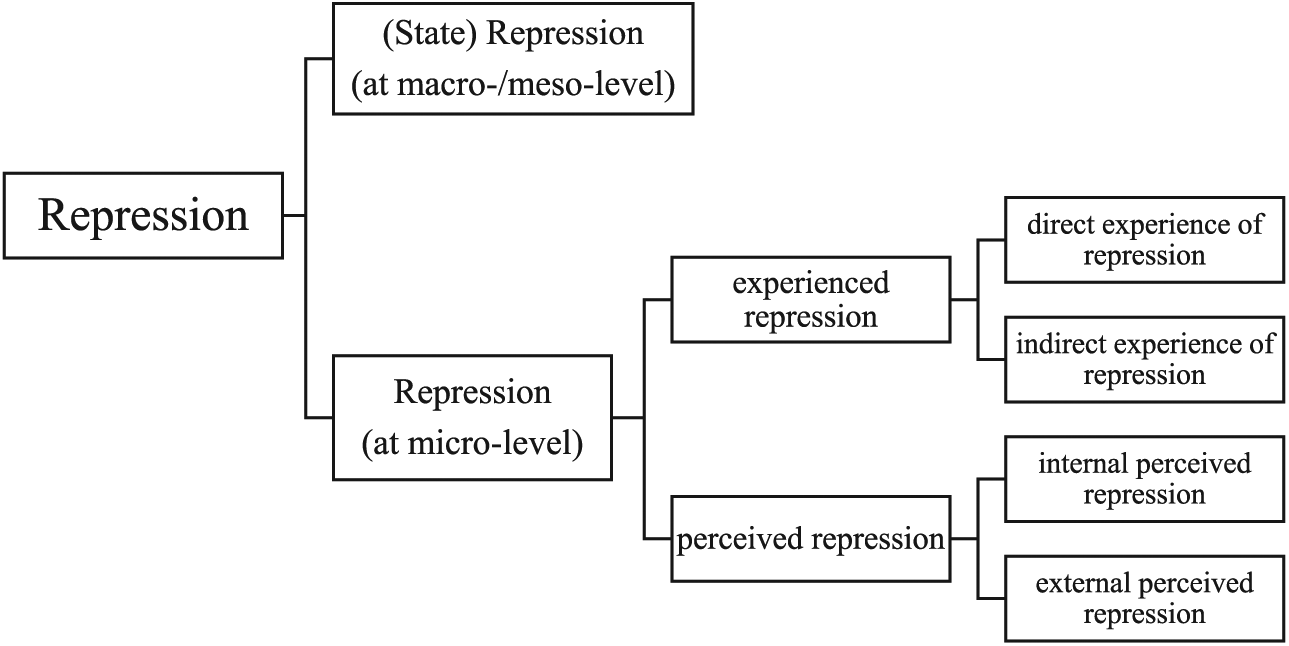
In dealing with the effect of repression at the micro-level, some studies focus on individual experiences of repression, whether direct experiences such as protest-related arrests (Earl, 2011b) or indirect experiences such as arrest or disappearance of immediate family (Thalhammer, 2001). Similarly, some narrow their conceptualization of repression down to protest policing, as the most short-term and visible experience that is likely to be an accurate indicator of state repression experienced by individuals (Della Porta, 1995: 11). In general, however, scholars operationalize the experience of repression in a broader sense, asking whether, ‘in the past respondents had contact with police or security forces for political reasons such as [being] watched, questioned, instructed, taken to the police station’ (Opp, 1994: 135).
Other studies translate state repression into the micro-level by focusing on individuals’ perceptions – in opposition to experiences – of repression. Therefore, in defining individuals’ perspectives on repression, I propose to disentangle experienced repression from perceived repression. I define experienced repression as individuals’ actual experiences of state repression and perceived repression as individuals’ perceptions about obstacles and threats to political participation imposed by the state.
Among studies that focus their attention on perceived repression, two definitions of repression can be observed. In some studies, the term (perceived) repression is used to describe the subjective assessment of contextual factors of state repression (Opp and Roehl, 1990) such as the violation of human rights (Anderson et al., 2002; Booth and Richard, 1996). In other studies, perceived repression is conceptualized as individuals’ assessments about the risks taken through their own political activities (Opp, 1994). This has led to variation in the operationalization of perceived repression.
Individuals’ perceived repression has been measured by surveys asking respondents about, for instance, ‘whether they [believe] the amount of violence in their society to be low, medium or high’ (Booth and Richard, 1996: 1210) or ‘[t]o what degree do [they] believe there is respect for individual human rights nowadays in [their] country’ (Anderson et al., 2002: 445) or how they evaluate police action (Opp and Roehl, 1990). On the other hand, respondents’ assessments about the risks of their own actions have been measured by questions asking about the probability of facing some sort of ‘state repression’ such as being arrested, being hurt by security forces, or being harassed at their place of work (Opp, 1994). Both approaches shed light on how the severity of the perceived repression, whether contextual (external) or individual (internal), affects the intensity of activism. In sum, while scholars focus on addressing the effects of repression, a more nuanced conceptualization of perceived repression may be useful in accounting for the variation in the findings of both approaches. A summary of the conceptualizations of repression can be seen in Figure 1.
Conceptualization of repression.
Dependent variable
Repression studies at different levels use different dependent variables relating to political participation. In micro-level studies political participation of individuals is the focus of attention. Political participation, as conceptualized by Van Deth (2014: 353), refers to the voluntary activities of citizens which take place in or are targeted toward the sphere of politics. In repression literature, this refers to the willingness to participate or actual participation in the past, including online activities (Mou et al., 2011) and voting (Beyerlein and Andrews, 2008).
At the macro-level, the effect of state repression is investigated by – mostly – the intensity and form, and – rarely – location and timing of protests (Almeida, 2008; Della Porta, 1995; Grimm and Harders, 2018; Koopmans, 1997; Ortiz, 2013), as well as mobilization of social movements (Boykoff, 2006; Wood, 2007). Studies examining the effect of state repression at the macro-level on political participation at the micro-level are rare. A notable exception is Booth and Richard, 1996.
Repression in classic social movement theories
The following is a brief review of the effect of repression through the lens of the main social movement theories. This illustrates that different theories predict different effects of repression.
Relative deprivation theory (psychological/system-driven theories)
Relative deprivation theory predicts an inverted-U curve relationship between repression and political participation. Applying a frustration–aggression mechanism from psychological approaches, Gurr (1970) suggests that ‘relative deprivation’ increases the intensity of discontent and in turn leads to anger and violence in societies. In the relative deprivation approach repression is assumed, on the one hand, as a deterrent when considering repression as a source of fear. On the other hand, it is assumed an escalation factor since it may elicit anger when it is perceived as unjust deprivation. Therefore, the effect of repression is conditioned by an equilibrium of fear and anger generated by (perceived) repression. The general inference is that perceived repression increases political participation as it increases relative deprivation and in turn raises anger to a certain threshold. However, severe repression spreads more fear, so at the same time it deters people from participating in political actions (Gurr, 1970: 239).
Collective action, rational choice and resource mobilization theory (economics-driven theories)
The classic collective action theory (Olson, 1965) treated (perceived) repression as synonymous with cost, which would have a direct deterrent effect on political participation. Olson (1965) suggested that rational and self-interested individuals will act to achieve their common good on the basis of cost–benefit calculations. Thus, (perceived) repression as costs of participation that outweigh its benefit decreases the likelihood of political participation. In response to the failure of Olson’s original theory to predict participation in large groups, particularly in high-risk contexts, Oberschall’s (1973) elaboration and modification of the theory came to the fore. This author extends the selective incentives definition to the prospect of prestige, respect and selective incentives of leaders after the overthrow of governments, so that prospective rewards can outweigh the high cost of political participation.
In the same vein, seeing individuals as rational, Lichbach (1987) predicts, using formal modelling, that a tactic shift will take place as a consequence of changes in the level of repression. It is argued that changes in repression influence the choices between violent and non-violent tactics. An increase in repression of non-violent activities raises the relative costs, so it may reduce the level of non-violent activities but at the same time increase the level of violent activities with relatively more payoffs.
In the view of resource mobilization theory, repression may disrupt the aggregation of social movement organizations’ resources, either by increasing costs for any individual or organization allocating resources to social movement organizations or by serving as constraints on the use of resources for social movement purposes (McCarthy and Zald, 1977). Assuming that individuals are rational and repression directly increases the costs of political participation and aggregating resources for political purposes, resource mobilization theory, thus, predicts a negative effect. Klandermans’ (1984) social-psychological expansion of resource mobilization theory – with the similar assumption of rationality of individuals – integrates perceptions of individuals into the theory to predict the participation of individuals. Overall, according to this view, repression (police actions) increases costs – or ‘perceived costs’ (Klandermans, 1984) – and therefore negatively affects ‘the readiness of bystanders, adherents, and constituents to alter their own status and commitment’ (McCarthy and Zald, 1977: 1222).
Political process theories
The prevailing early view of the effect of repression among political process theorists is deterrence. This theory emphasizes the contextual or structural factors to explain the emergence, development and decline of social movements – or using a broader term: contentions. In this view, repression is an integral part of the opportunities/threats that facilitate/hinder social movement activities. This makes, for political process scholars, explaining repression effects ‘straightforward’ (Earl, 2011a): political activities are the outcome of the negative linear function of repression. However, this view has been criticized for the fact that it fails to explain political protests in severely repressive contexts. To overcome this failure, some scholars raised the importance of the difference between objective state repression and the perception of social movement organizations or individuals. They state that how opportunities and threats are perceived matters for the outcome of repression (Kadivar, 2013; Kurzman, 1996; Maher, 2010).
Emotions, identity and framing (social/cultural constructionism theories)
In response to the dominance of structuralist, rationalistic and organizational approaches in earlier social movement studies, cultural constructionists reintroduced emotions, and added identity and framing to social movement studies in general and to the repression scholarship in particular. Culturalists suggest that individuals’ political participation not only depends on the weighing up of (perceived) costs and (perceived) benefits, but also upon how emotions are constructed, how individual and group identity is shaped, and how circumstances and grievances are framed.
Socially constructed emotions can both escalate political participation and demobilize social movements. According to Goodwin and Pfaff (2001), the effect of repression depends on the effectiveness of the management or mitigation of people’s fear. But an increase in the severity of repression can arouse not only feelings of fear but also anger. The former can paralyse social movements and the latter can be the basis for mobilization (Jasper, 1998: 409). Jasper (2011) distinguishes reflexive emotions, ‘that are transitory responses to external events and new information’ (such as anger or fear), from affective emotions, which are ‘relatively stable feelings, positive or negative, about others or about objects’, such as solidarity and moral emotions. More stable emotions can lead to political action and make repression ineffective. Feelings of solidarity increase the commitment of activists under repression (Hirsch, 1990) and can lead to escalation of political participation (McAdam, 1990).
Affective emotions are often intertwined with group identity. Jasper explains that in the case of the boycott in Montgomery, repression strengthened the sense of being together as a moral community under threat – striking up emotional solidarity – and fused collective and movement identities (Jasper, 1997: 257–258).
Viewing social movements as agents actively involved in the framing, i.e. assigning meaning to and interpreting relevant events and conditions (Snow and Benford, 1988: 198), scholars in this area link the effect of repression to how it is framed. If repression is framed as a legitimate act it can demobilize people, but if it is framed as illegitimate (unjust) behaviour of the state it can radicalize people (Kenney, 2001).
To conclude, the above-mentioned theories predict different effects of repression and raise for advocates of each the puzzle of contradictory effects.
The puzzle of variation in the effect of repression
To solve the puzzle, early scholars of repression, under the dominance of structuralist approaches – i.e. political opportunities perspective and resource mobilization theory – ‘tended to focus attention on the environmental facilitation or suppression of movement activity rather than on internal characteristics or dynamics of the movement themselves’ (Aminzade and McAdam, 2001: 14). Therefore, the bulk of the literature attempted to explain the variation in the effect of repression by examining the moderating effect of some macro variables (Davenport, 2007). Examples of such variables are the form and time lag of repression (Koopmans, 1997; Rasler, 1996), the location in the protest cycle (Brockett, 1993, 2005), influential allies, elite divisions, press freedom (Schock, 1999), the role that media and public opinion management play (Hess and Martin, 2006), military infrastructure (Ortiz, 2007) and political regime setting (Ortiz, 2013). Some others expanded the conceptualization of repression’s effects into diversification, decentralization and substitution of social movements (Chang, 2015; Grimm and Harders, 2018). While these works enhance our knowledge on macro conditions that explain variations in the effect of repression, empirical evidence showed that those explanations were not fully convincing. In severely repressive contexts with no major structural changes in political opportunities (at the macro level) and with no strong oppositional organizations and identifiable leaderships, social movements emerged (Loveman, 1998) and persisted (Jasper, 1997: 39), revolutions occurred (Kurzman, 2004; Opp and Gern, 1993; Osa, 2003; Pfaff, 1996), resistances were staged (Einwohner, 2003) and even backlash against brutal massacres unfolded (Francisco, 2004, 2005).
Hence, political changes did not necessarily go hand in hand with structural changes. Nor do all individuals who experience similar structural changes display similar levels of political participation (see also Van Stekelenburg and Klandermans, 2013; Viterna, 2006). To make sense of the variation in the effects of repression it has been suggested, in addition to factors relating to political and social structure, it is important to pay attention to the social-psychological processes which enhance participation (McAdam and Paulsen, 1993; Pfaff, 1996). This highlights the necessity of a microfoundation of the repression effect and in turn the enquiry of micromobilization in puzzling out the variation in the effects of repression.
Even more detrimental, most studies tend to focus on constraints on individuals and do not see individuals as having agency (for a similar argument see Schock, 2005; for exceptions see Moghadam and Gheytanchi, 2010; Viterna, 2006).
Yet, as Earl (2011a) observed, there is less research at the micro-level on the effects of repression than at the macro-level – mainly because the data at the individual level are not easily available, particularly in contexts of severe repression (Osa, 2003; Wood, 2007). In fact, there have been few attempts to link the macro-level and micro-level within the repression effects literature (Earl, 2011a). In attempting to investigate the micro processes and mechanisms to account for the macro puzzle of the state repression effect, many studies used micromobilization theories without micro data (e.g. Almeida, 2005; Brockett, 1993; Khawaja, 1993; Rasler, 1996). The unavailability of data at the micro-level in repressive contexts hinders the opening of the micro-blackbox.
From ‘the effect of repression’ toward ‘the response to perceived repression’
In dealing with the variation in repression effects, I discuss the necessity of moving from ‘the effect of repression’ toward ‘the response to repression’. The following parts of this article describe in greater detail how to do so. The first part discusses perceived repression as a focal concept that enables scholars to translate the repression effect at the macro-level into the micro-level. The second part underlines the importance of attention to micromobilization. Finally, it will be argued that as individuals have the capability to act independently despite repression, agency should be taken into account while investigating the effect of repression on political participation.
Perceived repression
The repression effect question at the macro-level is translated into a micro-level question, which is: Why do some people risk their lives and participate in protests under repression while others do not? This question draws scholars’ attention to perceived repression (Kurzman, 1996). Klandermans (1984) argues that participation depends on individuals’ assessment of the costs against the benefits involved. Accordingly, individuals decide to participate or not on the basis of their perceived costs/risks and benefits of participation. However, from one individual to another, the perceived costs and benefits of a certain activity can vary greatly. Moreover, as Maher (2010: 255) explained, in repressive contexts ‘states often intentionally limit information about structural changes’. Therefore, perceived repression can be unrelated to the level of state repression at the macro-level (Kurzman, 1996). This has two implications for repression scholars. First, scholars should distinguish ‘objective’ repression – what states do – from ‘subjective’ repression – what individuals perceive (Kurzman, 1996; Wiltfang and McAdam, 1991). Second, and equally important, repression scholars should pay attention to the variation in perceived repression among individuals/activists (Kurzman, 1996). Acknowledging variation in micro-level perceived repression, as Viterna (2006: 3) states, ‘yields more accurate theories of high-risk activism and, in turn, improves our macro level understanding of the causes, successes, failures, and unintended consequences of popular revolutionary mobilization’.
Micromobilization
Scholars investigating the repression effect at the micro-level tend to adopt a social-psychological approach. They investigate micromobilization processes as a result of repression by considering perceived repression in conjunction with key social-psychological drivers of political participation (briefly ‘social-psychological drivers’). Therefore, the focus of our attention turns to how perceived repression influences social-psychological drivers.
Synthesizing different dominant theories and approaches, which were discussed above, Opp and Roehl (1990) theorized and empirically showed that perceived repression not only has a direct negative effect on political participation, it has also an indirect positive effect through ‘micromobilization processes’. Consequently, they explained the variation of repression effect as follows: ‘Depending on the strength of repression and the extent to which micromobilization processes provide positive incentives to protest, the direct deterring effect of repression is endorsed, overcompensated (i.e., a radicalizing effect is generated), or neutralized (i.e., there is no effect)’ (Opp and Roehl, 1990: 540–541). This led to a large amount of empirical research to investigate the indirect effects of perceived and experienced repression through social-psychological drivers. It is shown that perceived repression, by increasing perceived costs, negatively influences the perception of efficacy of political actions (using the rational choice approach), or increases grievances which invigorate participation (using relative deprivation theory) (Almeida, 2005). Perceived repression also may instil fear or elicit anger among people (Castells, 2012; Siegel, 2011). However, unlike the conventional wisdom saying that fear leads to demobilization, an intermediate level of fear may mobilize repressed individuals to participate in protests (Azab and Santoro, 2017). Experienced repression, for its part, may also forge politicized identity (using the social constructionist approach) (Almeida, 2005; Loveman, 1998); it may both affect beliefs and ideology and increase the degree of embeddedness of individuals in political networks (McAdam, 1986, 1990). Perceived and experienced repression may also generate moral and social incentives to participate in protests (Opp, 1994, 2009; Van Stekelenburg, 2013).
Recently, some scholars have paid closer attention to the relationship between repression, social-psychological drivers and political participation. Ayanian and Tausch (2016), examining the mediation effect of social-psychological drivers, highlighted the subjective importance of risk. They argued that ‘the expected likelihood of being harmed can be distinguished from the extent to which individuals perceive that risk is important’ (Ayanian and Tausch, 2016: 704). In other words, they scrutinized how perceived repression (perceived risk) shapes social-psychological drivers and how the subjective importance of risk mediated the relationship between social-psychological drivers and one’s willingness to participate. In the same vein, comparing Egypt and Tunisia with Algeria in the 2011 Arab uprisings, Pearlman (2013) also contends that the different emotions people have differentiate the risk of political participation that very different people take. To conclude, these studies on micromobilization processes argued that some people may take the risk of repression as a result of the abundance of social-psychological drivers of political participation. But in this view these social-psychological drivers are at the same time also dependent on perceived repression. So political participation is ultimately a function of perceived repression and individuals’ differential choices in response to repression are ignored.
Agency
While valuable, these social-psychological models still focus on constraints on individuals (repression) and do not see individuals as having agency (or acting independently), so they overlook ‘responses to repression’ as a key independent factor for explaining participation. I argue that the ignorance of response to repression constrains progress in opening the micro-blackbox of political participation under repression.
An Iranian women rights activist, in her article on the basis of her experience states: … campaigns such as One Million Signatures or Stop Stoning Forever [were] created after 2005, as Ahmadinejad’s government imposed difficult conditions on civil society. This repression led the women’s movement to ask many questions such as the following: What is the relationship between repression … and the appearance of social movements? Do social movements grow only under open and democratic conditions or also in contexts of oppression? This self-reflection led to the emergence of new strategies and tactics that would preserve and strengthen the Iranian women’s movement. (Abbasgholizadeh, 2014: 834)
This statement illustrates that, contrary to the expectation of the repression literature that repression is a decisive constraint on social movements, dissidents under repression have agency and can respond to repression by adopting different strategies. For example, even in the most extreme repressive conditions of the Nazi death camps or Polish ghettos during the Second World War, prisoners and Jews had some agency over their actions and decisions (Einwohner, 2003; Maher, 2010; Soyar, 2014). In Islamic societies, everyday resistance against forced veiling and gender inequality shows agency in times of repression. Women, despite authoritarian rule and without any formal movement organization, resist inequality by their day-to-day practices that yield far-reaching changes (Bayat, 2013). Moreover, despite harsh repression, opposition leaders are still able to innovate and spread tactics which lessen the risks of activities (Francisco, 2004) and make ‘massive, rapid and accelerating mobilization’ or backlash possible (Francisco, 2005: 59). This shows that despite repression (i.e. constraints), individuals have some sort of capability to act independently (i.e. agency).
My conclusion is that, although the existing literature provides much insight into what state repression has done to political participation – mainly from the macro-level perspective – we understand little of how individuals respond to repression (Linden and Klandermans, 2006; Moss, 2014; Zwerman and Steinhoff, 2005). To better understand and improve repression theories, it is necessary to open the blackbox of individuals’ decisions and choices in response to repression.
‘Choice points’: Windows to look into the blackbox
Each form of response to repression has its associated risk, costs and benefits, can be coherent with the cultural environment, ideology or beliefs, and can be congruent with the shared identity or not (Bernstein, 1997; Moghadam and Gheytanchi, 2010). As such they stem from ‘choice points’, defined by Jasper (2012) as moments or situations when people can choose to do something different and face alternatives. These choice points are dilemmas that an individual must solve with regard to how to respond to repression. The outcome of individuals’ choice points determines the response to repression which in turn contributes in the impact of repression. Following Jasper (2012), I suggest that in order to better understand how individuals respond to repression, more attention should be given to choice points: what choices are available to individuals and how they resolve the dilemmas embedded in these choice points.
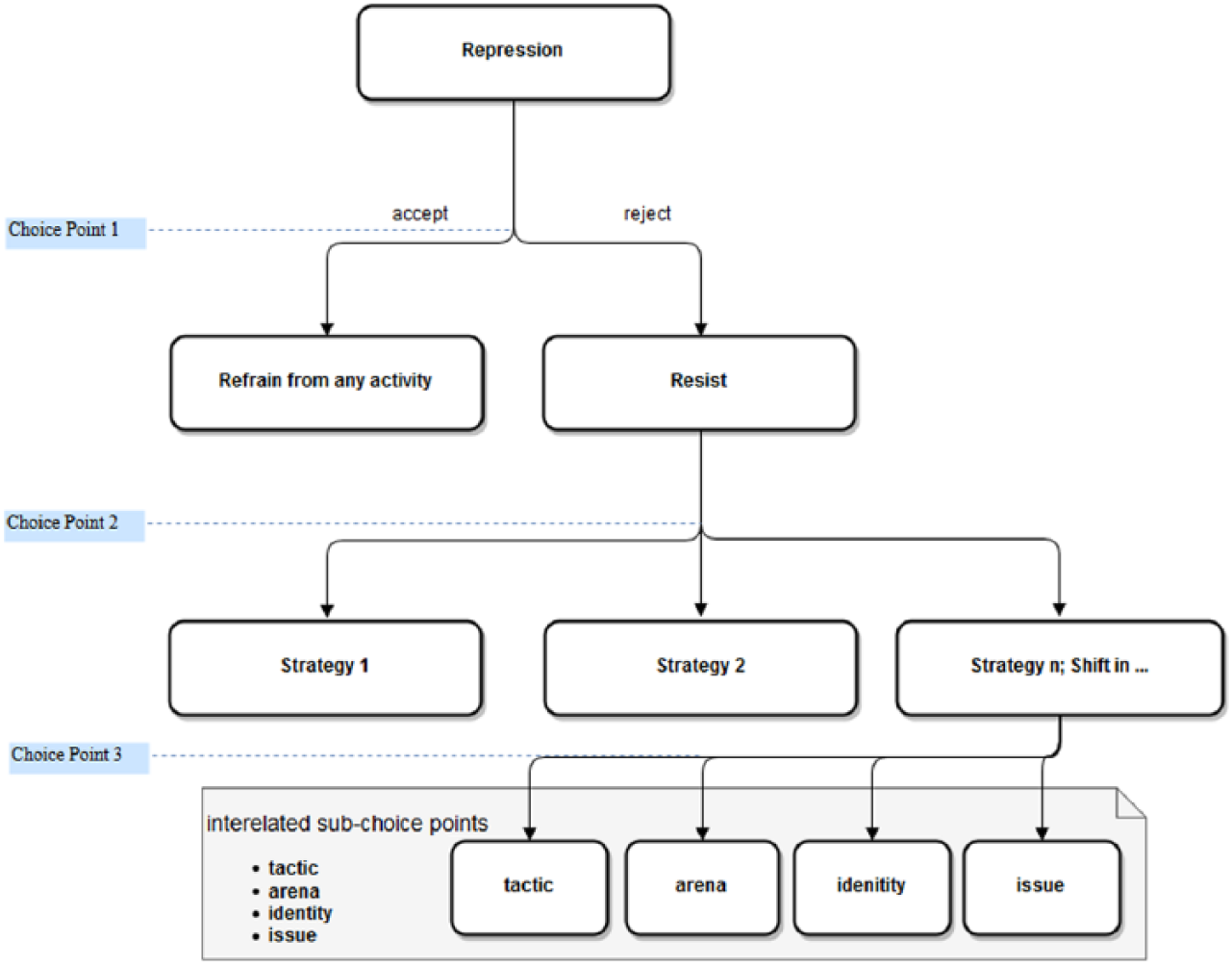
Inspired by Schock’s (2005) diagram of hypothetical responses to repression and injustice, I suggest a similar but elaborated schematic pathway of choosing strategies in response to repression (see Figure 2). Focusing on the path of resisting repression by participation in political actions, three sets of choice points are identifiable. One of the strategic decisions that any individual who faces repression should make is either to accept it and refrain from activities, or to reject it and resist (Choice Point 1). Many of the repression studies at the micro-level focus on this choice point: participate or not. However, in a broader context than a protest, people should not be categorized solely as either participants or non-participants. In fact, the dichotomy of participation or non-participation under repression tells only part of the story. The story will only be completed if scholars consider a variety of activities that people engage in to resist repression.
The schematic process of responses to repression and major choice points.
Strategies for responding to repression: Beyond the dichotomy of participant and non-participant
Once people opt to resist repression, they can choose between available strategies (Choice Point 2). Strategies have been defined as ‘a plan of collective action intended to accomplish goals within a particular context’ (Maney et al., 2012: xvii): for instance, going into abeyance in order to strengthen the activist network and forge collective identity (Taylor, 1989). Johnston and Mueller (2001) identified three common ‘unobtrusive practices’ of contention in Leninist regimes in Eastern Europe which are not open protest: oppositional speech, duplicate groups and dissidents’ circles. These unobtrusive practices ‘develop in response to relatively high levels of repression’ and serve as the basis for mass mobilizations when repression relaxes relatively (Johnston and Mueller, 2001: 352). Rossi (2015) also identified several ‘collective strategies’ that the piqueteros social movement in Argentina has adopted.
In what follows, on the basis of the existing literature, I will suggest the different strategies movements and individuals can choose from to resist repression.
Strategies at the meso-level
In response to repression, some movements may reduce their activities or refrain from any activities, or go underground to survive. Alternatively, other movements will continue and resist repression by adopting different strategies (Earl and Soule, 2010; Moghadam and Gheytanchi, 2010; Titarenko et al., 2001).
Reformation of mobilization networks over time (network reformation) is one kind of resistance to repression (Nepstad, 2004; Osa, 2003; Taylor, 1989). Movement leaders can strategically restructure the movement network to counter ‘the factors that foster movement exit’ (Nepstad, 2004). Under repression, coalitions across different sectors of civil society can be formed to enhance the mobilization ability of the opposition (Osa, 2003; Schock, 2005). These so-called multi-sectoral movements play a major role in mobilizing people by providing potential participants with ‘a sense of an efficacious movement with broad support across civil society’ (Almeida, 2005: 74). Under the longstanding dictatorships of Middle Eastern countries, movements also tend to form unstructured, loosely connected networks with no formal leadership, to resist repression (Bayat, 2013). People also tend to be involved in personal networks in repressive times (McAdam and Paulsen, 1993).
Movements can also utilize state repression and transform it into an opportunity (Moss, 2014). For instance, by reframing or publicizing repression they can enhance moral incentives (Kenney, 2001), creating ‘injustice frames’ (Gamson et al., 1982), delegitimize the state (Chang and Kim, 2007; Della Porta, 1995; Moss, 2014), or increase ideological commitments (Postigo, 2010). Reform-oriented activists can exploit repression to negotiate with the government (Moss, 2014).
In a very repressive context and lack of political opportunity, a strong sense of honour among the Warsaw ghetto fighters helped to construct a motivational frame that equated resistance with honour and made collective resistance possible (Einwohner, 2003). This interaction of positive emotions sometimes motivates movements to employ a so-called brinkmanship strategy as a response to repression, i.e. intensifying activities to escalate the repression to benefit from it (Zwerman and Steinhoff, 2005). In the presence of social norms in favour of political participation, those who are turned into martyrs and heroes give momentum to movement activities (Linden and Klandermans, 2006). This is most relevant in contexts where people who experience problems of repression are socially rewarded for this. In the late 1960s, in Italy and Germany some organizations transformed themselves into radicalized structures and ideologies to survive (Della Porta, 1995).
Furthermore, emotion management can be utilized to encourage participation in high-risk political activities. For instance, Goodwin and Pfaff (2001) argue that both the lack and a surplus of fear lead to demobilization. ‘So movement activists and participants themselves may have to manage, but not eliminate, their fears in more or less explicit and self-conscious ways’ (Goodwin and Pfaff, 2001: 285). Movements can utilize repression to intensify morally related emotions such as pride and anxiety (Jasper, 2011). One of the concerns is management of fear among participants in social movements: for example, the El Salvadoran social movement during the civil war in the mid 1970s took advantage of intensifying emotions such as pride and pleasure, which undermined fear of repression (Wood, 2001).
As Moss and Snow (2016: 554) note: ‘Strategies are broad plans for attaining goals, and tactics are the specific means and methods by which strategies are enacted.’ One sort of strategy is shifting forms of political activities. This is a strategic choice, not only in terms of the available tactics but also in which arena the struggle is fought out, what identity is deployed and which issue is targeted (Bernstein, 1997; Klandermans, 1984; Meyer and Staggenborg, 2012). Arenas refer to the field in which political participation takes place. To resist repression, movements can adjust the tactic, arena and issue of protests, as well as the identity, to the form and the extent of repression. This leads us to focus on Choice Point 3.
Shifting from one tactic or form of protest to another can be one strategy to continue political activities under repression (Almeida, 2008; DeNardo, 1985; Francisco, 1995, 1996; Lichbach, 1987). Evidence for shifting from non-violent to violent tactics as a result of repression is found in different contexts, such as the former GDR and Czechoslovakia (Francisco, 1995), Northern Ireland (White, 1993, 1989), El Salvador (Almeida, 2008), Peru and Sri Lanka (Moore, 1998), South Asia (Boudreau, 2002), the Palestinian Intifada/Palestinian–Israeli conflict (Araj, 2008; Longo et al., 2014) and China (O’Brien and Deng, 2015). These findings are in line with Goldstein’s (1983: 340) proposition that ‘those countries that were consistently the most repressive, brutal, and obstinate in dealing with consequences of modernization and developing working class dissidence reaped the harvest by producing oppositions that were just as rigid, brutal, and obstinate’. Despite considerably lower levels of repression, the shift from non-violent to violent tactics following increasing repression is also documented in democratic Western European societies (Kriesi et al., 1995). It should be mentioned that studies investigating tactical shifts beyond the dichotomy of non-violent and violent tactics are rare (for exceptions, see Boudreau, 2002; Moghadam and Gheytanchi, 2010).
Clearly, choosing among tactics and arenas is interrelated. Some tactics can be undertaken only in certain arenas. People can also innovate new tactics (McAdam, 1983) and spot new arenas for the field of political action. (For a more elaborated discussion on tactical shift see Honari, 2017a.)
Under repression, movements can shift arenas of resistance and choose the ones which are more difficult to control by the government or ones which have more impact on public opinion. In response to a repressive environment, the concentration of political activities may move into arenas in which activists are able to continue their resistance, recruit new participants, and sustain their activities and identities. For instance, in the early 1970s, in response to repression, New Left movements in Japan and the United States moved the resistance to the courts and prisons, went underground or into exile (Zwerman and Steinhoff, 2005). O’Hearn (2009) also shows how Irish political prisoners strategically made prisons a resistance arena to create solidarity and a culture of resistance to invigorate political activities against the British regime in Ireland during the late 1970s. An arena shift from the street to the Internet in response to repression has been documented by Della Porta and her colleagues (2006) in their studies on global movements – specifically the movement for global justice.
To lower the severity of repression imposed by governments and the risk associated with political participation, movements can also change the issue or demand of the protest (desensitization) (Kenney 2001). During Polish martial law in the 1980s, Freedom and Peace activists deliberately chose a set of issues to make their demands – for instance human rights and environmental issues – that the authorities could not object to, i.e. consensual issues (Verhulst, 2011). At the same time, raising these very issues publicly revealed the weakness of the regime and appealed to large social groups (Kenney, 2001).
Also, movements can continue political activities by de-identification or masking their real identity (Einwohner, 2006) – particularly in non-political or so-called ‘duplicate groups’ (such as social and recreational groups, churches and religious groups, intellectual and cultural groups) (Johnston, 2012). A movement can choose to either ‘celebrate’ or ‘suppress’ their identity as a strategic decision (Bernstein, 1997). In the extreme case of high-cost activism, hiding one’s real identity is the forced choice to resist repression and continue political activism, as Einwohner (2006) describes in the context of Jewish resistance in the Aryan side of the Warsaw ghetto. Einwohner (2006) reveals the complexity of identity work in which the resistance is fuelled by a strong sense of identity while the public expression of that very identity is risky.
Given that movements tend to stick to the same tactic even when this tactic has been repressed (Franklin, 2013), another choice can be circumventing repression. Earl et al. (2013) document how Twitter was used to circumvent policing surrounding the G20 meetings held in Pittsburgh in 2009. Circumventing web filtering and surveillances by using VPNs (virtual private networks) and online anonymity granting tools (like TOR) is a well-known strategy under severe repression in the online sphere (Jardine, 2016).
Strategies at the micro-level
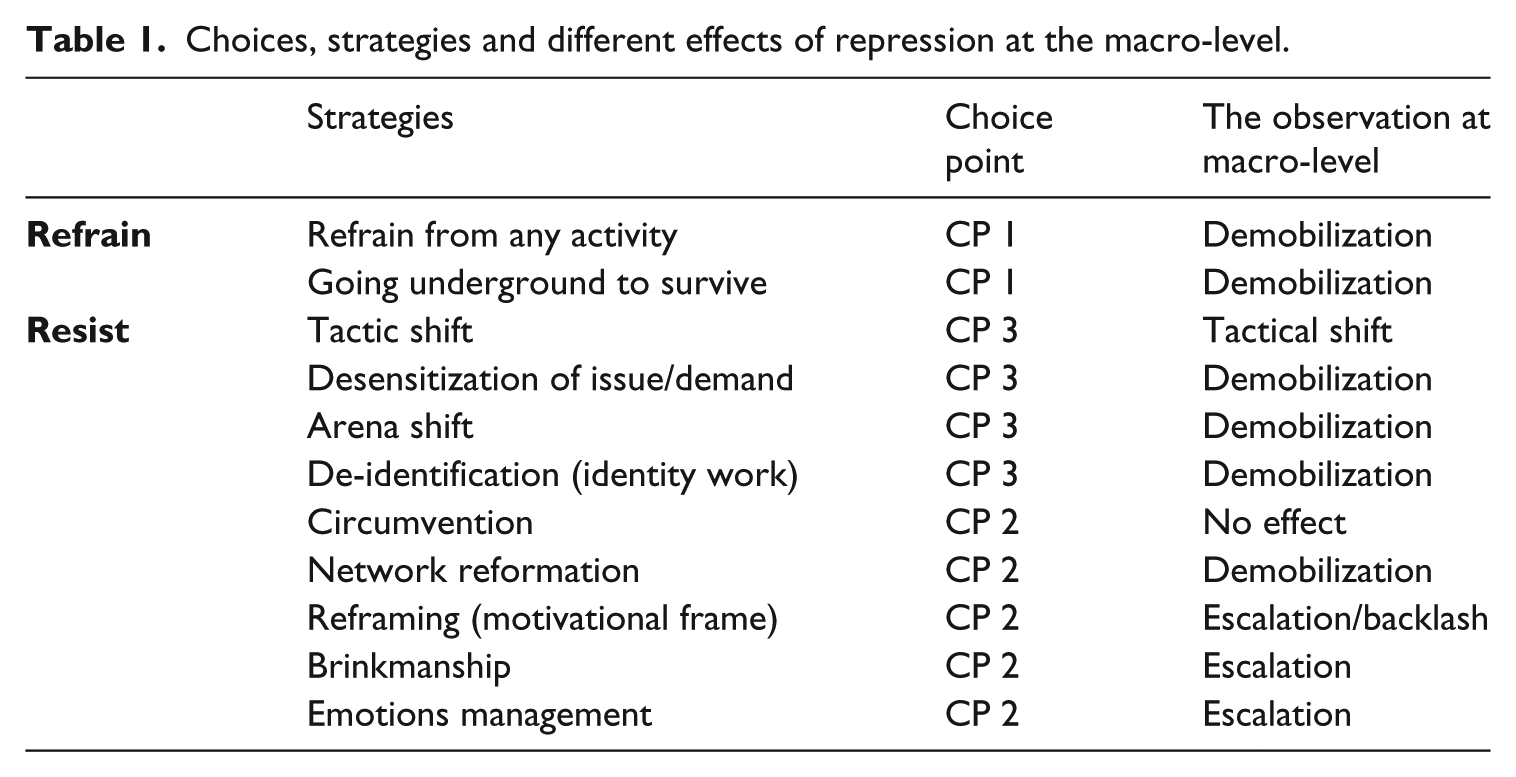
Although the works cited above have uncovered many examples of strategies adopted by social movements (leadership) in response to repression (at the meso-level), I suggest that this research should go one step deeper, into the micro-level. These above-mentioned strategies are supplied by social movement leaders and activists, but they are only influential and successful when they coincide with the demand side of political participation (Klandermans, 2004). This means they need to be accepted and adopted by individuals. In repressive contexts, we often fail to see strong leaders or organizations that are very effective in forcing individuals to follow their decisions. Decision making about political activities in such contexts is often characterized as non-centralized. In such contexts, individuals’ decisions to respond to repression are crucial in the outcome of repression. Individuals have a diverse array of choices available to them to respond to repression. Different strategies adopted by individuals, hence different choices made by individuals at the micro-level, can result in different effects of repression on social movements at the meso-level and macro-level. Table 1 presents some of the strategies which have been documented in the existing literature and have been discussed earlier. The right-hand column in Table 1 shows how the outcome of adopting those strategies will be observed at the macro-level. For instance, shifting arena, issues and identity by individuals, at first sight, from a macro-perspective, would make it seem that the protest was demobilized or dead. In fact, most quantitative indices of political protests ‘have ignored both the identity of the participants and the character of their demands’ (DeNardo, 1985: 5). Therefore, if movement activists continue their activities under another identity or strategically change the issue of their demands, it will be neglected by studies focusing on a certain issue/identity or overlooking the micro-level. As can be seen in Table 1, strategies can be diverse and consist of different elements. Therefore, we need to scrutinize the mechanisms underlying people’s strategic choices under repression by focusing on each of the choice points (see the third column in Table 1).
Choices, strategies and different effects of repression at the macro-level.
Repression and strategies for responding to repression in the online environment
In recent years, Internet and online political participation has attracted significant academic attention, particularly with regard to its effect on democratization in repressive contexts (Farrell, 2012). Thus, the debate in the academic scholarship about the effect of repression has been expanded into Internet research (Earl and Beyer, 2014). The Internet has been generally characterized as a low-cost and low-risk milieu for political activism (Bennett and Segerberg, 2013; Bimber et al., 2012). This has shaped the dominant explanation for online political participation: that the lower level of repression online than offline is conducive to being politically active ‘online’ under severe repression (Howard, 2011; Shirky, 2008). In the same vein, assuming that repression has a deterrent effect on online activism (Earl and Beyer, 2014), it is increasingly argued that if online repression increases, online activities will decline (Gladwell, 2010; Morozov, 2011). Yet, a few studies that have investigated the effect of repression on online political participation found variation in different cases: deterrence effect (Pearce and Kendzior, 2012; Varnali and Gorgulu, 2015), backlash effects (Postigo, 2010) and escalation effects (Earl and Beyer, 2014) and even no significant effect (Mou et al., 2011). In fact, the effect of repression on political participation in the online environment varies, just as it does offline. Honari (2017b) showed that the variation lies in the fact that online activists perceive and respond to repression differently. He identified the different strategies such as de-identification, circumventing and self-censorship that Iranian online activists adopted to manage risks of online activism during the Iranian Green Movement, 2009–2013.
Conclusion and discussion
This article aimed to contribute to a better understanding of the dynamics of repression and political participation. In addition to offering a review of the existing literature on repression, I argued for an approach that would lay the foundation for explaining individuals’ choices of a particular strategy in response to repression. First, I highlighted the contradictory prediction of repression effects by main social movement theories. Then I argued that the failure in explaining variation in the prediction of the repression effect is due to inattention to responses to repression. Then, to provide a framework to fill this gap, I brought to the fore the ‘choice point’ in repression research. Choice points can be the basis for investigation and hypotheses about why or under what conditions people or social movements choose a particular strategy to respond to repression. I then brought together the evidence that demonstrates that people may choose different strategies in response to repression. As the bulk of this literature overwhelmingly focuses on simply resisting to or continuing in participation, this approach gives an opportunity to observe broader forms and more diverse responses to repression. The article demonstrated that there is a shift possible from movement politics to electoral politics, from one tactic to another, or adopting strategies such as de-identification as a response to repression, through the deliberate decision making of individuals.
In most of the existing research on repression, power and agency are largely attributed to states, but not social movements and individuals (Zwerman and Steinhoff, 2005). By shifting the attention from state repression and going beyond the victimization of people toward people’s decisions and their agencies (Zwerman and Steinhoff, 2005: 90) the strategy approach helps to see states and dissidents equally as strategic actors; it provides a broader picture of activities under repression and includes activities that are not public and disruptive but widespread and crucial. These less known activities do not appear on the radar without focusing on the micro-level (Johnston, 2012). Finally, linking the micro-level decisions of individual responses to repression to the macro-level of state repression leads scholars to better understand the interplay of constraint and agency (Jasper, 2012: 39). By acknowledging the variety of strategies, future research could concentrate on social-psychological motives, mechanisms and processes by which people adopt particular strategies to respond to repression. A greater focus on the decision making process of individuals and social movements in response to repression could yield interesting findings that provide better accounts of political activism under repression. Another research task is related to the methodological challenges of gathering data at individual level from repressive contexts. The greatest challenges involve building trust with respondents and considering ethical issues. Social networking websites offer an alternative field for collecting such data at the user level, which begs further attentions by scholars of repression.