




Abstract
This article reassesses the classic thesis linking the globalization of production to union decline. Our argument is three-fold. First, prior literature does not appreciate how the exchange conditions characterizing global value chain (GVC) relations between leading firms in rich democracies and supplier firms in less developed countries (LDCs) can undermine unionization through trade. Second, the worldwide entrenchment of GVCs as an organizational form over time, and cross-national variation in the strength and scope of two key labor market institutions (wage-coordination and Ghent systems), should moderate the effect of LDC trade on unionization. Third, trade with LDCs is endogenous in models of union decline, because high unionization often leads to offshoring. Empirically, we use an instrumental variable (IV) design and a panel dataset covering the longest historical period studied to date. IV estimates suggest that trade with LDCs reduces unionization in rich democracies; these estimates are nearly three times as large as results obtained by OLS, and they increase in size as GVCs entrench worldwide. Estimates also weaken in countries with highly coordinated wage-setting institutions and Ghent systems. Nevertheless, conditional effects and counterfactual histories suggest that GVCs cause union decline even in countries with the most union-friendly institutions, and were more important for union decline overall than either wage-coordination or Ghent systems.
There is perhaps no more dramatic change to the socioeconomic landscape of rich democracies in the past five decades than the decline of organized labor: unionization has declined by about 33 percent, on average, and as much as twice that in the least unionized countries. A prominent explanation for union decline evokes the spatial reorganization of production (e.g., Silver 2001), and suggests the globalization of production has contributed to the decline in organized labor in rich democracies. In fact, the social science literature implicates the globalization of production in several processes that are related to unionization as either cause or effect, including deindustrialization, rising income inequality, and declining labor share of income (Alderson 1999; Alderson and Nielsen 2002; Autor, Dorn, and Hanson 2013; Kollmeyer 2009a; Kristal 2010; Lin and Tomaskovic-Devey 2013; Mahutga, Roberts, and Kwon 2017; Wood 1994). This research posits that a key mechanism linking the globalization of production to these outcomes is increased trade, particularly with less developed countries (LDCs). Such trade exposes workers to LDC labor markets, where relatively lower worker bargaining power and wages raise the relative costs of union membership in rich democracies. That is, rising globalization is thought to reduce the bargaining or associational power of workers in rich democracies.
However, the quantitative macro-comparative literature has been largely unable to substantiate consistent effects of the globalization of production on more direct measures of the power resources of workers, such as union density (Brady 2007; Kollmeyer and Peters 2019; Lee 2005; Scruggs and Lange 2002). To the contrary, by the early 2000s, quantitative macro-comparative social scientists largely concluded that the globalization of production played, at most, a small role in the decline of organized labor, particularly in relation to contending explanations. In sociology, for example, “despite all the concern with dramatically increasing globalization, [my] analyses provide no evidence that globalization undermines workers’ likelihood of being union members” (Brady 2007:84). Similarly, “the recent discussion stressing the effect of globalization of trade [and] production on domestic labor markets and social forces has insufficient grounds” (Lee 2005:79). Sano and Williamson (2008:496) argue that “concerns over globalization are not as crucial to union densities as many analysts have suggested” (see also Kollmeyer and Peters 2019; cf. Kollmeyer 2022; Vachon, Wallace, and Hyde 2016; Western 1997). Likewise, in political science, prominent labor scholars argue there is “little support for the thesis that globalization . . . hurts all union movements severely” (Scruggs and Lange 2002:135), and “changes in union density seem unaffected by globalization” (Checchi and Visser 2005:9). Comparative economists largely concur: “[e]conometric analysis finds basically zero correlation between trade flows and changes in union patterns” (Slaughter 2007:333), and “[s]ome trends like economic globalization . . . do not seem to have impeded union membership and density, and probably will not pose serious problems for unions in the future” (Schnabel 2013:268). 1
We identify theoretical and empirical reasons why prior research on the globalization of production and union density did not find significant effects. Theoretically, existing studies did not consider that imports from LDCs stem largely from the embeddedness of LDC firms into global value chains (GVCs) headquartered in rich democracies. This embeddedness should increase competitive pressure on unions in rich democracies above and beyond what would occur under normal trade conditions. As we will describe, GVC analysis blossomed in the early 2000s and eventually argued that the exchange conditions characterizing the relations between leading firms and their LDC suppliers lead to excessive cost concessions by the latter, which are in turn borne by LDC workers (Blasi and Bair 2018; Kollmeyer 2009a; Kumar 2020; Mahutga 2014a). LDC imports thus undermine unionization more than would be anticipated by standard theories linking trade globalization to union decline. The twenty-first-century “discovery” of GVCs also reflects their dynamic nature, empirically. The phenomenon took off in earnest during the early 1980s, after which it became the predominant organizational form in manufacturing worldwide (Hamilton and Gereffi 2009; Mahutga 2014b). We argue that this dynamic exacerbated the exchange conditions characterizing the markets for LDC suppliers, and therefore the effect of LDC imports on union density should get stronger as GVCs become more entrenched worldwide.
Empirically, and despite some theoretical recognition that imports from LDCs should play a particularly pernicious role in the fate of organized labor, most previous studies operationalize trade with imports from and exports to all countries (Brady 2007; Checchi and Visser 2005; Kollmeyer and Peters 2019; Sano and Williamson 2008; Scruggs and Lange 2002; Slaughter 2007; Western 1997). Moreover, while labor scholars have long recognized the critical role labor market institutions play in either promoting or constraining unionization (Checchi and Visser 2005; Western 1997), they have rarely considered the degree to which these institutions moderate the effects of trade on unionization directly (cf. Scruggs and Lange 2002). Finally, past studies assume that trade is exogenous in models of unionization, but this assumption is questionable: firms in rich democracies appear to offshore when unionization is high, but high LDC imports make union mobilization more difficult. This implies a simultaneous relationship between unionization and LDC imports that biases regression coefficients toward zero.
We estimate the effect of LDC imports on union density among 22 rich democracies from 1963 to 2017. We consider the static and unconditional effect of LDC imports, as well as the theoretically informed problem of parameter heterogeneity, where we allow the effect of LDC imports to vary across national contexts characterized by varying levels of wage-coordination and the Ghent system, and world-historical contexts that vary by the degree to which GVCs entrench into modal organizational forms worldwide. In estimating these spatially and temporally varying effects, we use an instrumental variable design that should correct for the potential of simultaneity bias.
Our results suggest that LDC imports cause union decline in rich democracies. Our unconditional IV results are around 2.7 times larger and explain around 51 percent more of the average union decline than do our OLS estimates. These effects strengthen as GVCs become more modal organizational forms, but weaken in countries with high wage-coordination and a Ghent system. When considering these countervailing effects simultaneously, we find that GVC entrenchment does not erode the buffering effect of wage-coordination, but weakens that of the Ghent system. Overall, LDC imports caused union decline in even the most wage-coordinated countries, and among Ghent countries when GVCs were sufficiently entrenched worldwide. With exercises in counterfactual history, we find that LDC imports had a much more consequential effect on union density than did either of these labor market institutions.
Does the Globalization of Production Reduce Union Density through Trade?
Past research frequently conceptualizes rising trade flows as increasing international competition among firms, which makes firms employing unionized workers less viable. Rising international competition through trade is thought to undermine unions’ ability to deliver better contracts, which reduces worker incentives to join unions (Farber 1990), encourages employers to adopt more strident anti-union policies (Abowd and Farber 1990; Farber 1990; Freeman and Kleiner 1990; McCammon 2001), or hollows out highly unionized sectors of rich democracies (Lee 2005). Political arguments suggest that rising competition causes governments to deregulate labor markets, which makes it harder for unions to organize (Häberli, Jansen, and Monteiro 2012).
Cross-nationally comparative empirical research on the effects of trade globalization on unionization is mixed, however, with the weight of the evidence falling against it. With the exception of Western (1997), Vachon and colleagues (2016), and Kollmeyer (2022), the vast majority of this literature is unable to document statistically significant negative effects of trade on union decline (Brady 2007; Checchi and Visser 2005; Kollmeyer and Peters 2019; Lee 2005; Sano and Williamson 2008; Scruggs and Lange 2002; Slaughter 2007). We argue that several interrelated theoretical and empirical issues beg a reconsideration.
Theoretically, this conceptualization of the globalization of production through trade as a simple increase in international competition presupposes that “each country produces goods and offers services that are exported as final products to consumers abroad,” and that trade effects are static (OECD 2023). Empirically, most studies linking trade globalization to union decline focus on measures of “trade openness,” which include exports and imports from developed and less developed countries, infrequently consider the degree to which labor market institutions moderate trade effects, and assume trade is exogenous in models of unionization (e.g., Brady 2007; Checchi and Visser 2005; Kollmeyer and Peters 2019; Sano and Williamson 2008; Scruggs and Lange 2002; Slaughter 2007; Western 1997). We elaborate on these theoretical and empirical issues in the next sections.
Theoretical Issues: The Relational and Dynamic Nature of GVCs
Theories linking trade to union decline through competitive pressure focus on behavioral models of union growth, which suggest rising prices increase the benefit to union membership, as workers join unions to boost their real incomes. Conversely, slack labor markets raise the costs of union membership by increasing the supply of replacement workers (Ashenfelter and Pencavel 1969). To the extent that trade reduces prices or increases unemployment, it should reduce the incentive for workers to join unions. However, many scholars also acknowledge that trade with poor countries, in particular, should matter most for unions in rich democracies. These arguments are rooted in modern trade theory, which implies the high wages embodied in union-bargained contracts in rich democracies will experience downward pressure from the low wages embodied in imports. This pressure drives a price wedge between otherwise equivalent goods produced in rich and poor countries, reducing the realized replacement cost of unionized workers in rich democracies (e.g., Wood 1994; on worker replacement costs and U.S. union growth, see Kimeldorf 2013).
Even scholars who acknowledge that LDC imports should have more deleterious effects on unionization, however, often reason that the competitive pressures affecting unionized workers follow from competition between firms in rich democracies and LDCs (Scruggs and Lange 2002; Western 1997). Yet, rising imports from LDCs increasingly reflect much more than simple market competition between firms in the two types countries. Major international governmental organizations estimate that most contemporary world trade is “governed” by GVCs (OECD 2023; UNCTAD 2013). 2 Leading GVC firms in rich democracies organize value chains through strategic sourcing decisions involving ownership stakes and, more commonly, shorter-term contracts with suppliers in LDCs (Gereffi 1999; Gereffi, Humphrey, and Sturgeon 2005; Kumar 2020; Mahutga 2012). As the GVC and related literature developed, scholars recognized that decisions about whether to externalize manufacturing and where to locate this manufacturing (domestically or offshore) were tied largely to ex ante estimates of the competitive pressures affecting manufacturing (the “make” or “buy” dilemma), and to the distribution of supplier capabilities worldwide (Coe 2021; Coe and Yeung 2015; Dicken 2015; Gereffi 1999; Gibbon and Ponte 2005; Mahutga 2012; Sturgeon 2002). As such, the manufacturing functions most likely to be offshored to LDCs were those for which “barriers to entry” were comparatively low, which allowed leading firms to exercise a kind of monopsonistic market power to reduce production costs and increase profitability (Heintz 2006; Kumar 2020; Mahutga 2012).
More recent research explicates this monopsonistic power in terms of the “exchange conditions” that characterize inter-firm relations between leading firms in rich democracies and their suppliers in LDCs (Bair and Mahutga 2023). Here, exchange conditions are not just the dyadic relationship between any two firms, but “the broader network structure constituted by possible exchange” (Bair and Mahutga 2023:819). In particular, as Bair and Mahutga (2023:821) note, the ratio of LDC suppliers to lead firm buyers determines the degree of bargaining power enjoyed by the former: Ceteris paribus, a ratio of suppliers to buyers much greater than one . . . generates . . . exchange relations [that] are characterized by large power asymmetries between buyers and suppliers . . . buyers can both extract economic concessions from, and maintain dyadic relations with, particular suppliers because of the ever-present exit threat that is authenticated by the buyer’s many possible alternative partners.
That is, the prevailing exchange conditions characterizing final and intermediate goods “markets” created by GVCs are a function of the degree to which suppliers are substitutable for lead firms, which in turn is a function of the ratio of current and potential suppliers to leading firms. Lead firms have become particularly adept at leveraging the asymmetrical bargaining power afforded by these exchange conditions to reduce unit output prices (Heintz 2006; Schrank 2004).
The vast majority of research on the consequences of GVCs for labor examines labor in LDCs (Anner, Bair, and Blasi 2013; Blasi and Bair 2018; Kumar 2020; Mahutga and Jorgenson 2016), but the precarious position of workers in LDC suppliers should also matter for unions in rich democracies. GVC research consistently finds that the low wages and substandard working conditions of LDC workers are a function of the aforementioned exchange conditions (Anner et al. 2013; Blasi and Bair 2018). In particular, the ease with which leading firms can bargain LDC suppliers against one another leaves the latter with little choice but to squeeze cost concessions out of wages and salaries (Anner 2018, 2020; Blasi and Bair 2018; Guschanski and Onaran 2023). The resulting wage and salary wedge between workers in rich democracies and LDC suppliers incentivizes a number of employer strategies that undermine unions in rich democracies. These include direct employer offensives, downsizing, domestic factory migrations (or the threat thereof), the development of two-tiered bargaining systems that undermine new union members vis-à-vis incumbents, and various forms of contingent employment relations and, of course, offshoring (Bronfenbrenner 1996; Kalleberg 2018; Milberg and Winkler 2013; Weil 2017). In short, the exchange conditions characterizing the final and intermediate goods markets encountered by firms in LDCs should increase LDC imports’ downward pressure on union density above what might exist if LDC firms were simply competing with firms in developed countries (Kollmeyer 2009a; Mahutga 2014a).
Adopting the more relational orientation of GVC analysis also invites a dynamic understanding of the effect of LDC imports on unions in rich democracies. The embedding of trade in GVCs is a historically dynamic phenomenon, with many scholars suggesting GVCs became modal organizational forms only after the early 1980s (e.g., Hamilton and Gereffi 2009; Mahutga 2014b). The entrenchment of GVCs as a modal organizational form over time created new export markets for manufacturing firms in LDCs. In some cases (e.g., apparel), this allowed leading firms to move entire industries offshore (Bair and Gereffi 2001; Schrank 2004). In other industries (e.g., autos and electronics), it allowed leading firms to move a growing number of “tasks” offshore (Galanis and Kumar 2021; Mahutga 2012; Sturgeon, Van Biesebroeck, and Gereffi 2008).
As these final and intermediate goods markets expanded, so did the number of firms supplying them. For example, Figure 1 shows that the number of manufacturing establishments in LDCs, or “potential suppliers,” more than tripled from 1981 to 2017 (UNIDO 2024). This historical process also set LDC firms on dynamic learning curves, which allowed them to upgrade their capabilities. In some cases, suppliers started with simple assembly via export processing zones, and then transitioned to “full package” production models, whereby suppliers produce (or procure) their own intermediate inputs rather than importing them from leading firms (Bair and Gereffi 2001; Fröbel, Heinrichs, and Kreye 1980; Schrank 2004). In other cases, “tiered” supplier pools emerged in LDCs, corresponding to varying degrees of complexity with respect to manufacturing processes and requisite transactions between lead firms and suppliers (Gereffi et al. 2005; Sturgeon et al. 2008). These tiers include first-tier “mega” suppliers who frequently employ their own geographically diverse set of suppliers, as well as “middlemen” suppliers that inculcate their own ties with independent suppliers in various countries (see Bair and Gereffi 2001; Hamilton and Gereffi 2009; Mahutga 2014b; Sturgeon et al. 2008). Thus, the diffusion of GVCs worldwide increased the supply of capable LDC firms competing for inclusion into both final and intermediate goods created by leading GVC firms (Bair and Gereffi 2001; Mahutga 2012; Sturgeon 2002; Sturgeon et al. 2008).
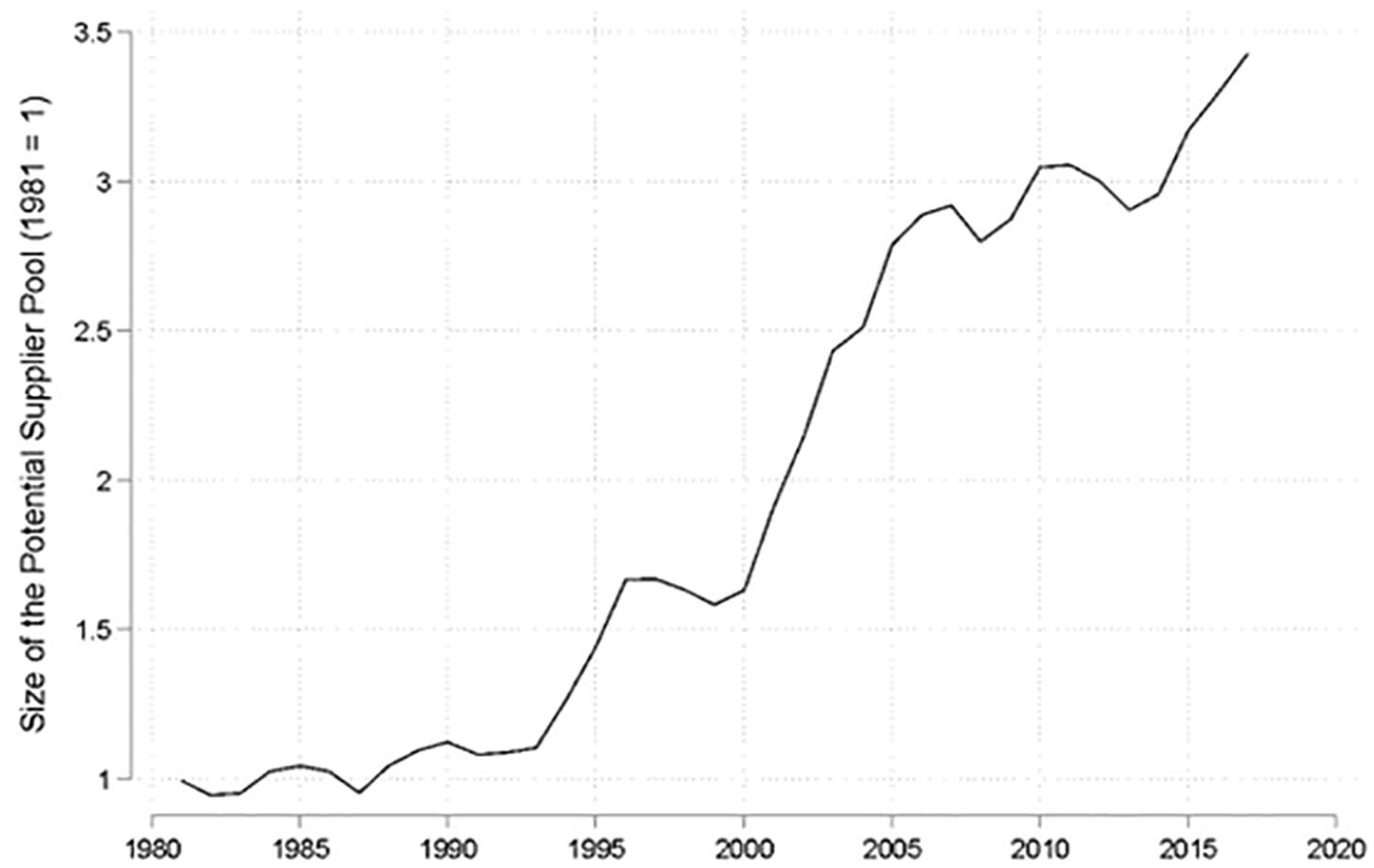
Potential LDC Supplier Pool
According to the “exchange-theoretic” theory of GVCs described above, this growing supply of capable LDC suppliers should matter for the effects of LDC imports on unions. Holding the supply of leading firms fixed, the theory suggests a rapidly growing ratio of suppliers to buyers. Indeed, the correlation between our measure of GVC entrenchment (see below) and the index of LDC manufacturing establishments in Figure 1 is 0.959. Of course, a parallel body of research suggests the supply of leading firms has contracted, at least when measured by market concentration among the largest firms in the relevant sectoral categories in rich democracies (e.g., manufacturing and retail trade; Autor et al. 2017; Philippon 2019). This suggests that GVC entrenchment has exacerbated the exchange conditions characterizing the intermediate and final goods “markets” for LDC suppliers, and thereby decreased their relative bargaining power vis-à-vis lead firms, with predictable implications for labor in countries containing both types of firms.
Empirically, for example, Schrank (2004:144) finds that Dominican apparel manufacturers experienced declining unit prices over time because there emerged “a cutthroat competition” for inclusion into the GVCs of North American lead firms as the number of capable “full package” suppliers increased (see also Arrighi, Silver, and Brewer 2003). Mahutga (2020) finds that positional power in GVCs exacerbated the rich/poor country wedge in labor’s structural bargaining power only after GVCs became entrenched worldwide. Heintz’s (2006) formal model of apparel manufacturing explains an observed inverse association between North American import penetration and relative unit prices for imported goods with the rising bargaining power of North American buyers. Pandian (2017) shows that the positive effect of industrialization on economic growth in LDCs declined precipitously over the period during which GVCs became most entrenched. Mahutga (2014a) finds that average wage gaps in garment manufacturing between countries containing lead firms and the LDCs containing suppliers nearly doubled after GVCs became an entrenched organizational form worldwide (see also Mahutga 2014c). This dynamic should reduce the individual-level incentives to join unions a la behavioral models and multi-tiered bargaining systems, and facilitate employer offensives, downsizing efforts, domestic factory migrations (or threats), and more offshoring. That is, the effects of LDC imports on union decline should increase as the worldwide entrenchment of GVCs skews the exchange conditions of supplier markets in favor of leading firms. Models that do not incorporate this global-level organizational dynamic are likely misspecified (e.g., Mahutga et al. 2017; Oatley 2011; Pandian 2017).
The dynamism of GVCs also suggests a secondary empirical explanation for the lack of consistent empirical links between trade globalization and union decline: most previous comparative studies of union decline used datasets that predate much of the organizational changes associated with the entrenchment of GVCs, and much of it predates the intense scholarly attention that GVCs now enjoy (Brady 2007; Checchi and Visser 2005; Lee 2005; Sano and Williamson 2008; Scruggs and Lange 2002; Slaughter 2007; cf. Vachon et al. 2016). Even in the two studies we found that directly assess the effect of imports from developing nations on unionization, the only one that found support for the negative effects of globalization on union density (Vachon et al. 2016) utilized much more recent data (cf. Lee 2005).
Empirical Issues: Measurement, Labor Market Institutions, and Simultaneity Bias
Trade Openness or LDC Imports?
One key empirical explanation for the lack of consistent effects of trade on unionization is the operationalization of trade. As we discussed earlier, much of the theoretical basis for expecting trade to undermine unions is due to imports from LDCs. Yet the most common operationalization of trade globalization is trade openness (the sum of total imports and total exports over GDP) (Brady 2007; Checchi and Visser 2005; Kollmeyer and Peters 2019; Sano and Williamson 2008; Scruggs and Lange 2002; Slaughter 2007; Western 1997). This was undoubtedly motivated in part by Katzenstein’s (1985) seminal work on the successes of democratic corporatism among small open economies, but it is not at all obvious that workers should experience disincentives to join unions (either via market or political mechanisms or from employer offensives) when they work in countries that employ domestic labor to supply material goods to other countries. Arguably, such exports would buffer any negative domestic economic conditions, and disincentivize employer offensives (cf. Kollmeyer 2022; Vachon et al. 2016). 3 As a result, the use of general trade openness to measure economic globalization likely partially explains the null results in past studies. 4 Half of previous studies using LDC imports in regressions of unionization on trade observe a negative effect, compared to only 12.5 percent of those that use trade openness.
Do Labor Market Institutions Moderate the Effect of GVCs?
Another key explanation for inconsistent effects in previous research is that GVCs likely reduce union density, through trade with LDCs, more in some countries than others (Scruggs and Lange 2002). Scholars generally agree that labor market institutions are important drivers of union density across affluent democracies (Brady 2007; Checchi and Visser 2005; Lee 2005; Wallerstein and Western 2000; Western 1997). Two labor market institutions are particularly prominent in this literature: wage-coordination and union-administered unemployment programs (the Ghent system). This research often shows that these institutions may moderate the negative effects of the business cycle (e.g., Checchi and Visser 2005; Kollmeyer and Peters 2019; Lee 2005; Western 1997). Little of this work, however, has considered the degree to which these institutions moderate the effect of external shocks like trade on union decline.
Scruggs and Lange (2002:126), however, do allow labor market institutions to moderate measures of trade directly, and conclude that “the effects of economic globalization are marginal and conditional on particular economic institutions.” More recent research in the United States, where labor market institutions are comparatively weak, may be consistent with this view. For example, studies linking Chinese manufacturing imports to local U.S. labor markets find deleterious effects on employment, unemployment, wages, labor force participation, union certification elections, and union membership (especially in right-to-work states), although some of this work suggests these effects are small or countervailed across sectors (Acemoglu et al. 2016; Ahlquist and Downey 2023; Autor et al. 2013; Browne and Cole-Smith 2021; Charles, Johnson, and Tadjfar 2021).
Given the cross-national context that concerns us here, we argue that both wage-coordination and the Ghent system should reduce the negative effects of LDC imports on union decline (for similar arguments about inequality, see Mahutga et al. 2017; Roberts and Kwon 2017). It is widely recognized that coordinated wage-bargaining systems strengthen unions by facilitating more harmonious relationships between employer associations, works councils, and unions during contract negotiations (Boeri, Brugiavini, and Calmfors 2001). Moreover, highly coordinated economies extend wage agreements to non-union shops, which disincentivizes employer opposition to unions with respect to the domestic labor force. However, the more cooperative relations between labor and management that prevail in these countries also produce wage restraint (Höpner and Lutter 2014; Wallerstein 1990). This wage restraint should act as an additional disincentive for employers to undermine domestic unions with lower-cost workers in LDCs.
In countries with a Ghent system, unions administer unemployment insurance, and in many cases, workers must belong to a union to receive unemployment insurance. Thus, unions play an important non-market role in the provision of social security. 5 Moreover, signing up workers for unemployment benefits has become an important recruitment tool for unions in countries with Ghent systems (Lindvall 2011). Both factors should compensate for the downward pressure on union density of LDC imports. For these reasons, we expect both wage-coordination and the Ghent system to blunt the effect of LDC imports on union decline.
A prominent critique of research on institutional effects suggests that “omitting macro processes causes scholars to draw biased inferences about . . . how variation in domestic [institutions] shapes variation in the phenomena of interest” (Oatley 2011:318–19). Thus, we also assess if the worldwide diffusion of GVCs matters for any moderating effect of labor market institutions.
With respect to wage-coordination, the wage-restraint achieved with this more cooperative labor market institution may fail to keep up with the cost savings found with offshoring via GVCs. Thus, the worldwide expansion of GVCs may undermine the disincentives for employer offensives in highly coordinated economies. Similarly, increases in the rate of decline (increase) in the estimated benefits (costs) of union membership associated with the worldwide diffusion of GVCs may overwhelm the non-market incentives motivating individual workers to join unions, and the mobilizing advantages of union organizers, in countries with Ghent unemployment systems. Thus, in our empirical models, we consider the possibility that the worldwide entrenchment of GVCs undermines the insulating role of labor market institutions by estimating three-way interactions involving LDC imports, each of these labor market institutions, and the worldwide entrenchment of GVCs.
Simultaneity Bias?
A final plausible explanation for inconsistent effects in prior research is that the causal arrow runs in both directions, leading to attenuation bias in estimated coefficients on trade. The key argument for a negative association between LDC imports and unionization is that increased trade both incentivizes and empowers “employers to adopt a more confrontational, antiunion strategy” (Scruggs and Lange 2002:129). Indeed, labor scholars frequently recognize that the mere presence of offshoring behavior validates employer threats to relocate economic activities in the face of aggressive union bargaining (Bronfenbrenner 1996; Stepan-Norris and Zeitlin 2003). However, scholars have also argued that employers are more likely to offshore when union density is high. Brady (2007:72), for example, suggests “employers often globalize production to avoid higher labor costs, rigid work arrangements, and unions” (with respect to other dimensions of globalization, see Alderson 2004). That is, the literature suggests both that high LDC imports reduce unionization and that high unionization increases offshoring via LDC imports. Thus, the negative association implied by LDC imports → union density should be countervailed by the positive association implied by union density → LDC imports. Any resulting simultaneity bias would mean that coefficients on trade in previous studies of union decline are biased upward (toward zero).
Data and Method
Sample
Our sample includes 22 rich democracies from 1963 to 2017, the most recent year for which all data are available: Australia, Austria, Belgium, Canada, Denmark, Finland, France, Germany, Greece, Ireland, Italy, Japan, Luxembourg, Netherlands, New Zealand, Norway, Portugal, Spain, Sweden, Switzerland, the United States, and the United Kingdom. Fifteen of these countries have observations throughout the period, and seven do not, either because they were not separate statistical categories the entire period (Belgium and Luxembourg prior to 1999) or for idiosyncratic reasons. Thus, we analyze an unbalanced dataset of 1,061 country-years.
Panel Regression Analysis
We begin our analysis with a standard OLS regression that includes fixed country-effects and a linear time trend, with our standard errors made robust to heteroskedasticity and arbitrary serial correlation within countries. In our most saturated models, we estimate the following,

where i and t index countries and years, respectively; x refers to LDC imports; δ refers to a labor market institution; and θ refers to GVC entrenchment. ∅ is an n x k matrix of constituent terms required to correctly estimate βxitδitθt; ϑ is an n x k matrix of baseline controls informed by the behavioral model of unionization; z is a matrix of fixed country intercepts; and ε is the idiosyncratic error term. Two issues, however, make this equation likely to produce biased estimates of the parameters of interest.
Heterogeneity Bias on Interaction Terms in Fixed-Effects Models
Recent research shows that interaction terms involving unit and time-varying covariates in fixed-effects models reintroduce between-case variation into the equation, and thus parameter estimates for these terms are prone to heterogeneity bias (Giesselmann and Schmidt-Catran 2022). This work further shows that these biases can be eliminated by “double de-meaning” (DDM; the covariates are unit-demeaned before forming their product term and then included in the original fixed-effects regression). Thus, we consider this possibility when estimating interactions involving LDC imports and wage-coordination.
Simultaneity Bias and Two-Stage Least Squares
Second, and as we described earlier, there is ample reason to suspect LDC imports are endogenous in unionization equations. The standard approach to this identification problem is instrumental variables. Instrumental variable regression proceeds in two stages. In the first, the potentially endogenous regressor is regressed on the exogenous variables and at least one “excluded” instrument. In the second stage, the dependent variable is regressed on the predicted values from the first stage along with the exogenous variables. The two-stage least squares equation can be written with Equations 2 and 3:

and

In Equation 2, LDC imports are regressed on an excluded instrument (
Finding instruments that satisfy the first two conditions can be difficult. We borrow from econometric strategies that exploit variation in supply shocks (like LDC imports) in comparable cases over the same time-period. For example, a classic study by Autor and colleagues (2013) instrumented Chinese imports with the average of Chinese imports to other rich democracies. Borrowing from this approach, we follow Schaller’s (2023) analysis of union elections by instrumenting each country’s LDC imports with the average LDC imports of their peers in the same year. That is, our instrument (
We consider instrument strength more formally below, but it is worth noting that the correlation between realized LDC imports and this instrument is rather high at 0.789, and rises to 0.956 using the within-country variation we exploit in our analysis. This variable is plausibly excludable in the second stage because it is difficult to construct a scenario in which other-country’s LDC imports affect a focal country’s rate of unionization except through their correlation with the focal country’s realized LDC imports (see note 13 for the results of a formal test of the null that the instrument is uncorrelated with the error term of the second-stage regression; the excludability criterion).
Dependent Variable
Union density
Our dependent variable, union density, is measured as net union membership, which is the percentage of employed wage and salary earners that belong to a union. Union density data come from the Comparative Welfare State (CWS) dataset compiled and updated by Brady, Huber and Stephens (2020). The original source of the data is versions 5.0 and 6.0 of Visser’s ([2015] 2019) “Database on Institutional Characteristics of Trade Unions, Wage Setting, State Intervention and Social Pacts in 55 Countries between 1960 and 2018.”
Independent Variable
LDC import penetration
The value of manufacturing imports from countries in LDCs is a common measure of production globalization among advanced industrial countries (Alderson and Nielsen 2002). However, as the scale of trade increases linearly with country size, direct comparison of southern manufacturing imports across countries with different economic and geographic scales is difficult. One common approach to facilitate cross-country comparisons is to divide the imports from LDCs by gross domestic product (GDP). However, this approach may under- or overestimate the degree to which southern workers are integrated into the supply chains of firms in a given advanced industrial country, as GDP may increase as LDC imports increase. For example, prior work shows GDP increases along with increased LDC imports as the latter increase profit rates among offshoring firms (Kollmeyer 2009a; Mahutga et al. 2017).
To alleviate the potential biases of the first approach, we utilize an alternative normalization procedure developed elsewhere, which divides manufacturing imports from LDC countries (non-OECD countries as well as Chile, the Czech Republic, Estonia, Hungary, Korea, Mexico, Poland, the Slovak Republic, Slovenia, and Turkey) by total imports (Mahutga et al. 2017). In contrast to the first approach, the ratio of LDC imports/total imports will change temporally if and only if the relative rate of growth in LDC manufacturing to other types of imports changes. In addition, this ratio measures the pattern instead of the level of trade, as total imports represent the maximum possible volume of LDC imports for a country (Beckfield 2006; United Nations 2014; for a detailed discussion and formal proof, see Mahutga et al. 2017).
Our data on LDC manufacturing imports and total imports come from the CWS dataset and OECD. As a robustness check, we use the first measure, the ratio of LDC imports/GDP in our analysis. The data on GDP come from the CWS dataset and are measured in billions of U.S. dollars at purchasing power parity (OECD [2019] 2021). We apply a log base 10 transformation to both measures so their distributions approximate a normal distribution. 7
Moderating Variables
Global value chain entrenchment
As we elaborated earlier, GVC entrenchment is a world-historical phenomena describing the degree to which GVCs became a modal organizational form. When the organizational form is more entrenched, more of the world’s final and intermediate goods market is controlled by leading GVC firms, capable suppliers are more numerous in LDCs (on average), and leading firms can therefore leverage their monopsony power to extract price concessions from any particular supplier. Because a lack of cross-nationally and temporally comparable firm-level data precludes a direct measure of this worldwide ratio (Bair 2005; Mahutga 2014a, 2014b), we follow Mahutga and colleagues (2017), who measure the worldwide entrenchment of GVCs as the ratio of world manufacturing imports to world value-added in manufacturing (see also Feenstra 1998). This measure increases primarily with the volume of value-added exported, and with the double counting of trade at the country level that happens when value chains cross national borders multiple times. Although not a direct measure of the ratio of suppliers to buyers, it does directly capture the embedding of manufacturing production in trade and is nearly perfectly correlated (0.959) with the numerator of this ratio (see Figure 1).
Data on world manufacturing imports come from the United Nations (UN 2020), and data on world value-added in manufacturing come from the UNIDO’s Industrial Statistics database (UNIDO 2021). Because our explication of the exchange conditions favoring leading firms in GVCs conceptualizes the global supply of capable suppliers as the key numerator in the ratio of suppliers to buyers, our covariate varies over time but not across countries. 8 At the beginning of the period, trade stood at 21.9 percent of value-added. By the end of the period, trade was 103 percent of value-added after peaking at 114 percent of value-added in 2008.
Ghent
Previous studies have shown that union density is higher in Ghent countries, where unemployment insurance is administered by unions (Scruggs and Lange 2002; Wallerstein and Western 2000). A dummy variable indicates the presence of a Ghent system, identifying Belgium, Denmark, Finland, and Sweden as Ghent system countries (Scruggs and Lange 2002; Western 1997).
Wage-coordination
We measure wage-coordination with the measure developed by Kenworthy (2001) in the CWS (Brady et al. 2020). Data are derived from the database on “Institutional Characteristics of Trade Unions, Wage Setting, State intervention and Social Pacts” developed by Visser ([2015] 2019) and updated by the OECD/AIAS (2021). The scale ranges from 1 to 5, with 1 indicating fragmented wage-bargaining and no coordination, and 5 indicating the most centralized, concentrated, and coordinated bargaining by the central union and employers’ associations, or unilateral government imposition of a wage schedule or freeze.
Baseline Controls
Following previous studies, we control for several variables derived from behavioral (Ashenfelter-Pencavel) models applied to macro-contexts, which account for macro-economic conditions that matter for the ebb and flow of unions: inflation, unemployment, and economic growth (Ashenfelter and Pencavel 1969; Brady 2007; Kollmeyer 2018). Inflation is thought to increase individuals’ incentives to join unions (because they decouple wages from prices), although Checchi and Visser (2005) suggest these effects should be muted in countries where collectively bargained contracts extend to the non-union sector. Unemployment is thought to reduce union density, but some work suggests these effects might be different in Ghent countries, where union membership is critical for access to unemployment insurance. 9 Economic growth is thought to increase the bargaining power of labor and thus increase unionization. Inflation is measured as the consumer price index (Brady et al. 2020). Unemployment is measured as the percentage of unemployed persons among the civilian labor force; it was harmonized to facilitate international comparability (Brady et al. 2020). Economic growth is measured as the annual rate of change in real GDP per capita (Brady et al. 2020; Feenstra, Inklaar, and Timmer 2015).
Additional Controls
In addition to LDC imports, other dimensions of economic globalization have been implicated in models of union density (Lee 2005; Scruggs and Lange 2002). In our robustness checks, we consider two of these: trade openness and capital mobility. We measure trade openness with the sum of imports and exports as a percentage of GDP (Brady et al. 2020); we measure capital mobility with outward FDI stocks as a percentage of GDP. Data on outward FDI come from the United Nations Conference on Trade and Development (UNCTAD 2021). GDP is measured as GDP at current prices in million U.S. dollars (OECD 2021).
Our auxiliary analyses also consider a second explanation, financialization. Studies have found that growing financialization is associated with a decline in unionization, as financialization increases resistance to workers’ efforts to unionize, and shifts employment from manufacturing to the service industry, where unionization is more difficult (Kollmeyer and Peters 2019; Martin and Quick 2020; Vachon et al. 2016). Thus, we consider financialization operationalized as the share of employment in finance, insurance, and real estate (FIRE). Data on FIRE sector employment and total civilian employment come from the OECD ([2019] 2021).
Finally, we also consider two important sectoral arguments: the employment share of industry, and a proxy for the size of the public sector (government outlays on goods and services [in constant PPP] as a share of GDP). The former data come from the Penn World tables 10.1 (Feenstra et al. 2015); the latter come from the CWS 2020 (Brady et al. 2020). Unionization tends to be higher in the public sector, which suggests that unionization is correlated with the size of the public sector cross-nationally (Western 1997). Omitting this control may inflate our estimated coefficients if it is a post-treatment control (i.e., if LDC imports reduce the size of the public sector) or a confounding correlate of unionization. Conversely, omitting this control may attenuate our estimated coefficients if LDC imports increase unionization in the public sector indirectly (Ahlquist and Downey 2023), or if general government spending reduces the error rate of our models. However, cross-nationally and temporally available data on public sector employment is notoriously sparse (Kollmeyer and Peters 2019). Thus, we follow previous work (Kollmeyer 2022; Kollmeyer and Peters 2019) and use government expenditure as a proxy for public sector employment (higher employment shares increase expenditure). Previous research suggests deindustrialization may be a post-treatment control for union decline with models of LDC imports on the right-hand side (e.g., Alderson 1999; Kollmeyer 2009b; Lee 2005), but it is nevertheless useful as an additional robustness check because it allows us to assess the effect of LDC imports net of employment shrinkage in the historical heart of the union movement.
Results
Table 1 reports OLS and DDM-OLS (all with fixed-effects) coefficients. Unemployment and economic growth are correlated with unionization in ways consistent with conventional thinking, although only unemployment is marginally significant. The baseline coefficients are more or less consistent throughout, and we devote the remainder of our attention to the empirics central to the substantive focus of the article. We report the unconditional effect of trade openness (Model 1) and LDC imports (Model 2), along with a baseline model. Consistent with most prior studies, the coefficient on trade openness is incorrectly signed and nonsignificant. 10 Consistent with only one prior study, LDC imports have a significantly negative association with union density. Because LDC imports are logged, the coefficient is a semi-elasticity—it implies that union density declines by roughly two-tenths of one percentage point (19.56/100) for every one percent increase in LDC imports. This estimated effect is small relative to its standard error.
Fixed-Effects Regression of Union Density on LDC Import Penetration, Interactions and Controls
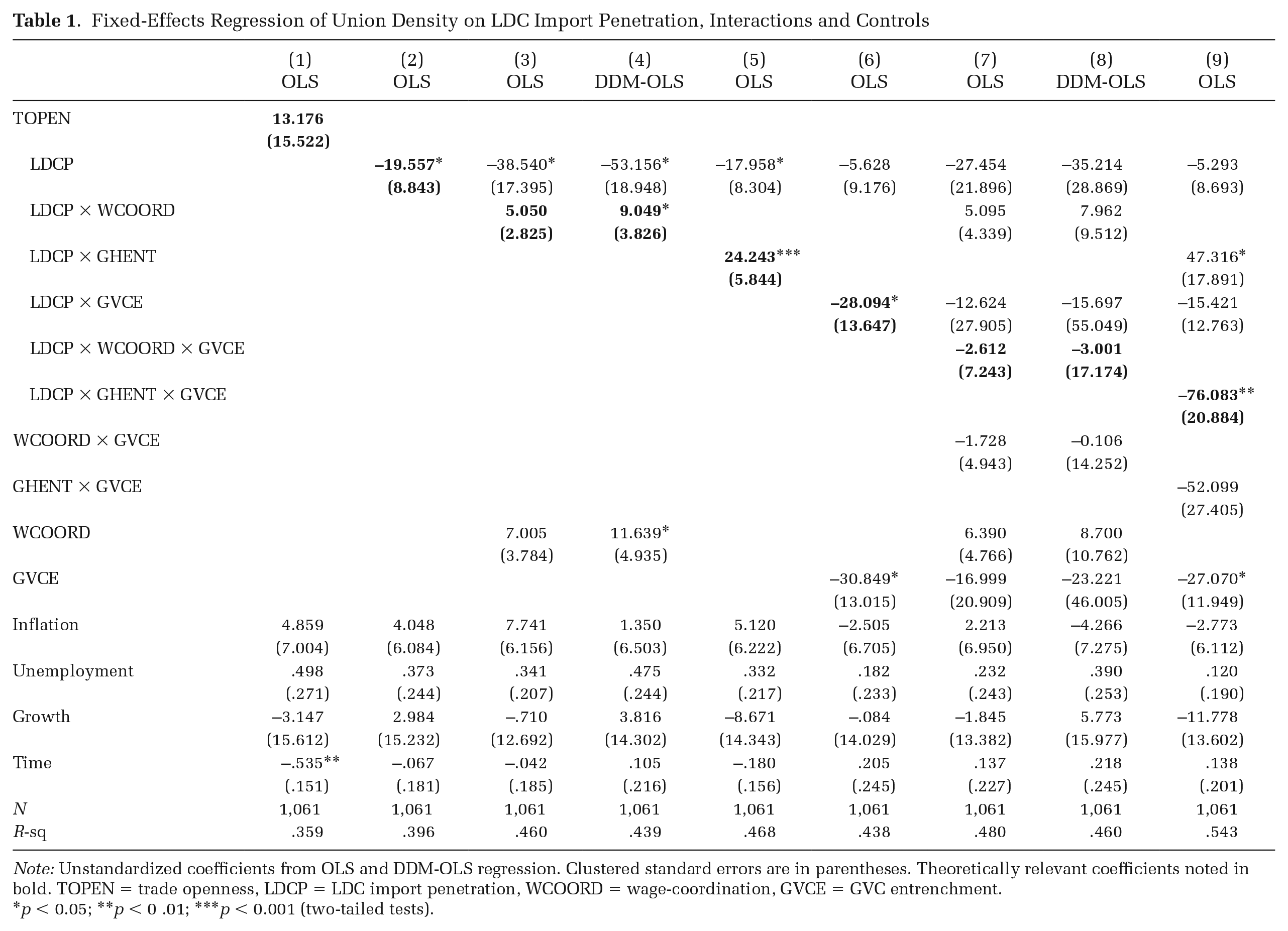
Note: Unstandardized coefficients from OLS and DDM-OLS regression. Clustered standard errors are in parentheses. Theoretically relevant coefficients noted in bold. TOPEN = trade openness, LDCP = LDC import penetration, WCOORD = wage-coordination, GVCE = GVC entrenchment.
p < 0.05; **p < 0 .01; ***p < 0.001 (two-tailed tests).
Model 3 introduces an interaction between LDC imports and wage-coordination. The interaction is positively signed, but the coefficient is not significant. As we discussed earlier, the results of the interaction terms in Model 3 should be read with caution, owing to biases from the reintroduction of between-case variation. Thus, Model 4 reports results of the previous model using the double-demeaned (DDM) interactions that correct for likely biases in the estimates of interactions involving two time-varying covariates. Consistent with the intervention of Giesselmann and Schmidt-Catran (2022), the interaction between LDC imports and wage-coordination is now positive and significant. Model 5 introduces the interaction with Ghent, which is positive and significant: LDC imports have a significantly less deleterious effect on union density among Ghent countries. 11 Model 6 introduces the interaction with the worldwide entrenchment of GVCs; this is significantly negative, suggesting LDC imports have more deleterious effects on union density as GVCs become more entrenched organizational models worldwide.
The three-way interactions in Models 7, 8, and 9 examine the degree to which GVC entrenchment erodes the moderating effects of wage-coordination (Models 3 and 4) and Ghent (Model 5). The relevant test statistics for these null hypotheses are the coefficients and t-statistics on the three-way interaction terms, which suggest GVC entrenchment erodes the moderating effect of Ghent (Model 9) but not wage-coordination (Models 7 and 8).
Thus far, we have shown that LDC imports reduces union density but trade openness does not, that LDC import effects weaken in countries with high wage-coordination and a Ghent system but strengthen as GVCs become more entrenched worldwide, and that GVC entrenchment weakens the ameliorating effect of the Ghent system. In Table 2, we consider the final explanation for mixed results proffered in previous research: endogeneity in models of union decline with LDC imports on the right-hand side. Table 2 reports unstandardized coefficients for IV and DDM-IV (where necessary, i.e., Models 2 and 5) regressions that correct for likely simultaneity bias in the association between LDC imports and union density. Model 1 reports the unconditional IV regression of unionization on LDC imports. 12 Consistent with our argument about endogeneity in this relationship, the coefficient is much larger than that in Table 1 in both absolute terms and relative to its standard error. According to this estimate, union density declines by just over half a percentage point (around 0.524) for every one percent increase in LDC imports, which is around 2.7 times larger than the coefficient estimated in Table 1. To put the two estimates into greater perspective, the predicted average decline in unionization, given the observed average increase (x) in LDC imports over the entire period, is equal to β*log10(1.x), or −4.60 and −12.32 percentage points for the OLS and IV estimates, respectively. The observed average decline was −15.20. Thus, our IV estimate explains around 51 percent more of the decline than does our OLS estimate.
IV and DDM-IV Regression of Union Density on LDC Import Penetration, Interactions and Controls
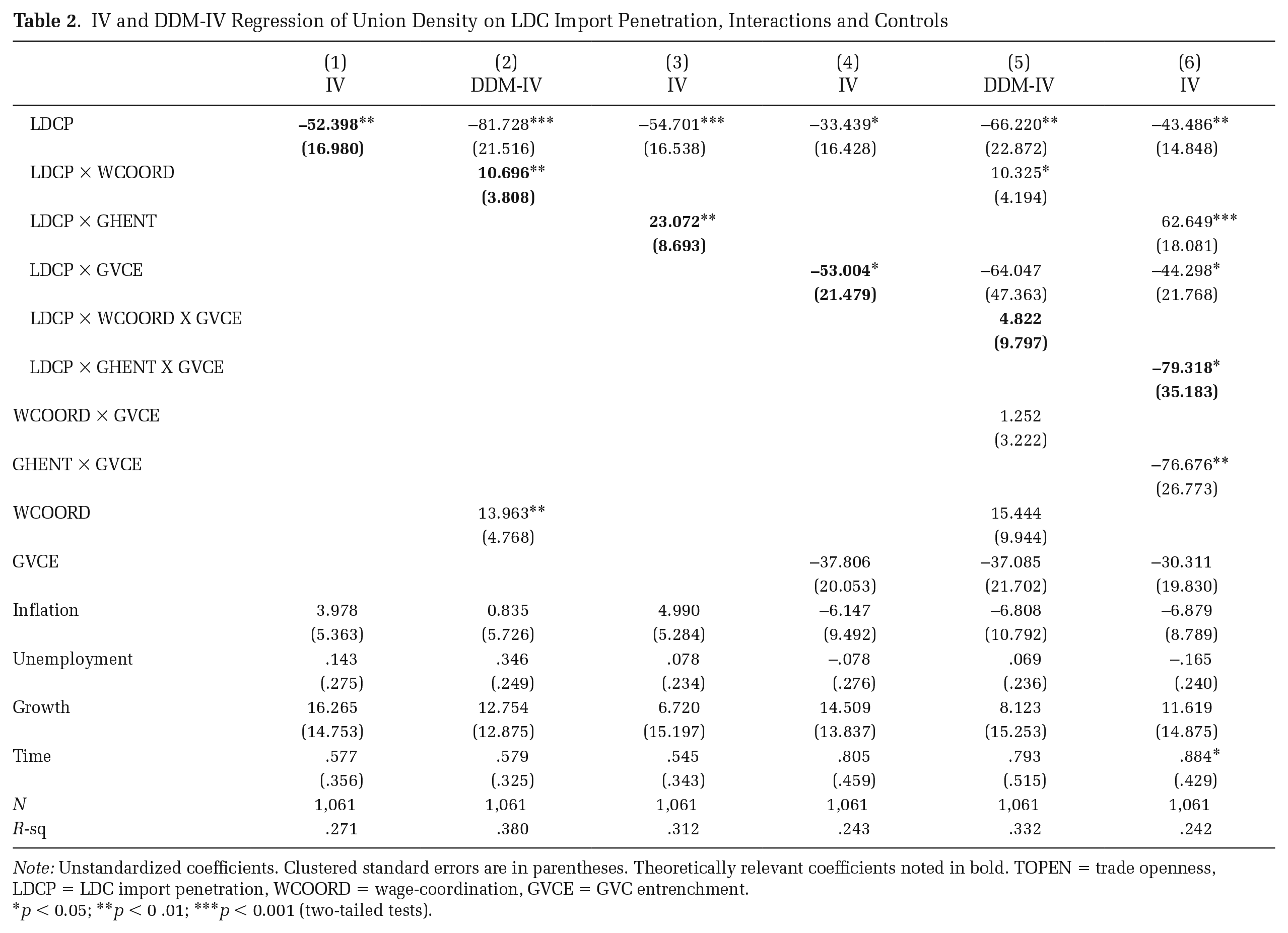
Note: Unstandardized coefficients. Clustered standard errors are in parentheses. Theoretically relevant coefficients noted in bold. TOPEN = trade openness, LDCP = LDC import penetration, WCOORD = wage-coordination, GVCE = GVC entrenchment.
p < 0.05; **p < 0 .01; ***p < 0.001 (two-tailed tests).
Before proceeding to an analysis of the conditional effects of LDC imports, it is important to consider the degree to which the requisite assumptions of instrumental variable regression hold in this model. Excluded instruments must be sufficiently correlated with the potentially endogenous covariate (potentially endogenous covariates in first-state regressions should be correlated with excluded instruments, and large correlations are better). If true, then IV coefficients are unbiased (or less biased than OLS), and we can also test the null hypothesis that LDC imports are endogenous. 13 We test the null that LDC imports are underidentified with the Kleibergen-Paap (2006) rk F statistic. We test the null that they are weakly identified with a similar Kleibergen-Paap Wald rk F statistic and critical values obtained from Stock and Yogo (2005), which depend in part on the number of excluded instruments. In each case, a rejection of the null suggests our instruments are sufficiently strong. The test statistic (~c2) for the null that the instruments are underidentified is 10.35 (p < 0.01). The test statistic (~c2) for the null that the instruments are weakly identified is 22.05, which is larger than the threshold (16.38) for the minimum bias (10 percent of OLS) identified by Stock and Yogo (2005) for the degrees of freedom of our test. We therefore test the null that LDC imports are exogenous, and we reject this null (p < 0.05). Consistent with our argument about simultaneity bias in trade-based models of union decline, we find that LDC imports are endogenous.
Do the conditional effects observed in Table 1 hold up when adjusting for endogeneity? The DDM-IV interaction with wage-coordination in Model 2 is larger and further from the null vis-à-vis Models 2 and 3 in Table 1. Conversely, the IV interaction with Ghent in Model 3 is slightly smaller in absolute terms and relative to its standard error vis-à-vis Model 4 in Table 1. The interaction with GVC entrenchment in Model 4 is larger and further from the null vis-à-vis Model 5 in Table 1. Finally, the three-way interactions in Models 5 and 6 are substantively identical to Models 6, 7, and 8 in Table 1, although the one involving Ghent is larger in size but slightly smaller relative to its standard error vis-à-vis Table 1. In short, the results in Table 2 are consistent with our argument for simultaneity bias in equations of union decline with LDC imports on the right-hand side. 14
Sensitivity Analyses
We examine the degree to which our results are sensitive to an alternative measure of LDC import penetration; to controls for additional dimensions of economic globalization, FIRE sector employment, industrial employment, and government expenditures on goods and services; and to perturbations of sample composition. The full battery of results is available in Tables S1 to S6 in the online supplement. In Table 3, we summarize these analyses by reporting only the coefficients corresponding to our primary analysis, as displayed in the bolded coefficients in Table 2.
Relevant Coefficients from Sensitivity Analyses
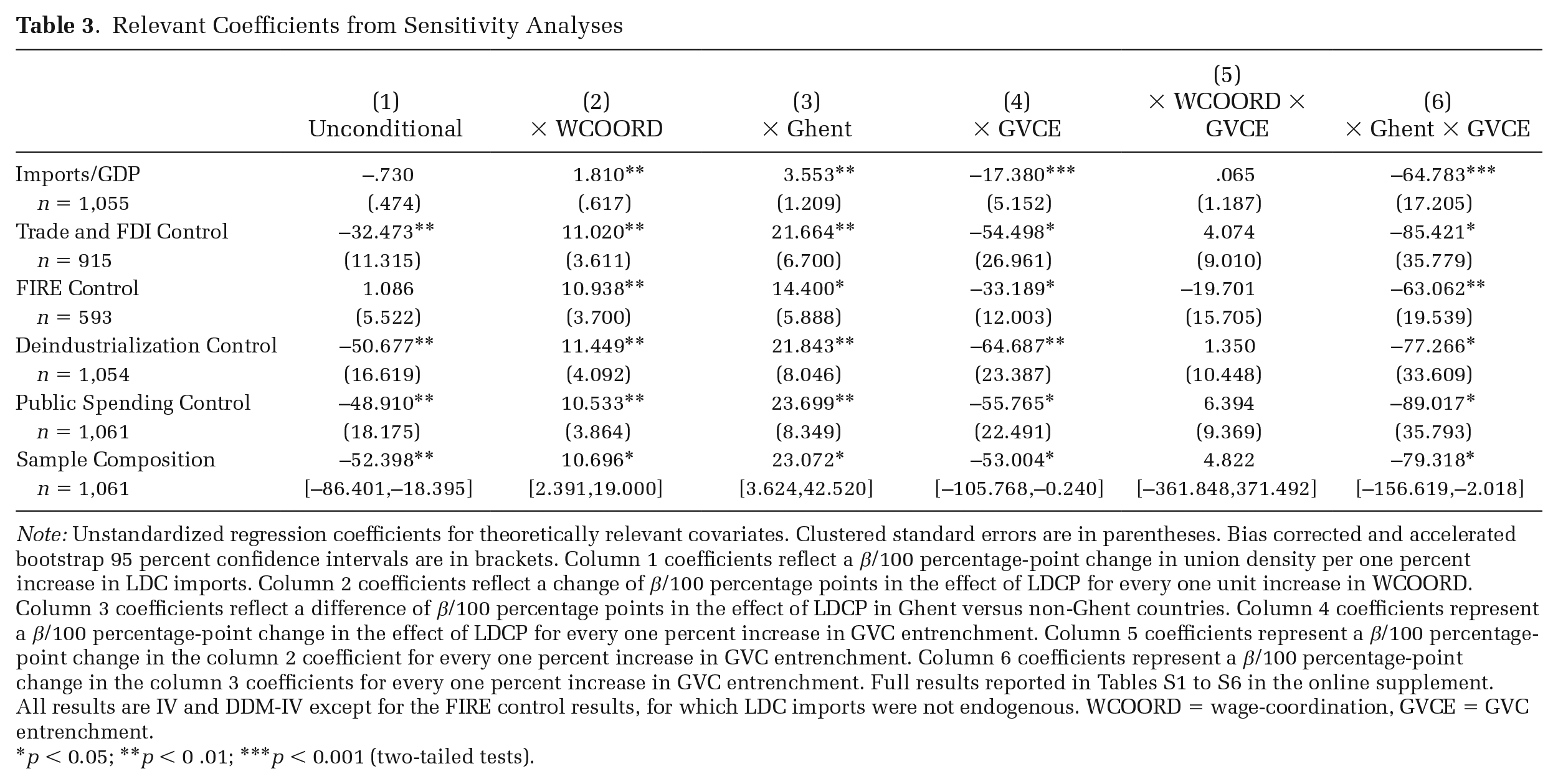
Note: Unstandardized regression coefficients for theoretically relevant covariates. Clustered standard errors are in parentheses. Bias corrected and accelerated bootstrap 95 percent confidence intervals are in brackets. Column 1 coefficients reflect a β/100 percentage-point change in union density per one percent increase in LDC imports. Column 2 coefficients reflect a change of β/100 percentage points in the effect of LDCP for every one unit increase in WCOORD. Column 3 coefficients reflect a difference of β/100 percentage points in the effect of LDCP in Ghent versus non-Ghent countries. Column 4 coefficients represent a β/100 percentage-point change in the effect of LDCP for every one percent increase in GVC entrenchment. Column 5 coefficients represent a β/100 percentage-point change in the column 2 coefficient for every one percent increase in GVC entrenchment. Column 6 coefficients represent a β/100 percentage-point change in the column 3 coefficients for every one percent increase in GVC entrenchment. Full results reported in Tables S1 to S6 in the online supplement. All results are IV and DDM-IV except for the FIRE control results, for which LDC imports were not endogenous. WCOORD = wage-coordination, GVCE = GVC entrenchment.
p < 0.05; **p < 0 .01; ***p < 0.001 (two-tailed tests).
The first row of Table 3 shows the DDM-IV regression results after replacing our preferred measure of LDC imports with LDC imports/GDP. The unconditional coefficient in Model 1 is nonsignificant, but the rest of the coefficients are substantively identical to the results of Table 2. In row 2, we control for trade openness and outward FDI throughout and observe substantively identical coefficients. In row 3, we control for FIRE sector employment. All but the unconditional coefficient in Model 1 are substantively identical to that observed in Table 2. In row 4, we introduce deindustrialization as an additional control. Consistent with prior work suggesting deindustrialization could be a mechanism through which LDC imports reduce union density (Alderson 1999; Kollmeyer 2009b; Lee 2005), we see a slight attenuation in four out of six coefficients. Nevertheless, they all remain statistically significant. Row five introduces public spending and yields coefficients that are substantively identical to those in Table 2.
Of the 30 coefficients reported in rows 1 to 5, only two differ from our main analysis. However, all models yield a different sample and the additional controls are frequently nonsignificant (see Tables S2 to S6 in the online supplement), implying that any observed differences between these results and those in Table 2 can be attributed to differences in sample composition. Thus, the last row in Table 3 shows the results of a more explicit assessment of the sensitivity of our results to perturbations in sample composition. Here, we use bootstrapping to remove entire countries at random (with replacement) and conduct non-parametric hypothesis tests using bias corrected and accelerated confidence intervals derived from the resulting distribution of coefficients. All these coefficients/confidence intervals yield results that are substantively identical to our main analysis.
Finally, our theoretical mechanism involves exchange conditions that are not directly observable. However, it is possible to leverage a quasi-placebo test by comparing the coefficients obtained above to those we would obtain if we replaced LDC import penetration with import penetration from more developed countries (MDC), where the exchange conditions underlying our theoretical argument do not prevail. To proceed, we measure imports from MDC over total imports, analogous to our primary instrument. We then replicate the regressions above. The differing exchange conditions that prevail in rich democracies should mitigate against the endogeneity concerns we raise above with respect to LDC imports. Nevertheless, we apply our instrumentation strategy and assess the degree to which this assumption holds. Our OLS results yield no significant effects for imports from MDC, and none of the interactions are significant in the expected direction. We obtain the same results with our IV regressions, but we fail to reject the null hypothesis that imports from rich democracies are exogenous. Thus, we provide the OLS results in Table S7 in the online supplement.
Substantive Significance
Having established that our results are robust to the variety of factors discussed above, we now consider the substantive significance of these findings. We begin by considering the degree to which LDC import penetration effects should be characterized as entirely conditional on the nature and scope of national institutions (e.g., Scruggs and Lange 2002) or on the entrenchment of GVCs worldwide (e.g., Mahutga et al. 2017). We report the estimated effect of LDC imports at each level of our measure of wage-coordination (Figure 2) and among Ghent countries and the rest (Figure 3). In Figure 2, the y-axis is the estimated coefficient (from Model 2 of Table 2) of LDC imports, and the 95 percent confidence interval is denoted with dashed lines. Because this confidence interval never contains zero, LDC imports have a significantly negative effect on unionization across the full range of wage-coordination, even among the most coordinated countries. In Figure 3, the y-axis is again the estimated coefficient on LDC imports (estimated with Model 3 of Table 2), but confidence intervals are now indicated by the capped line. LDC imports have a significantly negative effect among non-Ghent countries, but the effect among Ghent countries is nonsignificant at the 0.05 level (p < 0.10). However, this does not account for the moderating effect of GVC entrenchment identified in Model 6.
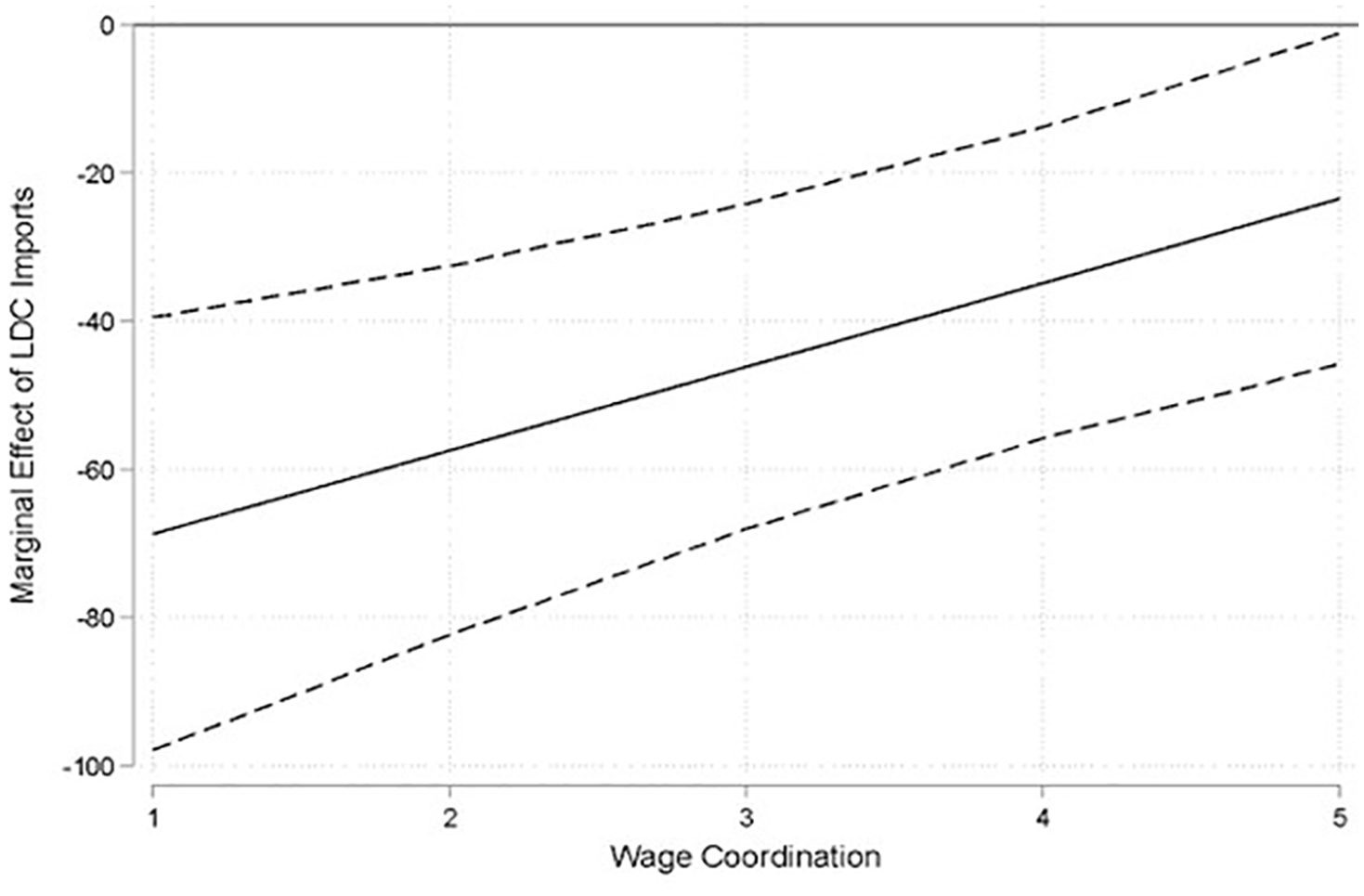
Marginal Effect of LDC Imports by Wage-Coordination
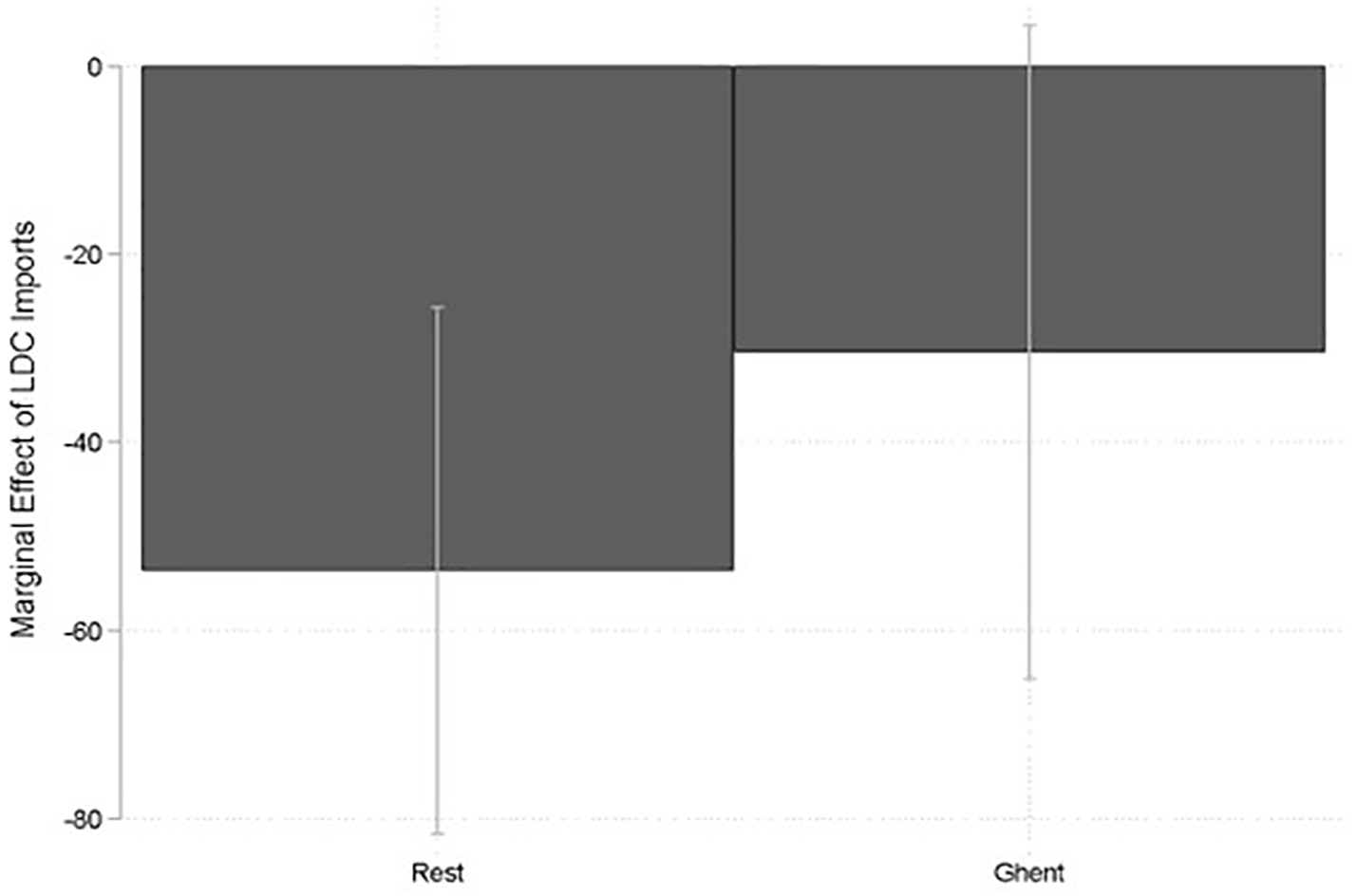
Marginal Effect of LDC Imports by Ghent
Figure 4 thus integrates the significant three-way interaction (Model 6 of Table 2) involving the Ghent system and GVC entrenchment. Like Figure 3, the y-axis is the estimated effect of LDC imports, and confidence intervals are denoted with capped lines. However, we now estimate three coefficients within each group corresponding to the minimum, median, and maximum observed value of GVC entrenchment. In non-Ghent countries, the effect simply becomes more negative throughout. In Ghent countries, LDC imports do not yield a significantly negative effect on union density at the minimum level of GVC entrenchment, but do yield significantly negative effects at the median level of entrenchment and higher. Auxiliary analyses suggest the effect becomes significant at the 0.05 level among Ghent countries when GVC entrenchment reaches 45.7 percent, which corresponds to the early 1980s. Thus, LDC imports caused union decline among Ghent countries, but this effect was delayed vis-à-vis non-Ghent countries.
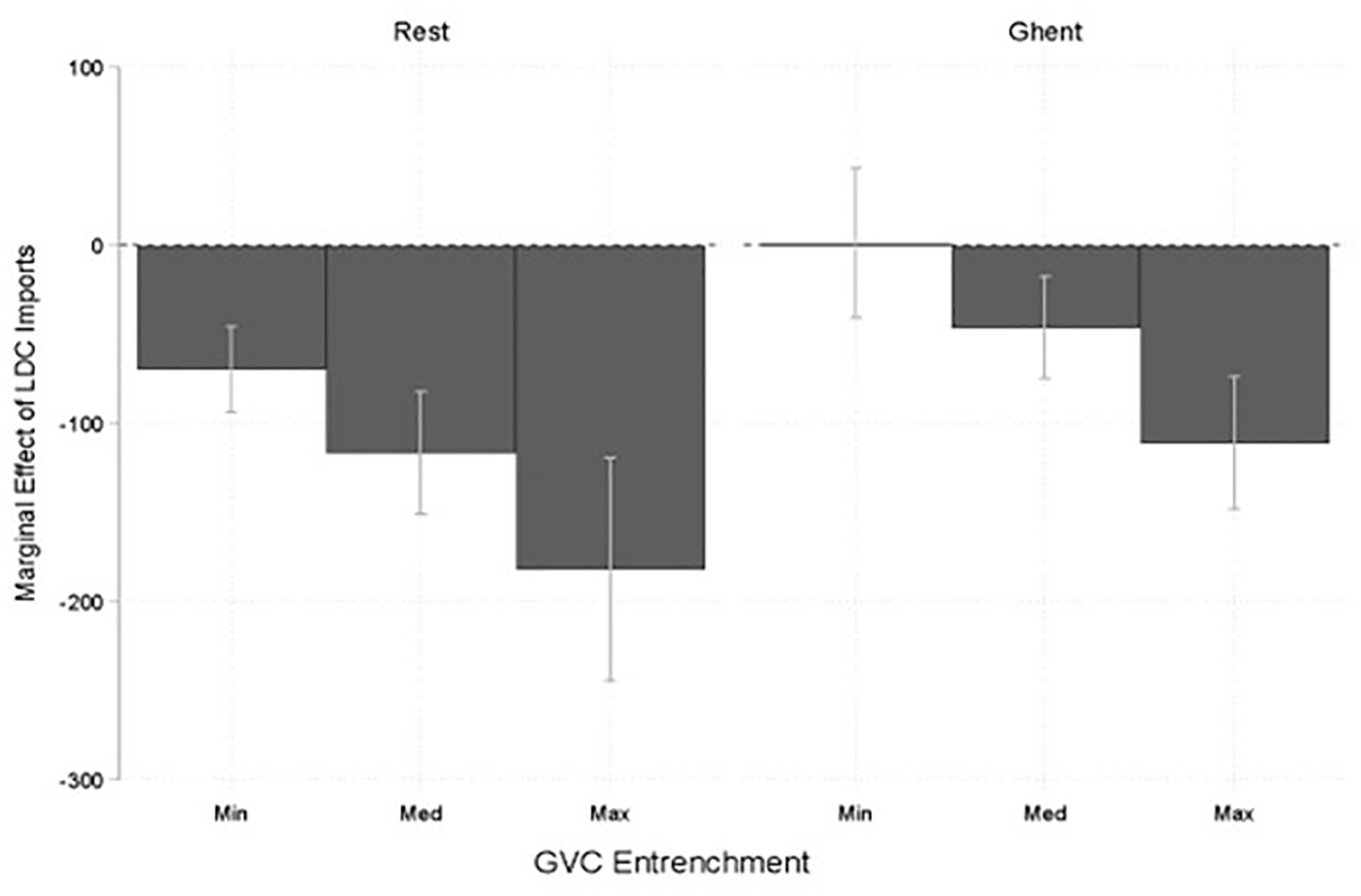
Marginal Effect of LDC Imports by Ghent and GVC Entrenchment
What do these conditional effects tell us about the relative efficacy of GVCs and labor market institutions? To answer this question, we engage in two exercises in counterfactual history. Each counterfactual history compares a world in which GVCs did not expand (and labor market institutions are as observed), to a world in which labor market institutions are most labor-friendly (and GVC expansion is as observed). With the first, we estimate what the unionization trend would be if (1) LDC imports remained at their minimum throughout with wage-coordination as observed. We then compare this to (2) the trend that would have occurred if wage-coordination were at the observed maximum but LDC imports were as observed. To estimate these two trends, we use Model 2 of Table 2. With the second, we repeat this exercise except (1) is the trend that would be observed if both LDC imports and GVC entrenchment were at the minimum observed, and trend (2) is as if all countries had a Ghent system, with both LDC imports and GVC entrenchment as observed, using Model 6 of Table 2. To proceed, we estimate counterfactual predicted values by manipulating the values of LDC imports (min. varies by country), GVC entrenchment (min. = 0.220), wage-coordination (max. = 5), and Ghent (max. = 1).
Figure 5 displays the predicted values from the first set of counterfactual exercises in the form of indexes, where average union density in 1963 = 1. The substantive effect of wage-coordination was nontrivial. Had all countries consistently fielded the maximum observed wage-coordination score throughout the period and globalization proceeded as observed, union density would have increased by 17.4 percent, on average. 15 Nevertheless, the institutional buffering of wage-coordination implied by this counterfactual exercise was much more muted than the effect of the expansion of GVCs. Had LDC imports remained at the within-country 1963 minimum throughout the period, union density would have increased by 80.5 percent, on average. Consequently, union density would have been 53.7 percent higher, on average, in 2017 if LDC imports remained at their 1963 level than if all countries fielded the maximum observed level of wage-coordination and LDC imports increased as observed.
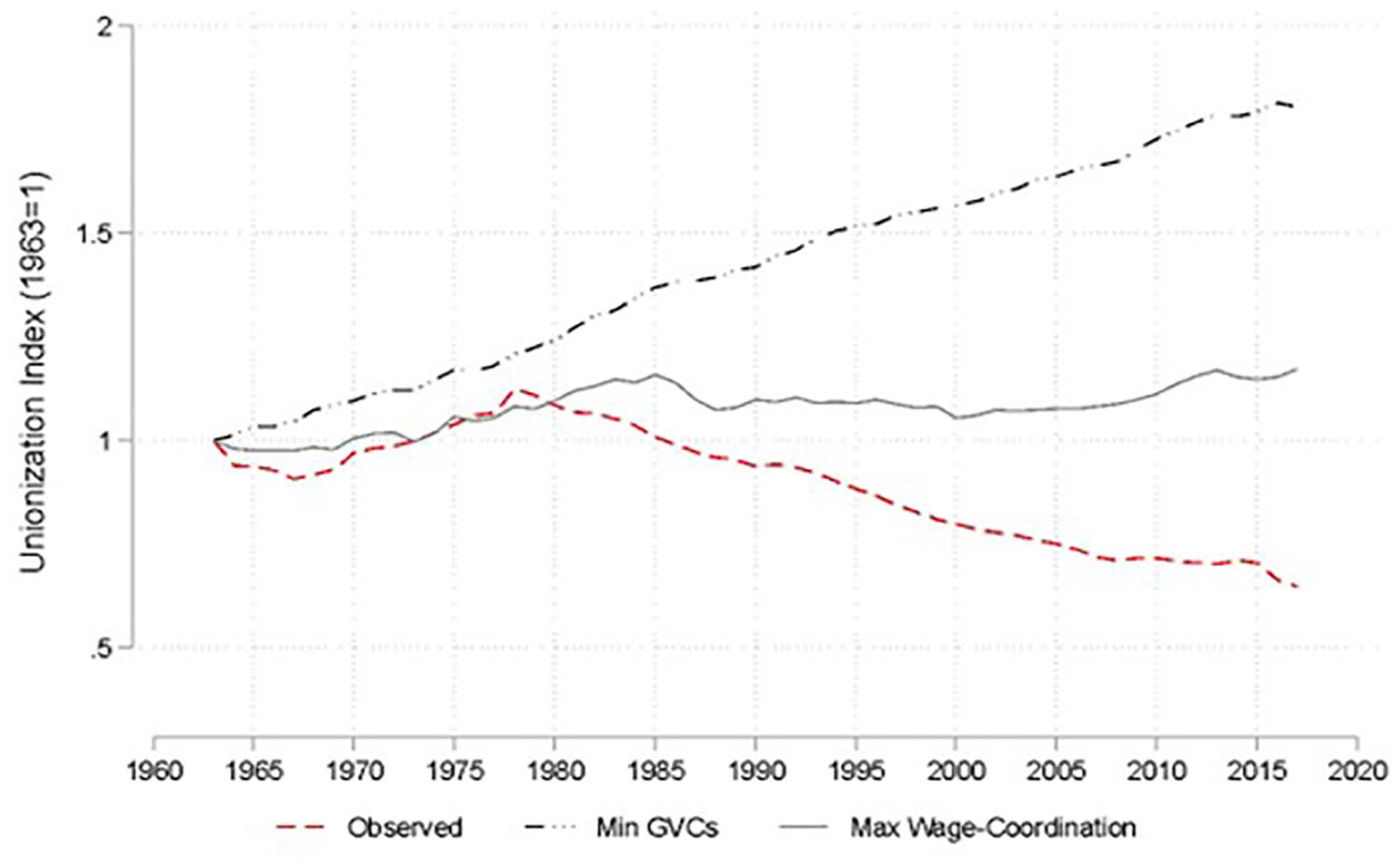
Counterfactual Union Decline, Wage-Coordination
Figure 6 displays the indexed predicted values from the second set of counterfactual exercises. Here again we see a nontrivial effect of Ghent as an institutional buffer. Had GVCs expanded in a world where unions administered unemployment insurance programs in all rich democracies, union density would have grown by 7.3 percent, on average. Much like the previous exercise, however, the buffering effect of Ghent was much more muted than that of the expansion of GVCs. Had LDC imports and GVC entrenchment remained at their 1963 level with Ghent as observed, unionization would have grown by 97.6 percent, on average. As with our counterfactual comparison to wage-coordination, contemporary levels of unionization would be much higher (84.2 percent) in the absence of global value chains than if all rich democracies featured union-controlled unemployment compensation systems and global value chains proceeded as observed.
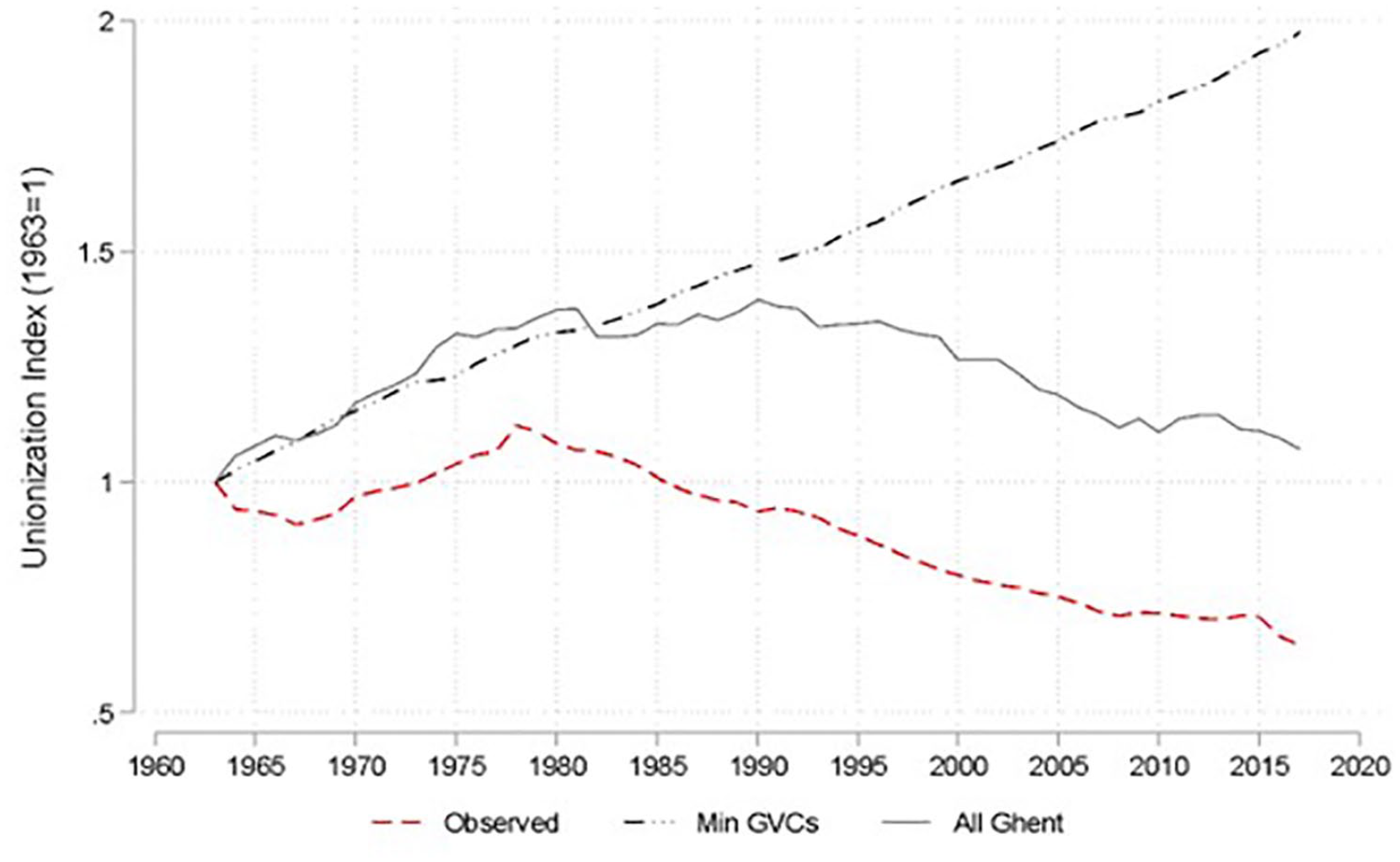
Counterfactual Union Decline, Ghent
Conclusions
In this article, we addressed persisting skepticism that “globalization and the concomitant surge in trade” reduced union density, and we proposed that global value chains cause union decline through trade with LDCs (Kollmeyer and Peters 2019:2). We argued that most prior cross-nationally comparative research was unable to systematically document the deunionizing effects of trade for theoretical and empirical reasons. Theoretically, prior work has not considered GVCs as a unique dimension of the globalization of production because GVCs are a historically dynamic phenomenon that were not sufficiently elaborated until the early 2000s. Empirically, previous research frequently measured trade in ways that did not capture the theoretical mechanisms of GVCs (Brady 2007; Checchi and Visser 2005; Kollmeyer and Peters 2019, Sano and Williamson 2008; Slaughter 2007; Western 1997). Nor did it examine if trade effects are moderated by the worldwide entrenchment of GVCs or labor market institutions (Western 1997; cf. Scruggs and Lange 2002). Finally, prior research has also treated trade as exogenous in models of union decline.
Drawing from the now highly elaborated GVC literature, we argue that GVCs should erode unionization in rich democracies. The relational exchange conditions favoring leading GVC firms undermine unionization more than anticipated by standard theories linking trade to union decline, and these effects should increase with the entrenchment of GVCs as a modal organizational form worldwide. LDC imports capture these theoretical mechanisms more than trade openness. But labor market institutions should also matter for the effects of GVCs on unions. The cooperative capital-labor relations underlying wage-coordination provided a sufficient level of wage restraint to offset the incentive for employers to undermine domestic unions with lower-cost workers in LDCs. Similarly, union-administered unemployment insurance systems provide a non-market incentive to join unions and facilitate union organizing. Finally, the likely simultaneous relationship of LDC imports and unionization attenuated the effects of the former.
Our empirical results are largely consistent with our theoretical intervention. We used a panel dataset covering the longest period to date in the literature, which includes the decades during which GVCs became entrenched organizational forms worldwide. We show that trade openness has no effect on unionization, whereas LDC imports reduce it. We also show that the worldwide entrenchment of GVCs exacerbates these effects, while wage-coordination and the Ghent system blunt them. Estimated coefficients on LDC imports are nearly three times larger when correcting for simultaneity bias. Collectively, our analyses provide a compelling explanation for the lack of significant effects observed in the vast majority of prior research on globalization and union decline.
Our results also support (a perhaps softer version of) an important corrective in the political economy of organized labor: institutions do matter (Scruggs and Lange 2002; Western 1997). The oft-cited postwar capital-labor accord was more strongly institutionalized in some countries. Where unions played a more direct and centralized role in setting wages, unions frequently restrained wage growth, and central banks facilitated this with monetary policies that constrained inflation (Franzese 2001). This wage restraint allowed employers to maintain a more unionized labor force in the face of strong anti-union pressure from GVCs. Our analysis suggests the negative effects of LDC imports on union density were much smaller in the most wage-coordinated countries (Figure 2). Similarly, Ghent systems created a sticky incentive for workers to join unions and facilitated union organizing, even in the face of GVC dynamics. These reduced and delayed the negative causal effect of GVC expansion on unionization (Figure 4).
Nevertheless, GVCs had profound causal effects on unions even in the presence of these union-friendly labor market institutions. LDC imports caused union decline even in countries with the most coordinated remuneration systems (Figure 2), and in countries with a Ghent system, albeit with a delay (Figures 3 and 4). The moderating effects of these labor market institutions were not strong enough to nullify the negative causal effect of GVCs. Moreover, our exercise in counterfactual history reveals that the causal effect of GVCs was much more consequential to unionization in rich democracies than was the moderating effect of either labor market institution. On average, rich democracies would have around 17 and 7 percent more unionization than was observed in 1963 if all countries had adopted the most coordinated models of wage-bargaining (Figure 5) or a Ghent system (Figure 6), respectively. In the absence of GVCs, however, union density would be around 81 to 98 percent higher, on average, than it was in 1963 (Figures 4 and 5). 16 These comparative estimates may in fact overstate the buffering effect of wage-coordination and the Ghent system, as parallel strands of research suggest the causal force of both institutions is likely in decline (Baccaro and Howell 2017; Lindellee and Berglund 2022).
What does this historical research portend for the future of unions in rich democracies? On one hand, the Covid-19 pandemic and other geopolitical considerations may have paused the globalization of production via GVCs (Chase-Dunn, Álvarez, and Liao 2023; cf. Goldberg and Reed 2023). If the world is bounding toward another period of deglobalization, it could create the structural conditions under which a much-anticipated surge in labor organization can be realized (Clawson 2003). Our own data, however, appear to show a decoupling between national-level integration into GVCs and their worldwide expansion. LDC import penetration does not appear to have slowed, much less declined, over the period. Yet, GVC entrenchment peaked in 2008 and declined thereafter. When coupled with the apparent slow-down in the size of the potential supplier pool after 2007 in Figure 1, this could reflect a long-anticipated consolidation in the supply base of GVCs that results in more LDC imports originating from a smaller set of bigger and less geographically diffuse LDC suppliers (Appelbaum 2008; Galanis and Kumar 2021; Kumar 2020).
By reducing the asymmetrical bargaining power between leading MDC firms and their LDC suppliers, such a process of consolidation might lead to new exchange conditions between lead firms and suppliers that favor union growth in rich democracies (see also Kimeldorf 2013). As Kumar (2020:34) persuasively argues, any consolidation should enhance “the bargaining power of workers [in LDCs] to exact a large share of value from their now value-laden direct employers.” Because rising unionization among workers employed by LDC firms would increase their wages and improve their working conditions, it would also reduce the competitive pressures of LDC imports on unions in rich democracies. That is, GVCs may have unwittingly sowed the seeds for stronger labor movements worldwide (see also Silver 2001). One way or the other, the dynamism of GVCs is an always unfolding project.
Finally, our results call for a renewal of research on the socioeconomic effects of globalized production via GVCs. GVCs should matter for a host of additional socioeconomic outcomes in rich democracies, if not directly than indirectly through their effect on unions (see Gao, Mahutga, and Kwon forthcoming; Mahutga and Maldonado 2018; Mahutga et al. 2017). For example, unionization matters for distributional outcomes (Bradley et al. 2003; Freeman and Medoff 1984; Kollmeyer 2018; Pontusson 2013; Pontusson, Rueda, and Way 2002; Rosenfeld 2014; Shin 2014; VanHeuvelen 2018, 2020; Verma 2005; Wallerstein 1999), poverty (Brady, Baker, and Finnigan 2013; VanHeuvelen and Brady 2022), the fortunes of political parties (Western 1997), and the size and scope of the welfare state (Brown 1997; Huber and Stephens 2001). Unionization also matters for social relations more generally, including gender and racial egalitarianism (Milkman 2006; Rosenfeld and Kleykamp 2009, 2012), working conditions for unionized and non-unionized workers (Parolin and VanHeuvelen 2023; Western and Rosenfeld 2011), workplace democracy (Stepan-Norris and Zeitlin 2003), and political participation (Flavin and Radcliff 2011; Kerrissey and Schofer 2013; Leighley and Nagler 2007; Radcliff and Davis 2000; Rosenfeld 2014). If the social scientific evidence is correct in linking union density to these broader societal outcomes, then GVCs may have had profound socioeconomic effects in rich democracies beyond union density.
Supplemental Material
sj-pdf-1-asr-10.1177_00031224251315496 – Supplemental material for Global Value Chains and Union Decline in Rich Democracies
Supplemental material, sj-pdf-1-asr-10.1177_00031224251315496 for Global Value Chains and Union Decline in Rich Democracies by Matthew C. Mahutga, Manjing Gao and Roshan K. Pandian in American Sociological Review
Footnotes
Acknowledgements
The authors thank John S. Ahlquist, Marissa Brookes, David Brady, Barry Eidlin, Gary Gereffi, Andrew K. Jorgenson, Christopher Kollmeyer, and Judith Stepan-Norris for reading previous drafts.

Notes
References
Supplementary Material
Please find the following supplemental material available below.
For Open Access articles published under a Creative Commons License, all supplemental material carries the same license as the article it is associated with.
For non-Open Access articles published, all supplemental material carries a non-exclusive license, and permission requests for re-use of supplemental material or any part of supplemental material shall be sent directly to the copyright owner as specified in the copyright notice associated with the article.
