



Abstract
The U.S. criminal legal system is highly localized. This reality extends to what U.S. Supreme Court Justice Stephen Breyer called “geographic arbitrariness” in the implementation of the death penalty. The inhabited institutions perspective, augmented with concepts from Weber’s sociology of law, frames our analysis of how a local process that is not arbitrary—prosecutors’ interpretations of statutory aggravating factors—result in geographic arbitrariness in the aggregate, in which defendants’ exposure to the death penalty is strongly conditioned by locality. We utilize data coded from prosecutors’ office case files and court docket transcripts, as well as interviews with current and former District Attorneys and Assistants in Pennsylvania, to illuminate prosecutorial death penalty decisions and their interpretations of statutory aggravating factors. Our analysis is driven by two sets of questions. First, how do prosecutors differ in the filing of specific aggravating factors in the face of similar factual circumstances? Second, how do prosecutors evaluate the meaning of the aggravators and decide whether to seek the death penalty? We show that prosecutors inhabit death penalty statutory law by (1) defining statutory aggravators, drawing comparisons and contrasts from experience with prior cases; (2) making strategic assessments of how local juries will view evidence; (3) normatively evaluating individual cases, offenders, and—crucially—victims; and (4) subjectively evaluating the legal value of aggravating factors themselves. Because ambiguity in statutory aggravators necessitates differing interpretations by prosecutors, death penalty law ensures geographic arbitrariness.
A principal fact of criminal justice, and governance in general, in the United States is that it has always been highly localized (Garland 2010). This stands out markedly in the implementation of the death penalty, where Garland (2010:117) notes, “the most important decisions about capital charging and sentencing remain matters for county-level decision makers.” This reality, in turn, invokes concerns for what U.S. Supreme Court Justice Stephen Breyer called “geographic arbitrariness.” Justice Breyer, in Jordan v. Mississippi and Evans v. Mississippi (585 US 2018) stated: “Geography also plays an important role in determining who is sentenced to death. . . . And that is not simply because some States permit the death penalty while others do not. Rather within a death penalty State, the imposition of the death penalty heavily depends on the county in which a defendant is tried.”
Death penalty disparity research has focused on the race/ethnicity of defendants and victims, which is of vital importance (see reviews by Paternoster 2011; Steiker and Steiker 2020). But much less research has focused on differences between local courts in seeking and imposing the death penalty. Yet arguably, geographic arbitrariness is the largest extra-legal difference in the administration of the death penalty (Barnes, Sloss, and Thaman 2009; Smith 2012). As LaChance (2016:21) notes, “Regional variations in customs, statutes, and political structures all imposed significant limitations in trying to tell a national story about the death penalty.”
The fact of geographic variation in death penalty outcomes is well established, and local prosecutors’ decisions to seek the death penalty are a crucial factor behind such variation (Barnes et al. 2009; Beardsley et al. 2015; Donovan 2022). We therefore examine the question, how does geographic arbitrariness in death penalty prosecution arise? How do prosecutors in different locales vary in their filing of specific aggravating factors as grounds to seek the death penalty? What considerations among local prosecutors go into the decision to seek the death penalty? How do prosecutors interpret statutory aggravating factors that define eligibility for the death penalty?
Our research is framed by neo-institutional theories of organizations, the “law in practice” approach in the law and society tradition (Suchman and Edelman 1996), the inhabited institutions perspective (Hallett and Hawbaker 2021), and concepts from Weber’s sociology of law. These perspectives and concepts are all congruent in that they emphasize how actors interpret, use, and implement law in divergent and contextualized ways, but each brings different strengths when integrated. Applying these perspectives frames our analysis of how a process that is not arbitrary—individual prosecutors’ empirical justice and substantively rational interpretations—result in geographic arbitrariness in the aggregate.
Legal opinions on capital punishment define geographic arbitrariness as when the application of the death penalty depends heavily on the locality where a case is tried, but we argue this dependence is not produced arbitrarily. Instead, the meaning and normative use of the statutory aggravating factors are ambiguous, and ambiguity in law invites mediation by organizations and individuals (Edelman 1992). Therefore, neo-institutional theories and the inhabited institutions perspective would posit that geographic variation is endemic to the death penalty, because the meaning of statutory aggravating factors warranting capital punishment is ambiguous and thus requires local court discretion and interpretation. What court opinions have defined as geographic arbitrariness is actually produced by nonarbitrary processes of local sense-making and discretion invited by the ambiguity and breadth of the statutory aggravators.
Prior research has quantitatively demonstrated geographic variation in death penalty decision-making in Pennsylvania and other states (e.g., Baumgartner et al. 2020; Beardsley et al. 2015; Marceau, Kamin, and Foglia 2013; Ulmer, Zajac, and Kramer 2020). However, the inhabited institutions perspective has not been previously empirically applied to prosecutorial discretion in general, or the decision to seek the death penalty specifically. We have two sets of research questions. First, how do prosecutorial decisions regarding the death penalty differ between county jurisdictions? How do prosecutors differ in the filing of specific aggravating factors in the face of similar factual circumstances? Second, how do prosecutors evaluate the meaning of the aggravators? How do prosecutors decide to pursue aggravators, or not, as a strategic case decision? How do prosecutors decide if specific aggravating factors are appropriate to pursue or not on a case-by-case basis? That is, given prosecutors’ specific interpretations of what a statutory aggravating factor means (i.e., what “counts” as an instance of a specific aggravator), how do they interpret whether they should pursue the death penalty based on that aggravator? Finally, how do prosecutors evaluate the legal value of specific aggravating factors?
This study makes several contributions. Empirically, we present a rare view of prosecutorial discretion regarding the most serious criminal cases and the most serious sanctions. The study of courts and sentencing is dominated by statistical modeling of archival data, but many scholars have called for that to be balanced by multimethod research and qualitative data (Lynch 2019). Theoretically, this study shows the value of the inhabited institutions perspective for understanding the law in action, in contrast to the law on the books—a perennial distinction in the sociology of law (Gould and Barclay 2012; Suchman and Edelman 1996). Furthermore, we describe how local organizations and their actors mediate ambiguities in law (Edelman 1992). Seeing institutions like law as inhabited by local actors and organizations leads us to the study of how court actors, such as prosecutors, make sense of and use statutory law.
We enhance this inhabited institutions framing with concepts from Weberian sociology of law. We find that prosecutors engage in what Weber (1958) called empirical justice and substantive rationality in exercising their discretion to seek the death penalty. Prosecutors inhabit death penalty law by (1) defining statutory aggravators, drawing comparisons and contrasts from experience with prior cases; (2) making strategic assessments of how local juries will view evidence; (3) normatively evaluating individual cases, offenders, and victims; and (4) subjectively evaluating the aggravators themselves. This substantively rational empirical justice by prosecutors is arguably the critical point of discretion that produces geographic arbitrariness in administration of the death penalty (Barnes et al. 2009; Donovan 2022).
We utilize data from four sources that illuminate prosecutorial decisions to seek the death penalty and prosecutors’ interpretations of statutory aggravating factors: (1) data coded from docket transcripts from the Administrative Office of Pennsylvania Courts (AOPC) for all cases statewide from 2012 to 2016 charged with murder or criminal homicide; (2) data on first-degree murder convictions from 2000 to 2010 coded from prosecutors’ office case files or court clerks’ files in 18 counties; (3) data coded from prosecutors’ office and court files on cases charged with murder or criminal homicide in 12 counties from 2012 to 2016; and (4) in-depth interviews with current and former District Attorneys and Assistants in five counties.
The Institutional Context of Capital Punishment Law
Death penalty legislation and case law provide the institutional framework within which local prosecutors use their discretion to seek the death penalty. In Furman v. Georgia (408 U.S. 238 1972), the U.S. Supreme Court ruled that the existing vague and unstructured procedures allowed for rampant bias in the death penalty’s application against the poor, uneducated, mentally disabled, and racial minorities, along with arbitrariness in exposure to the death penalty across states and localities. In Furman, Justice Potter Stewart defined the concept of arbitrariness (at 309–310 concurring opinion): “These death sentences are cruel and unusual in the same way that being struck by lightning is cruel and unusual. For, of all the people convicted, many just as reprehensible as these, the[se] petitioners are among a capriciously selected random handful upon which the sentence of death has in fact been imposed.” Gregg v. Georgia (428 U.S. 153 1976) permitted the death penalty to resume after Furman, provided that states adopt certain procedural guardrails. Importantly, these included a requirement that any aggravating factors that would warrant seeking the death penalty must be statutorily defined.
However, Justice Stephen Breyer (joined by Justice Ginsburg) in Glossip v. Gross (576 U.S. 2015, https://www.supremecourt.gov/opinions/14pdf/14-7955_aplc.pdf), argued that the death penalty, as currently administered, suffered from “geographic arbitrariness,” that is, wide geographic disparity in death sentences and their concentration in a comparatively small number of counties nationwide. In Jordan v. Mississippi and Evans v. Mississippi (585 US 2018), Justice Breyer argued that the declining frequency of the death penalty in the early twenty-first century, with its clustering in particular counties, also made geographic arbitrariness more egregious.
Research on Local Variation in the Death Penalty
Compared to the large literature on race/ethnicity and the death penalty, relatively fewer studies directly focus on between-county differences in capital prosecutorial or sentencing decisions (Steiker and Steiker 2020). However, several studies have found capital sentencing or prosecutorial pursuit of the death penalty to vary substantially between local courts, even controlling for case-level attributes (Baldus et al. 2002; Barnes et al. 2009; Beardsley et al. 2015; Hindson, Potter, and Radelet 2006; Marceau et al. 2013; Paternoster and Brame 2008; Paternoster et al. 2004; Songer and Unah 2006). Alschuler (2008) found that some county prosecutors routinely sought the death penalty in any first-degree murder case where an aggravating factor might be argued, and then used this as plea-bargaining leverage. Donohue (2014) pointed to differences in prosecutorial ideology as key to differences in death penalty outcomes in Connecticut counties. West and Yelderman (2023) demonstrated that some statutory aggravators resonated with prosecutors’ moral values more strongly than others, and prosecutors pursued aggravating factors that triggered their moral intuitions. LaChance (2016) focused on two prosecutors in Texas and Oklahoma who stood out in their frequency of seeking the death penalty, demonstrating the symbolic and populist dimensions of their ardor for the death penalty. Similarly, Donovan (2022) found that Virginia’s death penalty application continuously declined prior to its abolition in 2021, but it also became increasingly localized, kept alive by just two county prosecutors who frequently sought the death penalty. Beardsley and colleagues (2015) demonstrated that the application of death sentences in Colorado depended significantly on the defendant’s geographic location, and these differences were not due to geographic differences in homicide.
Prior quantitative studies of death penalty decision-making in Pennsylvania from 2000 to 2010 also show large differences between counties. Ulmer, Zajac, and Kramer (2020) found that the likelihood of death filings by Pennsylvania prosecutors varied greatly, controlling for the factual presence of statutory aggravators, evidence strength, case characteristics, and defendant and victim race, gender, and age. Further models uncovered no evidence that county partisan composition was associated with differences in death penalty decisions (Ulmer, Zajac, and Kramer 2020). However, while this prior research demonstrates the problem of geographic arbitrariness quantitatively, it does not provide the qualitative data necessary to examine prosecutors’ interpretive decisions and social interactions behind the process of seeking the death penalty. This study extends these prior efforts by quantitatively demonstrating geographic variation in prosecutors’ death penalty decisions and qualitatively illuminating how this variation is produced through differing interpretations of the statutory aggravators and of murder cases and victims relative to those aggravators.
The Death Penalty as an Inhabited Institution
We draw guidance from two congruent perspectives, the “law in practice” approach in the law and society tradition (Suchman and Edelman 1996), and the inhabited institutions perspective (Hallett and Hawbaker 2021). We augment these with Weber’s typology of formal and substantive rationality and his concept of empirical justice. The law in practice tradition in the sociology of law and the inhabited institutions framework are quite compatible, but they are pitched at different levels of theoretical abstraction. The inhabited institutions perspective is more generic, in that it encompasses institutions and organizations generally, whereas the law in practice literature is specific to legal institutions and action. The law in practice literature emphasizes that law is adapted and used in ways that often depart from its formal intent; the inhabited institutions perspective broadens this insight to all institutions and their organizational arenas of action. The Weberian concepts we draw on augment both of these perspectives by providing ideal typical models for modes of legal decisions and discretion.
The inhabited institutions perspective emphasizes “examining meaning as a local battleground and the struggles over meaning through which interests are constructed” (Hallett and Hawbaker 2021:18). Institutions are broad symbolic systems of meaning that guide activity by providing ideal cultural prescriptions for how organizations and individuals should operate (Hallett and Hawbaker 2021; Meyer and Rowan 1977). Institutions, however, are enacted and interpreted by organizations and actors, giving them social reality (Hallett 2010; Weick 1995). As Hallett and Ventresca (2006) argue, actors and their interactions suffuse institutions with local direction and force. As an institution, law contains symbolic meanings that are codified by the state, with state-administered sanctions (Hallett and Hawbaker 2021). But law is also the site of individual and collective sense-making and interpretation (Scott 2008), and it relies as much on cognitive and normative as coercive elements.
Furthermore, law creates legal environments for organizations, and these legal environments produce varying opportunities for the mediation, or endogeneity, of law (Edelman and Suchman 1997). The mediation of law is, in part, occasioned by vague legal language and ambiguous meaning (Edelman 1992). Edelman (1992), for example, demonstrated that the ambiguity in Equal Opportunity/Affirmative Action law in what constituted discrimination and its remedies left the door open for organizations to decide what the law meant and how to comply. Ambiguous meaning and vague language also characterize death penalty law. Many scholars point to ambiguity in the definition of statutory aggravators (Baldus et al. 2019), and prior research shows that many statutory aggravators potentially encompass most murder cases (Barnes et al. 2009; Beardsley et al. 2015; Grosso et al. 2019; Marceau et al. 2013). Even aggravators that are specific and narrow must be interpreted and applied via prosecutorial discretion.
Applying the inhabited institutions perspective, Hallett (2010) and Everitt (2012) studied the implementation of national education reform policies and showed how local teachers differentially interpreted and adapted accountability structures imposed from above (see also Hall and McGinty 1997). McPherson and Sauder (2013) applied this perspective to drug courts, showing how actors in a drug court balanced the demands of multiple, conflicting institutional and organizational demands, and how court actors interpreted which legal considerations were relevant in applying the law on a case-by-case basis. Similarly, we emphasize prosecutors’ sense-making around statutory aggravating factors for the death penalty, their perceptions of strategic use of aggravators in convincing judges and juries of arguments, and prosecutors’ normative evaluations of those aggravators.
Court communities (Eisenstein, Flemming, and Nardull 1988) are an instantiation of inhabited institutions in criminal law (Ulmer 2019). Court communities resemble “tiny publics,” that is, small communities of interest, experience, and meaning that mediate the micro and macro social orders (Fine 2010). Conceptualizing courts as communities focuses on how prosecutors, judges, and defense attorneys interpret law in distinctive ways shaped by local contexts, which produces differences in criminal justice outcomes across court jurisdictions (Ulmer 1997). Court communities contour criminal law in that they develop their own informal norms, culture, politics, and constraints, producing variation in the application of criminal law and in the severity of legal sanctions (Eisenstein et al. 1988).
Ulmer (2019) delineated several implications of the inhabited institutions perspective for the study of courts as communities. First, research should go beyond statistical modeling of case outcomes to study what court community actors think and do, which places a premium on qualitative data. Second, researchers should recognize that individual legal decisions are not made in isolation, but are embedded in the social interactions of court communities. Third, the perspective directs us to uncover actors’ interpretive processes that produce variation between court communities’ criminal punishment practices.
We augment the inhabited institutions perspective with concepts from Weber’s sociology of law, which can illuminate prosecutors’ interpretive processes around the statutory aggravating factors. Research on non-capital sentencing and prosecution is frequently framed in terms of the contrast between formal and substantive rationality in criminal legal decision-making discretion, typically in the context of sentencing guidelines (Savelsberg 1992; Ulmer and Kramer 1996). Formal rationality is typified by gapless, bureaucratic decision criteria that are applied uniformly with minimal decision-maker discretion; substantive rationality, in contrast, involves decision-making that is individualized, discretionary, and oriented toward accomplishing particular value goals external to the law itself (Kalberg 1980; Westby 1991). As specified by Weber (1958), and later elaborated by Savelsberg (1992), formal rationality in law describes a process where free rational actors deserve the same reward/punishment for their actions no matter what their substantive circumstances. Formal rationality in law consists of a method of centralized control through the type of rule-driven logic and “law without gaps” described by Weber (1958:219) in bureaucracies. By contrast, substantive rationality refers to decision-making characterized by flexible, individualized discretion based on decision-makers’ subjective assessments and pursuit of value goals external to, although not necessarily in conflict with, the law (Kalberg 1980; Savelsberg 1992).
A related concept described by Weber (1958:216) is “empirical justice,” in which “formal judgements are rendered though not by subsumption under [formal] rational concepts, but by drawing on ‘analogies’ and by depending upon and interpreting concrete ‘precedents.’” In empirical justice, legal actors make decisions and pursue courses of legal action based on their interpretation of cases and the facts surrounding them, comparing and contrasting cases at hand with their prior experience. Empirical justice need not, and often does not, entail formal legal reasoning about case-law precedent. Empirical justice can instead consist of individual decision-makers logically pursuing actions that comport with their definitions of justice, according to their own substantively rational values external to the law (Kalberg 1980).
Prior research on prosecution and sentencing has long identified the importance of informal templates such as “normal crimes” (Sudnow 1965) or “going rates” (Eisenstein et al. 1988) in court communities, which provide organizational norms prescribing how routine criminal cases should be handled. We view these going rates and informal case-processing norms as guidelines for the process of empirical justice. The decision to seek the death penalty entails the defining characteristics of substantive rationality and the practice of empirical justice. Like the equal opportunity employment law studied by Edelman (1992), statutory law defining aggravating circumstances for murder necessitates that prosecutors inhabit law with their discretion. Statutory law designates specific aggravating factors that may be used to seek the death penalty. This requires that prosecutors engage in empirical justice, making decisions about whether to seek the ultimate sanction based on their substantive rationality.
Study Context
Pennsylvania is instructive for examining geographic differences in criminal punishment (Ulmer and Johnson 2004). The state contains two large metropolitan areas, as well as many medium-sized metropolitan areas and many rural counties, all with varying demographics, homicide rates, and sociopolitical contexts. Pennsylvania also has many features that are like most other states that retain capital punishment. First, Pennsylvania, as with all but five U.S. states, has local partisan elections for chief prosecutors, known as District Attorneys. Pennsylvania’s statutory aggravators (see Pa. Title 42 § 9711(d)) are also similar to those in most other death penalty states (see https://deathpenaltyinfo.org/facts-and-research/crimes-punishable-by-death/aggravating-factors-by-state). Prosecutors in Pennsylvania initiate homicide prosecutions by charging defendants under the general criminal homicide statute (18 Pa.C.S. §2501; §2502); the charge can specify first-, second-, or third-degree murder, or not. If the latter, the degree of murder (i.e., first, second, third) is determined at conviction. Prosecutors can file notice of aggravation, and thus seek the death penalty, in any case charged under the general criminal homicide statute.
In 2015, then-Pennsylvania Governor Tom Wolf announced a moratorium on executions (although death sentences can still be imposed), which was extended by Governor Josh Shapiro in 2023. Prior to this moratorium, the state had executed only four people since 1962, the most recent being 1999.
Data and Methods
Our study asks both quantitative and qualitative questions. That is, we are first interested in variation in the likelihood of prosecutorial death filings across county courts, and in county prosecutors’ offices variation in filing specific aggravating factors. Next, we are interested in the interpretive questions of what prosecutors consider in deciding to seek the death penalty, and how they interpret the aggravating factors.
We utilize statistical data from three sources to examine the extent to which prosecutors’ decisions to seek the death penalty vary between counties, and their differential filing of specific aggravating factors, given their factual presence. In addition, we present qualitative data from in-depth, open-ended interviews with current and former District Attorneys and Assistant District Attorneys, defense attorneys, and judges in five counties from 2018 to 2019.
Our first source of statistical data comprise all cases charged with first-, second-, or third-degree murder or criminal homicide statewide between 2012 and 2016 from the Administrative Office of Pennsylvania Courts (AOPC) text docket transcripts. We coded case outcomes through 2021 so that all cases had a minimum of five years follow-up. The AOPC docket transcripts include the sex, race, and age of the defendant, the arrest charges, original charges, conviction charges, sentence, and other information. The docket transcripts also contain information on whether prosecutors filed notice of aggravating circumstances in murder cases, which indicates the intent to seek the death penalty.
The docket transcript data were coded by a team of five coders. Each county’s cases were coded by a minimum of two independent coders: one initially coding the data on standardized coding sheets and another checking the first coding. The first and second authors jointly resolved any conflicts between the two codings. Because any case charged under the general criminal homicide statute or as first-degree murder is eligible for filing aggravating circumstances, we identified and coded data on all cases in the AOPC dockets initially charged with general homicide or first-, second-, or third-degree murder from 2012 to 2016 (N = 1,933). These statewide docket data, however, do not contain details on which specific aggravators prosecutors filed, so we turn to the next two sources of data showing whether aggravators were factually present, and which ones were actually filed.
Second, as part of an earlier project, we coded in-depth case-file data from 18 District Attorneys’ offices case files and court clerks’ files for 880 cases convicted of first-degree murder from 2000 to 2010. These 18 counties accounted for 87 percent of the murder cases in the state, and these were the only counties with 10 or more first-degree murder convictions from 2000 to 2010 (Ulmer, Kramer, and Zajac 2020). These case files consisted of police reports, arraignments, evidence presented, motions filed (including those presenting statutory aggravating circumstances), information about crime circumstances, and victim characteristics. Access to these types of case files for research purposes is relatively rare (Baumer 2013; Kutateladze et al. 2014).
Third, we later extended this collection of in-depth case-file data to 2012 to 2016, and we expanded the focus from first-degree murder convictions to all cases charged with any degree of murder or criminal homicide. This later data collection included 12 counties and encompassed 427 cases. The key selection strategy for the counties in 2012 to 2016 was to include as many of the 18 counties from our earlier data collection as possible (see Table 3). To do this with our existing resources, we decided to focus on medium-sized counties, omitting Philadelphia and Allegheny as these two would have taken up most of our resources. In addition, studies of prosecution in large urban jurisdictions are common (e.g., Eisenstein and Jacob 1977; Kutateladze et al 2014; Spohn and Tellis 2019), but studies of case-processing in medium and small jurisdictions are less so. Yet most U.S. prosecutors’ offices operate in counties of less than one million (Perry and Banks 2011). Therefore, our focus on medium-sized metro counties encompasses the size of prosecutorial jurisdictions that are more typical in the United States. The 12 counties each contained metropolitan statistical areas with populations ranging from 200,000 to 600,000, and each were among the top 20 counties in the state in the number of murders. These counties vary in geographic location throughout the state and differ in partisan voting patterns in the 2012 and 2016 elections. 1
Our coding protocol was the same for the case-file data collection in both time periods. These documents were in paper files, and a team of five researchers coded data using standardized coding forms and written coding decision rules. We coded the presence of statutory aggravators from the case files in two ways: (1) as filed by the prosecutor in court records, and (2) as independently determined to be factually present by our coding team. For the latter, we attempted to minimize discretionary coder judgment by coding the presence of aggravating factors as present only if there was an unambiguous positive record of the factor in the documents in the District Attorney’s (DA) office files. This independent coding also served as a temporal control, as the elected DA for a given county may have changed during the timeframe of our study, and it was important to code the objective presence of aggravators, as prosecutorial policies may change when new DAs assume office.
These data on case characteristics and outcomes address our first set of research questions. How do prosecutorial decisions differ between county jurisdictions? How do prosecutors vary in filing specific aggravating factors in the face of similar factual circumstances? However, these quantitative data cannot illuminate prosecutors’ considerations that go into the decision to seek the death penalty, nor how prosecutors interpret statutory aggravating factors. Therefore, we conducted 28 in-depth, open-ended interviews with current and former District Attorneys and Assistant District Attorneys (ADAs) in a subgroup of five counties from our case-file data collections. To preserve anonymity, we do not identify the five counties by name, but they are among those in Table 4, as part of our 2012 to 2016 case-file data collection. We contacted representatives of the 16 medium-sized DA’s offices in our earlier data collection, and we received positive responses from four by late 2018 when we began our interviews. We made progress until the spring of 2020, when the COVID-19 outbreak shut down all Pennsylvania DA’s and court offices for a considerable period. We resumed interviews in a further county by late 2021.
The individuals interviewed represented the central decision-makers in murder prosecution in those counties. To identify such individuals, we asked the Chief DA in each county to identify the ADAs, in addition to themselves, who had prime responsibility for homicide cases. Sometimes this was one individual in addition to the DA, in other counties there was a homicide division, with a chief and team members. We conducted 15 interviews with current prosecutors. In addition, we interviewed individuals in each county who were former DAs or senior ADAs experienced in murder prosecution, but who were now defense attorneys who frequently represented murder defendants, or judges who frequently heard murder trials (N = 13). Our interviews per county, and the current position of each subject, are shown in Table 1. 2 The number of interviews per county differ because the number of key participants in murder prosecution varied with the size of the DA’s office and county. Within each county, we interviewed the number of individuals that led to thematic saturation (Small 2009) regarding the murder prosecution process in that county—that is, when we obtained similar answers across interviews within a given county.
Summary of Interviews
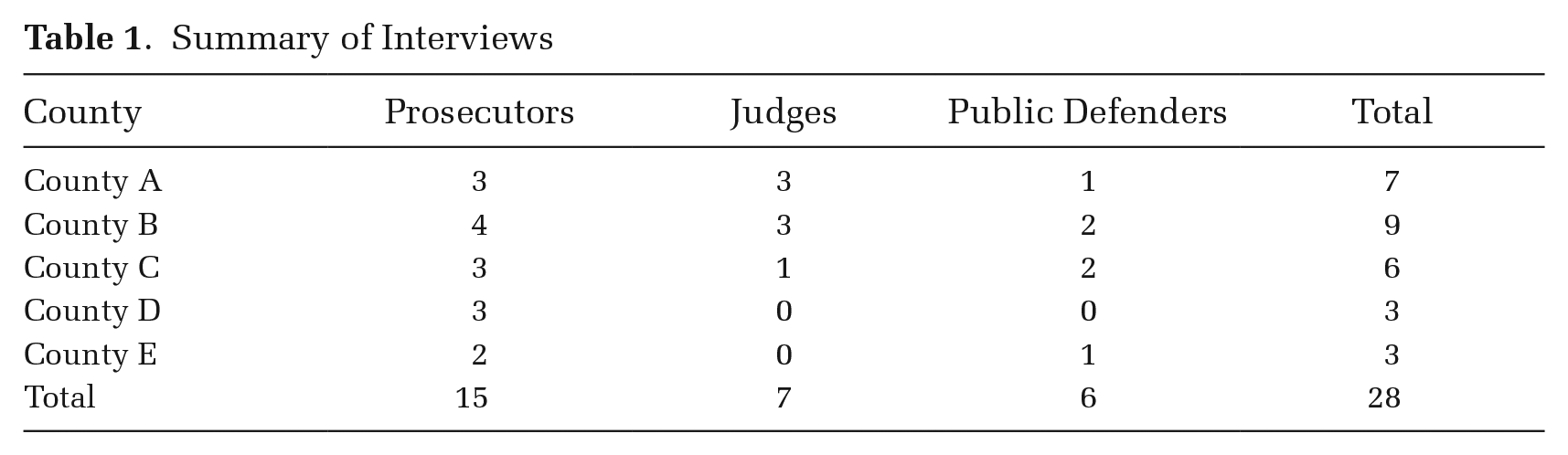
The first and second authors’ participation in the quantitative data collection from case files in DA’s offices entailed reading not only filed legal documents such as arrest reports, charging documents, motions, plea colloquies and trial transcripts, and sentencing forms, but also materials such as interrogation transcripts, autopsy reports, crime scene photos, and case notes. Furthermore, we engaged in many informal conversations with Chief DAs and ADAs during these site visits. All these experiences gave us a strong familiarity with the structure of the homicide prosecution process and its key decision points, and they helped us sensitize interview questions about how prosecutors interpreted aggravating factors and made different decisions based on similar-seeming sets of facts.
All interviews were recorded with subjects’ permission and informed consent. Our interviews spanned the following five broad topics: (1) defendant characteristics and facts of the crime; (2) role of victim characteristics; (3) case-processing considerations (e.g., evidentiary issues, financial burdens on the DA’s office from lengthy capital cases); (4) court community norms; and (5) political and community factors. Our approach to the interview data did not constitute a strictly inductive, grounded theory coding and analysis (Glaser and Strauss 1967). Rather, our strategy resembled Tavory and Timmermans’s (2014) abductive approach. Abduction seeks surprising or anomalous empirical findings and uses them as a roadmap to search for explanations, in a recursive dialogue with theory and method (Tavory and Timmermans 2014).
We followed two sources of guidance in our approach to the interview data. First, prior literature and theory emphasize the importance of prosecutorial discretion and the potentially key role of differing interpretations of statutory aggravators. Second, our prior quantitative research found large statistical differences between counties in filing to seek the death penalty, and in filing specific aggravators (Ulmer, Zajac, and Kramer 2020). These prior statistical analyses sensitized our qualitative inquiry into what lay behind the wide variation in the likelihood of death filings.
Our coding of the interview data followed our open-ended interview schedule questions in terms of topics. We coded for emergent differences in any aspect of the decision process across counties, and our coding themes were not established a priori. We then centered our analysis around themes that emerged surrounding variation in the interpretation of aggravating circumstances, and how these shaped decisions to seek the death penalty. Specifically, we first went through all interviews and identified all instances where prosecutors discussed the statutory aggravators, and we noted the considerations that went into decisions to seek the death penalty. Next, we compared how prosecutors interpreted the aggravators, evaluated cases, and described the aggravators in positive or negative terms. We then specifically examined differences and similarities between counties.
Findings
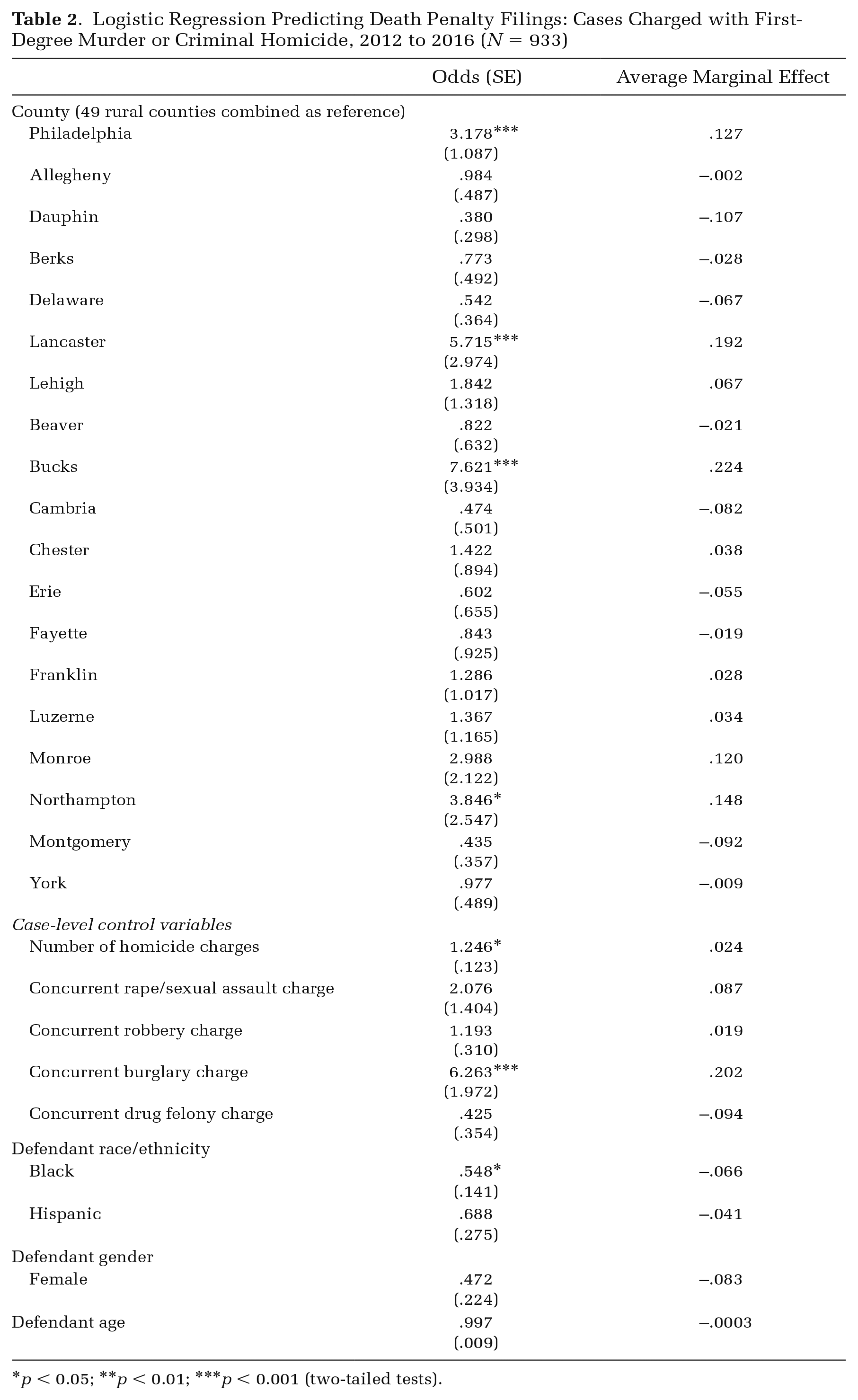
Prosecutors statewide sought the death penalty in 67 cases after Governor Wolf’s 2015 moratorium on executions, and six death sentences were issued after that moratorium. 3 Thus, prosecutors continued to seek the death penalty in Pennsylvania, and juries continued to impose it, even after the moratorium. Table 2 presents logistic regression results predicting prosecutors’ decisions to seek the death penalty in all cases statewide charged with any degree of murder or with general criminal homicide from 2012 to 2016.
Logistic Regression Predicting Death Penalty Filings: Cases Charged with First-Degree Murder or Criminal Homicide, 2012 to 2016 (N = 933)
p
The average marginal effects predict prosecutors’ decisions to seek the death penalty by filing a motion of aggravation for one of the 18 statutory aggravating factors. 4 The model controls for case- and defendant-level factors to highlight between-county differences via the county dummy variables, net of the effects of caseload or defendant composition factors. Dummy variables are included for the 19 largest counties in the state, with the remaining 48 rural counties combined as the reference. We combined the rural counties because there were only 80 eligible homicide charges, and only 10 death filings, across those 48 counties. The model controls for defendant race (Black = 1, non-Black = 0), 5 gender (female = 1), and age (in years). In addition, controls include the number of homicide charges (which reflects the number of victims: each victim results in a separate homicide charge), and the presence of concurrent felony charges alongside the homicide. The latter are captured with dummy variables for concurrent rape/sexual assault, robbery, burglary, and drug-trafficking felony charges.
Statewide, prosecutors filed for the death penalty in 15.54 percent of first-degree murder and criminal homicide cases from 2012 to 2016. Prosecutors varied widely across counties in their probability of filing to seek the death penalty in cases with death penalty-eligible murder charges. Prosecutors in Bucks and Lancaster Counties stand out as particularly likely to seek death; each was about 20 percent more likely to file aggravation than those in the combined rural counties. Prosecutors in Northampton and Philadelphia were also comparatively more likely to file for the death penalty. Interestingly, this time period predates the election of Larry Krasner in Philadelphia in 2018, a vocal opponent of the death penalty who has not sought the death penalty in any case since he took office. The other major metropolis, Allegheny County (Pittsburgh), is quite different from Philadelphia, in that their prosecutors sought the death penalty more rarely. On the other end of the spectrum is Dauphin County (home of the state capital, Harrisburg), whose prosecutors were the least likely to seek the death penalty, even though Dauphin was third only to Philadelphia and Allegheny in the number of death penalty-eligible murders.
Table 3 shows cases convicted of first-degree murder in 18 counties from 2000 to 2010, coded from DA’s office files and court records. These 18 counties accounted for 87 percent of all Pennsylvania’s first-degree murder convictions in that period. The table shows the presence of specific statutory aggravators, as determined independently by coders, compared to whether that specific aggravator was filed in seeking the death penalty. Five of the 18 statutory aggravating factors are not shown in the tables because there were no or very few occurrences of them. 6 Table 4 shows the differences in aggravators independently coded by those filed by prosecutors, among cases charged with murder or criminal homicide, for 12 counties from 2012 to 2016.
Counts of Statutory Aggravators Filed by DA; Aggravators Independently Coded as Factually Present (Percent), 18 Counties, Cases Convicted of First-Degree Murder, 2000 to 2010
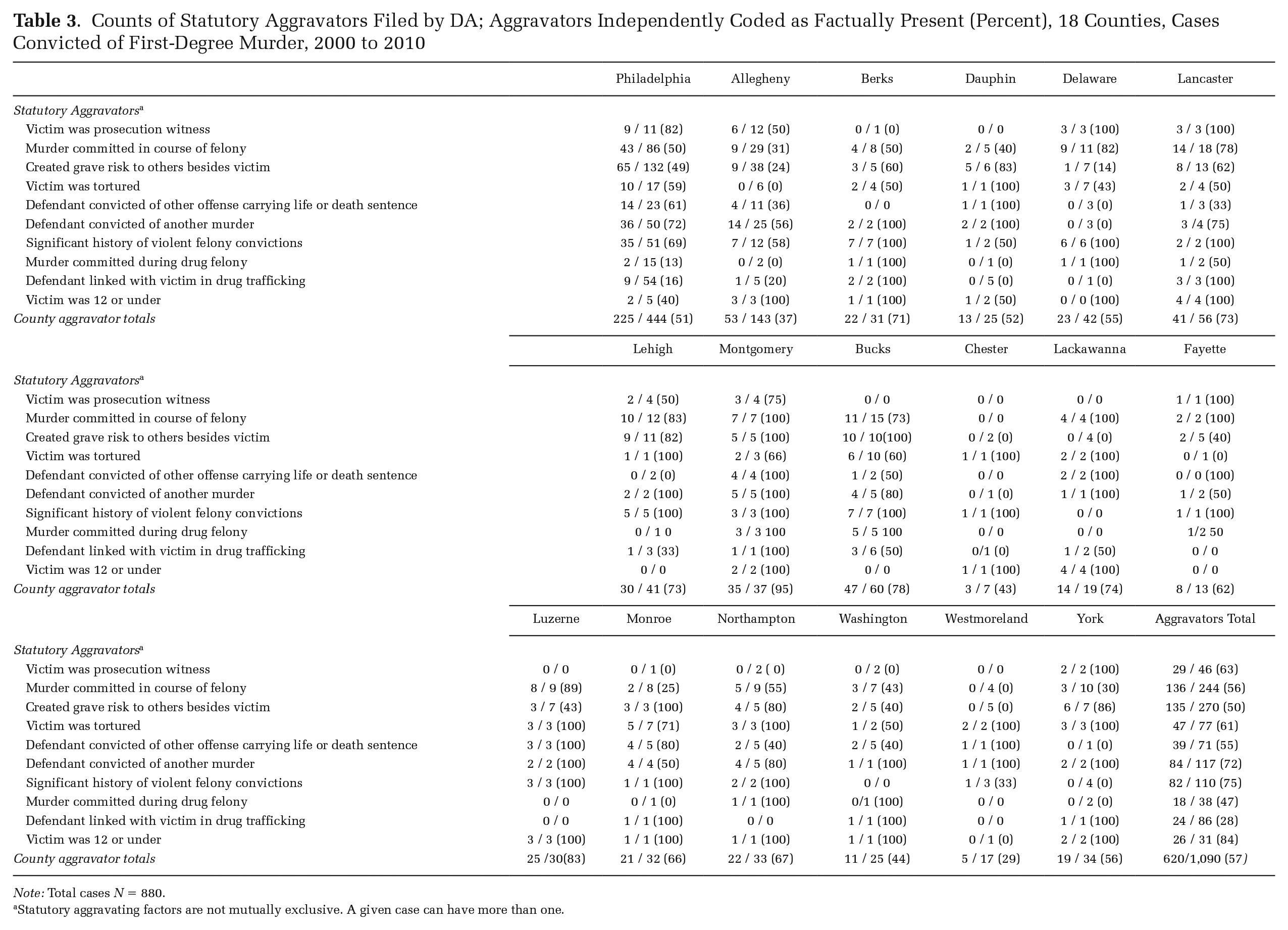
Note: Total cases N = 880.
Statutory aggravating factors are not mutually exclusive. A given case can have more than one.
Counts of Statutory Aggravators Filed by DA; Aggravators Independently Coded as Factually Present (Percent), 12 Counties, Cases Charged with Murder or Criminal Homicide, 2012 to 2016
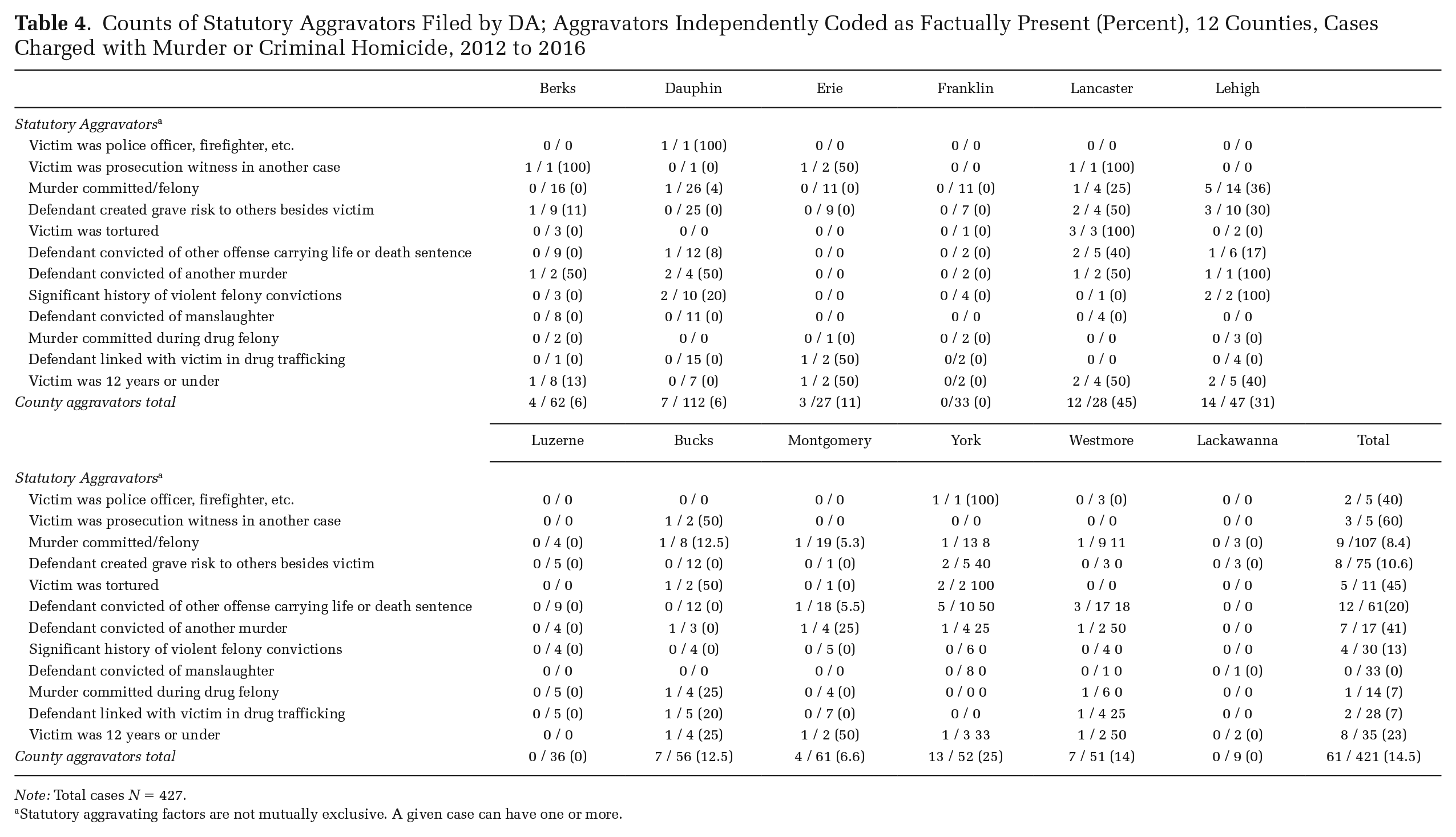
Note: Total cases N = 427.
Statutory aggravating factors are not mutually exclusive. A given case can have one or more.
Tables 3 and 4 show that different counties’ prosecutors reacted differently to the same aggravators. In Table 3, from 2000 to 2010, Philadelphia had 86 first-degree murders committed during another felony, and half resulted in a death filing. In Lehigh, Lancaster, Delaware, Bucks, Luzerne, and Montgomery Counties, murder during a felony was filed at much higher rates (100 to 78 percent). In other counties, such as Allegheny, York, and Monroe, this aggravator was filed in only a minority of cases in which it was present. Similarly, in Philadelphia, 132 cases involved the defendant clearly creating a grave risk to another besides the victim (e.g., shooting on a public street with many bystanders or in a crowded bar), and DAs filed 49 percent of these in seeking the death penalty. By comparison, Allegheny had 38 such cases, and 24 percent of these were filed in aggravation. A defendant having a significant history of violent convictions was filed in aggravation in each case in which it was found in several counties, but rarely filed in others. Defendant linked to victim in drug trafficking was seldom or never filed in some counties, but filed every time in others.
The overall county totals show wide variation in the percent of total aggravators present that result in death filings. For example, Montgomery and Luzerne Counties’ prosecutors filed in connection with over 80 percent of total aggravator occurrences, whereas those in Allegheny and Westmoreland filed in connection with 37 and 29 percent of aggravator occurrences. Philadelphia, Delaware, Dauphin, and others filed in connection with about half of all their aggravator occurrences.
The total percentages of filings per statutory aggravator vary as well, and suggest that prosecutors view some aggravators as more compelling than others. Prosecutors filed to seek the death penalty in connection with 84 percent of instances where the victim was age 12 or under, and over 70 percent of instances where the defendant was convicted of another murder or had a substantial history of violent felony convictions. However, prosecutors only filed to seek death in connection with half of cases where the defendant put others besides the victim in grave danger. From 2000 to 2010, prosecutors filed on the basis of the drug-related aggravators least often. When the murder occurred during a drug felony, prosecutors filed that aggravator 47 percent of the time, and they filed 28 percent of the time when the victim was connected to the defendant in drug trafficking.
Table 4 presents 2012 to 2016 data from a smaller pool of 12 counties, but from a wider pool of cases—those charged with any degree of murder or general criminal homicide, rather than those convicted of first-degree murder. Notably, as with Table 2, this period overlaps with the governor’s moratorium on executions, which likely reduced the willingness of DAs to file aggravation motions to seek the death penalty. For example, prosecutors in Luzerne, Lackawanna, and Franklin did not seek the death penalty at all. The broader, more common aggravators show great variation across counties in the proportion of times they were filed versus how often they were found by our coding. For example, murder committed during a felony was never filed once in Berks County in 16 occurrences, nor in Erie and Franklin in 11 occurrences, and only once in Dauphin in 26 occurrences. Yet it was filed in Lehigh 36 percent of the time our coders found it, and 25 percent in Lancaster.
Surprisingly, even some of the narrowly applicable and clearly defined aggravators varied quite a bit in their filing across counties. Murder of a victim 12 years or younger was not filed at all in seven occurrences in Dauphin, and once in eight occurrences in Berks, but it was filed in two of four times in Lancaster, two of five occurrences in Lehigh, and one of two in Erie and Westmoreland. A defendant being convicted of another offense carrying a life-or-death sentence was never filed in nine occurrences in Berks, but filed in 5 of 10 in York. Finally, some aggravators seem to hardly ever be filed in these eight counties, despite their occurrence: murder committed during a drug felony, defendant linked with victim in drug trafficking, and defendant previously convicted of manslaughter.
These counties show some interesting differences between the two time periods as well. Each of them filed aggravators at lower rates in 2012–2016 than 2000–2010. Dauphin filed 48 percent in the earlier period but 6.3 percent later. Lancaster filed 67 percent of the aggravators found earlier, but 45 percent later, and Lehigh declined from 73 to 31 percent. Berks and Lackawanna showed the biggest changes. Berks filed 61 percent of the aggravators found in 2000 to 2010, but only 6.5 percent in 2012 to 2016, and Lackawanna filed 74 percent of aggravators from 2000 to 2010, but none in 2012 to 2016.
Interviews with Prosecutors
The statistical data demonstrate that, across two time periods, county prosecutors indeed differ widely in seeking the death penalty in comparable murder cases, and they vary greatly in their filing of specific statutory aggravating factors. What these quantitative data do not show is prosecutors’ discretionary considerations in making these decisions, and their interpretations of the statutory aggravators’ meaning and legal value.
Prosecutors inhabited the statutory law on aggravating factors with their practice of empirical justice, which was driven by substantively rational concerns. Recall that substantive rationality refers to decision-making characterized by flexible, individualized discretion based on decision-makers’ subjective assessments and pursuit of value goals external to the law, rather than following uniform formally rational rules (Savelsberg 1992). Empirical justice refers to legal actors, prosecutors in this instance, comparing cases at hand with their experience of prior cases, and making legal decisions about them according to their substantively rational values.
In our interviews, prosecutors were well aware there was little likelihood of any death sentence they secured actually being carried out, even before the 2015 moratorium. One prosecutor noted, “I might have gone for it more often if there was a chance of it actually being carried out, but it was pointless.” Still, all the prosecutors we interviewed saw a death sentence as a strong symbol that signaled community condemnation. As another prosecutor stated, “The death penalty is the right thing to do in some cases, the only remedy for some cases where we must assert the rule of law.”
None of the current and former prosecutors reported having any formal, written policies around the statutory aggravators or seeking the death penalty. Indeed, prosecutors indicated that such a policy would be superfluous, as represented by the DA from County A (see Table 1) who noted, “Our approach is driven by the facts of the individual case, so it would be difficult to write a policy anyway, but everybody is on the same page about how we do things here.” Still, that there were informal norms is evident throughout our interviews, and these informal norms were almost entirely determined by the preferences and views of the elected DAs in these offices.
We discern in our interview data four themes that characterize prosecutors’ substantively rational interpretations and empirical justice decision-making about the death penalty in murder cases: (1) the meaning of the statutory aggravators, (2) the strategic use of the aggravators on a case-by-case basis, (3) the normative value of specific aggravators as law or policy, and (4) the holistic appropriateness of seeking the death penalty in a given case, including evaluating the value of victims. These four themes characterize the ways prosecutors inhabit the statutory law governing the pursuit of the death penalty.
The Meaning of Aggravators
First, prosecutors necessarily interpret the meaning of specific aggravators, especially the broader ones. This is an example of constitutive logic in the mediation of law by social actors (Edelman 1992; Scott 2008), whereby prosecutors, individually and via social interaction, made sense of the statutory aggravators by deciding what counted as examples of them. What constitutes a “grave risk to others” besides the victim, or a “significant history of violent convictions”? Prosecutors’ interpretations of the meaning of aggravating factors were heavily informed by their experience with prior cases, as they compared and contrasted what “counted” as an instance of a particular aggravator.
These interpretations were an interactive process, as the Chief DA would discuss and debate whether particular aggravators were applicable with ADAs, although the DA always had final say over whether to file aggravation. Counties A and E had formal homicide teams that jointly discussed and made recommendations to the DA about these decisions. As the DA in County E said, “The first Assistant and I sign off on everything, but it [filing aggravation] is done as a team.” The three other counties took a more ad hoc approach, with ADAs rotating who was assigned to murders. Typically, at least two ADAs were assigned to murder cases in these counties, designated as first and second “chairs.”
The following quotes illustrate definitions of the aggravator where the defendant posed a grave risk to others besides the victim. An ADA from County B described a case where they filed this aggravator: The man was firing down the street. It was spring night. It was a lot of people on this block and a girl was shot and killed. Bullets were striking right near other people.
A DA from County C described what does and does not constitute “grave risk”: In the cases I do, a lot of the city cases are shootings and anyone around, anyone in the vicinity could get hit. Had one, the guys just got into it, had beef. Right out in the middle of __ Street right over there, the defendant was sitting in his car, pulled out a gun and shot this guy in the back. We thought, could he have killed someone else? Yeah, he could have, there could be other people around. But, we felt, we decided that’s not really what great risk of danger is about there. As opposed to . . . that guy was in the middle of a nightclub on [street name] and started firing and he could have killed tons of people.
“Significant history of violent convictions” is another aggravator whose meaning is not self-evident. Does this refer to a defendant with two nonlethal assault or robbery convictions? Does it mean one prior very serious violent crime, such as an attempted murder or a rape? Or does it refer to a long, violent criminal history? Two ADAs from different counties described what this aggravator means in their offices: ADA, County D: If this defendant has a long history of violent criminal behavior, we file for the death penalty because of the aggravator. ADA, County E: I mean if the defendant has a large criminal history, has committed attempted murder before and those sorts of things, that’ll be something that’ll factor in [to filing this aggravator].
Even aggravating factors that seem self-evident and straightforward are subject to nuanced interpretations. For example, two prosecutors from different counties explained how the “victim 12 or under” aggravator does not necessarily warrant seeking the death penalty, and why they would plea bargain some of these cases to a lesser degree of murder: DA, County B: The other thing is, and the weird thing about killing children is I think for a lot of years, my experience was shaken baby cases. You shake a baby. A lot of those cases we pled out to third, or manslaughter. You know for a lot of times for whatever reason, even though the child was innocent, and it’s an aggravator, you know it wasn’t someone putting a gun to the child’s head and firing the shot. ADA, County E: Anytime a child is killed under a certain age, there’s automatically an aggravating circumstance. But in my cases, we don’t seek the death penalty a lot of the times cause honestly we feel that, hey, this is a third-degree murder case, involuntary manslaughter. It isn’t first-degree. So although you may have an aggravating circumstance, you still have to have the first prong which is do you honestly believe that you can prove this case beyond a reasonable doubt is a first-degree murder.
This latter quote suggests the importance of the second theme in our interviews, which revolves around strategic considerations of potentially presenting aggravating factors to a jury.
Strategic Considerations in Filing Aggravators and Seeking the Death Penalty
Another theme present in all our interviews is that prosecutors were greatly concerned with strategic considerations about proving specific aggravators to juries and the prospects of obtaining both a first-degree conviction in the guilt phase and a death verdict in the penalty phase of capital trials. These strategic considerations surrounding the aggravators and the evidence for them had an anticipatory, “downstream orientation” (Frohmann 1991) that was sharply focused on juries’ perceptions. As the DA of County C said: I’ve looked in those jurors’ eyes and when I’m talking about the death sentence, they don’t want beyond a reasonable doubt, they want to be sure that that’s the person that did it. So the guilty phase has to be overwhelming. Any kind of doubt, they won’t give the death penalty.
As an ADA from County A put it: If I have a death penalty case, I really don’t worry too much about the penalty as getting the conviction first. That’s my focus. If there is a penalty phase, 99 percent of our aggravating circumstance evidence has already come in through the trial.
These strategic considerations were formed interactively, through internal DA’s office discussions. They were also the site of negotiations with defense attorneys. The current defense attorneys we interviewed all stated that they started consulting and negotiating with the DA’s offices early on if a murder might have the potential for aggravation. The DA of County E said his office was quite open to negotiations with defense attorneys in murder cases: “We meet with defense attorneys. They have an opportunity to influence us with regard to charges, aggravators, mitigators. This is even before plea bargaining discussions.” The DA of County B saw his office as particularly open to discussions about filing aggravation with defense attorneys, and this was corroborated by a current County B defense attorney: I email the assigned ADA or the DA and find out upfront if it’s under consideration for capital murder. We usually discuss whether he is going to file and what the aggravators are when they file them. We talk about that [with the DA]. We didn’t have as much success in negotiating with his predecessor. [Current DA] has been more amenable.
The concern for evidence strength and witnesses as well as the uncertainty of jury decisions often provided grounds to negotiate a plea agreement to life in prison without parole (the only other sentence possible for first-degree murder in Pennsylvania). A County B ADA said: [The DA] always, no matter what the circumstance is, it is just his policy, personal belief, whatever you want to call it, life is always on the table. For every death penalty defendant. . . . If you’re willing to plead to life, we’re good with that.
The statewide 2012 to 2016 AOPC docket data show that 6 percent of cases where first-degree murder was the specified charge (as opposed to general criminal homicide, where the degree is determined at conviction) had charges reduced in connection with a guilty plea. But as with the filing of aggravators, the percentage of cases where murder charges were reduced via plea varied widely, ranging from 50 percent (Lawrence County) to only 1.4 percent (Philadelphia County). This suggests prosecutors, and perhaps DA’s office norms, differ a great deal in their willingness to plea bargain and reduce first-degree charges to homicide charges that are ineligible for the death penalty. Alternatively, it might suggest that in counties where first-degree murder charge reductions are less likely, prosecutors are more parsimonious in their initial charging decision—charging only what they have strong evidence for. Counties where murder charge reductions are more frequent might tend to overcharge weaker cases initially. 7
Whereas the County B and C DA’s offices were reluctant to reduce first-degree murder charges to third degree, those in Counties A, E, and D spoke of the negotiations by which such charge reductions occurred, and noted they were willing to negotiate pleas to third-degree murder to secure convictions in the face of uncertain evidence and witnesses, when they anticipated problems convincing juries. As a County E ADA put it: “Going to the jury is always a gamble. A plea is a sure deal if he wants to plead to third, and there’s reasons to do it, we recommend to the [victim’s] family, we should really look at this.”
The DA of County C remarked on the fact that many murders are “bad on bad,” a phrase used frequently in each county, meaning the victim was also involved in criminal activity (a theme we return to later). Here, the DA pointed out that such cases are often plagued with evidence problems and unreliable witnesses: The biggest driver of that fact [pleading death-eligible murder cases to third degree] is really evidentiary. The majority of these cases are city cases. And the majority are bad on bad. And frankly when you have bad on bad, it’s generally someone involved in something. And we gotta take those factors into the equation because the majority of, a vast majority of our cases have witness issues.
The DA from County A expanded on the downstream orientation toward jury perceptions, evidence, and witness considerations in decisions to plead a death-eligible murder charge down to third-degree murder: The provability. What’s the guy’s prior record. Does he have anything? Is this out of character? What’s the explanation. How’s this going to play in front a jury? Is he going to come across as sympathetic? Did he accept responsibility? Did he give a statement that said, “I didn’t mean to kill him. I just lost it.” Or did he give a statement like, “I hated this guy for the last 10 years, he’s my archnemesis.” What are the human factors here? How’s a jury going to look at this guy? I always say what’s our worst-case scenario? What’s the worst we’re going to get here. And it’s probably going to be third-degree murder. . . . Do you want to take the guaranteed 20 to 40 [year sentence] or do you want to roll the dice? Now we have a different conversation if some of those witnesses are shaky. One was drunk. One is a heroin addict. One died before the thing. We go to the family and say we might not get anything here. So then you’re saying to them 20 to 40 isn’t so bad because we have a proof problem.
Other strategic considerations included practical constraints, namely, effort and costs of defending death penalty verdicts on appeal. A DA from County D highlighted these issues: I think that some of the terms that we as prosecutors may use is “the worst of the worst.” I think that is a much more, a bigger factor than you could ever imagine. But the other factor that I really, really, really consider is what are the collateral consequences to this office if we get a death penalty verdict. Because even though we are one of the largest offices in the state, protecting these verdicts is difficult. And I have seen, I’ve been personally involved in many of these cases coming back time and time again.
The DA from County A expanded on this theme, noting the costs and risk of appeals: You know one of the things we really look at too is the cost . . . the practical factors including cost. Another factor is I’m impatient as hell. And whenever we seek death it takes forever for that case to come to the jury. . . . It just blows my mind. I don’t like these cases to linger. . . . Because very few of our cases get stronger as time goes on.
The Normative Appropriateness of Filing Aggravation
The third theme from our prosecutor interviews revolves around the normative evaluation of whether, in a given case, it was appropriate overall to seek the death penalty, and if so, the appropriateness of the aggravators. West and Yelderman (2023) found that prosecutors pursued aggravating factors that triggered their emotional and moral intuitions about the severity of murders, culpability of defendants, and vulnerability of victims. This coincides with the focal concerns perspective on punishment decision-making, which argues that sanctioning decisions center around perceptions of defendants as more or less morally blameworthy, or a danger to the community, as well as community protection and practical constraints (Steffensmeier, Ulmer, and Kramer 1998).
Similarly, we find that prosecutors evaluate cases and victims in terms of appropriate punishment, based on their substantively rational value judgments. That is, prosecutors’ practice of empirical justice evaluated whether specific murders rose to a level of overall moral gravity, compared to other murders in their experience, sufficient that they should file aggravation. In the words of one DA, “Is the murder so heinous that we should go down this road.” We discerned two dimensions to this assessment: (1) evaluating the case holistically, and (2) evaluating the moral value of victims.
Holistic Appropriateness
In deciding whether to seek the death penalty, prosecutors typically described taking a holistic view of the case and its severity. One County C ADA characterized “garden variety” murders that do not merit going to the Chief DA and requesting to file aggravation: For the most part, the types of cases that come in just have become so garden variety to me that they wouldn’t stand out. Like your typical robbery-homicide on its face wouldn’t be enough for me to go to [the DA] and say, “hey, we should do this as death.”
An ADA from County B acknowledged the breadth of circumstances covered by the statutory aggravators, and how the majority of murder cases entail the factual presence of at least one aggravator that could enable the office to seek death. However, the DA in County B was “very judicious” in filing them: I would say, a guess, I would think if you look at the list of aggravators, 60 percent of our cases, maybe 70 percent, we could in theory, seek death. But [DA] always, like I said, is very judicious about when he would do so. It is really only in the worst of the worst circumstances.
A DA from County C described the holistic, normative assessment of murder cases in deciding to seek death and opined that this consideration goes beyond the factual presence of aggravating factors. As with the quote above, he noted that one can fit most cases to one or another aggravator if desired: A more important thing that transcends those [aggravating] factors, really two things that are critical. One is just how bad is this. Forget the labels, the aggravating factors. Your just inner sense of how bad is this crime. And the second thing is how sure are we that this person did it. Those, I think, are the two most critical factors of whether someone is going to get the death penalty. You have to have an aggravating circumstance, but if you’ve got both of those things and you can fit them into any aggravating circumstance, I think that then you are going to come out with the death penalty most likely.
A current judge in County C (who had been the prior DA) stated that, from a judge’s perspective, he appreciated the holistic assessment of the appropriateness of seeking death: It’s the nature of some of the cases that the demand for justice from the community is there when something bad happens. And not only the family of the victim, but also the community at large, especially when you have these terrible crimes. Not your standard, routine murders. Again, I hate to use that term, but something over the top, something out of the ordinary. I think the DA has the obligation to ask for it [death penalty]. I don’t have a problem with the DA asking for it in the right kind of case.
However, a DA in County D described how the severity of case facts can lead to death verdicts aside from whether or not particular aggravating factors apply: Facts, sometimes, are more impactful even if they don’t fit within the aggravators. So for instance, even if I have a 14-year-old, so it doesn’t fit the aggravator, and I have some other aggravator that applies, the facts may drive the jury to the death penalty based on the horror of the facts. And they may hang their hat on a different aggravator, but that fact is still there, the fact that it was a 14-year-old or a 15-year-old.
An unanticipated but important difference between DA’s offices we found concerned social interactions with victims’ families, and how these did or did not influence overall assessments of whether seeking the death penalty was appropriate. Prosecutors’ social interactions with victims’ families had differing valences across counties. In Counties B and C, prosecutors said they gave a great deal of weight to what victims’ families wanted. For example: Would we do something without the family’s consent? Yes, but we wouldn’t want to. If the family were being very unreasonable and not looking at the situation with an open mind and being fair, it’s not their job to be fair necessarily, their loved one is dead. But I would be very reluctant to approve a resolution or to present a resolution without the family being onboard.
A current judge and former DA in County B emphasized the importance of victim family input: Victim input, I think is very important. It should not be a controlling factor, but I think it’s an important factor. Is your victim’s family willing to see that [seeking the death penalty] take place? Are they going to be, how much noise are they going to make if it’s a deal [plea bargain avoiding the death penalty] they don’t like? And I think a DA who is in an elected position has to be conscious of that.
In Counties A, E, and D, prosecutors said they gave victims’ families wishes less weight. For example, the County A DA said: I’ve definitely considered that, but I’ve gotta be honest. They [family members of the victims] are not going to be the ultimate decision-makers. Absolutely not. And I don’t give a damn what their position is. We gotta look at the case from the law, legal issues. And you know, you’re going to get a mix in the type of people. Some who are, want an eye for an eye, a tooth for a tooth, no matter what. And I’m not going to be swayed by their emotions.
A defense attorney in County A acknowledged the difficulty presented by victim family wishes: “I think when you look at the victim, the district attorney has a difficult decision because the family of the victim may be adamant about a capital or first-degree and not a reduction, not a charge bargain.”
Victims and Their Moral Value
The presence of victims’ families who could present their murdered family member in a sympathetic light contrasted with the “bad on bad” situation, where perhaps victim family impact was absent or carried less weight to prosecutors. A key difference between the DA’s offices in different counties concerned the moral distinctions they made between victims. Prior research has similarly found that prosecutors, judges, and juries make consequential distinctions about the moral worth of victims of murder, rape/sexual assault, and other crimes (Curry 2010; Farrell and Swigert 1986; Lantz, Wenger, and Craig 2023; Spohn and Holleran 2001; Williams, Demuth, and Holcomb 2007). In Counties A, B, and D, prosecutors were much less willing to file aggravating factors in “bad on bad” cases. When asked what the DA’s office in County B considered in seeking the death penalty, a current defense attorney said, “The biggest thing, in my experience, is an emotional response to the victims.”
As a County B ADA said, “Most of our victims are not necessarily great people. So any time we have a victim who isn’t a part of the criminal world, that’s a sympathetic victim.” An ADA from County D said: A helpless victim. And it seems to be entirely different if it is a helpless victim as opposed to two gangbangers going at it or drug dealers going at it. And that doesn’t minimize, I don’t mean to minimize the sanctity of human life. But there is almost a level of “you paid to play.” I mean if you’re involved in the drug culture and you get shot, well, you choose to play that game. You choose to be in that business.
Another ADA in County D expressed similar sentiments about how his discussions with other ADAs weighed the moral value and “sympathetic” nature of victims: Is the victim in any way responsible for what happened, liable for what happened? In your drug types of cases it’s two dealers. Fine, maybe you have a murder case, and might, because of the drugs involved constitute an aggravating circumstance, but the victim was a dealer. Alright, so the victim is not a very sympathetic figure. Why should we give this guy the death penalty for killing this drug dealer? Doesn’t a life sentence address this?
The DA in County A expanded: For instance, the murder of a child would be one thing. I think that the murder of an elderly person. A defenseless person. The murder of a special needs person. That would stick out right away for me. But that doesn’t mean I would bring it [death penalty]. But that would certainly take me to the next step. But, [we have] many, many, many, many drug killings. I’m looking at that in a different way and say we wouldn’t bring it.
As with the strategic consideration of evidence, prosecutors’ estimation of the moral value of victims had a downstream orientation (Frohmann 1991). These assessments centered around perceptions of how juries would morally view victims.
As implied above, in Counties A, B, and C, victim characteristics conditioned negotiations with the defense about charges and seeking the death penalty. That is, criminally involved, or otherwise less “sympathetic,” victims made prosecutors more willing to plea bargain about aggravation or reducing charges. A current defense attorney in one of these counties said: If you’re dealing with a victim who themselves has a criminal past, it’s very much more open for plea negotiations. Especially if it’s a well-known name in that town, it’s a well- known criminal who’s murdered by someone less well known, your DAs tend to be more willing to negotiate because the value of that person’s life sort of diminishes a little bit in their minds because of that defendant’s criminal past or background.
Counties C and E presented a sharp contrast to A, B, and D in the moral evaluation of victims and seeking the death penalty. These prosecutors rejected the notion of distinguishing between victims based on their moral worth or criminal involvement. In the words of an ADA in County E: The guy on ____ Street that got killed was a drug dealer but he got gunned down in front of his kid and his family. So there’s no sliding scale about “this person is up to no good.” So they’re no less entitled to be considered a victim. I’ve never thought that way as a prosecutor. I never would.
The DA in County C explained that the statutory aggravators already account for victim factors, and that prosecutors should not weigh one victim as more “worthy” than another. To do so would invite unwarranted disparities between cases: It’s not my job to make value judgments on whether someone’s good, bad, savory or unsavory. Justice is equal. It’s equal across the board. It’s equal when you apply it to defendants and it has to be equal when you look at victims. I think it’s essential for our justice system. I would never say a victim is more worthy of the death penalty aside from the aggravator, you know your unborn baby. That’s why the aggravators are there. Who the victim is is already accounted for in the aggravator and I think it’s important to do that. If it’s in the rules, that means it’s more likely to be consistently and fairly applied by prosecutors in making death penalty determinations. If it’s not, then it becomes more of a, just more potential for inconsistency there I guess.
A defense attorney in County C agreed with how the DA above characterized his practices, contrasting this DA’s norms with another county where “bad on bad” cases would not see a death filing: So in like Philadelphia if it’s a drug dealer on drug dealer, you’re probably not going to get the death penalty [filed]. In [County C] you absolutely are. And that’s actually an aggravator. So it doesn’t matter if the person who was killed is a bad person, or if it’s a good person. If he has an aggravator he pretty much seems to file.
Evaluating the Legal Value of Aggravators: “Strong” and “Weak”
Finally, prosecutors evaluated the normative value of the statutory aggravating factors themselves. Prosecutors engaged in substantively rational evaluation of the formal, statutory aggravating factors through their subjective value lenses. None of the individuals interviewed uncritically accepted the statutory aggravators as valid as a matter of law in practice. They all had definite opinions on the value of different aggravators, distinguishing between them as “strong” and “weak.” In the words of a County E ADA, “I think that as far as deciding the death penalty, I think you’re going to have to have some strong aggravators and have a number of them.” The DA of County A opined, “Murder committed in the course of a felony. That is a stupid aggravator.” The County C DA explained in more detail: In my opinion, not all aggravators are equal. The statute says okay, any one or more of these aggravators, it can just be one of these aggravators, it could be a bunch of these aggravators, and I think most practitioners would tell you, whether you’re defense or prosecution, that not all aggravators are created equal. So grave risk of danger to others is not nearly as strong an aggravator as killing a cop or killing a witness or killing multiple people.
The County B DA identified murder “committed during a drug felony” as a particularly weak aggravator, similar to the logic of “bad on bad” cases noted earlier, and contrasted it with what he sees as stronger aggravators: The weaker ones I can tell you like the drug trafficking one is about the weakest there is. We typically don’t even pursue that. Drug dealers shooting at each other. That would matter more if they killed an innocent bystander, cause they’re shooting at a drug dealer and miss and kill schoolchildren or something like that then it would be different. Obviously, you know torture. . . . If there’s a rape involved in addition to the murder. . . . And obviously children and the multiple victims.
The County E DA made similar distinctions about “murder committed in the course of a felony” versus stronger aggravators: Truthfully, I think you could understand that if you look at the aggravating factors, there are some that I consider are strong and overwhelming. And there are others that are, I consider somewhat ridiculous. For example, the murder was committed while committing a felony.
The County D DA listed several “strong” aggravators and pointed out others as weak: Certainly, killing a witness, police or firefighter, or child. Torture, I think, is a strong one. Depending again on your evidence for the torture, I think, is a strong one. . . . I think killing to further drug trafficking, I don’t know if that’s a strong one. It depends again on the circumstance. I think if it’s just a street crime and street dealers shoot another street dealer, that might not be that strong. Just because juries look at it like, “well that’s what you’re doing.” But I think if you have a drug kingpin who was just systematically killing people or competition, that might make it a little stronger. It depends. That one seems to be one of the weaker ones I think though. Grave risk of death is so vague that it’s, I don’t know how strong that is.
The interviews on the legal value of the aggravators are interesting in light of the patterns in Tables 3 and 4. As noted, drug-related aggravators were the least often filed, and our interviews most often identified them as “weak.” Murder during a felony was listed as a particularly weak aggravator, in part because it was so vague and could apply to most murders. Indeed, in some counties it was rarely filed, yet in several other counties, this aggravator was filed the majority of times it was present (see Table 3), and it was filed about a third of the time in the later time period (see Table 4). “Grave risk to others,” another aggravator often described as “weak,” was rarely or never filed when present in some counties, but filed relatively often in others. Prosecutors differed widely across counties in what aggravators they saw as valid and were willing to file.
Conclusions
Our statistical data show great variation across counties in prosecutors’ filing to seek the death penalty in eligible cases. County prosecutors’ offices also vary in their propensity to reduce death-eligible charges to second- or third-degree murder through plea bargaining. Furthermore, data from DA’s office case files from two time periods show that local prosecutors react quite differently to the factual presence of specific statutory aggravators. Filing an aggravating factor reflects a prosecutor’s discretionary assessment that the factor marks the seriousness of the murder sufficiently to warrant the death penalty, rather than the aggravator’s mere factual presence. A prosecutor in another county might come to a different conclusion. Thus, a factually present aggravating factor may not be seen as an actionable factor in the discretion of a prosecutor in one county, but might be seen as such by another.
Our interview data from DAs and their assistants in five counties illuminate how local prosecutors inhabit death penalty law. The statutory aggravators are mediated by prosecutors in four ways. First, prosecutors interpreted the meaning of specific aggravators. That is, prosecutors exercised judgment in determining what counts as an instance of an aggravator and what does not. DAs had the final say over filing aggravation, but this decision was typically made with input and discussion with assistants. This interpretation of aggravators exemplified constitutive logic in the mediation of law (Edelman 1992). Second, prosecutors were concerned with downstream strategic considerations and anticipated social interactions around proving specific aggravators to juries. These strategic considerations included evaluations and debates about evidence and witness quality, as well as negotiations with defense attorneys.
Third, prosecutors evaluated, in a normative sense, whether it was appropriate to file aggravation on a case-by-case basis. In doing so, prosecutors evaluated cases holistically in terms of their subjective sense of whether a murder rose to the level of seeking the death penalty, compared to other cases in their experience. DA’s offices differed in the influence that social interactions with victims’ families had, and how these did or did not influence overall decisions to seek the death penalty. Crucially, prosecutors also evaluated the moral value of victims, and they differed in how they did so. This echoes themes from a broader literature on the moral worthiness or value of victims in capital cases (Sundby 2003) and other violent crimes, showing that police, prosecutors, judges, and juries evaluate the moral worth of victims, resulting in unequal treatment (Curry 2010; Farrell and Swigert 1986; Lantz et al. 2023; Spohn and Holleran 2001). The characteristics and perceived moral worth of victims conditioned negotiations with defense attorneys as well. For example, prosecutors in some counties were reluctant to seek the death penalty in what they called “bad on bad” cases, and were more willing to plea bargain and reduce charges or not file aggravation. Prosecutors in other counties rejected such distinctions, and thought the aggravating factors should apply equally regardless of perceptions of victim “worthiness.” These prosecutors were less willing to negotiate about charge reductions and filing aggravation in “bad on bad” cases.
Fourth, prosecutors evaluated the legal value of the statutory aggravators themselves. The DAs interviewed had defined different aggravators as “strong” and others as “weak.” This is notable because DAs, as elected county officials, determine office policy and practice. Variations in their opinions of the statutory aggravators as strong or weak directly translate into between-county variation in the filing of those aggravators.
There is a temporal dimension to the implementation of the death penalty as an inhabited institution as well. Practices and organizational norms surrounding the pursuit of the death penalty in a particular county are determined by the preferences and policies of the DA. As counties change DAs through elections, this changes eligible murder defendants’ exposure to the death penalty. This is illustrated by our statistical data, with some counties like Berks filing aggravators, and seeking the death penalty overall, much less often under the DA who was in office from 2012 to 2016 than under a previous DA who was in office 2000 to 2010. The temporal dimension of death penalty exposure is also seen in the divergent responses to the governor’s 2015 execution moratorium, with some counties seeking the death penalty very little or not at all, and others continuing to seek it. A particularly dramatic temporal change in prosecutorial practices is shown by Philadelphia. Philadelphia prosecutors sought the death penalty in about half of eligible cases in Table 3, and under several DAs going back well into the 1980s (Baldus et al. 1998). In 2017, Larry Krasner was elected DA; he campaigned against the death penalty and has never sought it.
Empirically, we have presented a rare and in-depth view of prosecutorial discretion and interpretive decision-making regarding the most serious criminal cases and most serious of sanctions. The study of courts and sentencing is dominated by statistical modeling of archival data, which is valuable (Baumer 2013). But many scholars have called for this to be balanced by multimethod research and qualitative data that illuminate the interpretive decision-making of court actors (Lynch 2019; Ulmer 2019). Theoretically, this study shows the value of the inhabited institutions perspective for understanding the law in action, in contrast to law on the books (Gould and Barclay 2012), and for illuminating how front-line legal actors mediate law (Edelman 1992). We enhanced the application of the inhabited institutions perspective to law in practice with concepts from Weberian sociology of law, arguing that prosecutors engaged in what Weber (1958) called empirical justice, which is driven by substantive rationality, in exercising their discretion to seek the death penalty.
The statutory law specifies that prosecutors may seek the death penalty when, in their discretion, particular aggravating circumstances apply. The statutory law does not constitute a formally rational set of rules that spells out what counts as instances of the aggravators; nor does the statutory law prescribe that prosecutors seek the death penalty when these aggravators objectively apply. Rather, the statutory death penalty law necessitates that prosecutors inhabit and mediate the law with their substantive rationality in the practice of empirical justice. This coincides with the fact that prosecutorial discretion in general has resisted attempts to impose rule-based uniformity and standardization in the United States, even as policies have targeted judicial or police discretion (Walker 1993). U.S. prosecutors have long enjoyed wide and largely unreviewable discretion over charging decisions and plea bargaining, for example (Johnson 2019).
Prosecutors’ insulation from attempts at formally rational constraints on their discretion differs from other areas of criminal legal decision-making, such as non-capital sentencing, parole, and to some extent, arrest decisions. For example, many states and the federal court system have sentencing guidelines, which prescribe uniform, standardized sentence recommendations based on numerical scores for offense severity and criminal history. Such guidelines attempt to impose formally rational rules onto a historically substantively rational sentencing process (Savelsberg 1992). Parole guidelines similarly try to standardize and formalize parole release decisions via codified decision rules (Gottfredson 1979; Rhine, Petersilia, and Reitz 2017). Even arrest decisions have been the subject of various attempts to impose formalized, uniform decision rules (Walker 1993).
Yet the inhabited institutions perspective would seem to imply that pure formal rationality, in law or in other institutions, is likely not possible. Institutions are enacted by actors whose sense-making and social interactions are crucial to organizational activity (Hallett and Ventresca 2006; Weick 1995). The struggle over meaning is central to institutions, and meaning is central to social interaction (Hallett and Hawbaker 2021). Even formally rational bureaucratic rules require actors to engage in constitutive logic and interpretation, deciding what counts as an instance of a category or a rule (Edelman 1992; Scott 2008). Such interpretation is, in turn, often the site of negotiation or conflict (Hallett and Hawbaker 2021; Strauss 1993). These realities would seem to limit the reach of formal rationality, and ensure the ubiquity of substantive rationality, in law and other institutional fields where front-line workers (Lipsky 1980) mediate formal rules.
For example, a substantial literature demonstrates how sentencing guidelines seek to control judicial discretion via uniform decision rules, but they are interpreted and applied differently across court contexts (see reviews by Lynch 2019; Ulmer 2012). This literature illustrates the fundamental tension between efforts to promote formally rational uniformity in punishment, and the persistence of local substantive rationality characterized by flexibility, individualization, and the influence of decision-makers’ values (Kramer and Ulmer 2002; Savelsberg 1992). The dilemma of formal and substantive rationality is that the latter allows localized interpretation of rules, case-by-case individualization, and the pursuit of value-driven goals, but it also provides the opportunity for disparity and unequal treatment of legally similar cases (Ulmer and Kramer 1996). In the same way, death penalty law allows local prosecutors’ practice of substantively rational empirical justice, but produces geographic arbitrariness in the aggregate.
This study has limitations that should spur further research. Our data are limited to one state, which has executed few people and currently has a moratorium on executions. Despite this, Pennsylvania courts have handed down 113 death sentences since 2000 and 32 since 2010, placing it in the middle of death penalty states in the number of death sentences (Death Penalty Information Center 2023). The continued production of death sentences in the well-known absence of executions in Pennsylvania suggests death sentences continue to serve a symbolic and populist function, as argued by LaChance (2016). However, further research on the role of prosecutorial discretion in seeking the death penalty, and its geographic arbitrariness, would be warranted for states such as Texas, Florida, or others that hand down more death sentences and conduct more executions. Prosecutors in states with no moratoria and more frequent executions may be more likely to seek the death penalty, but there also may be greater variation in their enthusiasm for doing so. 8 For example, even in Texas, the majority of death sentences come from a handful of counties (Curry 2010; LaChance 2016). Thus, in higher-use death penalty states, a few prosecutors may be ardent death penalty supporters who seek it whenever possible (as described by LaChance 2016), whereas many other prosecutors may be disturbed by the moral implications tied to the very real possibility of executions.
Our interviews covered a limited number of counties, and research is needed that includes interviews with prosecutors across wider and more diverse locations. In addition, future research should investigate other dimensions of the capital punishment decision process that are known to vary across localities, such as the quality of defense representation (Bright 1994; Donahue 2014). Research should also explore how other actors, such as judges and juries, inhabit law through their interpretations of statutes, rules, and cases (Hans et al. 2015).
Furthermore, prior research on death penalty prosecution and sentencing has shown inequalities, sometimes large ones, connected to defendants’ race and especially victims’ race and gender (see reviews by Paternoster 2011; Steiker and Steiker 2020; Williams et al. 2007). To what extent do disparities in death penalty decisions connected to defendants’ or victims’ race/ethnicity or gender vary geographically? In our study, a key theme was that many prosecutors made moral judgments about the value of victims in deciding to seek the death penalty. To what extent is the perceived value of victims shaped by race, ethnicity, gender, or other social statuses? Prior research (e.g., Curry 2010; Williams et al. 2007), including recent research on Pennsylvania, found substantial disparities based on race and gender of murder victims (Ulmer, Hanrath, and Zajac 2022; Ulmer, Kramer, and Zajac 2020). The current study, in turn, found that definitions of victims’ moral worth differed between county prosecutors, which raises the possibility that victim race, gender, or other statuses might influence prosecutorial discretion differently across places and individuals.
In addition, death sentences have declined steadily over the past decade. But the increasing rarity of death sentences, along with their concentration in fewer jurisdictions, arguably makes understanding geographic arbitrariness more important (Donovan 2022). Prosecutors’ substantively rational empirical justice is arguably the critical point of discretion that produces geographic variation in administration of the death penalty (Barnes et al. 2009; Donovan 2022). Many scholars argue that the key factor in enabling this varying discretion is the breadth and vagueness of many statutory aggravating factors, which fail in their narrowing function (see Baldus et al. 2019; Barnes et al. 2009; Grosso et al. 2019; Marceau et al. 2013). In fact, a 2018 challenge to Arizona’s death penalty statute, Hidalgo v. Arizona (583 U.S., 138 S. Ct. 1054, 2018), charged that statutory aggravators failed to sufficiently narrow the scope of murder cases eligible for the death penalty and gave too much discretion to local prosecutors.
The ambiguity of the statutory aggravators requires prosecutors to mediate the law (Edelman 1992) via their sense-making, constitutive logic, and social interactions. These prosecutorial decisions are not arbitrary. Instead, they are based on prosecutors’ empirical justice, driven by their substantively rational judgment. However, the aggregate outcome of this process is a seemingly arbitrary pattern whereby defendants’ exposure to the death penalty depends on the locality where they are tried. Prosecutors mediate the statutory law of capital punishment, and they do so differently from one another. Local autonomy and decentralization are features of U.S. federalism, and they certainly characterize the U.S criminal legal system. The death penalty presents a dilemma in which principles of U.S. federalism foster geographically unequal treatment. Because it is an inhabited institution, death penalty law ensures geographic arbitrariness.
Footnotes
Acknowledgements
We thank John H. Kramer for making this project possible, and for his tremendous efforts in organizing the data collection effort. We also thank the Pennsylvania Interbranch Commission for Gender, Racial, and Ethnic Fairness for providing the impetus and initial funding for the project.
Funding
This research was funded by the National Science Foundation, Award # SES-1754076-001.
